 by Tom Gurney
Tom Gurney BSc (Hons) is an art history expert with over 20 years experience
Published on June 19, 2020June 19, 2020 / Updated on July 6, 2026
Email: tomgurney1@gmail.com / Phone: +44 7429 011000
Introduction
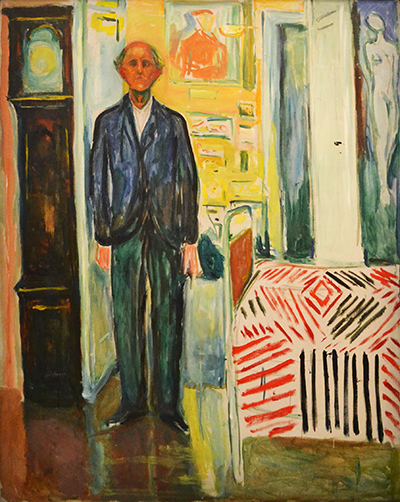
Self-Portrait Between the Clock and the Bed is one of Edvard Munch's last major statements about himself. Painted in 1940-1943, when the artist was in his late seventies, it shows him standing upright between a grandfather clock and a bed, with the yellow room of his own paintings behind him. MUNCH identifies the work as Self-Portrait. Between the Clock and the Bed., oil on canvas, 1940-43, and places it within the long career of an artist active from the 1880s until his death in 1944. [1]
The painting is often read as a confrontation with mortality, and the title certainly invites that reading. But its power comes from how little it forces. Munch does not stage a dramatic deathbed scene. He stands still, almost narrow, in the zone between time and rest, while the evidence of a lifetime's work remains behind him. [5]
At a Glance
- Artist: Edvard Munch
- Title: Self-Portrait. Between the Clock and the Bed.
- Date: 1940-1943
- Medium: Oil on canvas
- Collection: MUNCH, Oslo
- Context: Late self-portraiture, Ekely, and Munch's final decade
Why This Painting Matters
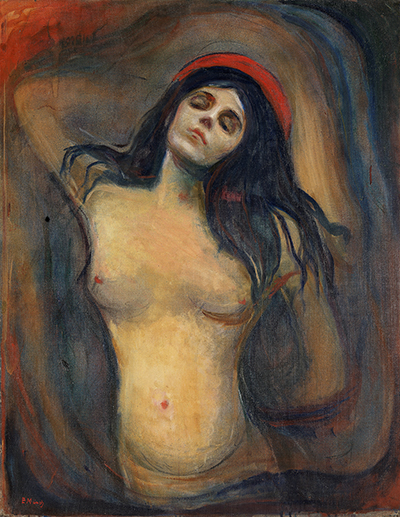
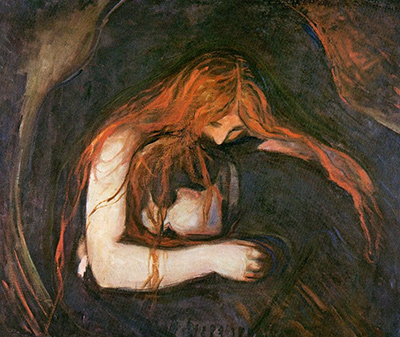
This self-portrait has become a key painting for the late Munch because it gathers many of his lifelong concerns into one quiet interior. The artist who made The Scream, The Sick Child, Madonna, Vampire and The Dance of Life ends not with a crowd, a shoreline or a dramatic embrace, but with a body in a room. [6]
That shift is why the 2017-2018 exhibition Edvard Munch: Between the Clock and the Bed used the painting as its title image. The exhibition frame helped reposition the late Munch as an artist still actively testing modern painting, rather than simply repeating the motifs that made him famous in the 1890s. [4] [5]
The picture is also important because it is a self-portrait about looking back without turning around. The old artist faces us. The paintings behind him are present, but indistinct. The bed and clock are concrete objects, yet they open into larger questions about sleep, time, illness, work and the end of life. [7]
Museum Perspective
MUNCH's own presentation of the artist is especially useful here because it refuses to reduce him to one decade or one image. The museum describes Munch as one of Modernism's significant artists and notes his experimentation across painting, printmaking, drawing, sculpture, photography and film. It also stresses that he worked for more than sixty years, from his debut in the 1880s until his death in 1944. [1]
That long view matters for this painting. Self-Portrait Between the Clock and the Bed is not just an image of age. It is the late work of an artist who had already made self-portraiture, illness, interior space and emotional exposure central to modern art. MUNCH's Ekely material adds the physical setting: Munch bought Ekely in 1916 and made it his permanent home, building studios on the property and working there through his final decades. [3]
Looking Carefully
The composition is built from three vertical presences. On the left is the clock. In the middle is Munch. On the right is the bed. The arrangement is simple enough to be remembered after one glance, yet it becomes more unsettling the longer one looks. [5]
The clock is tall, dark and faceless. It does not tell a readable hour, so it becomes less a measuring instrument than a standing witness. Munch's body echoes it. He is upright, frontal and still, dressed darkly against the yellow light behind him. The bed is lower and more horizontal, but its closeness to the standing figure makes it impossible to ignore. [6]
Behind him, the room is not empty. Paintings hang on the wall, suggesting the work of a life that continues to surround him. This is one reason the image is more complicated than a simple death allegory. Munch stands near the bed, but he also stands in front of his own artistic past. [7]
Video Guide
This selected video from MUNCH offers useful visual context before the detailed analysis continues.
The Clock and the Bed
The title gives the viewer the two objects that matter most: clock and bed. The clock can be read as measured time, but Munch makes it strangely mute. The bed can suggest sleep, illness and death, but it is not occupied. The artist occupies the space between them. [1]
This is where the painting's restraint becomes powerful. Munch had painted death and sickness directly before, especially in the works connected to his sister Sophie's illness and death. In this late self-portrait, he does not return to the sickroom as narrative. He compresses the idea into furniture and posture. [6]
The result is a painting about proximity. Death is not shown as an event. Time is not shown as a clock face. The body is not collapsing. Instead, Munch asks us to stay with the fact of a living person standing close to the objects that define the end of a day and, by implication, the end of a life. [5]
Paintings Behind Him
One of the most important details is the room behind Munch. It is bright, yellow and filled with paintings. This background changes the tone of the work. The old artist is not isolated in a void. He stands before the record of his own making. [5]
The paintings behind him are not easy to identify individually. That blurring is useful. They read less as a catalogue of specific masterpieces than as a wall of memory and labour. The artist is positioned in front of his oeuvre, but he does not turn back to it. He faces outward, as if the final subject is not the art behind him but the present fact of being the person who made it. [7]
This is also why the painting belongs naturally with Munch's other self-portraits. Self-Portrait with Burning Cigarette stages the young artist as a figure emerging from darkness. Self-Portrait with a Bottle of Wine presents a more isolated public self-image. Self-Portrait Between the Clock and the Bed reduces the drama to stance, room and threshold. [6]
Late Munch at Ekely
Munch's late career was rooted in Ekely, the property outside Oslo that he bought in 1916. MUNCH records that Ekely became his permanent residence and that he built several outdoor studios as well as a winter studio there. By the time of this self-portrait, the estate was not just a home. It was the working environment of an artist who had spent decades building his own visual world. [3]
That context helps resist a narrow reading of late Munch as withdrawal. He did live apart from many public art-world routines, but the late paintings can be forceful, experimental and physically present. Self-Portrait Between the Clock and the Bed is quiet, but it is not slight. Its scale, directness and severe structure give it the authority of a final summing-up. [4] [5]
Comparison Works
This painting is strongest when seen in relation to Munch's other self-images and major motifs. It is part of a long sequence in which Munch used his own body as evidence, testing what a painted self could reveal about identity, age and inner pressure. The comparison links below were checked against the Edvard Munch sitemap during production. [7] [9]
- Self-Portrait with Burning Cigarette gives the young Munch an almost theatrical modern identity, with the artist appearing through smoke and shadow. [6]
- The Sick Child matters because the bed was one of Munch's most charged motifs from early in his career. In the late self-portrait, the bed is no longer occupied by Sophie or by a family grief scene. It waits beside the painter himself. [6]
- The Sun offers a revealing counterpoint. There Munch works at monumental scale with radiating light and public decoration. In Self-Portrait Between the Clock and the Bed, the radiance is brought indoors and placed behind a solitary body. [5]
Things You Might Miss
- The clock has presence without information. Because no clear face or time is offered, it becomes an object of duration rather than a readable device. [5]
- The bed is near, but not central. Munch does not lie down. He stands. The difference keeps the painting from becoming sentimental. [7]
- The yellow room behind him prevents the image from becoming purely dark. The painting contains mortality, but also light, colour and memory. [5]
- The works on the wall are part of the drama. Munch is not only between clock and bed; he is also between his past work and the viewer. [7]
- The pose is unusually plain. There is no theatrical gesture. The stillness is the statement. [6]
Interpretation
Self-Portrait Between the Clock and the Bed is not difficult because its symbols are hidden. It is difficult because they are so visible. Clock. Bed. Old artist. Painted room. The problem is not identifying the elements, but taking them seriously without turning them into a formula. [5]
The best reading begins with the painting's facts. Munch was near the end of his life. He had lived through illness, bereavement, fame, controversy, war and decades of work. He had repeatedly used self-portraiture to test the relation between body, image and inner life. In this late painting, he places himself between objects that belong to ordinary life but also carry final meanings. [7]
That is why the painting feels both personal and general. It is unmistakably Munch: the yellow room, the stark figure, the emotional pressure of a simple interior. But the situation is also broad enough to be understood without knowing every detail of his biography. A person stands between time and rest, with the evidence of a life behind him. [8]
Timeline
- 1863: Edvard Munch is born. [1]
- 1880s: Munch begins his public career as an artist. [1]
- 1890s: Munch develops many of the motifs later associated with Symbolism and Expressionism, including anxiety, love, sickness and death. [1]
- 1916: Munch buys Ekely outside Oslo. [3]
- 1940-1943: Munch paints Self-Portrait. Between the Clock and the Bed. [1]
- 1944: Munch dies. [1]
- 2017-2018: Edvard Munch: Between the Clock and the Bed reframes his late career for a broad museum audience. [4] [5]
FAQs
It is a late self-portrait in which Munch shows himself standing between a clock and a bed, with paintings behind him. The image is usually read as a meditation on time, mortality, memory and the artist's life work. [5]
MUNCH identifies the painting as oil on canvas, 1940-43. [1]
It is in the collection of MUNCH, Oslo. [2]
The title directs attention to them. The clock suggests time, while the bed suggests sleep, illness and death. Munch's position between them makes the painting less an allegory than a lived confrontation with age and duration. [5]
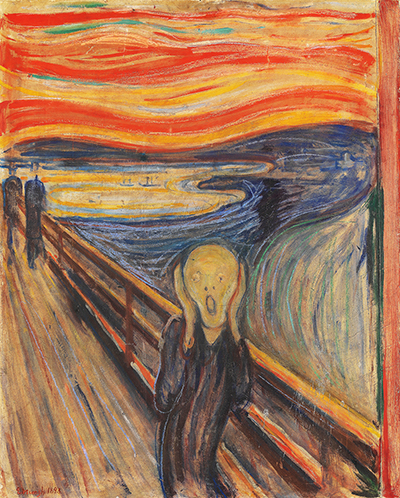
The connection is not subject matter but method. Both paintings make an inner condition visible through the body and its surroundings. The Scream externalises anxiety in landscape and sky; the late self-portrait condenses pressure into a room, a standing figure and two pieces of furniture. [6]
References
- MUNCH, "Edvard Munch (1863-1944)," official artist page, accessed 5 July 2026.
- MUNCH, "Catalogue Raisonne / About the Collection," accessed 5 July 2026.
- MUNCH, "Ekely," accessed 5 July 2026.
- The Metropolitan Museum of Art, "Edvard Munch: Between the Clock and the Bed," exhibition page, accessed 5 July 2026.
- Gary Garrels, Jon-Ove Steihaug and Sheena Wagstaff, eds., Edvard Munch: Between the Clock and the Bed, San Francisco Museum of Modern Art / The Metropolitan Museum of Art / MUNCH, 2017.
- Gerd Woll, Edvard Munch: Complete Paintings, London: Thames & Hudson, 2009.
- Patricia G. Berman, ed., Edvard Munch: The Modern Life of the Soul, Museum of Modern Art, 2006.
- eMunch, Edvard Munch's Writings: The English Edition, accessed 5 July 2026.
- TheHistoryOfArt.org, Edvard Munch sitemap and local internal-link validation, checked 5 July 2026.