by Tom Gurney
Tom Gurney BSc (Hons) is an art history expert with over 20 years experience
Published on June 19, 2020 / Updated on November 1, 2026
Email: tomgurney1@gmail.com / Phone: +44 7429 011000
Construction Workers, Final State: Introduction
Four men carry a red beam through a forest of steel. Above them, a seated worker extends an arm into the framework; higher still, another man leans forward across a yellow girder. Blue sky shows through almost every opening. Fernand Léger’s Construction Workers, Final State makes a building site feel both solid and strangely airborne, its broad bodies and brilliant colours held in an intricate arrangement of lines.
This is the monumental painting recorded by the Musée national Fernand Léger at Biot as Les Constructeurs (définitif), dated 1950. Painted in oil on canvas, it measures 300 by 228 centimetres and bears inventory number MNFL 94001. It entered the national collection through the donation of Nadia Léger and Georges Bauquier in 1969. [1] Its six workers offer several ways of inhabiting the same structure: carrying, sitting, reaching and balancing. Their differences turn the building site into a place of several simultaneous human encounters.
At a Glance
- ArtistFernand Léger
- SubjectConstruction Workers Final State
- Date1950 [1]
- CollectionMusée national Fernand Léger, Biot [1]
This work across Fernand Léger’s career
Nudes in the Forest
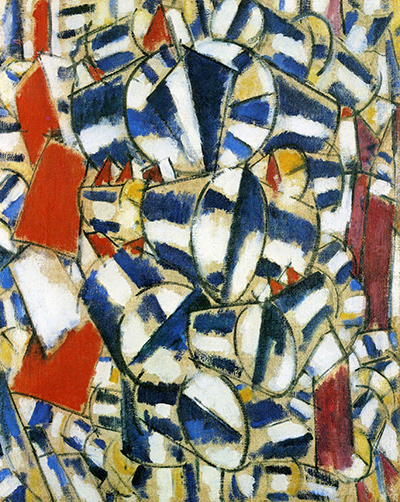
1909–1911 [2]Contrast of Forms
1913 [3]The Mechanic
1920 [5]Three Women
1921–22 [6]Contents
- Four men and a shared load
- Two figures above
- Steel that builds the picture
- An open sky in a crowded space
- The rope and the root
- Reconstruction and a public audience
- What “final state” means
Four men and a shared load
The lower group gives the painting its most immediate human encounter. The four men stand close together, with the beam crossing in front of their waists. Hands curl beneath it, and the line of the load gathers their separate bodies into one compact unit. Bent elbows and planted feet make the task readable before we have untangled the surrounding construction.
Each man nevertheless has a distinct appearance. The leftmost wears a patterned top whose little rectangles repeat, in miniature, the divisions of the building. Beside him, a paler figure wears a cap and an open jacket. The dark-haired man near the middle turns his head sideways, his yellow top giving him a warmer, brighter presence. The worker on the right has a striped shirt, a cap and pale trousers. Pattern, dress and the direction of a face keep the row from becoming interchangeable.
The beam is a particularly effective device because it joins them without hiding their differences. Its red upper face makes a strong continuous band, while the black below gives it apparent thickness. Small pale circles punctuate its side. These marks belong to the same visual family as the bolts elsewhere in the picture, linking the object in the men’s hands with the larger skeleton surrounding them.
Look beneath the load and the poses become less regular. Knees bend at different angles. One pair of legs makes a narrow opening, while another forms a broader, darker shape. The men’s shoes spread across the striped platform, anchoring this small gathering near the foot of the canvas. A suggestion of forward movement remains, but Léger suspends it long enough for us to inspect how a collective action is assembled from individual grips and stances.
The picture allows a reading of solidarity through these visible relationships. No single carrier can account for the whole action, and no one figure has been isolated as its commanding hero. The weight seems to pass along the row. Yet their faces retain an everyday reserve: they neither address a crowd nor perform obvious enthusiasm. Their cooperation is carried principally by their bodies.
Two figures above
Above the carriers, the central worker introduces a different rhythm. His pale clothing is modelled with dark grey shadows that swell around his thighs, torso and sleeves. One arm extends towards the right, while the other rests lower beside his body. A bent leg crosses the narrow ladder beneath him. The angled knee and hanging foot interrupt the straight runs of metal with a looser, almost conversational posture.
He is conspicuous partly because there is room around him. The men below overlap one another; he has a separate pocket of sky and structural space. His body occupies the interval between the heavy horizontal load below and the broad upper girder. The ladder draws our eye upward to him, but his turned limbs redirect it sideways. He becomes a hinge within the composition rather than simply the next person in a vertical sequence.
At the top, the sixth man appears smaller and more distant. His forward-reaching arms and bent legs bring his body close to the yellow beam. The warm brown of his upper body stands out against the cooler sky and pale trousers. From this position, near the top of the canvas, even a small bend in an elbow or knee has considerable force: it interrupts a long, emphatic stretch of colour.
Together the two upper figures make the site feel inhabited beyond the foreground. They also complicate its atmosphere. The lower group suggests the deliberate effort of carrying; the central man seems comparatively at ease, and the upper worker concentrates on something beyond his immediate perch. Different tempos coexist. The building site is held at a moment when exertion, pause and attention can all be seen together.
Steel that builds the picture
The girders organise our movement through the canvas as strongly as the figures do. A broad dark diagonal enters from the upper left. Tall red and pale uprights run through the centre, while yellow horizontal faces stretch towards the right edge. Black outlines separate these surfaces with the clarity of cut shapes. The colour allows us to pick out a beam quickly even when its path passes through a crowded intersection.
The joints receive unusual attention. Pale plates, dark dots and short rectangular divisions give certain crossings the appearance of assembled parts. Elsewhere, thinner latticework fills small suspended frameworks. This variation of scale matters: a few little dots can make an adjacent band seem immense. Léger can suggest the magnitude of construction without showing a complete building or providing a distant view of the site.
It is tempting to follow every member and work out where it leads. Some continue beyond the painted edge; others disappear behind a figure, a ladder or another girder. The promise of a comprehensible framework keeps drawing us onward, but the different slants never settle into one simple view. We recognise the ingredients of a structure while experiencing the picture as an arrangement of competing directions.
The black has more than one role. Sometimes it represents a shaded face of metal, giving a girder depth. Sometimes it is an outline around an arm or trouser leg. In other places it becomes a broad, almost independent strip across the canvas. The same colour connects body and building across these different shapes.
The pale faces of the beams are equally active. They divide the strong reds and yellows, opening bright channels through the crowded image. A white horizontal behind the seated worker draws attention to the lower group, while the light platform under their shoes gives the foreground a firm base. The building’s apparent heaviness depends on many such carefully placed patches of brightness.
An open sky in a crowded space
Although the framework occupies nearly the whole canvas, the painting does not feel enclosed. Blue fills the gaps between its members, establishing a bright outdoor setting. The sky reaches surprisingly close to the foreground: small openings among the lower diagonals carry the same saturated blue as the large spaces above. Distance is constantly available through the construction.
The clouds introduce another kind of volume. Their pale centres and smoky dark edges make them appear rounded and substantial. They gather in uneven strings and clusters, especially on either side of the central figure. Where a beam cuts across a cloud, the crisp edge of the steel makes the cloud’s lumpy softness more evident. Where a cloud crosses an open patch of blue, it has the isolated presence of an object.
The result is a curious exchange between heaviness and lightness. The clouds look almost graspable; the metal, despite its thickness, forms an open network through which the sky can pass. The men’s rounded limbs occupy a position between those two conditions. They share the clouds’ swelling shapes, yet their contacts with beams and ladders bring them back to the practical business of supporting a body.
Léger offers no broad view down to a street. Our sense of height grows from the exposed positions, narrow footholds and continuation of the framework beyond the edges. The absence of a reassuring horizon keeps the viewer near the workers. We look into their immediate surroundings rather than surveying a completed urban landscape from afar.
The rope and the root
At the right, a thick rope hangs in a long, irregular curve. Alternating light and dark sections make its twist legible, while its loose bends refuse the straight paths of the steel. It loops across a pale beam, drops beside the framework and turns inward near the bottom. Following it gives the eye a slower, more wandering route through the right side of the picture.
There is a related interruption under the men’s feet: a gnarled piece of wood, with narrow branches projecting upward. Its crooked outline lies across the orderly platform. Beside the neat angles of shoes, trouser legs and beams, this small form looks stubbornly irregular. Its pointed offshoots also make a delicate counterweight to the thick members above.
Neither detail needs an elaborate symbolic explanation to contribute to the scene. The rope introduces flexibility into the construction equipment; the root brings an organic contour into the immediate foreground. Both make the engineered order more varied. They encourage the eye to notice how much of the painting’s vitality comes from the encounter between things that can be aligned and things that resist alignment.

Fernand Léger, Two Women Holding Flowers. Joined figures and independent colour take a different form in this late composition.
Reconstruction and a public audience
Writing in 1953, Katharine Kuh connected the Builders group with European reconstruction after the war. She emphasised the encounter of human figures, open steel structures and clouds. Her catalogue reproduced this six-man composition, showing that its principal contrasts were already central to an account published during Léger’s lifetime. [9] That context gives the unfinished framework an outward-looking significance: it can be read as a place where a future is being made.
Such a reading remains richer when the people retain their physical particularity. The men have awkwardly bent knees, broad hands and clothes that catch the light differently. Their work has a recognisable practical shape, even though its setting has been freely arranged. The optimism comes through the sustained visibility and dignity of these ordinary figures as much as through the upward reach of the structure.
Rachel Boate’s account for the Metropolitan Museum of Art places Léger’s desire to reach a broad public alongside his commitment to modern painting. She also connects his later career with the everyday worker and with architectural media such as stained glass and mosaic. [10] This canvas makes those interests tangible at the scale of a room. Three metres high, it gives the labourers a presence that can confront the viewer bodily, while its strong divisions remain legible from a distance.
The Centre Pompidou’s account of Léger’s monumental work describes the suitability of his vivid colours and black-edged forms for stained glass. [11] Here, on canvas, a related clarity makes each figure and structural member assert itself across a busy surface. Closer viewing then reveals the smaller differences: fingers, clothing patterns, bolt heads and the wood’s fine branches. The smaller details reward an approach towards the canvas after that first impression.
The Biot museum recounts Léger’s experiment of displaying Constructors paintings in a Renault factory canteen. In the artist’s recollection as relayed by the museum, workers initially mocked the figures’ impractical hands; later they grew accustomed to the pictures, and one suggested their colours would be missed when removed. [1] The account concerns the group of paintings. Familiarity and pleasure could emerge alongside doubts about the way workers had been represented.
That tension remains visible here. The carrying hands make the action instantly intelligible, but their weighty simplification also invites scrutiny. Léger’s effort to reach a public did not eliminate the demands of his own visual language. A worker could recognise the subject and still question the bodies. The painting gives that encounter a lasting form, bringing common experience into an arrangement that continues to surprise the eye.

Fernand Léger, Big Julie. Bicycle, figure and open colour offer an earlier comparison for the late public world.
What “final state” means
The title identifies this particular developed composition within the Constructors group. It need not imply that Léger stopped painting the subject in 1950. Kuh observed more generally that he sometimes returned to themes after completing their culminating canvases. [9] The title describes the standing of this arrangement, while leaving room for the wider series to continue.
For that reason, this canvas rewards sustained attention on its own terms. Its six men are distributed across three levels, and every level establishes a different relationship between body and steel. The shared load below gives us cooperation; the seated figure offers a pause within the structure; the upper man continues its upward activity. Around them, the sky keeps the framework open. Léger makes the act of construction visible through the construction of the picture itself, holding people and their enormous surroundings in a bright, unsettled balance.
Léger in video
Explore abstraction, monumental painting and cinema through films from MoMA and the Centre Pompidou. These videos offer context for Léger’s wider work; the restoration film is in French.
Restaurer un… Fernand Léger
Follow conservation of Composition with Two Parrots, 1935–39, and look at painting on a monumental scale. French-language film.
Watch on YouTubeFernand Léger artworks directory
Works covered in these articles and further documented works. Studies and finished works have separate entries; alternate titles share an entry. This is not a catalogue raisonné.
| Name | Date | Medium |
|---|---|---|
| Acrobats and Clowns from Le Cirque | 1950 | |
| Adieu New York | 1946 | Painting |
| Ballet mécanique | 1924 | Film |
| Big Julie | 1945 | Painting |
| Builders with Aloe | 1951 | Painting |
| Charlot cubiste | 1924 | Sculpture |
| Chimneys on Rooftops | 1911 | Painting |
| Cirque (artist’s book) | 1950 | |
| Composition | 1929 | Painting |
| Composition (Study for Nude Model in the Studio) | 1912 | Drawing |
| Composition of Three Figures | 1932 | Painting |
| Composition with Two Parrots | 1935–39 | Painting |
| Construction Workers Final State | 1950 | Painting |
| Contrast of Forms | 1913 | Painting |
| Derrière le miroir, nos.121–122 (posthumous publication, includes a lithograph after Léger) | 1960 | |
| Drawing for The Card Game | 1917 | Drawing |
| Drawing for The Staircase | 1913 | Drawing |
| En attendant le départ | 1914 | Drawing |
| Grand Parade with Red Background | 1953 | Painting |
| J’ai tué (illustrated book) | 1918 | |
| La Cocarde, l’avion brisé | About 1916 | Drawing |
| La Couseuse | about1910 | Painting |
| La Fin du monde filmée par l’Ange N.-D. (illustrated book) | 1919 | |
| Les Femmes au bouquet (Women with a Bouquet) | 1921 | Painting |
| Man and Woman | 1921 | Painting |
| Man in Profile with Rope: Study for The Constructors | 1950/1 | Drawing |
| Man in the Blue Hat | 1937 | Painting |
| Matinée d’ivresse, from Les Illuminations | 1949 | |
| Mechanical Elements | 1918–23 | Painting |
| Mechanical Elements (Metropolitan Museum) | 1920 | Painting |
| Men in the City | 1919 | Painting |
| Mes voyages (posthumous illustrated book) | 1960 | |
| Mona Lisa with the Keys | 1930 | Painting |
| Nude Model in the Studio | 1912–13 | Painting |
| Nudes in the Forest | 1909–1911 | Painting |
| Propellers Second State | 1918 | Painting |
| Reading | 1924 | Painting |
| Soldier with a Pipe | 1916 | Painting |
| Soldiers Playing Cards | 1917 | Painting |
| Soldiers Playing Cards (front drawing) | 1916 | Drawing |
| Standing Nude, Rear View | 1911 | Drawing |
| Still Life with a Beer Mug | 1921–2 | Painting |
| Still Life with Tankard | 1921 | Drawing |
| Study for The Aviator | 1920 | Drawing |
| The Acrobat and his Partner | 1948 | Painting |
| The Acrobats in the Circus | 1918 | Painting |
| The Alarm Clock | 1914 | Painting |
| The Chalices and the Sponge, stained-glass model | 1950 | Drawing |
| The City | 1919 | Painting |
| The Disks in the City | 1920 | Painting |
| The Mechanic | 1920 | Painting |
| The Railway Crossing | 1919 | Painting |
| The Three Musicians | 1944, after a 1924–25 drawing | Painting |
| The Wheels | 1945 | Drawing |
| Three Women | 1921–22 | Painting |
| Two Women Holding Flowers | 1954 | Painting |
| Umbrella and Bowler | 1926 | Painting |
| Verdun, dessin du front | About 1915 | Drawing |
| Woman with a Book | 1923 | Painting |
| Woman: Costume Design for La Création du monde | c.1922–23 | Drawing |
Discussion
Look again at the images and ideas explored in Construction Workers, Final State. These editorial prompts invite your observations.
Reader Insights
What becomes easier to notice in Construction Workers Final State when you compare it with Big Julie?
Where does the comparison with Two Women Holding Flowers reveal the clearest change in Léger’s approach?
Which detail would you follow first when returning to the work, and why?
Join the Conversation
Share a detail, comparison or question about Construction Workers, Final State below.
References
- Musée national Fernand Léger, “Les années 50, les constructeurs”, complete Les Constructeurs (définitif) entry and accompanying museum image: title, 1950 date, oil on canvas, 300 × 228 cm, inventory MNFL 94001, 1969 donation and museum-mediated Renault-canteen recollection. Consulted 31 October 2026. View source.
- Kröller-Müller Museum, Nus dans la forêt / Nude Figures in a Forest, collection record KM 101.045. Current date, medium, identifier, curatorial sections “Distinctive cubist style”, “Geometric shapes” and “‘Battle of volumes’”, and museum reproduction. View source.
- Fondation Beyeler, Contraste de formes, Fernand Léger, current collection record, Inv.90.6: date, medium, dimensions, collection and signature on reverse. View source.
- Philadelphia Museum of Art, The City, 1919, collection record and interpretation; A. E. Gallatin Collection, 1952-61-58. View source.
- National Gallery of Canada, The Mechanic, 1920, accession 14985, collection details and interpretive paragraph; French collection record, Le mécanicien. View source.
- The Museum of Modern Art, Fernand Léger. Three Women. 1921–22, collection record, object 189.1942: artwork image, metadata, 2021 gallery label, publication excerpt, installation history and provenance. View source.
- Musée national Fernand Léger, La Joconde aux clés, collection record and museum commentary (French): object data, owning museum image, artist recollection, sardine tin and symbolic interpretations. The artist’s recollection is consulted as reproduced by the museum; the page does not date it. View source.
- Musée national Fernand Léger, La Grande Parade sur fond rouge, complete object record and displayed reproduction: 1953, oil on canvas, 114.5 × 156.2 cm, inventory MNFL 96006; donation of Nadia Léger and Georges Bauquier. View source.
- Katharine Kuh, Léger (Chicago: Art Institute of Chicago, in collaboration with the Museum of Modern Art and the San Francisco Museum of Art, 1953), pp. 7–8 on serial working and quotation placement, p. 72 on the Builders, and p. 73 reproduction of the six-worker canvas (PDF pp. 12–13 and 77–78). Consulted in the locally preserved digitised catalogue, 31 October 2026. View source.
- Rachel Boate, “Fernand Léger (1881–1955)”, Metropolitan Museum of Art, May 2018, passages on a mass public, everyday workers and late architectural media. Consulted 31 October 2026. View source.
- Centre Pompidou, “Fernand Léger”, educational dossier, 2008, “Les grands formats” and “Le monumental,” particularly the Audincourt stained-glass discussion. Consulted in the preserved text capture, 31 October 2026. View source.