by Tom Gurney
Tom Gurney BSc (Hons) is an art history expert with over 20 years experience
Published on June 19, 2020 / Updated on November 1, 2026
Email: tomgurney1@gmail.com / Phone: +44 7429 011000
Mona Lisa with the Keys: Introduction
A bunch of keys hangs in front of the Mona Lisa, large enough to compete with her head and folded hands. Their bright shafts cut across the small, greenish figure while a broad blue circle presses in from the left. In Fernand Léger’s Mona Lisa with the Keys, recognition arrives quickly; understanding how these things belong together takes longer. The familiar portrait becomes one encounter among several, caught between metal, colour and wandering lines.
Léger painted La Joconde aux clés in 1930. The oil on canvas measures 91 × 72 centimetres and belongs to the Musée national Fernand Léger in Biot, through the donation of Nadia Léger and Georges Bauquier. [1] Its upright format gathers the scattered elements into a compact field. Although there is room around individual objects, almost every part of the surface contributes to the exchange between them.
At a Glance
- ArtistFernand Léger
- SubjectMona Lisa with the Keys
- Date1930 [1]
- CollectionMusée national Fernand Léger, Biot [1]
This work across Fernand Léger’s career
Nudes in the Forest
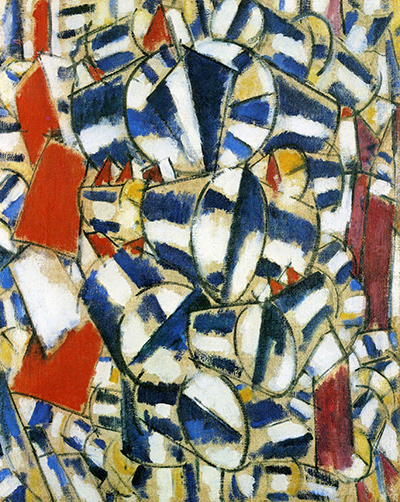
1909–1911 [2]Contrast of Forms
1913 [3]The Mechanic
1920 [5]Three Women
1921–22 [6]Contents
- The keys take the foreground
- A portrait becomes a smaller picture
- How Léger found the contrast
- Circles, wedges and wandering lines
- Colour without a fixed code
- Objects released from a story
- The Mona Lisa after reproduction
The keys take the foreground
Begin at the cluster of loops just left of centre. White edges turn into grey and then black, making the rings appear rounded and solid. One passes across another; the eye can follow an individual curve only so far before encountering a new intersection. This knot of relatively small circles concentrates attention in the middle of the canvas. The longer shafts then carry it outwards, towards the top right, down towards the bottom, and diagonally across the portrait.
The keys offer a peculiarly direct kind of recognition. Their teeth and circular bows remain legible despite their enlarged scale and complicated overlap. They look usable, yet no hand holds them and no lock explains their presence. Their practical identity survives while their everyday setting disappears. We can imagine taking hold of them, although the arrangement gives little sense of where our own body would stand.
Their pale highlights also make the keys look nearer than the portrait. Against the dark clothing of the Mona Lisa, the diagonal shaft becomes a particularly firm barrier. It interrupts our route to her folded arms without preventing us from recognising the pose. The effect is more persistent than a momentary visual joke: even after finding the famous face, we have to look past the keys each time we return to it.
Above them, a long shaft rises towards a blocky, angular end. Its diagonal answers other straight lines without quite merging into their network. Here Léger keeps an identifiable object close to an abstract construction. A small change of contour or shading is enough to make a line feel like the edge of metal rather than a mark crossing the canvas.
A portrait becomes a smaller picture
The Mona Lisa occupies the lower right portion of the composition. Her head is clear against a warm yellow-orange area, and her body darkens towards its outer edges. Her hands provide a second pale focus beneath the face. Together these details retain the basic rhythm of a seated portrait: head, shoulders, crossed arms. The distant landscape normally associated with the image has ceased to organise our experience of her.
That change matters because it alters the kind of attention the portrait receives. We cannot enter a continuous world behind the sitter. Instead, she appears as a self-contained image brought into another painting. Her face is softer than the keys’ rims; her shaded sleeves seem to recede where their shafts project. The meeting involves two different kinds of painted presence as well as two recognisable subjects.
There is an imbalance between cultural familiarity and physical size. A viewer who recognises the Mona Lisa may initially give her priority, yet the larger blue form and the gleaming keys repeatedly reclaim the eye. Her reputation cannot dictate where we look. Each return to the face involves a negotiation with the forms around it.
The small red rectangle towards the top supplies another image within the image. Tilted at an angle, it contains a pale fish motif inside a dotted border. Its graphic clarity gives it an immediate visual identity, even though it is far smaller than the portrait. The museum identifies a sardine tin among the painting’s objects. [1] At this scale, its red border acts almost like a concentrated colour sample: a small, sharply bounded patch set against the looser colour beneath it.
How Léger found the contrast
In a recollection reproduced by the Biot museum, Léger describes having already painted the keys when he encountered a Mona Lisa postcard in a shop window. It supplied the opposition he wanted; he subsequently added a sardine tin. The museum does not date this recollection. [1] It offers an account of the conjunction, rather than a complete record of every decision made at the canvas.
The anecdote makes the choice of the portrait seem both accidental and exact. Another object might have filled the available space, but the Mona Lisa carries a kind of recognition that the keys cannot possess. At the same time, the keys have the clarity of things handled and used. The difference survives even after Léger brings them into a common painted surface.
Looking at the result, we can understand contrast as something more demanding than placing unrelated subjects side by side. Their sizes, positions and degrees of sharpness are unequal. The keys cross the portrait; the portrait does not cross the keys. The face remains relatively quiet while its surroundings expand, hook, tilt and loop. The encounter has been composed down to the way one edge interrupts another.
Circles, wedges and wandering lines
The broad circular form at the left is the largest simple shape in the picture. Blue sections surround a pale centre, with a smaller reddish segment near the top. Its outer contour is interrupted and crossed, so it never becomes a sealed emblem. Nevertheless, its large curve gives the surrounding fragments something stable to answer.
The loops of the keys repeat this rounded vocabulary on a smaller scale. Because their edges are shaded, they appear to turn through space, whereas much of the blue shape reads as a flat coloured surface. The resemblance draws them together; their different treatment keeps them apart. Moving between the two, the eye experiences a change from broad colour to tightly packed volume.
Below the circle, a dark tapering wedge points towards the bottom edge. Its narrow tip seems especially sharp beside the rounded key bows. A pale diagonal crosses near its top, and a thin dark line passes across the lower part of the composition. These crossings prevent the wedge from becoming an isolated weight. It participates in a system of directions that reaches beyond any single object.
The more sinuous black forms behave differently. A line along the right edge bends in and out, then joins the curling passage near the bottom. On the left, another wavering contour slips around the circular form and descends towards the wedge. Their turns make the straighter marks feel unusually rigid. They also offer a slower route through the picture, one that circles around the hard objects rather than following their abrupt diagonals.
Near the upper right, short pale bars sit against a dark patch. Their repeated horizontals introduce a small area of regularity. Above them, an upright and a crossbar make an open, spare construction. The thin framework offers a pause beside the dense key cluster. Léger varies the amount of visual pressure across the surface.
Colour without a fixed code
Yellow-orange spreads through the painting in irregular passages. It gathers behind the portrait, appears inside the large circular form, and re-emerges lower down. These areas connect parts of the picture that otherwise differ in subject and shape. Their edges remain soft and uneven, allowing the warm colour to feel continuous even where a black contour cuts across it.
Blue behaves more compactly. Held within the large curved form, it has a greater sense of boundary. The small red areas are tighter still. We move between a colour that seems to spread, one that occupies a broad defined shape, and accents that punctuate the whole. None needs a prescribed symbolic meaning to exert a different force on our attention.
The grey and black passages are equally active. Some resemble smoky clouds behind the objects; others become crisp outlines or solid silhouettes. The same dark tone can suggest recession in one place and an assertive shape in another. This variety keeps the light background from becoming a neutral space on which the objects have simply been placed.
The museum discusses possible associations of keys with access, power and initiation. [1] Such associations can enrich a viewer’s response, but the visible arrangement does not require a single symbolic solution. The open rings, repeated teeth, hard shafts and changing directions already give the keys several roles. An interpretation based only on what they might unlock would overlook much of what they do within the painting.

Fernand Léger, Man in the Blue Hat. A figure from the following decade offers another arrangement of flowers, objects and emphatic outline.
Objects released from a story
The painting extends Léger’s wider investigations of independent objects. Discussing Composition of 1929, the Centre Pompidou describes forms suspended without weight. Its teaching dossier also reproduces part of Léger’s 1935 MoMA lecture, in which he argues that objects and pure colour can gain freedom when released from a governing subject. [9] These are later words that illuminate an approach, rather than instructions written specifically for this canvas.
Here that freedom is easy to experience. No tabletop measures the objects’ positions, and no room unifies their scale. The lower diagonal might momentarily suggest a boundary, but it offers no credible surface on which everything could rest. The portrait, key bunch and small red rectangle maintain their identities while answering to the dimensions and intervals of the picture.
Rachel Boate’s Met essay places Léger’s Study of Objects of 1930 within a democratic ambition for modern art, connecting recognisable forms and montage with accessibility. [10] The comparison helps explain the invitation offered here. Familiar things provide several entrances into a composition whose spatial relationships remain unusual. Recognising an object begins the encounter; following its visual connections extends it.

Fernand Léger, Umbrella and Bowler. Everyday objects gain a different presence when they remain within a compressed interior.
The Mona Lisa after reproduction
Another artist had already made the reproduced Mona Lisa the site of an intervention. The Centre Pompidou’s account of Marcel Duchamp’s L.H.O.O.Q. describes the moustache and goatee he added to a postcard in 1919; its collection record concerns a 1930 replica made with graphite on a photogravure. [11] The record distinguishes the later replica from the earlier postcard intervention.
Léger’s sitter keeps her unadorned face. The disturbance comes from her surroundings and her reduced command of them. Her image can still prompt recognition, but it has to coexist with a bundle of keys and a small fish picture. That coexistence gives ordinary things an unusual standing without making the portrait disappear.
The visual effect resembles collage because separate elements seem to have been brought together from incompatible settings. The museum records Léger’s work as oil on canvas. [1] Its pasted-together appearance should therefore be understood as an effect of the painting, without assuming an actual postcard was attached to its surface.
Return finally to the pale loops at the centre. They bind the bunch of keys together while also directing attention towards the blue circle, the portrait and the lower curls. One everyday object becomes the point through which several visual languages pass. The Mona Lisa continues to look out from this crowded arrangement, recognisable and composed, while the painting around her keeps finding other things for us to see.
Léger in video
Explore abstraction, monumental painting and cinema through films from MoMA and the Centre Pompidou. These videos offer context for Léger’s wider work; the restoration film is in French.
Restaurer un… Fernand Léger
Follow conservation of Composition with Two Parrots, 1935–39, and look at painting on a monumental scale. French-language film.
Watch on YouTubeFernand Léger artworks directory
Works covered in these articles and further documented works. Studies and finished works have separate entries; alternate titles share an entry. This is not a catalogue raisonné.
| Name | Date | Medium |
|---|---|---|
| Acrobats and Clowns from Le Cirque | 1950 | |
| Adieu New York | 1946 | Painting |
| Ballet mécanique | 1924 | Film |
| Big Julie | 1945 | Painting |
| Builders with Aloe | 1951 | Painting |
| Charlot cubiste | 1924 | Sculpture |
| Chimneys on Rooftops | 1911 | Painting |
| Cirque (artist’s book) | 1950 | |
| Composition | 1929 | Painting |
| Composition (Study for Nude Model in the Studio) | 1912 | Drawing |
| Composition of Three Figures | 1932 | Painting |
| Composition with Two Parrots | 1935–39 | Painting |
| Construction Workers Final State | 1950 | Painting |
| Contrast of Forms | 1913 | Painting |
| Derrière le miroir, nos.121–122 (posthumous publication, includes a lithograph after Léger) | 1960 | |
| Drawing for The Card Game | 1917 | Drawing |
| Drawing for The Staircase | 1913 | Drawing |
| En attendant le départ | 1914 | Drawing |
| Grand Parade with Red Background | 1953 | Painting |
| J’ai tué (illustrated book) | 1918 | |
| La Cocarde, l’avion brisé | About 1916 | Drawing |
| La Couseuse | about1910 | Painting |
| La Fin du monde filmée par l’Ange N.-D. (illustrated book) | 1919 | |
| Les Femmes au bouquet (Women with a Bouquet) | 1921 | Painting |
| Man and Woman | 1921 | Painting |
| Man in Profile with Rope: Study for The Constructors | 1950/1 | Drawing |
| Man in the Blue Hat | 1937 | Painting |
| Matinée d’ivresse, from Les Illuminations | 1949 | |
| Mechanical Elements | 1918–23 | Painting |
| Mechanical Elements (Metropolitan Museum) | 1920 | Painting |
| Men in the City | 1919 | Painting |
| Mes voyages (posthumous illustrated book) | 1960 | |
| Mona Lisa with the Keys | 1930 | Painting |
| Nude Model in the Studio | 1912–13 | Painting |
| Nudes in the Forest | 1909–1911 | Painting |
| Propellers Second State | 1918 | Painting |
| Reading | 1924 | Painting |
| Soldier with a Pipe | 1916 | Painting |
| Soldiers Playing Cards | 1917 | Painting |
| Soldiers Playing Cards (front drawing) | 1916 | Drawing |
| Standing Nude, Rear View | 1911 | Drawing |
| Still Life with a Beer Mug | 1921–2 | Painting |
| Still Life with Tankard | 1921 | Drawing |
| Study for The Aviator | 1920 | Drawing |
| The Acrobat and his Partner | 1948 | Painting |
| The Acrobats in the Circus | 1918 | Painting |
| The Alarm Clock | 1914 | Painting |
| The Chalices and the Sponge, stained-glass model | 1950 | Drawing |
| The City | 1919 | Painting |
| The Disks in the City | 1920 | Painting |
| The Mechanic | 1920 | Painting |
| The Railway Crossing | 1919 | Painting |
| The Three Musicians | 1944, after a 1924–25 drawing | Painting |
| The Wheels | 1945 | Drawing |
| Three Women | 1921–22 | Painting |
| Two Women Holding Flowers | 1954 | Painting |
| Umbrella and Bowler | 1926 | Painting |
| Verdun, dessin du front | About 1915 | Drawing |
| Woman with a Book | 1923 | Painting |
| Woman: Costume Design for La Création du monde | c.1922–23 | Drawing |
Frequently Asked Questions
The painting belongs to the Musée national Fernand Léger in Biot, France. [1]
Léger painted it in 1930. [1]
The recorded medium is oil on canvas. Its collage-like effect comes from the juxtaposition of distinct images, objects and abstract forms. [1]
Discussion
Look again at the images and ideas explored in Mona Lisa with the Keys. These editorial prompts invite your observations.
Which holds your attention longest: the Mona Lisa’s face, the keys, or the large blue curve?
Reader Insights
What becomes easier to notice in Mona Lisa with the Keys when you compare it with Umbrella and Bowler?
Where does the comparison with Man in the Blue Hat reveal the clearest change in Léger’s approach?
Which detail would you follow first when returning to the work, and why?
Join the Conversation
Share a detail, comparison or question about Mona Lisa with the Keys below.
References
- Musée national Fernand Léger, La Joconde aux clés, collection record and museum commentary (French): object data, owning museum image, artist recollection, sardine tin and symbolic interpretations. The artist’s recollection is consulted as reproduced by the museum; the page does not date it. Consulted 31 October 2026. View source.
- Kröller-Müller Museum, Nus dans la forêt / Nude Figures in a Forest, collection record KM 101.045. Current date, medium, identifier, curatorial sections “Distinctive cubist style”, “Geometric shapes” and “‘Battle of volumes’”, and museum reproduction. View source.
- Fondation Beyeler, Contraste de formes, Fernand Léger, current collection record, Inv.90.6: date, medium, dimensions, collection and signature on reverse. View source.
- Philadelphia Museum of Art, The City, 1919, collection record and interpretation; A. E. Gallatin Collection, 1952-61-58. View source.
- National Gallery of Canada, The Mechanic, 1920, accession 14985, collection details and interpretive paragraph; French collection record, Le mécanicien. View source.
- The Museum of Modern Art, Fernand Léger. Three Women. 1921–22, collection record, object 189.1942: artwork image, metadata, 2021 gallery label, publication excerpt, installation history and provenance. View source.
- Musée national Fernand Léger, “Les années 50, les constructeurs”, complete Les Constructeurs (définitif) entry and accompanying museum image: title, 1950 date, oil on canvas, 300 × 228 cm, inventory MNFL 94001, 1969 donation and museum-mediated Renault-canteen recollection. View source.
- Musée national Fernand Léger, La Grande Parade sur fond rouge, complete object record and displayed reproduction: 1953, oil on canvas, 114.5 × 156.2 cm, inventory MNFL 96006; donation of Nadia Léger and Georges Bauquier. View source.
- Vanessa Morisset, Fernand Léger, Centre Pompidou teaching dossier, April 2008, updated 2010: “Figures et objets,” especially Composition, 1929, and the reproduced excerpt from “Un nouveau réalisme, la couleur pure et l’objet,” MoMA lecture, 1935, identified there as Fonction de la peinture, 2004, pp. 187–188. Lecture excerpt consulted through the dossier, not the complete book. Consulted 31 October 2026. View source.
- Rachel Boate, Fernand Léger (1881–1955), The Metropolitan Museum of Art, May 2018: discussion of Study of Objects (1930), montage and democratic accessibility. Consulted 31 October 2026. View source.
- Centre Pompidou, Marcel Duchamp, L.H.O.O.Q., collection record for the 1930 replica and analysis by Marc Décimo, excerpted from Collection art graphique – La collection du Centre Pompidou, Musée national d’art moderne, edited by Agnès de la Beaumelle, 2008: replica medium and distinction from the 1919 postcard intervention. Consulted 31 October 2026. View source.