by Tom Gurney
Tom Gurney BSc (Hons) is an art history expert with over 20 years experience
Published on June 19, 2020 / Updated on November 1, 2026
Email: tomgurney1@gmail.com / Phone: +44 7429 011000
Two Women Holding Flowers: Introduction
A flower held between two enormous hands becomes the delicate centre of a tangle of bodies. In Fernand Léger’s Two Women Holding Flowers, one woman sits upright at the right while another reclines across the left and lower parts of the canvas. Their limbs bend around each other, filling almost the entire picture. Broad areas of orange, blue, red and yellow cross this black-outlined group, giving the quiet encounter an unexpectedly bold rhythm.
Painted in 1954, the work belongs to Tate, where it has the accession number T00246. Its French title is Deux femmes tenant des fleurs. The oil painting measures 97.2 by 129.9 centimetres and was purchased for the collection in 1959. [1] Within that substantial horizontal canvas, Léger makes a small subject—two women with flowers—feel expansive. The flowers occupy little space, yet the surrounding arms guide attention towards their narrow stems.
At a Glance
This work across Fernand Léger’s career
Nudes in the Forest
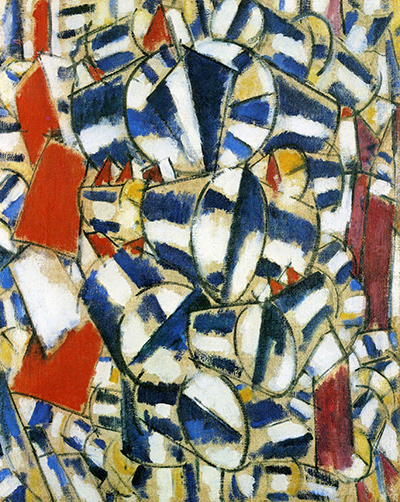
1909–1911 [2]Contrast of Forms
1913 [3]The Mechanic
1920 [5]Three Women
1921–22 [6]Contents
- Two poses woven together
- The flower and the hands
- Colour crosses the drawing
- Weight on a flat surface
- Faces within the pattern
- A late image of shared ease
Two poses woven together
The upright woman provides the clearest starting point. Her face sits high on the right, framed by dark hair which falls beside her neck. Her eyes look out of the picture. Below her head, broad shoulders and a rounded torso establish a stable presence, while one arm descends along the right side towards a large hand near the bottom. Its long fingers almost touch the lower edge. The other arm extends towards the centre, where the hands and stems gather.
The reclining woman turns this vertical arrangement into a loop. Her head appears low at the left, inclined towards one shoulder. Dark hair hangs beneath it in a long, open curl. From this small face, the eye follows the expansive sweep of a body and the immense raised arm that arches across the upper left. At the top, a hand bends down to grasp a stem. The bodily scale changes dramatically along this route: a modest head leads towards an arm that seems capable of enclosing half the composition.
The two poses interlock without becoming mirror images. The seated figure rises; the reclining figure stretches and turns. One face is nearly upright, the other tilted. One long arm establishes the right boundary, while the great curving arm at the left forms an answering enclosure. This uneven balance keeps the group lively. The rising and enclosing forms hold the picture in balance.
The lower half makes the overlap especially absorbing. A large bent knee rises towards the middle, and broad feet project towards the bottom. A pale foot at the far left pulls the eye sideways, while another nearer the centre turns down towards us. The crowded contours encourage us to trace limbs and recover their connections. A junction may demand a second look even after the two principal poses have become clear.
The flower and the hands
At the centre, the flower introduces a different kind of shape. A small pale blossom, dark leaves and curving stems interrupt the broad expanses of torso and limb. Their narrow forms branch and turn, making a compressed pattern within the larger pattern of bodies. The contrast of scale is striking: the hands are massive, while the stem passing between the fingers looks almost fragile.
The raised hand at the top does much of the work. Its fingers curve over the stem, their separated outlines giving the grip an unmistakable physical character. Below it, another hand approaches the plant from the side. The flower thus becomes a point where looking and touching meet. We can follow the stem through the hands, then move outwards along the arms into the rest of the composition.
There is a further echo lower down, where an upturned foot presents its toes close to the central group. The toes and fingers share a series of dark rounded divisions. This resemblance draws small extremities into a common rhythm: the grip above, the hand near the flower, the toes below and the descending fingers at the right. Léger gives these details enough specificity to make the bodies tangible while repeating their shapes across the canvas.
The flowers also offer a pause in the accumulation of flesh. Looking at the picture from a distance, one first notices its large shapes and forceful colours. Closer attention finds this little knot of stems, petals and fingers. The subject named in the title works quietly inside a composition with much louder visual accents. Discovering it changes the pace of looking, drawing attention from the broad colour fields into a few small, articulated forms.
Colour crosses the drawing
Léger’s colour has a freedom of its own. The tall orange area left of centre runs through the reclining figure, entering the raised arm and continuing down across her body. The tilted blue field covers much of the seated woman’s upper body, but its edge also cuts across the lower part of her face. A horizontal red block crosses the lower figures. None of these areas behaves like a straightforward description of skin, clothing or light.
Look at the blue crossing the upright woman’s face. Her eyes remain in a pale area above it, while her mouth and chin fall into blue. The black drawing continues across the change without losing its clarity. We recognise one face and simultaneously see two different colour zones passing through it. The picture asks the eye to keep both accounts active: the body described by the line and the arrangement established by colour.
Tate’s short description draws attention to precisely this combination of lightly shaded figures and emphatic rectangles. [10] The distinction becomes especially clear at the right arm. Its long pale stretch remains legible against the yellow, while neighbouring colour crosses other anatomical boundaries. Sometimes colour reinforces a body part; sometimes it slides across several forms or leaves them behind.
The Fondation Beyeler’s guide to Léger describes a broader late development in which colour fields separate from the outlines of the figures. Discussing Adieu New York, it also connects his autonomous bands of colour with his observation of illuminated advertising on Broadway. [11] That history provides a useful setting for this canvas’s red and blue interruptions. Here the effect is intimate: a large, freely placed field can pass over a face or a thigh without breaking the continuity of the person beneath it.
The smaller patches matter too. A red rectangle occupies the upper left, with green entering below it. Yellow stretches across the lower left and reappears at the right. These peripheral areas answer the stronger orange, blue and red within the figures. They keep the surrounding space involved, so that the bodies feel embedded in an arrangement extending to every edge.

Fernand Léger, Big Julie. The American painting offers an earlier comparison for bright colour and a flower-bearing figure.
Weight on a flat surface
For all the flatness of its colour, the painting gives its figures considerable bodily weight. Grey shading gathers along a foot, under a hand and around curved lower limbs. These modest tonal changes make surfaces turn. A thick dark boundary supplies further solidity, enclosing a thigh or shoulder as firmly as the contour of a sculpted object.
The result is a productive tension. The bodies feel broad and heavy, but they have little deep space to inhabit. The orange strip lies flat; the blue shape tilts across the surface; the red block cuts horizontally through the lower group. Meanwhile a curved knee appears to advance towards us. Depth arrives in local moments of swelling form, then yields again to the shallow arrangement of colours.
The white ground helps make this possible. It appears around heads and limbs and opens small intervals within the group, allowing the dark lines to remain distinct. Yet it offers few clues about distance. A white area can seem to surround an arm, continue through the space behind it or belong to the pale body itself. Léger makes the canvas spacious through these openings without constructing a room into which we could imaginatively walk.
At the far right, a black upright with short crosspieces introduces a firmer geometric accent. Beside the seated woman’s curved shoulder and arm, its straightness feels especially emphatic. The yellow blocks around it intensify the contrast. Its upright divisions give this side of the picture a measured framework beside the swelling figures.
Faces within the pattern
The women’s faces are small compared with their limbs, but their direct eyes give the composition a human address. Each face uses a short vocabulary of dark marks: arched brows, outlined eyes, a long nose and a shaped mouth. Their hair provides dense black areas against the bright surroundings. On the left, the loop of hair extends the rhythm of the reclining body; on the right, the falling dark lock steadies the upright head.
Their expressions remain difficult to translate into a story. The hands establish contact and the bodies share a space, while the faces turn towards the viewer. That arrangement allows a sense of companionship to emerge through proximity. We encounter two people joined by the act of holding, with the flower giving their relationship a visible centre.
There is a longer history behind Léger’s treatment of the face as part of a formal arrangement. In its discussion of La Lecture of 1924, the Centre Pompidou explains his idea of the human figure treated as an object in painting, subject to contrasts of shapes and colours. [12] In Two Women Holding Flowers, this helps explain the consistency between a circular breast, a rounded knee and the curve of a cheek. Each belongs to the larger structure, while the eyes and hands preserve the immediate recognition of human presence.
A late image of shared ease
The paired women belong to a late career in which Léger repeatedly returned to accessible human subjects. Rachel Boate’s account for the Metropolitan Museum places his later figures alongside swimmers and bicyclists, while tracing an earlier mechanical language of interlocking forms in works such as The Bargeman and Mechanical Elements. [13] The comparison makes the relaxed poses here especially interesting. The bodies retain an assembled clarity, but their activity is small and unhurried.
Leisure also supplies a useful wider context. The Fondation Beyeler guide identifies it as an increasingly important theme in Léger’s late French work, discussing the cyclist of La grande Julie. [11] Here shared ease emerges through the act of reclining and sitting together. The interlocked forms give rest a fullness of presence: bent limbs, broad hands and substantial feet occupy the canvas with complete assurance.
A contemporary observer had already noticed the force of faces and hands in Léger’s late painting. Writing in 1953, Katharine Kuh described the enlarged heads and hands of a series begun in 1947, crossed by independent strips of colour. [14] Her account predates this canvas, but it helps place its concentrated human details within an established concern. A face could remain recognisable while colour travelled across it; a hand could carry both physical contact and compositional emphasis.
What makes Two Women Holding Flowers distinctive is how closely these ambitions gather around a modest encounter. The flat colour areas establish a strong order, the outlines sustain two large bodies, and the central plant keeps returning attention to the hands. The women seem settled, yet looking never quite comes to rest. A finger leads into a stem, a stem towards an arm, a curving limb back into a coloured field. The painting turns the simple pleasure of holding flowers into a sustained experience of connection.

Fernand Léger, The Acrobat and his Partner. The late performers give interlocking bodies another sense of weight and shared ease.
Léger in video
Explore abstraction, monumental painting and cinema through films from MoMA and the Centre Pompidou. These videos offer context for Léger’s wider work; the restoration film is in French.
Restaurer un… Fernand Léger
Follow conservation of Composition with Two Parrots, 1935–39, and look at painting on a monumental scale. French-language film.
Watch on YouTubeFernand Léger artworks directory
Works covered in these articles and further documented works. Studies and finished works have separate entries; alternate titles share an entry. This is not a catalogue raisonné.
| Name | Date | Medium |
|---|---|---|
| Acrobats and Clowns from Le Cirque | 1950 | |
| Adieu New York | 1946 | Painting |
| Ballet mécanique | 1924 | Film |
| Big Julie | 1945 | Painting |
| Builders with Aloe | 1951 | Painting |
| Charlot cubiste | 1924 | Sculpture |
| Chimneys on Rooftops | 1911 | Painting |
| Cirque (artist’s book) | 1950 | |
| Composition | 1929 | Painting |
| Composition (Study for Nude Model in the Studio) | 1912 | Drawing |
| Composition of Three Figures | 1932 | Painting |
| Composition with Two Parrots | 1935–39 | Painting |
| Construction Workers Final State | 1950 | Painting |
| Contrast of Forms | 1913 | Painting |
| Derrière le miroir, nos.121–122 (posthumous publication, includes a lithograph after Léger) | 1960 | |
| Drawing for The Card Game | 1917 | Drawing |
| Drawing for The Staircase | 1913 | Drawing |
| En attendant le départ | 1914 | Drawing |
| Grand Parade with Red Background | 1953 | Painting |
| J’ai tué (illustrated book) | 1918 | |
| La Cocarde, l’avion brisé | About 1916 | Drawing |
| La Couseuse | about1910 | Painting |
| La Fin du monde filmée par l’Ange N.-D. (illustrated book) | 1919 | |
| Les Femmes au bouquet (Women with a Bouquet) | 1921 | Painting |
| Man and Woman | 1921 | Painting |
| Man in Profile with Rope: Study for The Constructors | 1950/1 | Drawing |
| Man in the Blue Hat | 1937 | Painting |
| Matinée d’ivresse, from Les Illuminations | 1949 | |
| Mechanical Elements | 1918–23 | Painting |
| Mechanical Elements (Metropolitan Museum) | 1920 | Painting |
| Men in the City | 1919 | Painting |
| Mes voyages (posthumous illustrated book) | 1960 | |
| Mona Lisa with the Keys | 1930 | Painting |
| Nude Model in the Studio | 1912–13 | Painting |
| Nudes in the Forest | 1909–1911 | Painting |
| Propellers Second State | 1918 | Painting |
| Reading | 1924 | Painting |
| Soldier with a Pipe | 1916 | Painting |
| Soldiers Playing Cards | 1917 | Painting |
| Soldiers Playing Cards (front drawing) | 1916 | Drawing |
| Standing Nude, Rear View | 1911 | Drawing |
| Still Life with a Beer Mug | 1921–2 | Painting |
| Still Life with Tankard | 1921 | Drawing |
| Study for The Aviator | 1920 | Drawing |
| The Acrobat and his Partner | 1948 | Painting |
| The Acrobats in the Circus | 1918 | Painting |
| The Alarm Clock | 1914 | Painting |
| The Chalices and the Sponge, stained-glass model | 1950 | Drawing |
| The City | 1919 | Painting |
| The Disks in the City | 1920 | Painting |
| The Mechanic | 1920 | Painting |
| The Railway Crossing | 1919 | Painting |
| The Three Musicians | 1944, after a 1924–25 drawing | Painting |
| The Wheels | 1945 | Drawing |
| Three Women | 1921–22 | Painting |
| Two Women Holding Flowers | 1954 | Painting |
| Umbrella and Bowler | 1926 | Painting |
| Verdun, dessin du front | About 1915 | Drawing |
| Woman with a Book | 1923 | Painting |
| Woman: Costume Design for La Création du monde | c.1922–23 | Drawing |
Discussion
Look again at the images and ideas explored in Two Women Holding Flowers. These editorial prompts invite your observations.
Reader Insights
What becomes easier to notice in Two Women Holding Flowers when you compare it with Big Julie?
Where does the comparison with The Acrobat and his Partner reveal the clearest change in Léger’s approach?
Which detail would you follow first when returning to the work, and why?
Join the Conversation
Share a detail, comparison or question about Two Women Holding Flowers below.
References
- Tate, collection open data, October 2014 snapshot, exact JSON record `t00246-8525.json`, T00246, Two Women Holding Flowers: title, French title, date, medium, support dimensions and acquisition credit. Exact record consulted locally, 31 October 2026. View source.
- Kröller-Müller Museum, Nus dans la forêt / Nude Figures in a Forest, collection record KM 101.045. Current date, medium, identifier, curatorial sections “Distinctive cubist style”, “Geometric shapes” and “‘Battle of volumes’”, and museum reproduction. View source.
- Fondation Beyeler, Contraste de formes, Fernand Léger, current collection record, Inv.90.6: date, medium, dimensions, collection and signature on reverse. View source.
- Philadelphia Museum of Art, The City, 1919, collection record and interpretation; A. E. Gallatin Collection, 1952-61-58. View source.
- National Gallery of Canada, The Mechanic, 1920, accession 14985, collection details and interpretive paragraph; French collection record, Le mécanicien. View source.
- The Museum of Modern Art, Fernand Léger. Three Women. 1921–22, collection record, object 189.1942: artwork image, metadata, 2021 gallery label, publication excerpt, installation history and provenance. View source.
- Musée national Fernand Léger, La Joconde aux clés, collection record and museum commentary (French): object data, owning museum image, artist recollection, sardine tin and symbolic interpretations. The artist’s recollection is consulted as reproduced by the museum; the page does not date it. View source.
- Musée national Fernand Léger, “Les années 50, les constructeurs”, complete Les Constructeurs (définitif) entry and accompanying museum image: title, 1950 date, oil on canvas, 300 × 228 cm, inventory MNFL 94001, 1969 donation and museum-mediated Renault-canteen recollection. View source.
- Musée national Fernand Léger, La Grande Parade sur fond rouge, complete object record and displayed reproduction: 1953, oil on canvas, 114.5 × 156.2 cm, inventory MNFL 96006; donation of Nadia Léger and Georges Bauquier. View source.
- Tate Shop, Fernand Léger: Two Women Holding Flowers, artwork description and image. Consulted 31 October 2026. View source.
- Fondation Beyeler, Fernand Léger: Paris–New York, exhibition gallery guide, 2008, German text by Philippe Büttner, Raphaël Bouvier and Daniel Kramer: entries on La grande Julie and Adieu New York, and concluding discussion of colour released from figure outlines. Consulted in the captured guide, 31 October 2026. View source.
- Centre Pompidou, Fernand Léger, educational dossier, 2008, “Figures et objets”, especially “La figure-objet” and La Lecture. Consulted in the captured text, 31 October 2026. View source.
- Rachel Boate, “Fernand Léger (1881–1955)”, Metropolitan Museum of Art, May 2018, sections on the mechanical aesthetic and later figurative work. Consulted 31 October 2026. View source.
- Katharine Kuh, Léger, Art Institute of Chicago, in collaboration with the Museum of Modern Art and San Francisco Museum of Art, 1953, p. 74, paragraph on portrait heads begun in 1947. Consulted in the captured catalogue, 31 October 2026. View source.