 by Tom Gurney
Tom Gurney BSc (Hons) is an art history expert with over 20 years experience
Published on June 19, 2020 / Updated on November 6, 2026
Email: tomgurney1@gmail.com / Phone: +44 7429 011000
Introduction
Fra Angelico’s high altarpiece for San Domenico at Fiesole is one of the most historically complicated works in his surviving career because the painting visible today is not simply the object Angelico completed in the early fifteenth century. The original ensemble was a medieval polyptych created for the high altar of Angelico’s own Dominican convent. The surviving predella, now in the National Gallery in London, dates to about 1423–24.
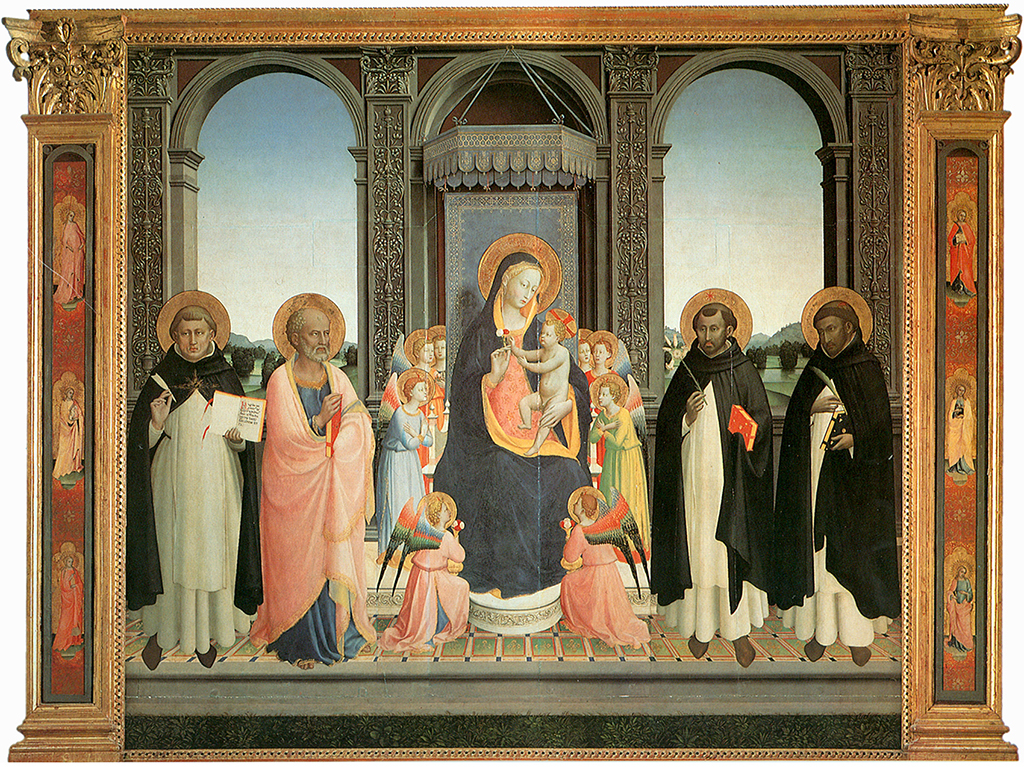
The main tier remained in San Domenico but was radically transformed by Lorenzo di Credi in 1501. Di Credi removed the older framing, repainted substantial areas and converted the multi-part Gothic structure into a unified Renaissance pala. This means the modern work has two principal artistic histories. Fra Angelico designed and largely executed the original altarpiece. Lorenzo di Credi reshaped it almost eighty years later to suit a new architectural and aesthetic environment.
The National Gallery’s technical research has reconstructed the original appearance through X-radiography, carpentry evidence, surviving fragments and study of di Credi’s repainting. The result is an extraordinary case study in how Renaissance taste could transform an earlier Renaissance object. The predella is equally unusual. Instead of a conventional narrative sequence, it presents Christ glorified in the court of heaven, surrounded by angels, saints, Old Testament figures, martyrs and Dominican Blessed. The imagery reflects the Dominican order’s sense of itself within the universal Church. [1]
At a Glance
- ArtistFra Angelico, later extensively reworked by Lorenzo di Credi [1]
- Original dateearly 1420s; predella about 1423–24 [1]
- Original locationhigh altar, San Domenico, Fiesole [1]
- Original formatmedieval polyptych [1]
- Later transformationLorenzo di Credi, 1501 [1]
- Current main tierSan Domenico, Fiesole, now in a side chapel [1]
- PredellaNational Gallery, London [1]
- Main central figuresVirgin and Child with angels and Saints Thomas Aquinas, Barnabas, Dominic and Peter Martyr [1]
- Predella subjectChrist glorified in the court of heaven [2]
- Workshopdesigned and largely executed by Fra Angelico with varying workshop assistance [1]
- Key significancerare surviving example of a major altarpiece radically remodelled across generations [1]
Contents
- Introduction
- Angelico at San Domenico
- The Original High Altar
- Early Date
- The Main Tier
- The Predella
- Christ Glorified in the Court of Heaven
- Workshop Participation
- Lorenzo di Credi in 1501
- Why the Fiesole High Altarpiece Matters
Angelico at San Domenico
San Domenico was Angelico’s own Dominican convent. He was not an outside painter arriving for a one-off commission. The high altarpiece therefore belonged directly to his religious community. The National Gallery notes that because Angelico was a friar at San Domenico, he would not have been paid for the work in the ordinary external-patron sense. This makes the commission structurally different from a guild or Medici altarpiece. Artistic labour and religious service overlapped. [5]
The Original High Altar
The altarpiece was created for the church’s principal altar. This was the liturgical centre of San Domenico. The work therefore needed to communicate to the Dominican community and lay worshippers within the church. Its original architecture was multi-part. Saints occupied separate compartments. Gold and framing created a hierarchical sacred structure. [5]
Early Date
The predella is now generally dated about 1423–24. This places the work extremely early in Angelico’s documented career. The date is especially important because it shows a young Dominican painter already designing a large and intellectually ambitious institutional ensemble. The high altarpiece therefore belongs near the beginning of Angelico’s surviving mature sequence rather than among his later conservative-looking commissions. [1]
Scholars have used the presence of Saint Vincent Ferrer among the Dominican Blessed as one chronological clue. Vincent died in 1419. His appearance therefore provides a terminus after his death, though his formal canonisation occurred later. Such evidence demonstrates how iconography can help establish chronology when contracts are incomplete. [1]
The Main Tier
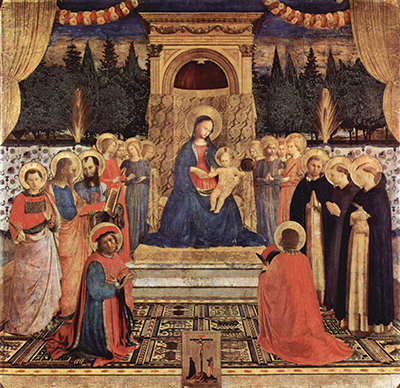
The main tier originally showed the Virgin and Child enthroned with angels and saints. Saints Thomas Aquinas, Barnabas, Dominic and Peter Martyr were included. Three of these figures have direct Dominican significance. The sacred assembly therefore reflected the identity of the convent. [1]
Thomas Aquinas represented the Dominican order’s intellectual authority. His presence connects the high altar with theology and study. For a Dominican house, he was not simply a popular saint. He embodied one of the order’s greatest achievements. [1]
Dominic represents the founder and institutional identity of the community. His place near Mary and Christ makes the order visually part of the sacred court. The friars worshipping before the altar saw their own founder permanently positioned within the holy assembly. [1]
Peter Martyr was another important Dominican saint. His presence reinforced the order’s history of preaching and martyrdom. The high altar therefore accumulated Dominican identity through saint selection. [1]
Barnabas differs from the other principal saints because he belongs to the apostolic period rather than Dominican history. His inclusion broadens the sacred assembly beyond one order. The Dominican community locates itself within the wider apostolic Church. [1]
The Predella
The surviving predella is one of the most remarkable parts of the original ensemble. It does not tell a simple linear story. The central panel shows Christ glorified among angels. Adjacent panels extend the heavenly assembly through the Virgin, saints, Old Testament figures and martyrs. Additional panels show Dominican Blessed. The whole lower structure therefore represents sacred hierarchy rather than narrative chronology. [2]
Christ Glorified in the Court of Heaven
The National Gallery dates the central predella panel about 1423–24. Christ appears resurrected and glorified. Angels surround him. The scene establishes the central heavenly focus. The surrounding panels expand the court outward. This creates a visual theology of the Church across time. [2]
The adjacent panels bring together figures from different periods. The Old Testament anticipates Christ. Christian saints follow. Martyrs testify. The predella therefore compresses salvation history into one heavenly assembly. [2]
The outer panels of Dominican Blessed are especially significant. These figures were revered within the order even when not formally canonised saints. Their inclusion gives the predella an unusually institutional character. The Dominican community effectively places its own holy history within the universal court of heaven. [3]
Predellas more commonly narrate episodes from the lives of saints shown above. The Fiesole predella is different. It creates hierarchy and community. This makes it one of the most distinctive lower registers in Early Renaissance altarpiece design. [2]
Workshop Participation
The National Gallery describes the altarpiece as designed and largely executed by Fra Angelico with workshop assistance. The exact division varies. The central predella panel seems to contain very little assistance. Other panels show more workshop involvement. The Dominican Blessed panels are also substantially connected with Angelico’s own hand. This varying authorship is typical of a large workshop project. [3]
Zanobi Strozzi is one of the assistants associated with Angelico’s workshop in modern scholarship. Earlier attributions assigned some predella areas to him. More recent dating can affect how plausible those proposals remain. This is another reminder that workshop attribution changes as chronology changes. [3]
Battista di Biagio Sanguigni has also been discussed in relation to workshop participation. The important point is not to force every figure into one named hand. The National Gallery itself cautions that isolating the painter of every figure is impossible. The object was collaborative. [3]
The Eucharistic Tabernacle
A tabernacle stood in front of the predella and held the Eucharistic Host. This is crucial to original function. The heavenly court was not merely decorative. It surrounded the sacramental centre of the altar. Christ glorified in the painting and Christ present in Eucharistic devotion were visually connected. [1]
The original polyptych included upper pinnacle panels. Surviving fragments have been identified in other collections, including an Annunciation and blessing Christ. These fragments help reconstruct the lost Gothic architecture. The current main tier no longer shows this original form. [4]
Additional saint figures belonged to the side pilasters. Some survive in other collections. These fragments demonstrate how much of the altarpiece extended beyond the present central image. The object was larger, taller and more articulated than modern viewing suggests. [4]
Lorenzo di Credi in 1501
The radical transformation of 1501 is the key event in the object’s later history. The church choir and high altar area were being renovated. The old polyptych no longer matched the new architectural environment. Lorenzo di Credi was commissioned to modernise it. [1]
Di Credi removed Gothic framing divisions and turned the principal tier into one rectangular field. He added landscape and sky. He repainted areas so the saints appeared to share one unified space. The operation effectively converted Angelico’s earlier object into the visual language of a later Renaissance generation. [1]
Modern viewers may instinctively treat di Credi’s intervention as damage. Historically, it was renovation. The community wanted to preserve the revered sacred image while adapting it to contemporary architecture and taste. This is important. Renaissance people did not necessarily value untouched historical authenticity as modern conservators do. A sacred object could remain alive through alteration. [1]
Vasari later complained that the high altarpiece had been retouched and made worse. His criticism preserves an early awareness that intervention had altered Angelico’s art substantially. At the same time, Vasari’s judgement reflects his own historical taste. The 1501 community had different priorities. [1]
Modern scholars have reconstructed the earlier form through several types of evidence. X-radiographs reveal hidden structures. Raking light shows di Credi’s additions. Carpentry reveals earlier panel relationships. Surviving fragments allow comparison. This makes the altarpiece an important example of technical art history. [6]
1502 Reinstallation
After restructuring, the altarpiece was reinstalled when the choir and high altar were rebuilt. The work therefore continued functioning liturgically. It was not transformed into a collectible artwork. The renovation extended its active religious life. [1]
Further changes to San Domenico eventually caused the altarpiece to leave the high altar permanently. The predella was separated and later sold. The main tier remained in the church but moved to a side chapel. The object gradually fragmented. [1]
The National Gallery bought the predella in 1860. This transformed the lower section into a museum object. Its unusual heavenly structure can now be studied closely, but its relationship with the Fiesole high altar has to be reconstructed intellectually. [2]
Modern Display
The main tier remains in Fiesole. The predella is in London. Other fragments are distributed across different collections. The original object is therefore geographically impossible to experience whole. Scholarship performs the reunion. [5]
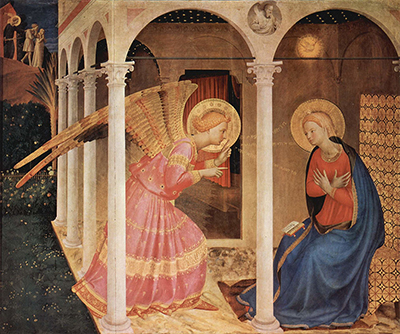
The Prado Annunciation was another Fiesole altarpiece created soon afterwards. Its unified square field shows Angelico already experimenting with new spatial form. This makes the high altarpiece especially interesting. Angelico himself moved towards newer formats not long after creating it. The later di Credi transformation therefore changes an object whose maker had already become a Renaissance innovator. [1]
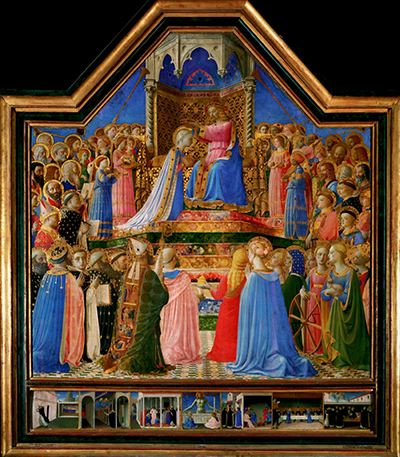
The Louvre Coronation adds another Fiesole solution. Gold-ground celestial hierarchy, Marian devotion and Dominican narrative operate differently there. Together the three altarpieces demonstrate extraordinary variety within Angelico’s own convent. [1]
Why the Fiesole High Altarpiece Matters
The Fiesole high altarpiece matters because it refuses to stay in one historical moment. It begins as an early Angelico polyptych. It becomes a mature Dominican institution’s sacred centre. In 1501, Lorenzo di Credi transforms it into a unified Renaissance pala. Later renovations fragment it. The predella enters the National Gallery. The main tier remains in Fiesole. Modern technical research then reconstructs the lost object. Few Angelico works possess such a visible biography. The altarpiece also reveals how workshop production functioned early in his career.
Angelico designed and largely painted the ensemble, while assistants contributed unevenly. The predella demonstrates institutional Dominican identity with unusual clarity. Christ, saints, prophets, martyrs and Dominican Blessed occupy one heavenly system. Finally, di Credi’s intervention provides a rare lesson in historical taste. What modern conservation might call alteration was once understood as renewal. The work survived because later generations continued to use and reshape it. For that reason, the Fiesole altarpiece is best understood not merely as a damaged early masterpiece but as a layered Renaissance object with multiple authors and lives. [1]
Frequently Asked Questions
Discussion
How should we understand the Fiesole Altarpiece when its surviving main tier, dispersed fragments and predella preserve different moments in its history?
Reader Insights
What did Lorenzo di Credi’s Renaissance conversion preserve, and what did it overwrite?
How does the heavenly assembly below reshape the meaning of the main tier above?
Can a scholarly reconstruction recover the experience of a dismantled polyptych?
Join the Conversation
Share your reading of the San Domenico Altarpiece at Fiesole below.
References
- National Gallery, London, Fiesole San Domenico Altarpiece, catalogue by Dillian Gordon. National Gallery Fiesole San Domenico Altarpiece catalogue.
- National Gallery, London, Fra Angelico, Christ Glorified in the Court of Heaven. National Gallery Christ Glorified in the Court of Heaven.
- National Gallery, London, Fra Angelico, The Dominican Blessed. National Gallery The Dominican Blessed.
- National Gallery, London, Saint Romulus: Frame Panel, reconstruction evidence. National Gallery Saint Romulus frame-panel catalogue.
- San Domenico, Fiesole, surviving main-tier context. National Gallery altarpiece reconstruction and original-setting evidence; Palazzo Strozzi Fiesole Altarpiece display context.
- Palazzo Strozzi / 2025 Fra Angelico restoration and reconstruction scholarship. Palazzo Strozzi and Museo di San Marco Fra Angelico exhibition; Palazzo Strozzi Fiesole Altarpiece restoration programme.
.jpg)
 Fra Angelico.jpg)