Francisco de Goya.jpg)
 by Tom Gurney
Tom Gurney BSc (Hons) is an art history expert with over 20 years experience
Published on June 19, 2020 / Updated on November 20, 2026
Email: tomgurney1@gmail.com / Phone: +44 7429 011000
Introduction
A child in a green suit stretches up towards a bunch of dark grapes. A seated man holds it by the stem, a woman cups her hand beneath the fruit, and the child’s fingers reach into the space between their sleeves. Above them, a woman steadies a basket of grapes on her head. At the right, beyond the low stone wall, two people work among the vines. Francisco de Goya painted The Grape Harvest, also called Autumn or La vendimia, in 1786–87 as a full-size design for a royal tapestry. The oil painting belongs to the Museo Nacional del Prado in Madrid. [1] [2]
At a Glance
- Artist and titleFrancisco de Goya, The Grape Harvest, or Autumn (La vendimia o El otoño). [1]
- Date and medium1786–87, oil on canvas. [1]
- Size and collection267.5 × 190.5 cm. Museo Nacional del Prado, Madrid, inventory P000795. [1]
- Original purposeFull-size tapestry design for the Four Seasons commission at El Pardo, planned as a companion to The Flower Girls, or Spring. [1] [4]
Works across Goya’s career
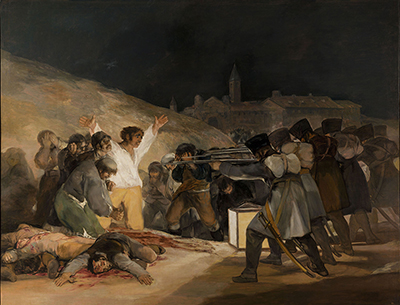
The Parasol
1777The Grape Harvest, or Autumn
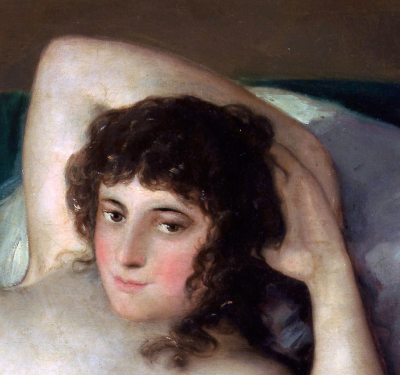
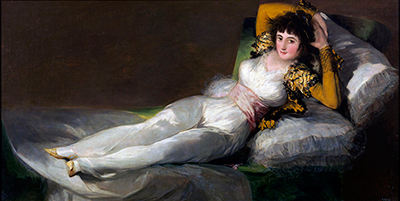
1786–87The Nude Maja
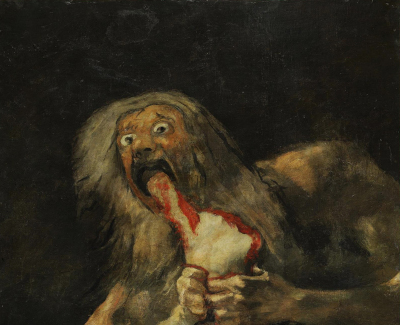
1795–1800Saturn Devouring His Son
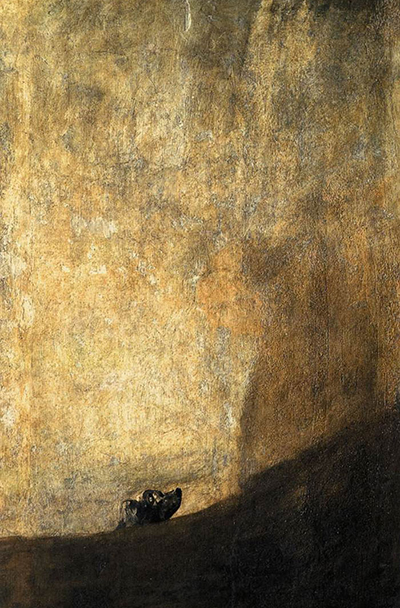
c. 1820–23The Dog
c. 1820–23A bunch of grapes between three pairs of hands
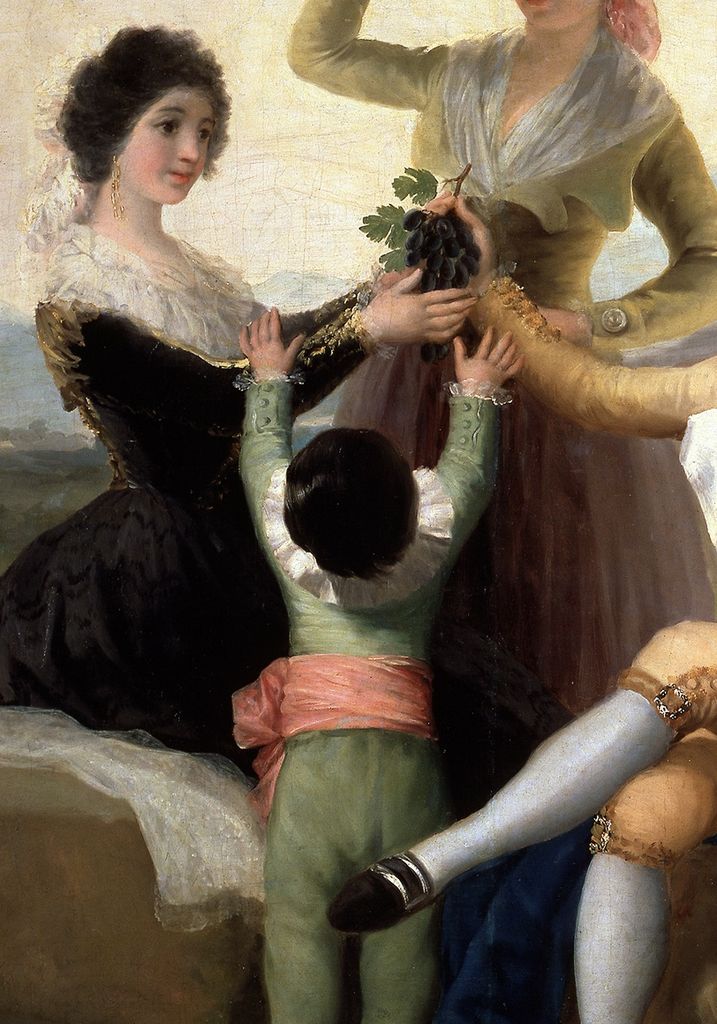
The bunch sits just below the basket carrier’s pale shawl. The little patch of green around the stem identifies it as a piece cut from a vine. The man’s gold sleeve leads in from the right, and the seated woman’s dark sleeve, edged with gold, approaches from the left. Their hands come together around the fruit. Goya gives the child two gestures at once. One hand comes up against the woman’s sleeve, while the other reaches towards the grapes from beneath the man’s wrist. The child’s face is turned away from us. With both feet still planted below the wall, the child has to stretch almost the full length of the body to reach into an exchange taking place at the adults’ sitting height. [1] [2]
The wall helps place everyone. The woman’s white shawl spills across the stone under her, and the man crosses one leg over the other, with a blue cloak bunched up beneath him. His pale stocking cuts a diagonal across the child’s green suit. The line brings our attention down to the feet and to the cut stems and vine leaves on the ground. From there, the child’s raised arms lead us back up. The pose of the seated man opens the picture out to the right, where his free arm rests at the rim of a second basket. The two baskets and the leaves below the wall show how much fruit has already been gathered, even as the hands at the centre concentrate on one bunch. [1] [2]
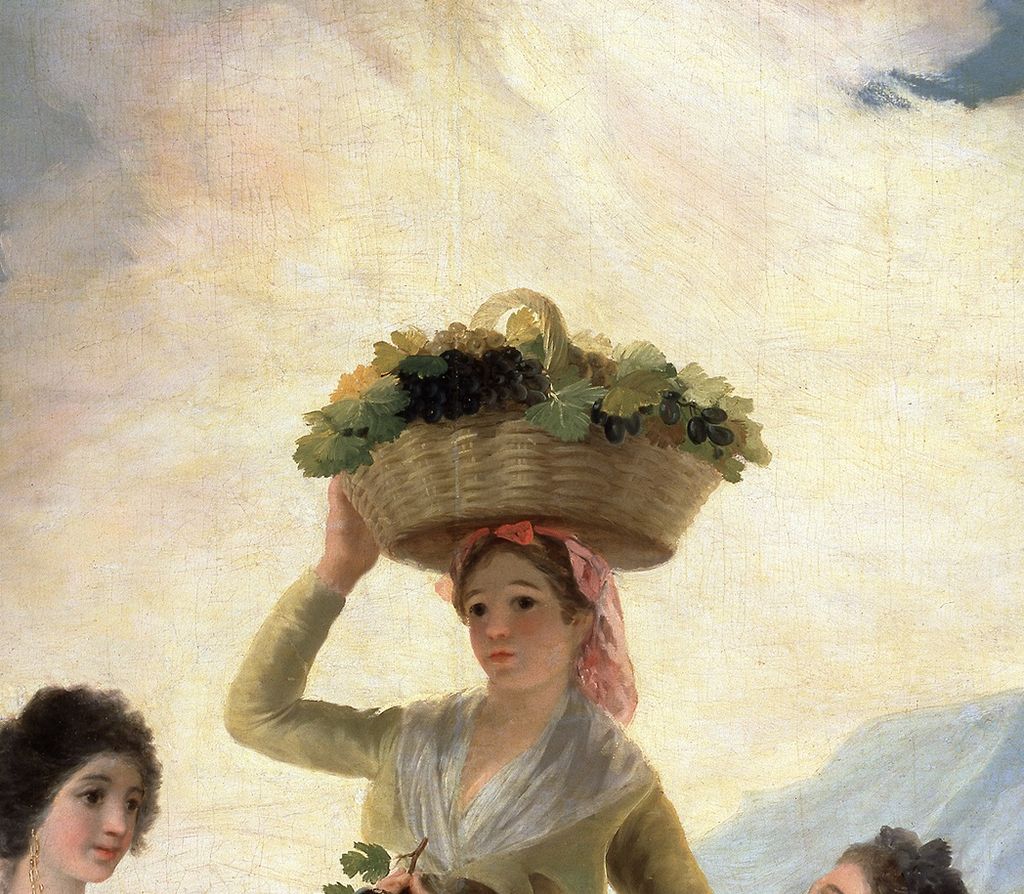
The tallest figure stands behind the wall with one hand under her basket and the other at her waist. Her wrist follows the basket’s curve. The pale cloud around its rim picks out individual leaves and dark bunches, so the weight she carries is visible from across the scene. Her basket forms the apex of a broad triangle whose lower corners are the two seated adults. The child’s movement takes place inside that triangle. The arrangement gives the picture a settled outline even as the smallest figure seems about to disturb it. [1] [2]
Annotated Details from The Grape Harvest, or Autumn
Follow the passing of the grapes and look beyond the foreground figures to the harvest.
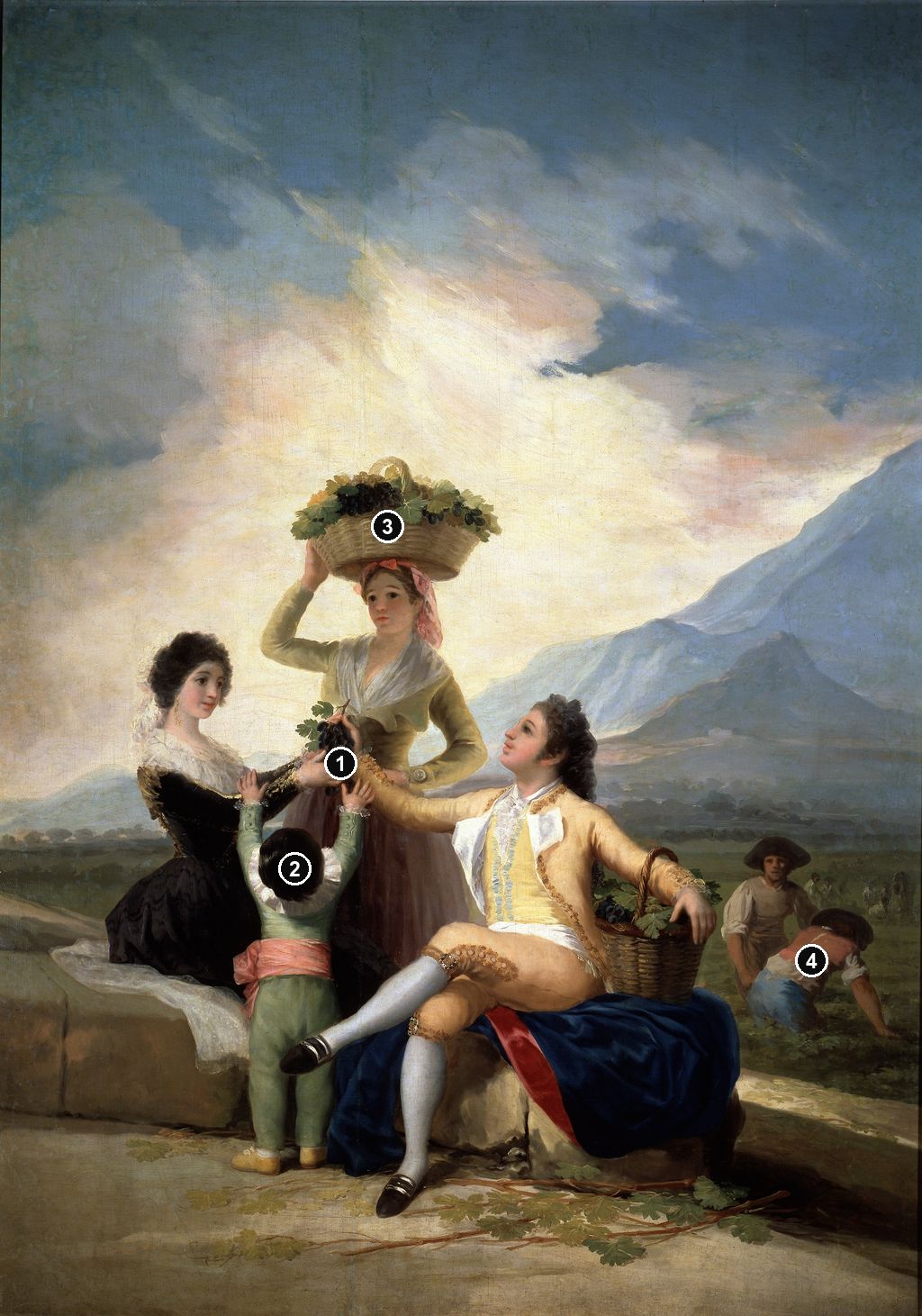
Details from THE GRAPE HARVEST, OR AUTUMN
Details from the tapestry cartoon in the Museo Nacional del Prado (P000795).
The offered grapes
The dark bunch sits between the man’s extended hand and the woman’s white sleeve.
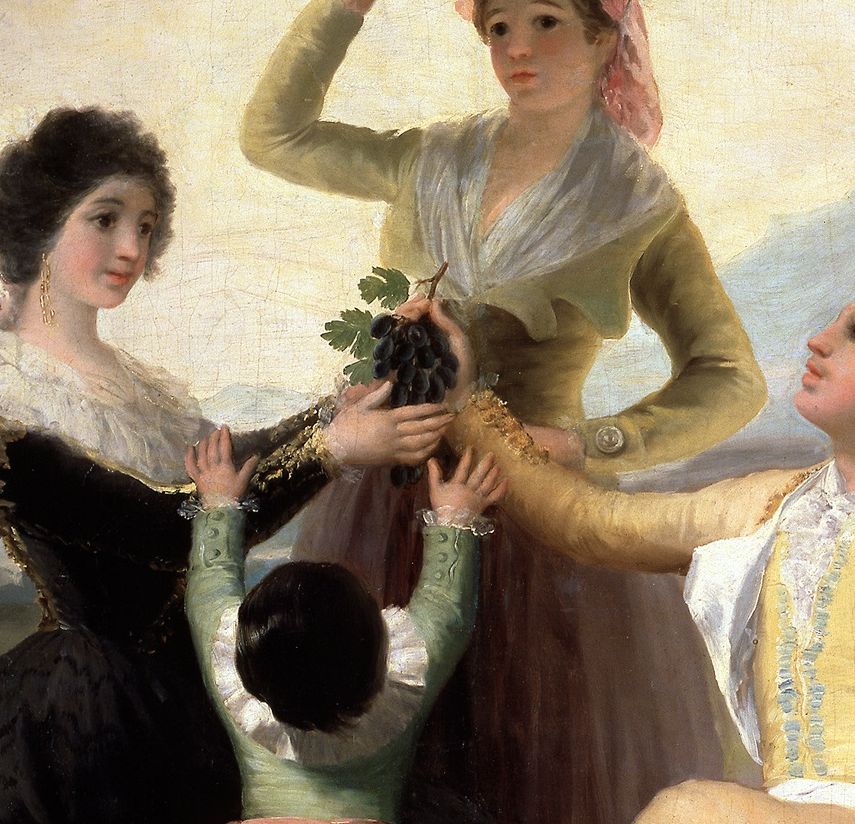
The child’s reach
The child stretches up into the space between the seated adults.
The basket
The woman steadies the basket of grapes above her head.
The workers
The much smaller figures at right bend and stand among the rows.
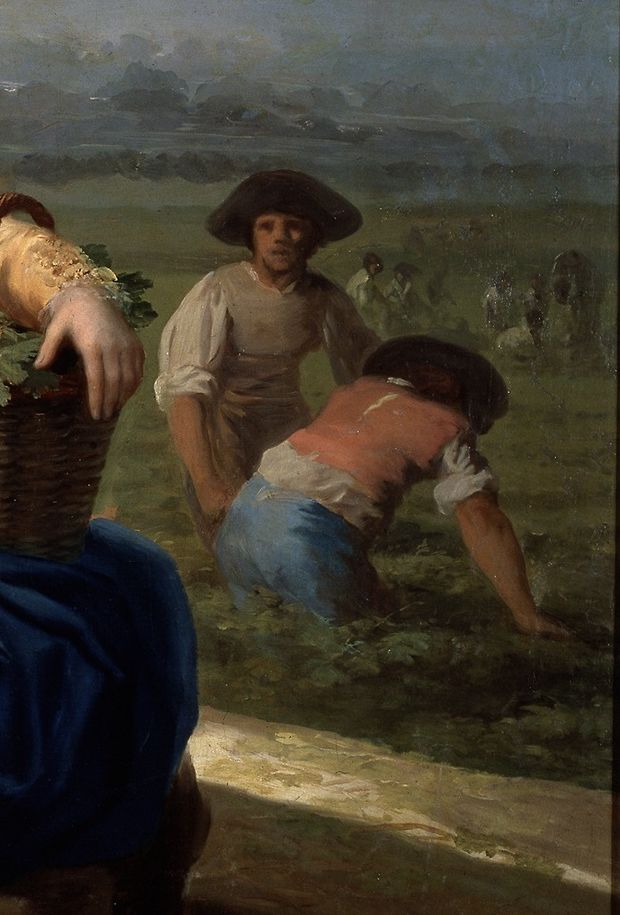
The people working beyond the wall
The two figures to the right give the harvest its particular motions. One in a broad hat raises his head above the vines. In front of him, another bends down, with an arm extended into the leaves. Farther back, a few small upright marks suggest more people in the field. The pale edge of the wall leads the eye past the richly dressed man towards the workers. Goya gives the viewer time to discover them by placing the brightest clothes and the largest gestures in front. The woman carrying the basket bridges the two groups. She stands with the people who have stopped to offer or take the fruit, and she is conspicuously occupied with the weight of what the vineyard has produced. [1] [2]
The courtly ease of the seated pair is part of that contrast. The woman’s short black jacket has gold trimming, and a white kerchief and hair covering pick out her face. The seated man, described in the catalogues as a majo, wears a finely decorated jacket and breeches. The term evokes a style of popular Spanish dress and bearing that fashionable people could also adopt. In the 2002 Prado and National Gallery of Art exhibition catalogue, Anna Reuter suggests that the pair could be landowners dressed in this fashion. Goya leaves the relationship between the figures open. The child’s reach and the adults’ hands show us a moment in the exchange. The painting supplies neither a family history nor the outcome of the gesture. [1] [2]
The mountain behind the workers fills much of the right-hand side. Its ridges become bluer and less distinct farther back. At the left, the landscape falls low enough for the woman’s dark hair to stand out against the light. The Fundación Goya en Aragón suggests that the mountains might evoke the ranges around Madrid. Their receding planes also serve a purpose we can see without locating the vineyard. They allow the landscape to open out behind a group whose four figures overlap so closely. The brightness around the basket and the strip of field below the mountains give separate spaces to the person who carries grapes, the people who offer them and the people who are still picking them. [1]
Goya on film
Five films explore Goya’s portraits, prints, Black Paintings and painting techniques.
The Duke of Wellington by Goya
The portrait, its military decorations and its later theft.
Watch on YouTubeFrom a small oil study to a royal tapestry design
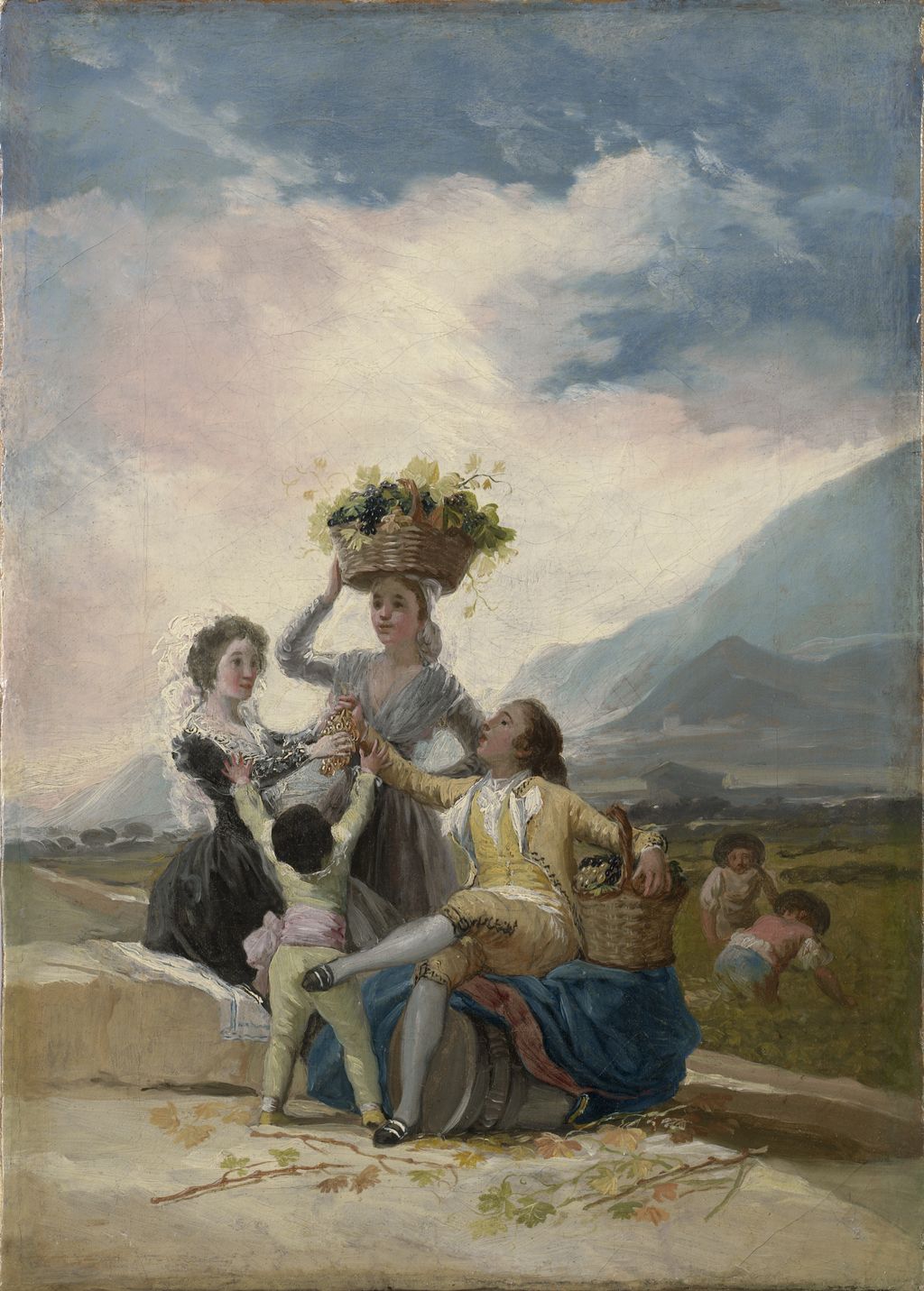
A small oil titled Autumn at the Clark Art Institute in Williamstown shows a closely related arrangement. Reuter treats it as Goya’s preparatory sketch. The Fundación Goya en Aragón catalogues the Clark picture as attributed to him and records an alternative attribution to his pupil Asensio Juliá. In the small oil, the man sits lower down, on what Reuter identifies as a barrel partly covered by his cloak. The grapes carried overhead are set against the sky on slender branches, and the bunch the man offers is a pale yellow. On the Prado canvas the seated pair share a single stretch of wall. A long edge draws the figures together, and the dark bunch between them is easy to pick out against the central figure’s clothes. The different positions show how decisions about the seat, the occupants’ height and the fruit’s outline can change how quickly we read the exchange. [2] [3]
This commission marked Goya’s return to making tapestry designs after several years away from that work. In September 1786 he wrote to his friend Martín Zapater about preparing sketches for a room used by the prince for meals. He was by then salaried as a painter to the king. The expense records still give a glimpse of how the commission proceeded. The carpenter’s account from the second half of November 1786 lists stretchers for the four seasons alongside those for The Injured Mason and Poor Children at the Well. The carpenter’s list places the familiar four scenes within a larger group being prepared for El Pardo. [2] [4] [5]
The full-size painting was the cartoon, the painted model delivered to the Royal Tapestry Factory of Santa Bárbara. Weavers had to rebuild the composition in thread, translating the meeting of dark and pale colours, the patterns of braid, and the softer shifts of tone in passages such as the sky. The canvas passed from the factory to the Royal Palace in Madrid in the nineteenth century and entered the Prado in 1870. The palace history of the oil design and the intended use of the woven hanging are two stages in the life of the composition. [2] [5]
Spring across the doorway
The room is often called the dining room of the Prince and Princess of Asturias, the future Charles IV and María Luisa of Parma. Tapestry historian Concha Herrero Carretero explains that the workshop accounts use words for both dining and conversation, and that the discovery of architect Francisco Sabatini’s plans helped scholars identify the king’s conversation room at the Royal Palace of El Pardo. The Fundación Goya en Aragón places Autumn and The Flower Girls, or Spring on either side of a doorway in the south wall. This was the planned arrangement. The Fundación records that the group never occupied its intended room following Charles III’s death in 1788. Herrero Carretero recounts Charles IV’s decision to send tapestries from the abandoned El Pardo project to the royal quarters at El Escorial. [1] [2] [4] [5]
In Spring, a kneeling woman offers a rose to a woman holding a little girl’s hand. Behind them a grinning man raises a hare and puts a finger to his lips. The rose marks the season in the same way that the bunch does in Autumn, and both objects belong to an exchange between people. The small child in Spring stands to one side and looks up into the group. The child in Autumn stands in the middle with both arms reaching up. In the tall design for Spring, a slender tree continues the upward movement above the figures. In Autumn, the fruit carrier and her basket take that place. The two designs could have answered each other across a doorway through their size, the placing of a child and the offering of something just gathered. Their gestures give each group a different pace. [1] [2] [4]
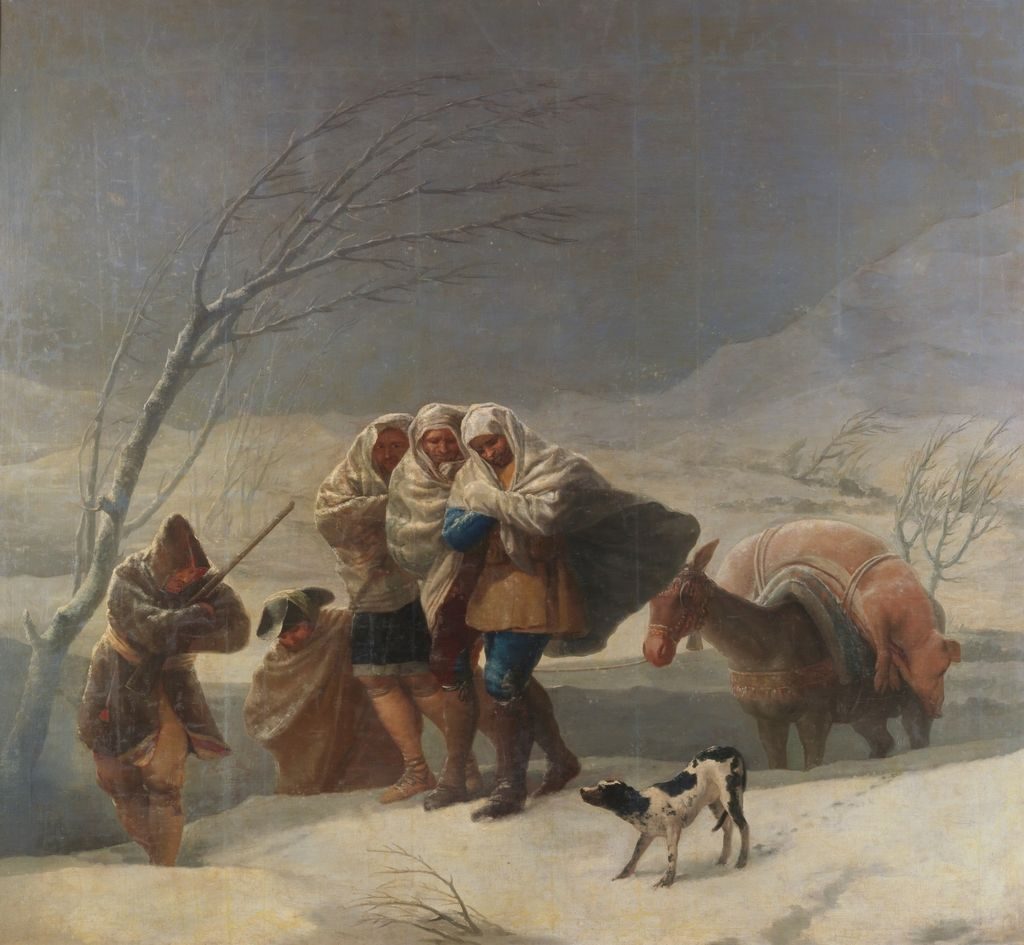
The Snowstorm makes the season visible through another set of actions. Its travellers huddle, pull their coverings close and bow their heads into the cold. A bent tree carries the movement of the wind into the sky. Across the four seasons, the people’s bodies do much of the work of telling us what time of year it is. In Autumn the lifted basket and the bending worker record how the fruit is gathered and carried. The small gesture at the centre shows what can happen to it once it reaches the wall. [1] [6]
 in Detail Francisco de Goya.jpg)
Artworks directory
| Name | Date | Medium |
|---|---|---|
| And There’s No Help for It, Plate 15 | Printed 1863 | |
| Asmodea | c. 1820–23 | Wall painting transferred to canvas |
| Boys Inflating a Bladder | 1777–78 | Tapestry cartoon |
| Boys Picking Fruit | 1778 | Tapestry cartoon |
| Bullfight in a Divided Ring | 1825 | Lithograph |
| Card Players | 1777–78 | Tapestry cartoon |
| Card Players (sketch) | 1777–78 | Painted sketch |
| Dance on the Banks of the Manzanares | 1777 | Tapestry cartoon |
| Duel with Cudgels | c. 1820–23 | Wall painting transferred to canvas |
| Heads in a Landscape | c. 1820–23 | Easel painting |
| Judith and Holofernes | c. 1820–23 | Wall painting transferred to canvas |
| Leocadia | c. 1820–23 | Wall painting transferred to canvas |
| Maja and Cloaked Men | 1777 | Tapestry cartoon |
| Maja and Cloaked Men (sketch) | 1777 | Painted sketch |
| Majo Clapping in Time to the Music | 1777 | Drawing |
| Men Reading | c. 1820–23 | Wall painting transferred to canvas |
| Out Hunting for Teeth, Plate 12 | 1799 | Etching, burnished aquatint and burin |
| Picnic in the Countryside (sketch) | 1776–78 | Painted sketch |
| Picnic on the Banks of the Manzanares | 1776 | Tapestry cartoon |
| Pilgrimage to San Isidro | c. 1820–23 | Wall painting transferred to canvas |
| Preparatory study for The Sleep of Reason Produces Monsters | c. 1796–97 | Drawing |
| Procession of the Holy Office | c. 1820–23 | Wall painting transferred to canvas |
| Quarrel at the Cockerel Inn (sketch) | 1777 | Painted sketch |
| Quarrel in the New Tavern | 1777 | Tapestry cartoon |
| Saturn Devouring His Son | c. 1820–23 | Wall painting transferred to canvas |
| Seated Majo Smoking | c. 1776 | Drawing |
| The Dog | c. 1820–23 | Wall painting transferred to canvas |
| The Drinker | 1777 | Tapestry cartoon |
| The Fates | c. 1820–23 | Wall painting transferred to canvas |
| The Great He-Goat | c. 1820–23 | Wall painting transferred to canvas |
| The Kite | 1777–78 | Tapestry cartoon |
| The Parasol | 1777 | Oil on canvas, tapestry cartoon |
| The Second of May 1808 | 1814 | Oil on canvas |
| The Sleep of Reason Produces Monsters, Plate 43 | 1799 | Etching and aquatint |
| The Third of May 1808 | 1814 | Oil on canvas |
| Thou Who Canst Not, Plate 42 | 1799 | Etching and burnished aquatint |
| Three Figures | 1776 | Drawing (lost) |
| Two Old Men | c. 1820–23 | Wall painting transferred to canvas |
| Two Old Men Eating Soup | c. 1820–23 | Wall painting transferred to canvas |
| Two Women and a Man | c. 1820–23 | Wall painting transferred to canvas |
| Universal Language: The Author Dreaming | 1797 | Drawing |
| The Family of Charles IV | 1800 | Oil on canvas |
| Witches’ Sabbath (Osuna painting) | 1797–98 | Oil on canvas |
| The Nude Maja | 1795–1800 | Oil on canvas |
| The Clothed Maja | 1800–07 | Oil on canvas |
| Self-Portrait (Drawing) | c. 1796 | Brush and carbon black ink on laid paper |
| The Swing, Madrid Album B.21 | 1795–97 | Brush and carbon black washes |
| Majas Fighting, a Majo Observing, Madrid Album B.15 | 1796–97 | Brush, grey and black washes on laid paper |
| Majos and Majas Conversing, Madrid Album B.16 | c. 1794–97 | Ink wash on paper |
| Weeping Woman and Three Men, Madrid Album B.17 | 1795–97 | Brush, carbon black washes and black chalk |
| Maja Seated on a Chair and Two Companions Behind, Madrid Album B.18 | 1795–97 | Brush and carbon black washes |
| Girl and Bull, Madrid Album B.23 | 1796–97 | Brush and carbon black washes |
| Lovers Sitting on a Rock, Madrid Album B.24 | 1796–97 | Brush and carbon black washes |
| Mariano Ceballos Riding a Bull | 1825 | Crayon lithograph and scraper |
| Landscape (lifetime impression) | c. 1807–10 | Etching and aquatint |
| Self-Portrait (1815), Prado canvas | 1815 | Oil on canvas |
| Self-Portrait (1815), Academy panel | 1815 | Oil on panel |
| Self-Portrait with Dr Arrieta | 1820 | Oil on canvas |
| Christ Crucified | 1780 | Oil on canvas |
| The Last Communion of Saint Joseph of Calasanz | 1819 | Oil on canvas |
| Christ on the Mount of Olives | 1819 | Oil on panel |
| The Flower Girls, or Spring | 1786–87 | Oil on canvas |
| The Grape Harvest, or Autumn | 1786–87 | Oil on canvas |
| The Snowstorm, or Winter | 1786–87 | Oil on canvas |
| The Threshing Ground, or Summer | 1786–87 | Oil on canvas |
| Picnic on the Banks of the Manzanares | 1776 | Oil on canvas |
| The Kite | 1777–78 | Oil on canvas |
| Dance on the Banks of the Manzanares | 1777 | Oil on canvas |
| A Fight at the Venta Nueva | 1777 | Oil on canvas |
| Blind Man’s Bluff | 1788 | Oil on canvas |
| Dogs on a Lead | 1775 | Oil on canvas |
| Hunting with a Decoy | 1775 | Oil on canvas |
| Hunter Loading His Rifle | 1775 | Oil on canvas |
| The Angler | 1775 | Oil on canvas |
| The Hermitage of San Isidro on His Feast Day | 1788 | Oil on canvas |
| The Meadow of San Isidro | 1788 | Oil on canvas |
| The Straw Manikin | 1791–92 | Oil on canvas |
| Witches’ Flight | c. 1797–98 | Oil on canvas |
| A Scene from ‘The Forcibly Bewitched’ | 1798 | Oil on canvas |
| The Duchess of Alba in Black | 1797 | Oil on canvas |
| The Duchess of Alba in White | 1795 | Oil on canvas |
| Charles III in Hunting Dress | c. 1786 | Oil on canvas |
| The Duke and Duchess of Osuna and Their Children | 1787–88 | Oil on canvas |
| Manuel Osorio Manrique de Zúñiga | 1787–88 | Oil on canvas |
| The Marquesa de Pontejos | c. 1786 | Oil on canvas |
| Equestrian Portrait of the 1st Duke of Wellington | 1812 | Oil on canvas |
| The Duke of Wellington | 1812–14 | Oil on wood |
| Portrait of Ferdinand VII of Spain | 1814 | Oil on canvas |
| Gaspar Melchor de Jovellanos | 1798 | Oil on canvas |
| María Tomasa Palafox y Portocarrero | 1804 | Oil on canvas |
| Señora Sabasa García | c. 1806–11 | Oil on canvas |
| Don Juan Bautista de Muguiro | 1827 | Oil on canvas |
| Doña Isabel de Porcel | Before 1805 | Oil on canvas |
| The Colossus | After 1808 | Oil on canvas |
| The Burial of the Sardine | 1808–12 | Oil on panel |
| The Madhouse | 1808–12 | Oil on panel |
| A Procession of Flagellants | 1808–12 | Oil on panel |
| Portrait of Jacques Galos | 1826 | Oil on canvas |
| Portrait of Mariano Goya, the Artist’s Grandson | 1827 | Oil on canvas |
| Milkmaid of Bordeaux | c. 1827 | Oil on canvas |
| Portrait of Don Juan Antonio Cuervo | 1819 | Oil on canvas |
| María Luisa of Parma (Naples version) | c. 1800 | Oil on canvas |
| The Countess of Baena | 1819 | Oil on canvas |
| The Family of the Infante Don Luis | 1783–84 | Oil on canvas |
| The Holy Family | c. 1787 | Oil on canvas |
| Saint Barbara | c. 1773 | Oil on canvas |
| Saints Justa and Rufina | 1817 | Oil on canvas |
| El Tío Paquete | c. 1819–20 | Oil on canvas |
| The Forge | c. 1815–20 | Oil on canvas |
| Majas on a Balcony (Metropolitan Museum version) | c. 1800–10 | Oil on canvas |
| Maja and Celestina on a Balcony | c. 1808–12 | Oil on canvas |
| The Water Bearer | 1808–12 | Oil on canvas |
| Time and the Old Women | c. 1810 | Oil on canvas |
Frequently Asked Questions
The Fundación Goya identifies them by their appearance and actions as a fashionably dressed man, a young woman, a child and a woman carrying the harvested grapes. Proposed identifications with named figures from Goya’s life remain speculative. [1]
Discussion
Look again at the images and ideas explored in The Grape Harvest, or Autumn. These editorial prompts invite your observations.
Follow the grapes from the vines at the right to the basket and then to the child’s fingertips. Which figure changes the way you read the harvest most? Look at Spring beside it and consider what changes when the child stands on the outside of the exchange.
Reader Insights
How do the child’s hands change the way you see the seated figures?
What differences between the small oil and the cartoon affect the exchange?
Join the Conversation
Share a detail, comparison or question about The Grape Harvest, or Autumn below.
References
- Fundación Goya en Aragón, La vendimia, catalogue entry for the Prado cartoon, P000795. View source.
- Anna Reuter, catalogue entries for The Flower Girls, Autumn and Autumn (The Grape Harvest), in Janis A. Tomlinson (ed.), Goya: Images of Women, National Gallery of Art, 2002, nos. 14–16, pp. 129–136. View source.
- Fundación Goya en Aragón, El otoño (boceto), catalogue entry for the Clark Art Institute oil, 1955.749. View source.
- Fundación Goya en Aragón, The Flower Girls (Las floreras), catalogue entry for the Prado cartoon, P000793, and the commission’s history. View source.
- Concha Herrero Carretero, ‘An Introduction to Goya’s Cartoons and Tapestries’, in Janis A. Tomlinson (ed.), Goya: Images of Women, National Gallery of Art, 2002, pp. 89–97. View source.
- Fundación Goya en Aragón, La nevada, catalogue entry for the Prado cartoon, P000798. View source.