



 by Tom Gurney
Tom Gurney BSc (Hons) is an art history expert with over 20 years experience
Published on June 19, 2020 / Updated on November 20, 2026
Email: tomgurney1@gmail.com / Phone: +44 7429 011000
Introduction
The pink sash in Francisco de Goya’s The Clothed Maja crosses the brightest expanse of the painting. It gathers the pale fabric at the waist and interrupts the long slope from the woman’s raised shoulders to her shoes. Her elbows spread above the cushions and her eyes look out towards us. There is almost twice as much canvas across as there is from top to bottom, and Goya makes the most of that width. The woman, the divan and the white bedding occupy virtually the whole scene. The darkness above leaves her gaze and the colours of her clothes to carry the encounter. [1] [2]
The painting, known in Spanish as La maja vestida, is an oil on canvas dated 1800–07 and held by the Museo Nacional del Prado in Madrid. Its inventory number is P000741. It has a companion in The Nude Maja, an earlier, separately painted canvas. Both works belonged to Manuel Godoy, a leading minister under Charles IV. An inventory records them together in 1808. In the records that follow, the dressed woman appears in turn as a Venus and as a woman in maja dress. The changes in description help explain why clothes matter so much to the way this painting has been seen. [1] [2] [3] [4]
At a Glance
Works across Goya’s career
The Parasol
1777The Nude Maja
1795–1800The Clothed Maja
1800–07Saturn Devouring His Son
c. 1820–23The Dog
c. 1820–23The sash, jacket and shoes
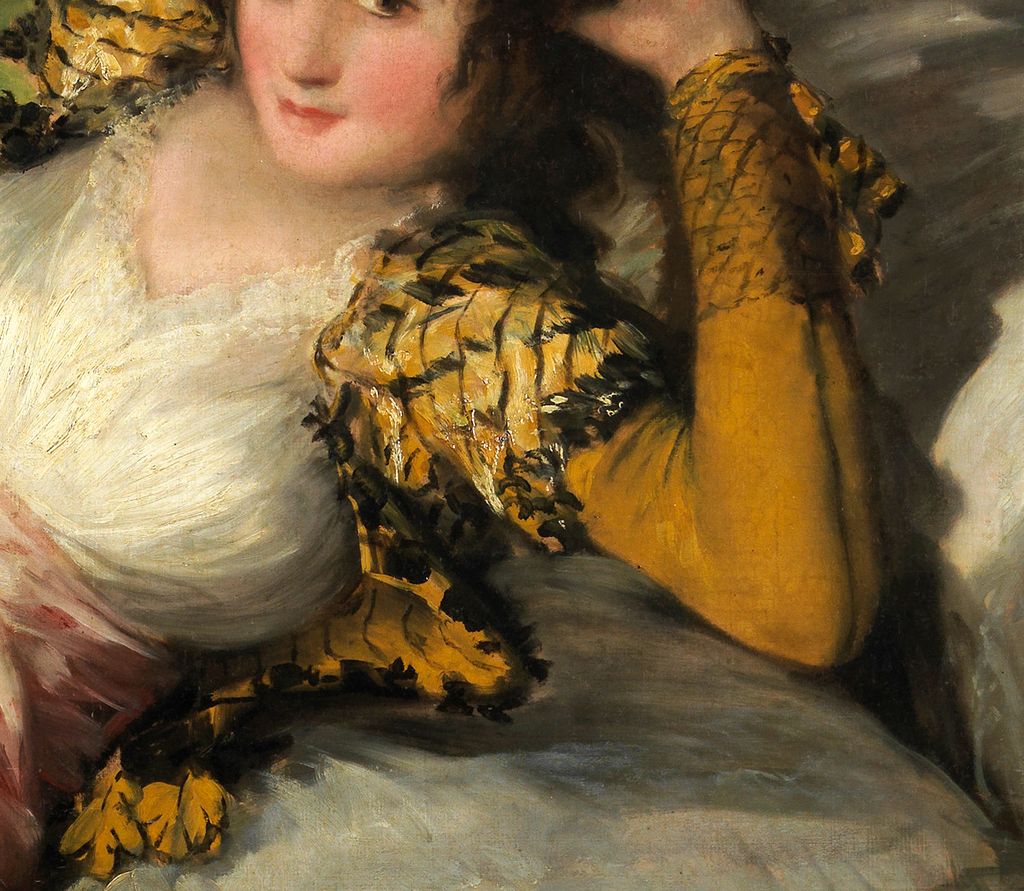
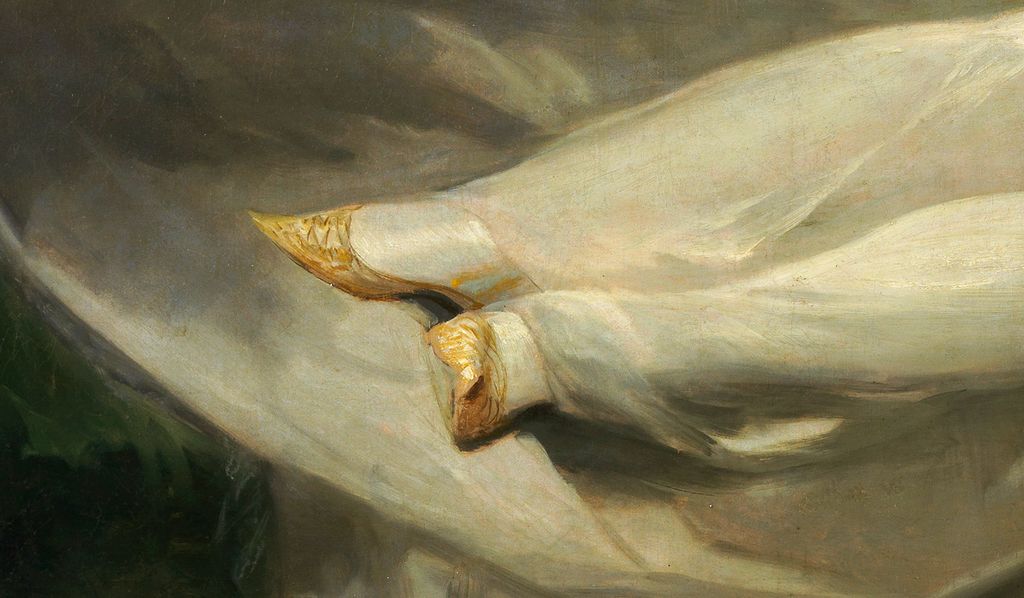
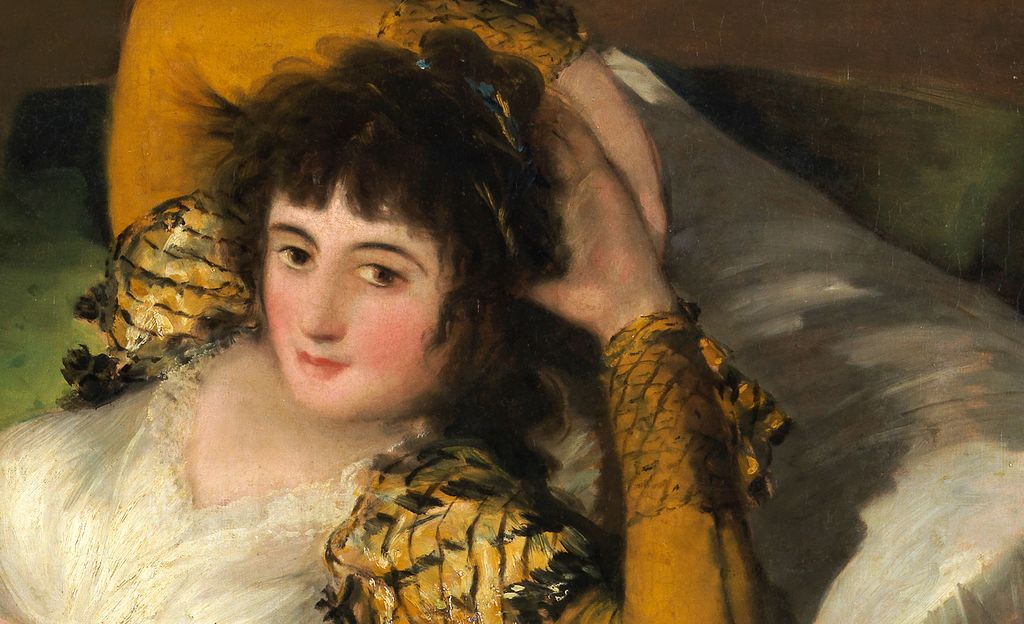
Start with the short yellow jacket. Its dark decoration is concentrated on the sleeves and at the edges, where it breaks the colour into small, uneven marks. The elbows lift to either side of the head, and the gold changes in tone where the fabric bends with the arms. The pointed shoes at the other end of the divan answer the jacket in colour. Between them lies the sweep of white cloth, which follows the legs and catches the light differently on either side of the sash. At a distance the yellow establishes the two ends of the figure. Close up it registers as many different strokes, against both the dark background and the lighter surface of the divan. [1] [2]
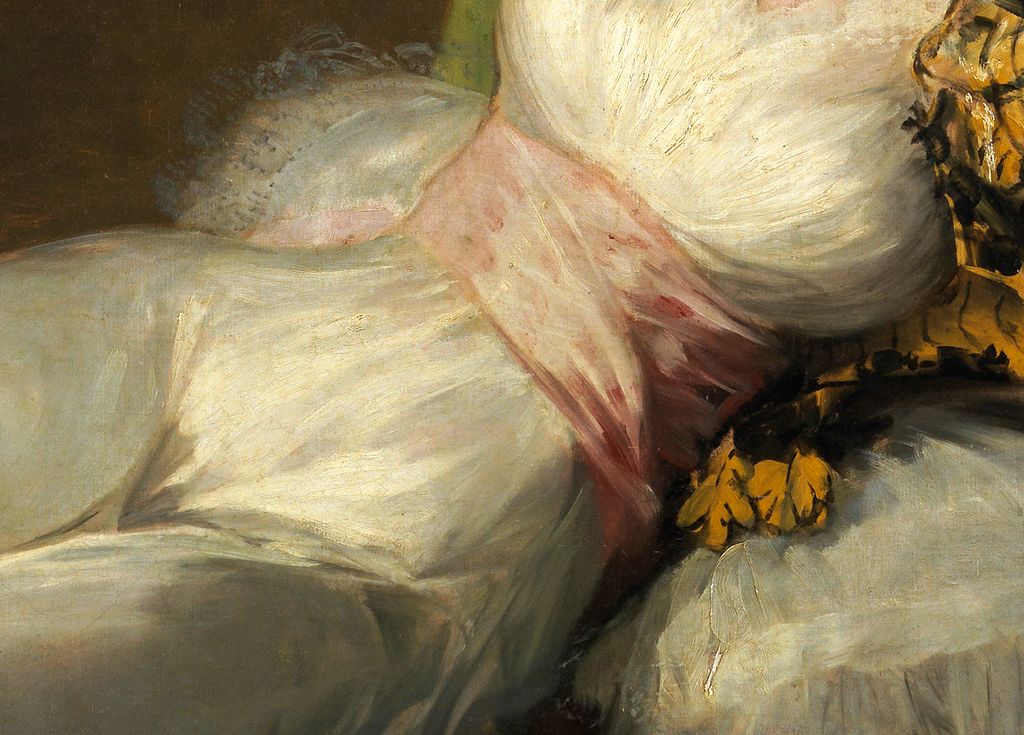
The sash is a broader patch of colour, with pink light on the upper folds and deeper red where it tightens. Its edge gives the waist a sharper turn than the long folds of white. Watch how the folds crowd together near the sash and spread as they run out across the lap and legs. The light material can read as translucent in parts, while the brightest touches of paint give individual creases a definite edge. Goya lets the fabric signal how the body is turned, sometimes by following its contours and sometimes by pulling away in a fold. A little reddish form projects below the hip. The Fundación Goya en Aragón records two proposed identifications, a closed fan and a dagger hilt. The small exposed area leaves the shape open to either reading. [2]
Majismo was a fashion as well as a way of representing urban Spaniards around Goya’s time. The Museo del Traje describes the maja’s fitted jubón, or bodice, and the coloured skirt known as a guardapiés. A woman could put on a black overskirt, the basquiña, and a mantilla to go out. The style was associated with popular dress and could also be adopted by people of higher rank. In Goya’s painting the conspicuous short jacket, sash and shoes suggest the associations of the title, and the pose makes this a very different arrangement from a dressed figure out in the street. The conspicuously pale fabric, uncovered hair and absence of a dark overskirt give the reclining figure a look of her own. The painting tells us how Goya used recognisable elements of dress, while the surviving garments at the Museo del Traje show what a fuller ensemble could include. [2] [5]
Annotated Details from The Clothed Maja
Look at the jacket, sash and slippers against the pale costume and bedding.
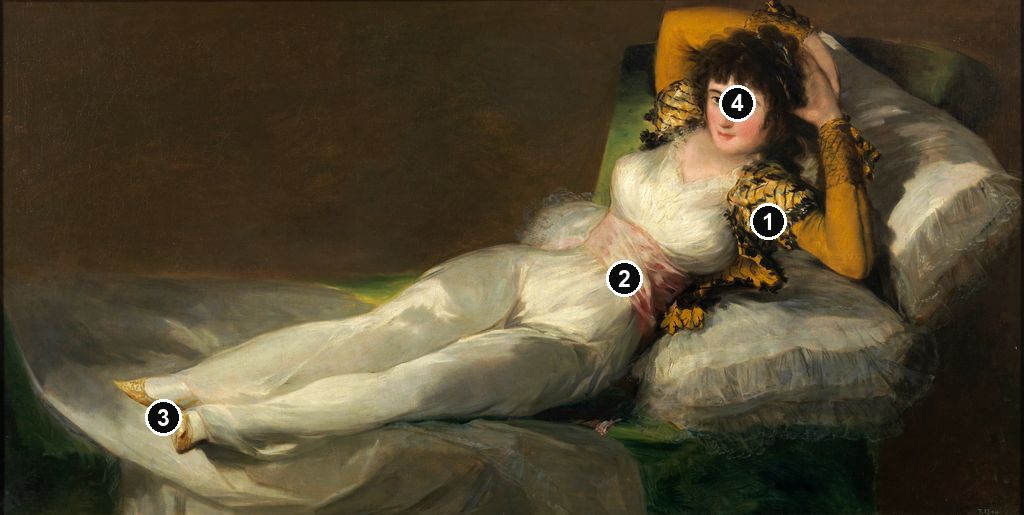
Details from THE CLOTHED MAJA
Details from the painting in the Museo Nacional del Prado (P000741).
Decoration on the jacket
Short light and dark strokes catch on the jacket near the shoulder. Its patterns contrast with the smooth field behind the figure.
The pink sash
Thin strokes of pink cross the pale folds and deepen where the sash turns across the waist.
Slippers and fabric
The bright toes of the slippers project from the pale costume. The folds below gather along the softer edge of the bedding.
Gaze and cushions
The face is turned towards the viewer. The pale cushion beyond the hair makes the angle of the head easier to read.
Brushwork across the divan
At the right, the pillows rise behind the neckline and head. Their light faces allow even the darker parts of the woman’s hair to register clearly. Across the lower edge the bedding forms another light band. Under it the green upholstery stays visible, especially beneath the figure and towards the left. Goya gives the body a broad support while preserving a clear distinction between the clothing that turns around the figure, the bedding that buckles under it and the green divan that carries both. The higher bedding also sets the face above the long diagonal of the body, a quiet adjustment that keeps bringing the eye back to her. [1] [2]
The Fundación remarks on the freer strokes and thicker application of paint in the clothes compared with the handling of The Nude Maja. The folds and trim show this difference especially clearly. Marks that look like separate dashes when you view the sleeve closely join up into patterned edging from farther away. In the bedding a pale stroke can sit abruptly against a greyer one and give the impression of an edge catching light. Along the cheek and around the eyes the changes are finer, giving the face a degree of definition that holds its own against all the movement elsewhere. Across a single canvas Goya varies how much work each brushstroke asks the eye to do. [1] [2]
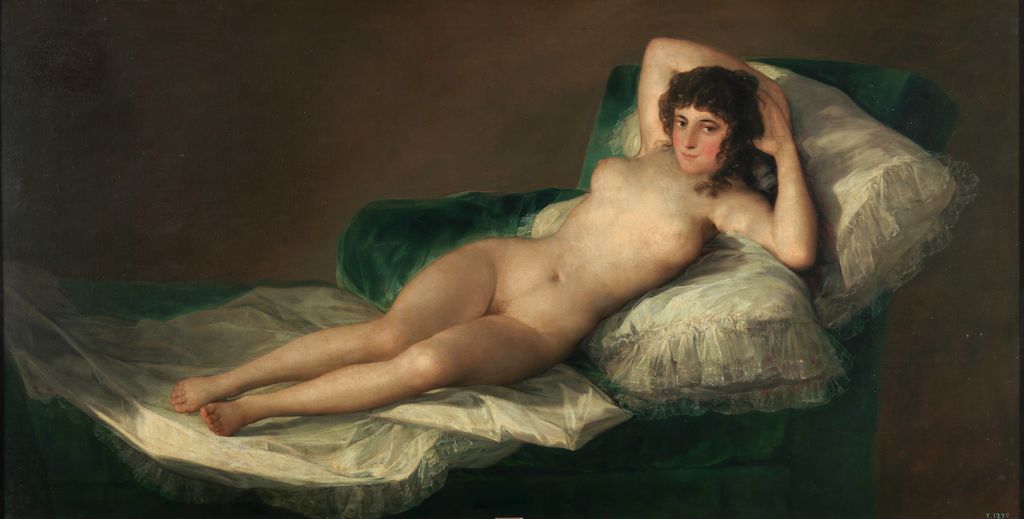
Two paintings of the same pose
In each canvas the face is turned towards us, the elbows are raised, and the legs extend diagonally towards the lower left. The background gives little indication of a room beyond the divan. The relationship is unmistakable even though the clothed canvas is a little smaller. Look first at the waist in each one. In the nude, shading carries the eye along the torso towards the hips, and the bedding throws the outline of the body into relief. In the clothed picture that passage is interrupted halfway by a strong band of pink, then resumes through the folds. Look next at the ends of the legs. The yellow shoes give them a firmer accent in the clothed picture and send the eye back up towards the jacket. By giving the two figures such similar poses, Goya makes differences in emphasis and handling easy to see. [1] [2] [6]
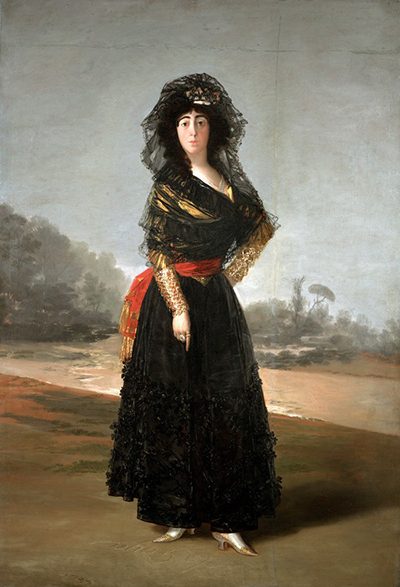
Another reclining woman shows how differently a costume could function in Goya’s paintings. His signed and dated 1805 portrait of Joaquina Téllez-Girón, Marchioness of Santa Cruz, shows her lying back in a pale gown, with a lyre-shaped instrument and a wreath of leaves and grapes. The Fundación Goya connects the instrument to the muse Erato. Her left hand rests on the instrument and her right holds a white handkerchief. Her pose and direct gaze echo the clothed maja’s, but in the portrait the objects and dress establish a mythological role and an inscription identifies a particular woman. In The Clothed Maja, the two lifted elbows keep the hands out of view, and the sash and jacket carry more of the pictorial interest. The comparison is also a reminder of the evidence Goya could supply when he wanted a sitter to be known by name. [2] [7]
Goya on film
Five films explore Goya’s portraits, prints, Black Paintings and painting techniques.
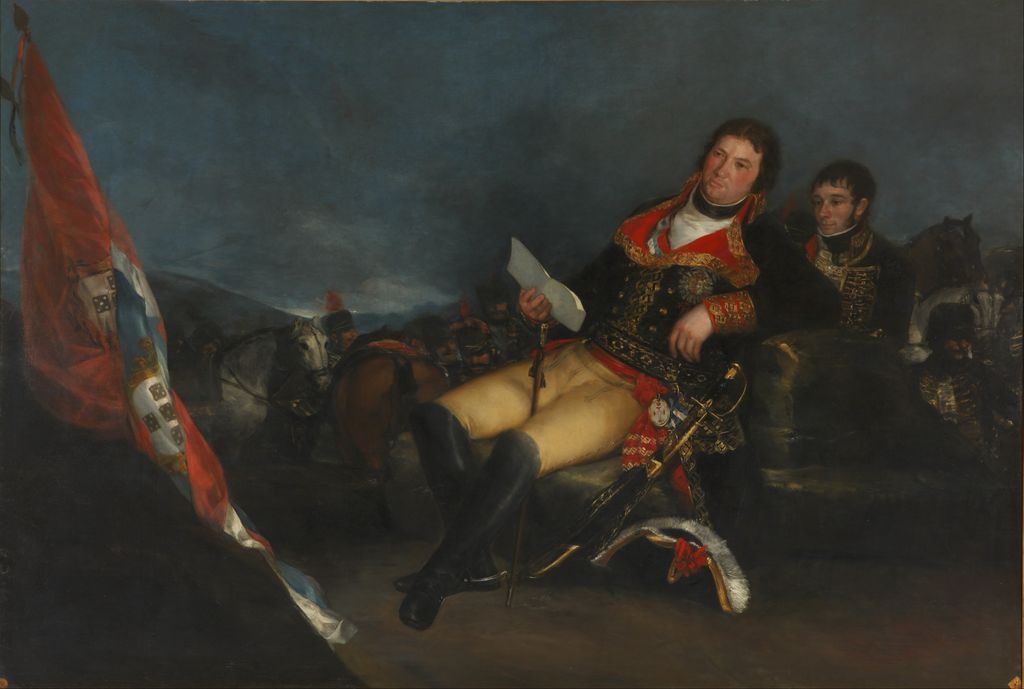
The Duke of Wellington by Goya
The portrait, its military decorations and its later theft.
Watch on YouTubeFrom Godoy’s collection to the Inquisition
The two canvases enter the surviving record at different times. On 12 November 1800 the engraver Pedro González de Sepúlveda saw the nude in a room of Godoy’s Madrid palace. His account gives a firm early sighting of that canvas alone. The first secure notice of the clothed one comes in Frédéric Quilliet’s inventory of Godoy’s collection in 1808. Quilliet couples the works in French as a nude and a dressed gitana, both reclining. The word is an inventory description, and the Prado’s published teaching material suggests that the costume of the clothed figure probably prompted it. It provides evidence for how the pictures were seen and listed in 1808. [3] [4]
As Godoy lost power in 1808, his property was seized. Entry 122 of the 1813 inventory describes the two pictures as Venuses, assigns both to Goya and distinguishes the nude figure on a bed from the clothed one. Isadora Rose-de Viejo’s archival catalogue places both pictures in the palace near the convent of Doña María de Aragón until their removal to the storehouse known as the Almacén de Cristales on 18 December 1813. A description in 1814 identifies the clothed subject through her maja dress. A separate receipt of 22 November 1814 records the transfer of the two works from the general depositary of Godoy’s seized property to the secretary of the Holy Office. A later report from the Director General of Sequestrations gives 28 November in connection with a group of five paintings. The receipt dated the 22nd refers specifically to the two Majas. [3] [4] [9]
On 16 March 1815 the Inquisition’s prosecutor called for Goya to appear and identify the paintings, say why he had made them, who had commissioned them and what purpose he intended them to serve. The file included both pictures among a group of works it deemed obscene. It specifically identifies the clothed subject as a woman dressed as a maja on a bed. The surviving request records what the authorities wanted to know. Goya’s appearance and any statement he gave are unconfirmed. The pictures’ similarity has prompted the suggestion that the clothed one could have concealed the nude in Godoy’s rooms. The inventories document possession of two canvases, and the evidence for the mechanics of their original display and for the circumstances of the commission remains uncertain. [4] [8] [9]
From the Academy to the Prado
Both canvases went to the Real Academia de Bellas Artes de San Fernando in April 1836. Its transfer list describes them as two horizontal portraits and treats the figures as the same young woman in the same attitude. The list records how convincingly the pair suggested a single subject to the writer. A name would have been a different kind of evidence. The Duchess of Alba and Godoy’s companion Josefa, known as Pepita, Tudó have both been proposed in discussions of the pair, especially of the nude. The costume was a mode of dress that could cross social boundaries, and the similarities in the figures establish a close pictorial relationship. The identity of the model or models remains uncertain. [3] [4] [5] [6]
The dress also mattered to what viewers could see in the Academy. The clothed version was included in its public exhibition of 1840, while the nude stayed out of sight for much of its early time there. Both canvases passed to the Prado in 1901. The matching frames catalogued by the museum were made in 1910–12 in a style associated with the reign of Ferdinand VII. They are part of the pictures’ museum history, nearly a century after the Inquisition investigated them. Seen as a pair at the Prado, the canvases invite the comparison that their shared pose sets up. Seen on its own, The Clothed Maja still holds the eye through the brightness of the jacket, the fit of the sash and the woman’s steady gaze. [4] [10]
The edges of a pendant and its frame
The Prado’s separate catalogue record for a frame associated with The Clothed Maja is worth keeping beside the records for the two canvases. A frame is another object with its own history. Its opening governs how much of each outer edge can be seen and makes the horizontal reach of the divan more insistent. Matching formats seem to invite the viewer to compare the paintings as a pair. A surviving frame can tell part of the story of how one canvas was presented, while evidence for original placement must still come from elsewhere. [11] [12]
Look at the shoes near the right boundary and compare the amount of space the hands have at the other end. Those small intervals are particularly easy to judge when the full borders are visible. When the image is cropped in reproduction, the woman can appear to stretch into space beyond the frame more sharply than she does in a full view. On the other hand, the horizontal lines of the cushions are long enough to continue in the imagination. Goya balances these two effects. The body is neatly contained by the field while the divan implies a larger furnishing that might continue beyond it. [11] [12]
The distinction helps explain the limits of a story about the paintings being built into any particular device for hidden display. Matching figures and broadly comparable dimensions could accommodate several presentations. The canvases and their frames should first be read for what they make visible, with later accounts and inventories brought in to answer questions about ownership or display. Museum presentation makes the two versions available together and in the same light. That is an unusually good opportunity to weigh the play of fabric and pose, and a circumstance with its own history. [11] [12]
The two records also help with a basic historical distinction between a painting’s stated measurements and the area we actually see. The canvas can have an extent behind the opening of a frame. An unframed or digital image can make a marginal passage visible without suggesting how much of it a viewer in the room once saw. That is especially pertinent here because the accessories sit close to the boundaries. A comparison between the tips of the shoes, the border of the divan and the reach of the sitter’s hands gains precision when we identify which visible edge we are actually comparing. [11] [12]

Artworks directory
| Name | Date | Medium |
|---|---|---|
| And There’s No Help for It, Plate 15 | Printed 1863 | |
| Asmodea | c. 1820–23 | Wall painting transferred to canvas |
| Boys Inflating a Bladder | 1777–78 | Tapestry cartoon |
| Boys Picking Fruit | 1778 | Tapestry cartoon |
| Bullfight in a Divided Ring | 1825 | Lithograph |
| Card Players | 1777–78 | Tapestry cartoon |
| Card Players (sketch) | 1777–78 | Painted sketch |
| Dance on the Banks of the Manzanares | 1777 | Tapestry cartoon |
| Duel with Cudgels | c. 1820–23 | Wall painting transferred to canvas |
| Heads in a Landscape | c. 1820–23 | Easel painting |
| Judith and Holofernes | c. 1820–23 | Wall painting transferred to canvas |
| Leocadia | c. 1820–23 | Wall painting transferred to canvas |
| Maja and Cloaked Men | 1777 | Tapestry cartoon |
| Maja and Cloaked Men (sketch) | 1777 | Painted sketch |
| Majo Clapping in Time to the Music | 1777 | Drawing |
| Men Reading | c. 1820–23 | Wall painting transferred to canvas |
| Out Hunting for Teeth, Plate 12 | 1799 | Etching, burnished aquatint and burin |
| Picnic in the Countryside (sketch) | 1776–78 | Painted sketch |
| Picnic on the Banks of the Manzanares | 1776 | Tapestry cartoon |
| Pilgrimage to San Isidro | c. 1820–23 | Wall painting transferred to canvas |
| Preparatory study for The Sleep of Reason Produces Monsters | c. 1796–97 | Drawing |
| Procession of the Holy Office | c. 1820–23 | Wall painting transferred to canvas |
| Quarrel at the Cockerel Inn (sketch) | 1777 | Painted sketch |
| Quarrel in the New Tavern | 1777 | Tapestry cartoon |
| Saturn Devouring His Son | c. 1820–23 | Wall painting transferred to canvas |
| Seated Majo Smoking | c. 1776 | Drawing |
| The Dog | c. 1820–23 | Wall painting transferred to canvas |
| The Drinker | 1777 | Tapestry cartoon |
| The Fates | c. 1820–23 | Wall painting transferred to canvas |
| The Great He-Goat | c. 1820–23 | Wall painting transferred to canvas |
| The Kite | 1777–78 | Tapestry cartoon |
| The Parasol | 1777 | Oil on canvas, tapestry cartoon |
| The Second of May 1808 | 1814 | Oil on canvas |
| The Sleep of Reason Produces Monsters, Plate 43 | 1799 | Etching and aquatint |
| The Third of May 1808 | 1814 | Oil on canvas |
| Thou Who Canst Not, Plate 42 | 1799 | Etching and burnished aquatint |
| Three Figures | 1776 | Drawing (lost) |
| Two Old Men | c. 1820–23 | Wall painting transferred to canvas |
| Two Old Men Eating Soup | c. 1820–23 | Wall painting transferred to canvas |
| Two Women and a Man | c. 1820–23 | Wall painting transferred to canvas |
| Universal Language: The Author Dreaming | 1797 | Drawing |
| The Family of Charles IV | 1800 | Oil on canvas |
| Witches’ Sabbath (Osuna painting) | 1797–98 | Oil on canvas |
| The Nude Maja | 1795–1800 | Oil on canvas |
| The Clothed Maja | 1800–07 | Oil on canvas |
| Self-Portrait (Drawing) | c. 1796 | Brush and carbon black ink on laid paper |
| The Swing, Madrid Album B.21 | 1795–97 | Brush and carbon black washes |
| Majas Fighting, a Majo Observing, Madrid Album B.15 | 1796–97 | Brush, grey and black washes on laid paper |
| Majos and Majas Conversing, Madrid Album B.16 | c. 1794–97 | Ink wash on paper |
| Weeping Woman and Three Men, Madrid Album B.17 | 1795–97 | Brush, carbon black washes and black chalk |
| Maja Seated on a Chair and Two Companions Behind, Madrid Album B.18 | 1795–97 | Brush and carbon black washes |
| Girl and Bull, Madrid Album B.23 | 1796–97 | Brush and carbon black washes |
| Lovers Sitting on a Rock, Madrid Album B.24 | 1796–97 | Brush and carbon black washes |
| Mariano Ceballos Riding a Bull | 1825 | Crayon lithograph and scraper |
| Landscape (lifetime impression) | c. 1807–10 | Etching and aquatint |
| Self-Portrait (1815), Prado canvas | 1815 | Oil on canvas |
| Self-Portrait (1815), Academy panel | 1815 | Oil on panel |
| Self-Portrait with Dr Arrieta | 1820 | Oil on canvas |
| Christ Crucified | 1780 | Oil on canvas |
| The Last Communion of Saint Joseph of Calasanz | 1819 | Oil on canvas |
| Christ on the Mount of Olives | 1819 | Oil on panel |
| The Flower Girls, or Spring | 1786–87 | Oil on canvas |
| The Grape Harvest, or Autumn | 1786–87 | Oil on canvas |
| The Snowstorm, or Winter | 1786–87 | Oil on canvas |
| The Threshing Ground, or Summer | 1786–87 | Oil on canvas |
| Picnic on the Banks of the Manzanares | 1776 | Oil on canvas |
| The Kite | 1777–78 | Oil on canvas |
| Dance on the Banks of the Manzanares | 1777 | Oil on canvas |
| A Fight at the Venta Nueva | 1777 | Oil on canvas |
| Blind Man’s Bluff | 1788 | Oil on canvas |
| Dogs on a Lead | 1775 | Oil on canvas |
| Hunting with a Decoy | 1775 | Oil on canvas |
| Hunter Loading His Rifle | 1775 | Oil on canvas |
| The Angler | 1775 | Oil on canvas |
| The Hermitage of San Isidro on His Feast Day | 1788 | Oil on canvas |
| The Meadow of San Isidro | 1788 | Oil on canvas |
| The Straw Manikin | 1791–92 | Oil on canvas |
| Witches’ Flight | c. 1797–98 | Oil on canvas |
| A Scene from ‘The Forcibly Bewitched’ | 1798 | Oil on canvas |
| The Duchess of Alba in Black | 1797 | Oil on canvas |
| The Duchess of Alba in White | 1795 | Oil on canvas |
| Charles III in Hunting Dress | c. 1786 | Oil on canvas |
| The Duke and Duchess of Osuna and Their Children | 1787–88 | Oil on canvas |
| Manuel Osorio Manrique de Zúñiga | 1787–88 | Oil on canvas |
| The Marquesa de Pontejos | c. 1786 | Oil on canvas |
| Equestrian Portrait of the 1st Duke of Wellington | 1812 | Oil on canvas |
| The Duke of Wellington | 1812–14 | Oil on wood |
| Portrait of Ferdinand VII of Spain | 1814 | Oil on canvas |
| Gaspar Melchor de Jovellanos | 1798 | Oil on canvas |
| María Tomasa Palafox y Portocarrero | 1804 | Oil on canvas |
| Señora Sabasa García | c. 1806–11 | Oil on canvas |
| Don Juan Bautista de Muguiro | 1827 | Oil on canvas |
| Doña Isabel de Porcel | Before 1805 | Oil on canvas |
| The Colossus | After 1808 | Oil on canvas |
| The Burial of the Sardine | 1808–12 | Oil on panel |
| The Madhouse | 1808–12 | Oil on panel |
| A Procession of Flagellants | 1808–12 | Oil on panel |
| Portrait of Jacques Galos | 1826 | Oil on canvas |
| Portrait of Mariano Goya, the Artist’s Grandson | 1827 | Oil on canvas |
| Milkmaid of Bordeaux | c. 1827 | Oil on canvas |
| Portrait of Don Juan Antonio Cuervo | 1819 | Oil on canvas |
| María Luisa of Parma (Naples version) | c. 1800 | Oil on canvas |
| The Countess of Baena | 1819 | Oil on canvas |
| The Family of the Infante Don Luis | 1783–84 | Oil on canvas |
| The Holy Family | c. 1787 | Oil on canvas |
| Saint Barbara | c. 1773 | Oil on canvas |
| Saints Justa and Rufina | 1817 | Oil on canvas |
| El Tío Paquete | c. 1819–20 | Oil on canvas |
| The Forge | c. 1815–20 | Oil on canvas |
| Majas on a Balcony (Metropolitan Museum version) | c. 1800–10 | Oil on canvas |
| Maja and Celestina on a Balcony | c. 1808–12 | Oil on canvas |
| The Water Bearer | 1808–12 | Oil on canvas |
| Time and the Old Women | c. 1810 | Oil on canvas |
Frequently Asked Questions
Discussion
Look again at the images and ideas explored in The Clothed Maja. These editorial prompts invite your observations.
Follow the yellow from sleeve to shoe, then look back towards the eyes. Which part of the painting takes hold of your attention first when you look again? For other ways Goya uses clothes and a direct gaze, see the paintings guide and The Parasol.
Reader Insights
Which part of the clothing first draws your attention?
Where do the colours and folds distinguish this painting from its companion?
Join the Conversation
Share a detail, comparison or question about The Clothed Maja below.
References
- Museo Nacional del Prado, The Clothed Maja, P000741. See also the Yale University Press plate record for the museum number and dimensions. View source 1. View source 2.
- Fundación Goya en Aragón, The Clothed Maja and Spanish catalogue entry, for dress, brushwork and the comparison with the Marchioness. View source 1. View source 2.
- Marta Torres del Rincón, Música española para piano y obras de Francisco de Goya, Prado teacher programme, 2014, p. 19, for the changing inventory descriptions and the 1814 claim by the Holy Office. View source.
- Isadora Rose-de Viejo, Catálogo actualizado de la colección de Manuel Godoy, 2021 version, entries 247–248. Entries transcribe and identify Quilliet’s 1808 inventory, the 1813 inventory, the 22 November 1814 receipt (AHN, Hacienda, leg. 3581), the Inquisition file (AHN, Inquisición, leg. 4499, nos. 3 and 6), and the Academy records for 1836 and 1901. View source.
- Museo del Traje, Majismo gallery, and Moda en 1808, for the garments and their social context. View source 1. View source 2.
- Fundación Goya en Aragón, The Nude Maja, Prado P000742. View source.
- Fundación Goya en Aragón, Joaquina Téllez-Girón y Alfonso Pimentel, Marchioness of Santa Cruz, Prado P007070, for the inscription, costume and instrument. View source.
- José María Lanzarote Guiral, ‘Goya investigado por la Inquisición: la censura de los Caprichos en 1804’, Príncipe de Viana 279 (2021), p. 114 and note 21, for the 1815 order and the limits of the evidence. View source.
- Ángel Canellas López, ed., Francisco de Goya. Diplomatario, Institución Fernando el Católico, 1981, p. 491, documents CXXXIV–CXXXV. Transcriptions of the 16 March 1815 report by the Director General of Sequestrations and the prosecutor’s request. View source.
- Museo Nacional del Prado, Frame of The Clothed Maja, M000611, for the paired frames’ date and style. View source.
- Museo Nacional del Prado, Frame of The Clothed Maja. View source.
- National Gallery of Art, Goya: Images of Women. View source.


