



 by Tom Gurney
Tom Gurney BSc (Hons) is an art history expert with over 20 years experience
Published on June 19, 2020 / Updated on November 20, 2026
Email: tomgurney1@gmail.com / Phone: +44 7429 011000
Introduction
The brightest thing in Francisco de Goya’s The Forge is the white shirt of a man with his back to us. His hammer is already overhead. Opposite him, a second smith grips a pair of tongs and leans over an anvil, where a strip of orange-red metal runs almost level across the painting. Between the two men an older face emerges, low beside the turn of the white shirt. Goya gives each worker a different posture and angle of view. It takes all three to make sense of the instant before the blow. [1] [2]
At a Glance
Works across Goya’s career
The Parasol
1777The Nude Maja
1795–1800The Forge
c. 1815–20Saturn Devouring His Son
c. 1820–23The Dog
c. 1820–23Three men at the anvil
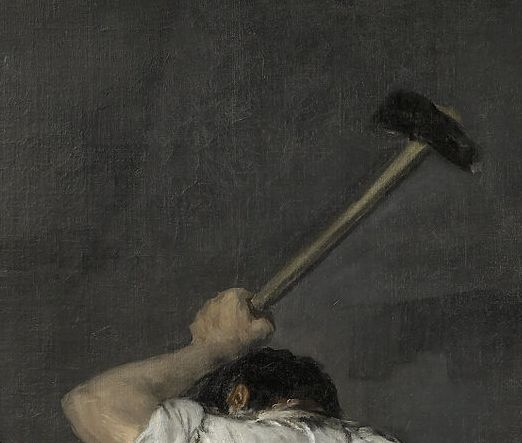
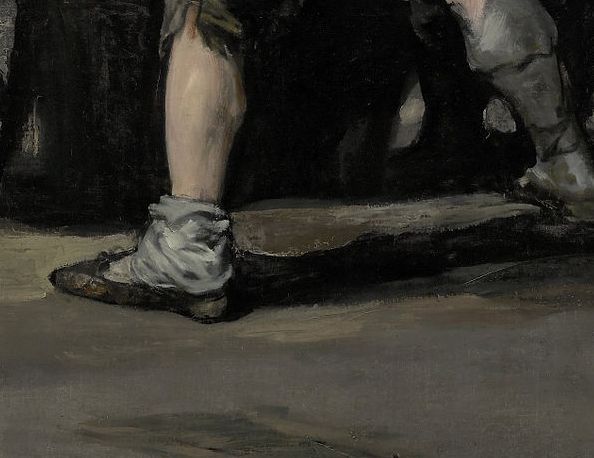
Start with the feet of the smith in the white shirt. His nearer foot projects to the left, the stocking gathered in folds around the ankle. His other foot reaches back to the right, and a patch of bare knee shows above the grey fabric. The stance sets a broad base for a body that twists as it rises. Goya follows the change of direction in the clothes. A light crease runs up one thigh. The shirt gathers near the waist and opens into broad, pale folds across the shoulder blades. From the lifted elbow, the angle changes again at the hand, where the shaft of the hammer rises diagonally into an area of nearly empty grey. The dark head of the tool is far enough from the body for us to see what the whole posture is preparing for. [1] [3]
The smith on the left has dropped his weight close to the anvil. His face is visible, but tipped towards his work. Part of his chest and shoulder shows through the wide opening in his dark clothing. His forearms come together below it, and the tongs angle towards the brightest spot on the metal. Look at the tiny interval between his hand and that spot. It is enough to show that he controls the workpiece from a distance. The man with the hammer is gathering force while his colleague holds the target steady. Their two movements take the eye in opposite directions, up over the back of the shirt and down through the arms on the left. [1] [2]
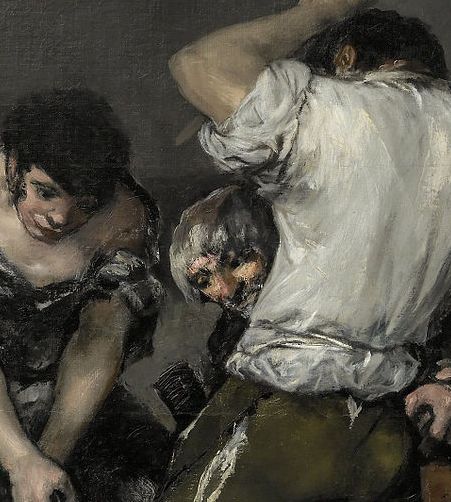
The older worker is harder to make out. The shoulder and flank of the foreground figure partly mask his body, and his dark coat spreads out to the right. A small patch of grey hair and the light on his cheek bring his head into view. His hand appears on the other side of the white shirt, near the younger man’s hip. The Frick identifies his equipment as bellows. The Fundación Goya en Aragón describes him more broadly as an older worker performing a task that seems to take less physical effort. In the painting the outlines of his equipment are much harder to follow than the tongs or hammer. That difference in clarity gives the third figure a quieter role without taking him out of the group. [1] [2]
Annotated Details from The Forge
Follow the hammer, the other workers’ hands and the weight on their feet.
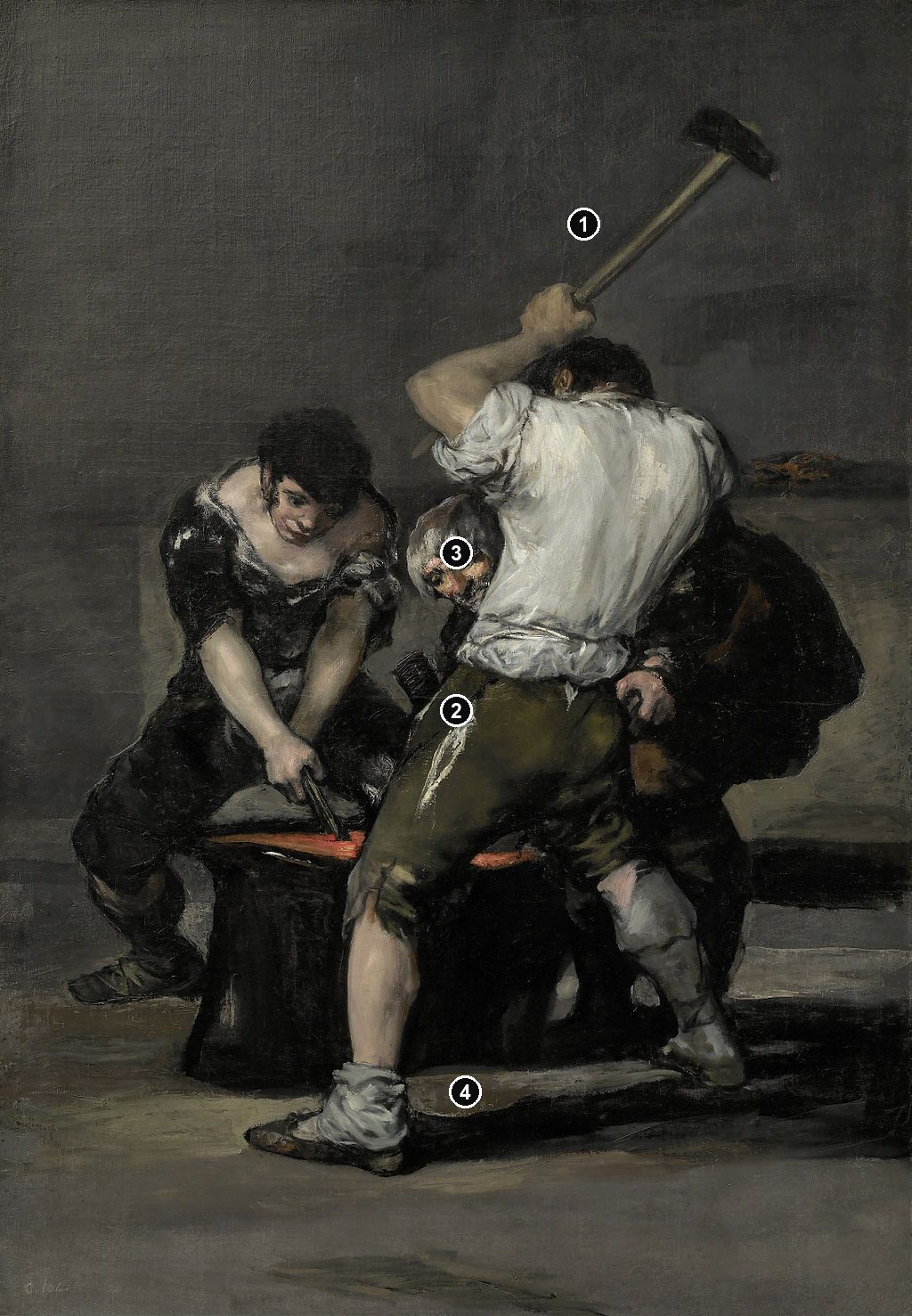
Details from THE FORGE
Details from the Frick painting (1914.1.65).
The arm and hammer
The raised arm and grip trace the movement of the hammer.
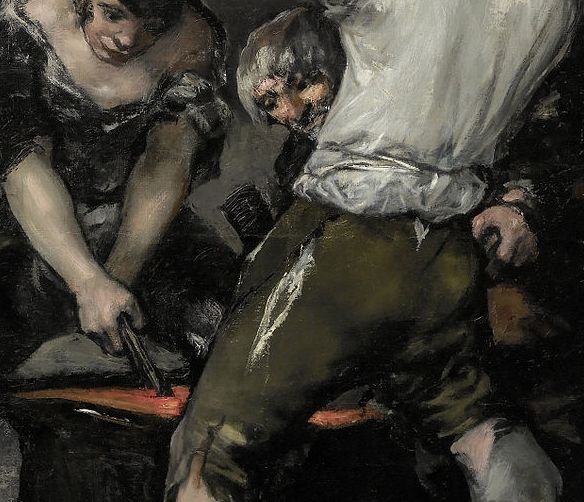
The metal at the anvil
A small pale-orange passage catches the light between the workers.
The older man’s face
The face turns down into the partly obscured working area.
The foreground stance
The bent leg and planted foot help steady the foreground figure.
The heat and the surrounding space
The anvil and its support form a dark mass in the lower half of the work. The hot metal lies across it in a thin band, disappearing behind the foreground worker’s thigh before showing again through the gap between his legs. The interruption helps us place the anvil behind him even where the dark shapes beneath it merge with those of the workers. The thin strip of colour also joins parts of the composition that are otherwise separated by the large figure. To the left it gives the tongs a destination. In the small opening to the right it draws the eye back to the same level, directly below the lifted hammer. [1] [3]
Goya gives a faint suggestion of the room with changes of tone. A horizontal edge behind the figures separates their upper bodies from a paler area, and the floor comes forward in broad strokes beneath their boots. The long dark shapes across it run out towards the right. Above the men, a wide field of low-contrast grey lets the lifted arm and hammer stand apart. The picture makes the physical conditions of the work legible through details close to the men: rolled sleeves, exposed skin and the narrow line of heat. The brightest light falls across the back of a shirt that turns away from the viewer. Its quick, irregular strokes pick out folds in the cloth, while small accents around the older man’s nose and cheek establish the angle of his head with much less paint visible from a distance. [1] [3]
At nearly 1.82 metres high, the picture has room for the full action, from the grip on the hammer to the planted feet. Its height also makes the blank space to the left of the hammer conspicuous. The group is broadest near the floor and comes together around the raised arm. The Frick describes the arrangement as pyramidal. Within that shape Goya makes the gaps count as much as the overlaps. There is space around the head of the suspended hammer, just enough between shoulders for the older face, and enough between the smith’s legs to pick up the line of the metal. Seen together, those openings make a tightly packed group readable in depth. [1] [3]
Goya on film
Five films explore Goya’s portraits, prints, Black Paintings and painting techniques.
The Duke of Wellington by Goya
The portrait, its military decorations and its later theft.
Watch on YouTubeFrom digging to forging
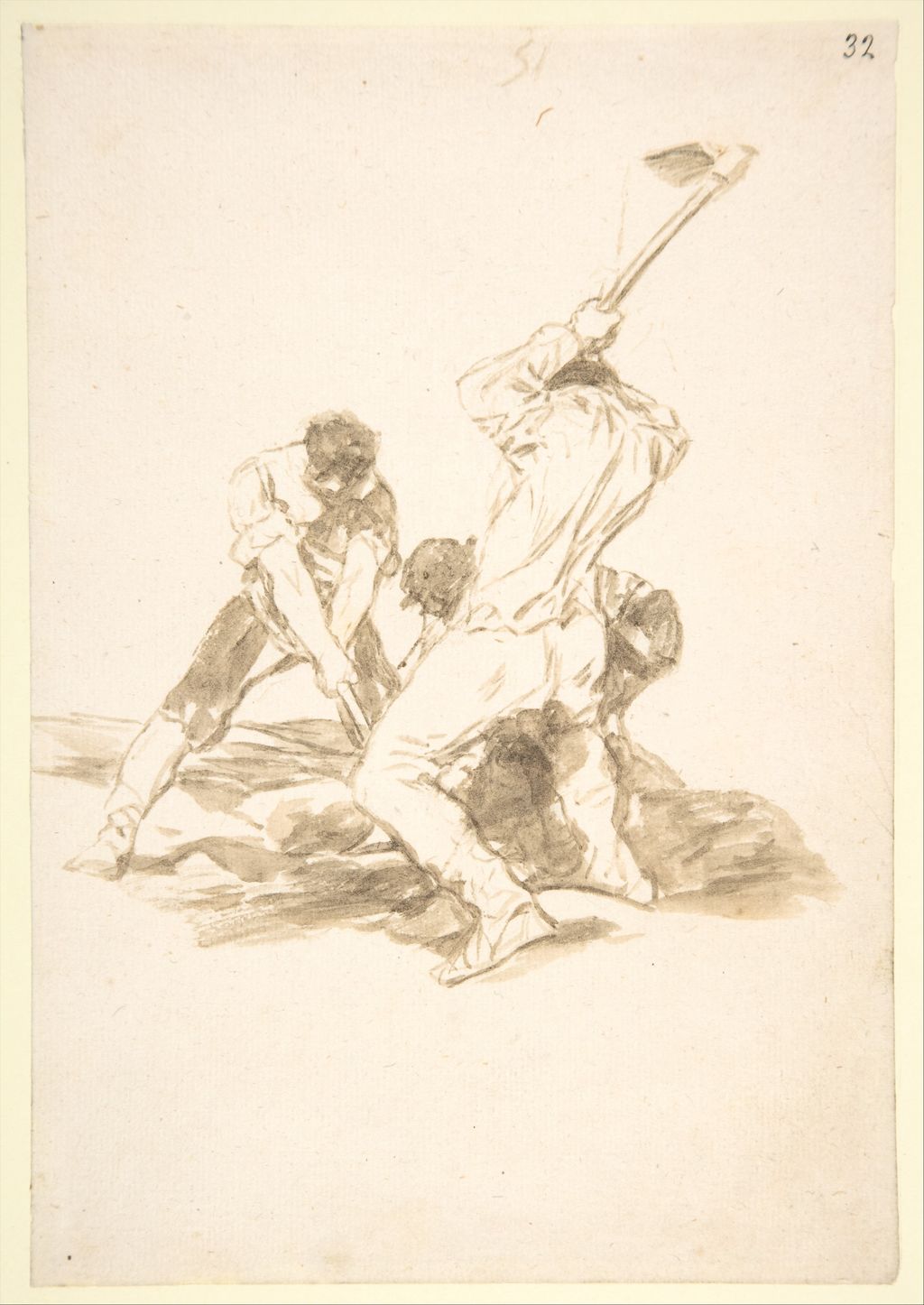
The Metropolitan Museum of Art holds a closely related sheet, Three Men Digging, folio 51 of Goya’s Images of Spain album, also known as Album F. The Met dates the drawing to c. 1812–20. In brown and grey-brown washes, Goya arranges three labourers around a patch of ground. The near figure bends low and raises a long tool overhead, while two more figures lean in from behind. Paper still shows around most of the group. There is much less to describe at the edges than in a finished oil, and the directions in which the men bear down on the ground carry the scene. [4] [5]
The Frick’s exhibition catalogue treats the drawing as a long-standing candidate for a preparatory study. The Fundación’s entry points out the changes of task and visibility. The work in the drawing takes the men closer to the ground, and their faces are hidden. The painting moves the centre of activity up to the anvil, introduces a distinct face on the left and slips the older man’s head into the central gap. In the oil, the nearest worker plants both feet and the heavy hammer extends the gesture well above the others. The overlapping dates and different actions leave the precise sequence uncertain. Comparing the objects shows how readily Goya could adapt a group of workers to a new task by changing the tools, the level of the action and the placement of the heads. [1] [4] [5] [6]
A large canvas for ordinary work
The Frick connects the painting with traditional images of the forge of Vulcan, the Roman god of metalworking. In Diego Velázquez’s Apollo in the Forge of Vulcan, Apollo comes into the smithy to tell Vulcan that Venus has been unfaithful. One raised hand comes into the room from the left and the smiths turn towards the interruption. Goya’s raised hand belongs to a man labouring at the anvil, and all three workers remain absorbed in their task. The comparison helps explain why a canvas of this scale matters. The familiar subject of men at a forge could support a painting of mythological ambition, and Goya builds his large picture around the exacting business of the work itself. [3] [7]
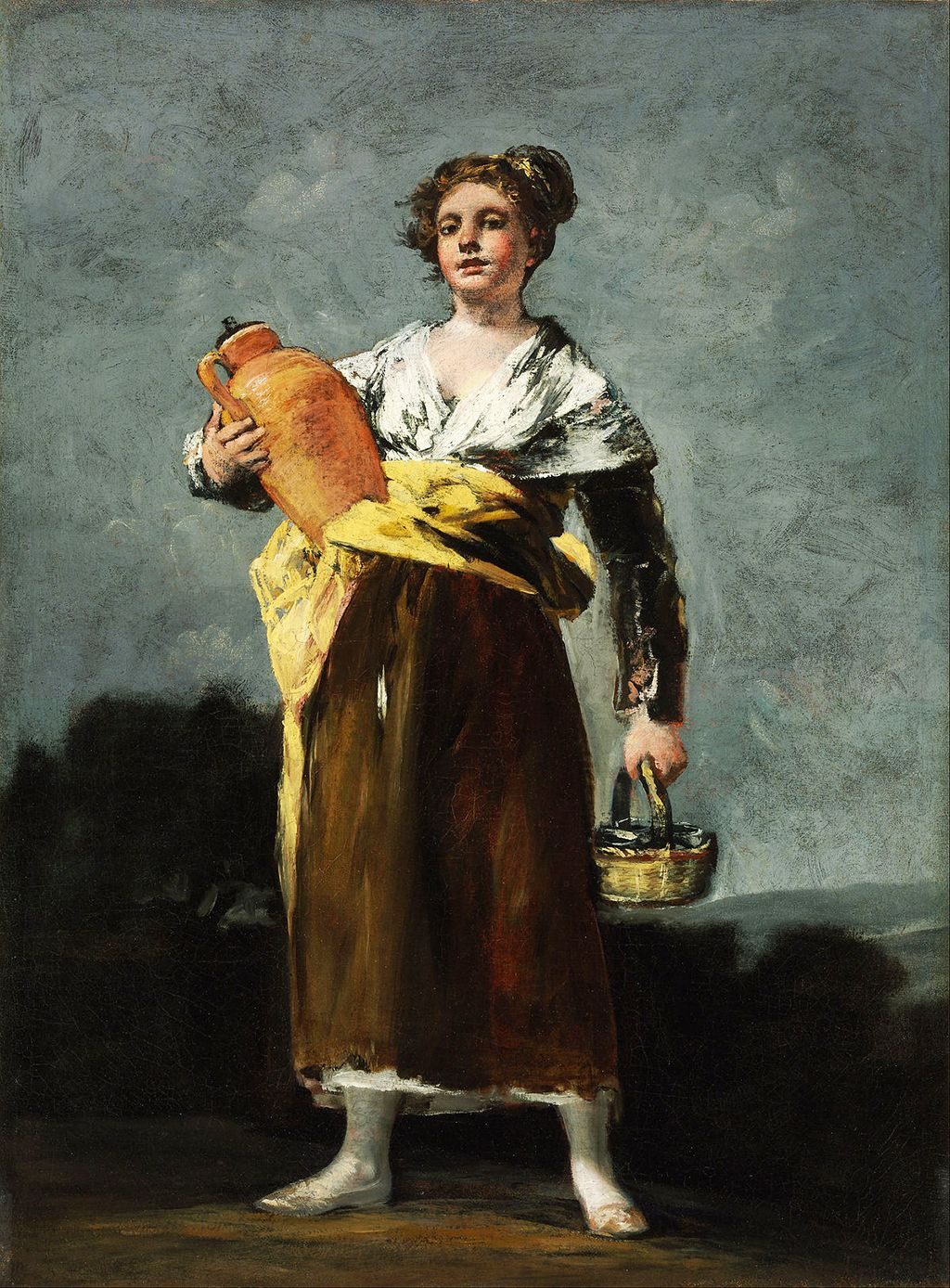
Two smaller comparators survive in Budapest, The Knife-Grinder and The Water Carrier, both dated 1808–12 by the Museum of Fine Arts. The grinder, like the smiths, works with his hands close together at a tool, although his face can turn towards us. The water carrier’s body tells us about effort through the way she holds her load. Both pictures bring the worker very close to the viewer. The Forge develops the subject on a different scale by letting us see several people come together to do something one body alone could hardly manage in the same way. There is also a tonal affinity with Goya’s Black Paintings, which the Fundación notes in its discussion of the dark palette. The Frick work is an oil on canvas with its own collecting history, while the Black Paintings were executed on the walls of the Quinta del Sordo. [1] [2] [8] [9] [10]
From Javier Goya to the Frick
The painting was in the possession of Goya’s son Javier. In 1836 Baron Taylor and Adrien Dauzats acquired it for the project that became Louis-Philippe’s Galerie Espagnole. The painting went from the artist’s family into a collection that presented Spanish art in Paris. It was offered again in the sale of Louis-Philippe’s collection at Christie’s in 1853, where it was lot 354. The Fundación records the price as £10. The purchaser, Henry Labouchere, later Lord Taunton, was succeeded as owner by his grandson E. A. V. Stanley. The Frick’s provenance records its subsequent passage through Agnew, then Colnaghi and Knoedler in 1914. [1] [2] [11]
Henry Clay Frick bought it from Knoedler in December 1914. The purchase file groups it with works by Turner, Maris, Manet and Degas, as well as Goya’s Portrait of a Lady (María Martínez de Puga?). The Frick gives that portrait the date 1824 and retains a question mark over the sitter’s identity. The works were brought together by one collector’s purchase, and they offer two ways to see Goya’s late work. The portrait gives one sitter space and an identifiable gaze. In The Forge, the most prominent figure turns away and the likenesses of his companions emerge from an action shared between them. [11] [12]

Artworks directory
| Name | Date | Medium |
|---|---|---|
| And There’s No Help for It, Plate 15 | Printed 1863 | |
| Asmodea | c. 1820–23 | Wall painting transferred to canvas |
| Boys Inflating a Bladder | 1777–78 | Tapestry cartoon |
| Boys Picking Fruit | 1778 | Tapestry cartoon |
| Bullfight in a Divided Ring | 1825 | Lithograph |
| Card Players | 1777–78 | Tapestry cartoon |
| Card Players (sketch) | 1777–78 | Painted sketch |
| Dance on the Banks of the Manzanares | 1777 | Tapestry cartoon |
| Duel with Cudgels | c. 1820–23 | Wall painting transferred to canvas |
| Heads in a Landscape | c. 1820–23 | Easel painting |
| Judith and Holofernes | c. 1820–23 | Wall painting transferred to canvas |
| Leocadia | c. 1820–23 | Wall painting transferred to canvas |
| Maja and Cloaked Men | 1777 | Tapestry cartoon |
| Maja and Cloaked Men (sketch) | 1777 | Painted sketch |
| Majo Clapping in Time to the Music | 1777 | Drawing |
| Men Reading | c. 1820–23 | Wall painting transferred to canvas |
| Out Hunting for Teeth, Plate 12 | 1799 | Etching, burnished aquatint and burin |
| Picnic in the Countryside (sketch) | 1776–78 | Painted sketch |
| Picnic on the Banks of the Manzanares | 1776 | Tapestry cartoon |
| Pilgrimage to San Isidro | c. 1820–23 | Wall painting transferred to canvas |
| Preparatory study for The Sleep of Reason Produces Monsters | c. 1796–97 | Drawing |
| Procession of the Holy Office | c. 1820–23 | Wall painting transferred to canvas |
| Quarrel at the Cockerel Inn (sketch) | 1777 | Painted sketch |
| Quarrel in the New Tavern | 1777 | Tapestry cartoon |
| Saturn Devouring His Son | c. 1820–23 | Wall painting transferred to canvas |
| Seated Majo Smoking | c. 1776 | Drawing |
| The Dog | c. 1820–23 | Wall painting transferred to canvas |
| The Drinker | 1777 | Tapestry cartoon |
| The Fates | c. 1820–23 | Wall painting transferred to canvas |
| The Great He-Goat | c. 1820–23 | Wall painting transferred to canvas |
| The Kite | 1777–78 | Tapestry cartoon |
| The Parasol | 1777 | Oil on canvas, tapestry cartoon |
| The Second of May 1808 | 1814 | Oil on canvas |
| The Sleep of Reason Produces Monsters, Plate 43 | 1799 | Etching and aquatint |
| The Third of May 1808 | 1814 | Oil on canvas |
| Thou Who Canst Not, Plate 42 | 1799 | Etching and burnished aquatint |
| Three Figures | 1776 | Drawing (lost) |
| Two Old Men | c. 1820–23 | Wall painting transferred to canvas |
| Two Old Men Eating Soup | c. 1820–23 | Wall painting transferred to canvas |
| Two Women and a Man | c. 1820–23 | Wall painting transferred to canvas |
| Universal Language: The Author Dreaming | 1797 | Drawing |
| The Family of Charles IV | 1800 | Oil on canvas |
| Witches’ Sabbath (Osuna painting) | 1797–98 | Oil on canvas |
| The Nude Maja | 1795–1800 | Oil on canvas |
| The Clothed Maja | 1800–07 | Oil on canvas |
| Self-Portrait (Drawing) | c. 1796 | Brush and carbon black ink on laid paper |
| The Swing, Madrid Album B.21 | 1795–97 | Brush and carbon black washes |
| Majas Fighting, a Majo Observing, Madrid Album B.15 | 1796–97 | Brush, grey and black washes on laid paper |
| Majos and Majas Conversing, Madrid Album B.16 | c. 1794–97 | Ink wash on paper |
| Weeping Woman and Three Men, Madrid Album B.17 | 1795–97 | Brush, carbon black washes and black chalk |
| Maja Seated on a Chair and Two Companions Behind, Madrid Album B.18 | 1795–97 | Brush and carbon black washes |
| Girl and Bull, Madrid Album B.23 | 1796–97 | Brush and carbon black washes |
| Lovers Sitting on a Rock, Madrid Album B.24 | 1796–97 | Brush and carbon black washes |
| Mariano Ceballos Riding a Bull | 1825 | Crayon lithograph and scraper |
| Landscape (lifetime impression) | c. 1807–10 | Etching and aquatint |
| Self-Portrait (1815), Prado canvas | 1815 | Oil on canvas |
| Self-Portrait (1815), Academy panel | 1815 | Oil on panel |
| Self-Portrait with Dr Arrieta | 1820 | Oil on canvas |
| Christ Crucified | 1780 | Oil on canvas |
| The Last Communion of Saint Joseph of Calasanz | 1819 | Oil on canvas |
| Christ on the Mount of Olives | 1819 | Oil on panel |
| The Flower Girls, or Spring | 1786–87 | Oil on canvas |
| The Grape Harvest, or Autumn | 1786–87 | Oil on canvas |
| The Snowstorm, or Winter | 1786–87 | Oil on canvas |
| The Threshing Ground, or Summer | 1786–87 | Oil on canvas |
| Picnic on the Banks of the Manzanares | 1776 | Oil on canvas |
| The Kite | 1777–78 | Oil on canvas |
| Dance on the Banks of the Manzanares | 1777 | Oil on canvas |
| A Fight at the Venta Nueva | 1777 | Oil on canvas |
| Blind Man’s Bluff | 1788 | Oil on canvas |
| Dogs on a Lead | 1775 | Oil on canvas |
| Hunting with a Decoy | 1775 | Oil on canvas |
| Hunter Loading His Rifle | 1775 | Oil on canvas |
| The Angler | 1775 | Oil on canvas |
| The Hermitage of San Isidro on His Feast Day | 1788 | Oil on canvas |
| The Meadow of San Isidro | 1788 | Oil on canvas |
| The Straw Manikin | 1791–92 | Oil on canvas |
| Witches’ Flight | c. 1797–98 | Oil on canvas |
| A Scene from ‘The Forcibly Bewitched’ | 1798 | Oil on canvas |
| The Duchess of Alba in Black | 1797 | Oil on canvas |
| The Duchess of Alba in White | 1795 | Oil on canvas |
| Charles III in Hunting Dress | c. 1786 | Oil on canvas |
| The Duke and Duchess of Osuna and Their Children | 1787–88 | Oil on canvas |
| Manuel Osorio Manrique de Zúñiga | 1787–88 | Oil on canvas |
| The Marquesa de Pontejos | c. 1786 | Oil on canvas |
| Equestrian Portrait of the 1st Duke of Wellington | 1812 | Oil on canvas |
| The Duke of Wellington | 1812–14 | Oil on wood |
| Portrait of Ferdinand VII of Spain | 1814 | Oil on canvas |
| Gaspar Melchor de Jovellanos | 1798 | Oil on canvas |
| María Tomasa Palafox y Portocarrero | 1804 | Oil on canvas |
| Señora Sabasa García | c. 1806–11 | Oil on canvas |
| Don Juan Bautista de Muguiro | 1827 | Oil on canvas |
| Doña Isabel de Porcel | Before 1805 | Oil on canvas |
| The Colossus | After 1808 | Oil on canvas |
| The Burial of the Sardine | 1808–12 | Oil on panel |
| The Madhouse | 1808–12 | Oil on panel |
| A Procession of Flagellants | 1808–12 | Oil on panel |
| Portrait of Jacques Galos | 1826 | Oil on canvas |
| Portrait of Mariano Goya, the Artist’s Grandson | 1827 | Oil on canvas |
| Milkmaid of Bordeaux | c. 1827 | Oil on canvas |
| Portrait of Don Juan Antonio Cuervo | 1819 | Oil on canvas |
| María Luisa of Parma (Naples version) | c. 1800 | Oil on canvas |
| The Countess of Baena | 1819 | Oil on canvas |
| The Family of the Infante Don Luis | 1783–84 | Oil on canvas |
| The Holy Family | c. 1787 | Oil on canvas |
| Saint Barbara | c. 1773 | Oil on canvas |
| Saints Justa and Rufina | 1817 | Oil on canvas |
| El Tío Paquete | c. 1819–20 | Oil on canvas |
| The Forge | c. 1815–20 | Oil on canvas |
| Majas on a Balcony (Metropolitan Museum version) | c. 1800–10 | Oil on canvas |
| Maja and Celestina on a Balcony | c. 1808–12 | Oil on canvas |
| The Water Bearer | 1808–12 | Oil on canvas |
| Time and the Old Women | c. 1810 | Oil on canvas |
Frequently Asked Questions
Discussion
Look again at the images and ideas explored in The Forge. These editorial prompts invite your observations.
Trace the raised hammer and then the tongs. Which clues tell you where the blow will land? How does your sense of the space change when you find the older man’s face and follow the orange strip of metal behind the nearest figure?
Reader Insights
Trace the hammer’s direction and the line of the tongs.
How does Goya communicate the weight of the work?
Join the Conversation
Share a detail, comparison or question about The Forge below.
References
- The Frick Collection, The Forge, collection entry and provenance published on Google Arts & Culture, drawing on Paintings in The Frick Collection: French, Italian and Spanish, vol. II (1968). View source.
- Fundación Goya en Aragón, La fragua, catalogue entry 462. View source.
- Giulio Dalvit, ‘Middle Ground: Goya and Tacca, The Poetics of Metalwork’, The Frick Collection, 23 February 2022. View source.
- The Metropolitan Museum of Art, Three men digging; folio 51 from the “Images of Spain” Album (F), object 35.103.32. View source.
- Fundación Goya en Aragón, Tres hombres cavando (F.51), catalogue entry 1842. View source.
- The Frick Collection, The Spanish Manner: Drawings from Ribera to Goya, exhibition checklist, no. 41. View source.
- Aix-Marseille Université, Utpictura18, Vulcan’s Forge, Diego Velázquez, Museo Nacional del Prado, P001171. View source.
- Museum of Fine Arts, Budapest, The Knife-Grinder (“El Afilador”), collection entry. View source.
- Museum of Fine Arts, Budapest, The Water Carrier (“La Aguadora”), collection entry. View source.
- Museo Nacional del Prado, La lectura, P000766, collection entry and background on the Quinta murals. View source.
- The Frick Collection Archives, Finding Aid for the Art Collecting Files of Henry Clay Frick, 1881–1925, undated, 1914 purchase file for works by Goya, Maris, Turner, Manet and Degas. View source.
- The Frick Collection, Frick Madison: A Guide to Works of Art on Exhibition (2021), pp. 36–37. View source.


