



 by Tom Gurney
Tom Gurney BSc (Hons) is an art history expert with over 20 years experience
Published on June 19, 2020 / Updated on November 20, 2026
Email: tomgurney1@gmail.com / Phone: +44 7429 011000
Introduction
A pale parasol shelters a group on a grassy slope. Beyond their shoulders and hats, hundreds of tiny figures and carriages spread across the ground beside the Manzanares. Across the river, the Royal Palace and the dome of San Francisco el Grande rise above the roofs of Madrid. Francisco de Goya painted this view in 1788 as a design for a royal tapestry. The surviving oil sketch, La pradera de San Isidro, belongs to the Museo Nacional del Prado. It shows the city on 15 May, the feast day of its patron saint. [1] [2]
At a Glance
- ArtistFrancisco José de Goya y Lucientes.
- Date1788. [1]
- MediumOil on canvas, painted as a preparatory sketch for a tapestry cartoon. [1]
- Size41.9 × 90.8 cm, height by width. [1]
- SubjectThe feast of San Isidro Labrador in the meadow west of the Manzanares, with Madrid in the distance. [2]
- CommissionA proposed tapestry for the Infantas’ bedchamber at the Royal Palace of El Pardo. [1] [3]
- CollectionMuseo Nacional del Prado, Madrid, P000750. [1] [2]
Works across Goya’s career
The Parasol
1777The Nude Maja
1795–1800Saturn Devouring His Son
c. 1820–23The Dog
c. 1820–23From the parasols to the river
The canvas is more than twice as wide as it is high. Goya lets the open hillside enter from the left and descend towards the middle. A second rise comes in from the lower right, so the foreground groups sit in a shallow hollow. The grassy slopes give the picture two clear edges from which to look into the crowd. Most of the people nearest us occupy a low band across the bottom, leaving room to see over their heads to the plain, the water and Madrid. [1] [2]
Look underneath the pale parasol left of centre. A dark blue passage at the bottom of a skirt makes the adjacent whites seem brighter. A seated woman has turned towards the man beside her, while other heads turn in different directions along the slope. A smaller parasol repeats the shape higher up on the left. Near the right edge, a standing figure in yellow with a touch of red rises above the seated company. Those few upright figures and parasols are easy to pick out even at a small scale. They mark where one gathering gives way to the next. [1]
There are fine clothes in the foreground, where Goya had room to suggest the fall of a skirt, the brim of a hat or the angle of an arm. The Fundación Goya en Aragón reads the scene as a gathering in which different social groups mingle. The smaller figures leave more to the eye. A few dark strokes read as people on foot because they are placed in rows and knots, interspersed with the taller forms of horse-drawn carriages. Patches of exposed ground run through the crowd, separating one cluster from another and suggesting the paths along which people move. [1] [2]
The bright strip of the Manzanares opens a gap behind the busiest part of the meadow. Across the water, the riverbank trees form pockets of dark green, with pale ground and buildings beyond. The strongest darks collect around the crowd, while the distant roofs are close in tone to the slopes and sky. This shift makes the far bank recede even where there are enough marks to follow individual buildings. The bustle Goya describes in his letter is concentrated below that quiet stretch of water, where a spectator can move in a single glance from a recognisable gesture to a crowd too far away for faces. [1] [2] [3]
Annotated Details from The Meadow of San Isidro
Follow the view from the foreground groups to the city on the horizon.
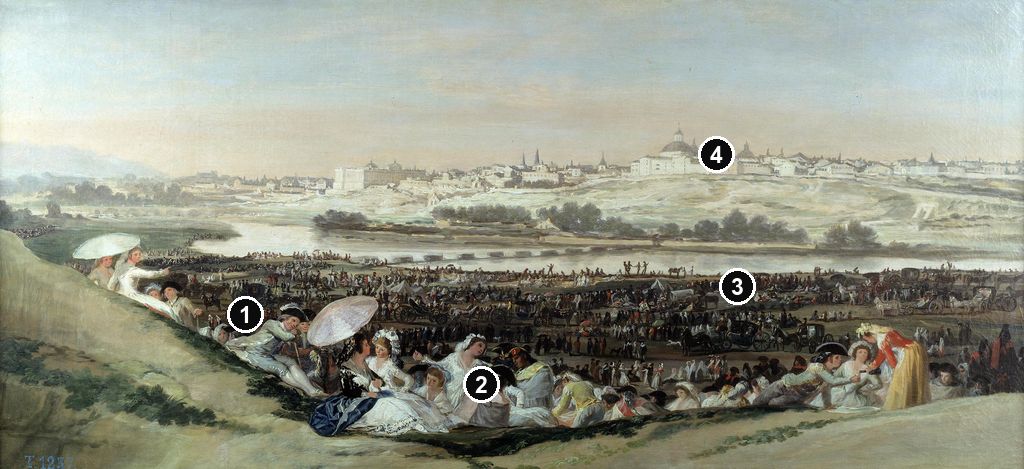
Details from THE MEADOW OF SAN ISIDRO
Details from the oil sketch in the Museo Nacional del Prado (P000750).
The parasols
Light parasols pick out separate groups along the foreground slope.
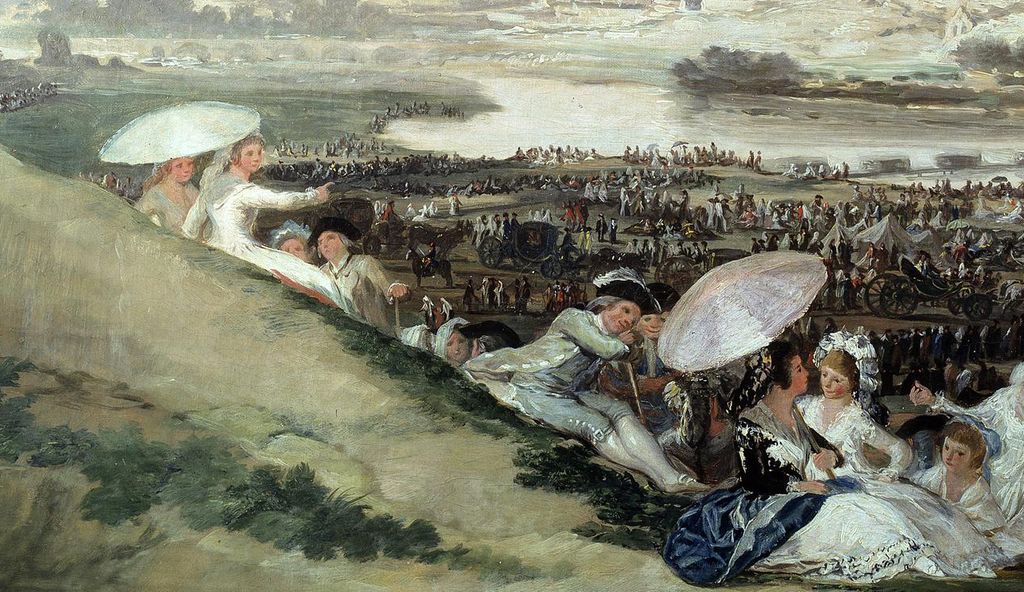
The nearest group
Pale dresses and darker coats give the nearest figures more definition than the crowd beyond.
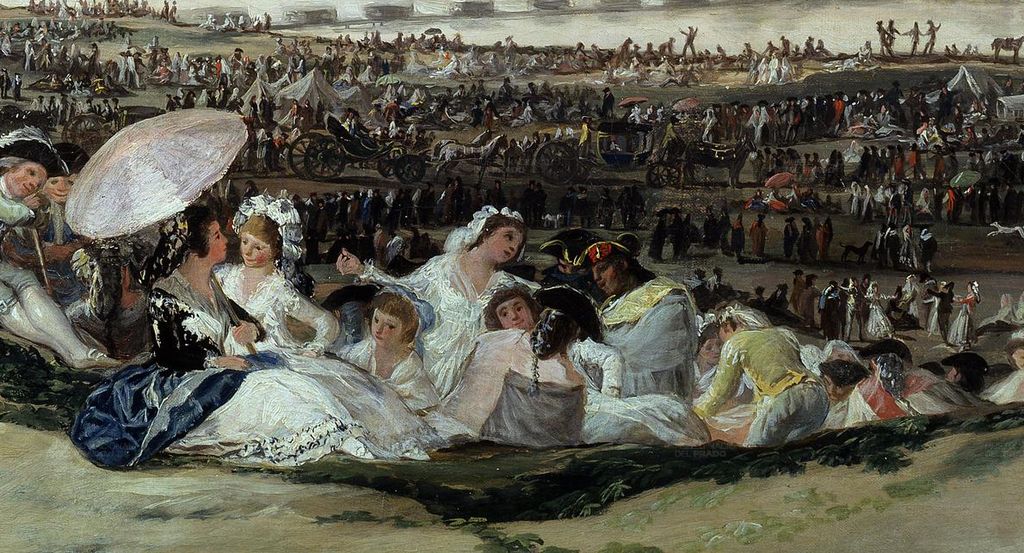
The broad gathering
The bodies compress into a ribbon of small marks between the foreground and the river.
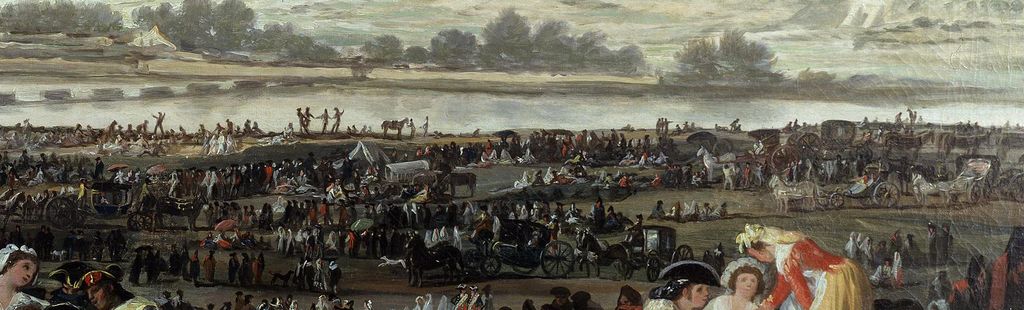
The skyline
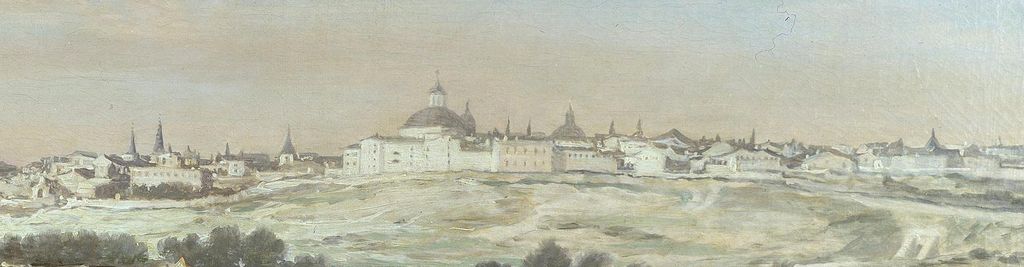
The dome and other building silhouettes break the soft, distant horizon.
Madrid across the Manzanares
The view looks towards the city from the meadow on the west side of the river. The Prado identifies the Royal Palace on the left of the skyline and the great dome of San Francisco el Grande to the right. The palace is the pale, block-like building left of centre. Once you have found it, follow the line of roofs until it swells into the rounded outline of the church. Notice how little dark paint Goya needs to establish those landmarks. The palace stands out through its broad façade and squared outline, the church through the shape of its dome. The intervening roofs vary just enough in height to make both silhouettes legible. [1] [2]
Below the skyline, the bridges help locate the action. Madrid’s municipal landscape study places the Puente de Segovia to the left and the smaller wooden crossing known as Los Pontones, or the San Isidro bridge, near the centre. The elevated viewpoint reveals a long section of the Manzanares and the approaches to the city. From a distance the river reads as one pale band. Up close, the crossings, trees and spaces between buildings give the eye points to stop at, much as the parasols and carriages do in the meadow. [2] [4]
Goya on film
Five films explore Goya’s portraits, prints, Black Paintings and painting techniques.
The Duke of Wellington by Goya
The portrait, its military decorations and its later theft.
Watch on YouTubeA feast day in two sketches
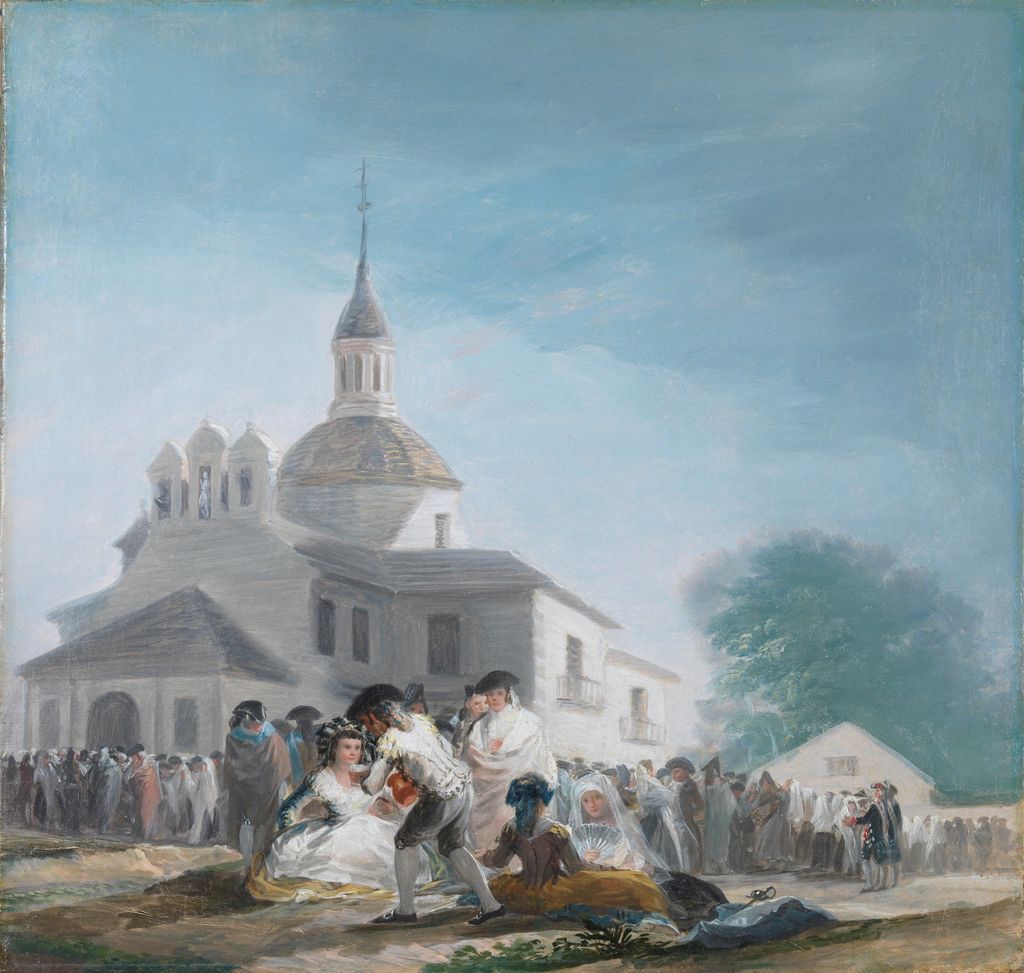
San Isidro Labrador, or Saint Isidore the Labourer, is Madrid’s patron saint. The pilgrimage on his feast day centres on the hermitage and a spring that, according to local tradition, he miraculously brought forth. Goya’s nearly square companion sketch, The Hermitage of San Isidro, puts the chapel immediately behind the gathering. Its roof and dome rise above the people waiting nearby. Just in front of that crowd, a few figures bend or kneel around a woman in white. The eye moves from this small encounter across the press of people and up the sharply rising outlines of the building. [5] [6]
The two compositions give different parts of the occasion room to unfold. In the Hermitage, people gather where the shrine and its water have drawn them. In the Meadow, scattered groups sit on the hillside while many more people keep moving across the plain below. The chapel picture gathers its figures around a single building. In the panorama, the city supplies a line of landmarks beyond the festivities. The two works together suggest how a visit to a shrine could also mean a day spent outdoors in company. [1] [5] [6]
From oil sketch to planned tapestry
On 31 May 1788, Goya wrote to his friend Martín Zapater about the designs he had been ordered to have ready for the Infantas’ bedchamber by the time the court arrived. The king and the royal family would see them, time was short, and the subjects were demanding. He singled out the meadow on the saint’s own day, with all the bustle that Madrid usually brought to the occasion. He said he could neither sleep nor rest until he had got through the work. An account for the Royal Tapestry Factory dated 30 April records payments for colours and stretchers, among other expenses. [3] [7]
The small canvas established the composition in oil. The next step would have been to paint a cartoon, the full-size model used by the weavers. The Fundación Goya en Aragón cites the carpenter Serrano’s measurements for the proposed stretcher, 348 × 752 cm. That is more than eight times the width of the surviving sketch. The proportions are close, so the planned hanging would also have offered a long, horizontal view. The dimensions tell us the scale Goya was working towards. How he would have enlarged individual figures or translated the flecks of colour into shapes suitable for weaving remains a matter of inference. [1]
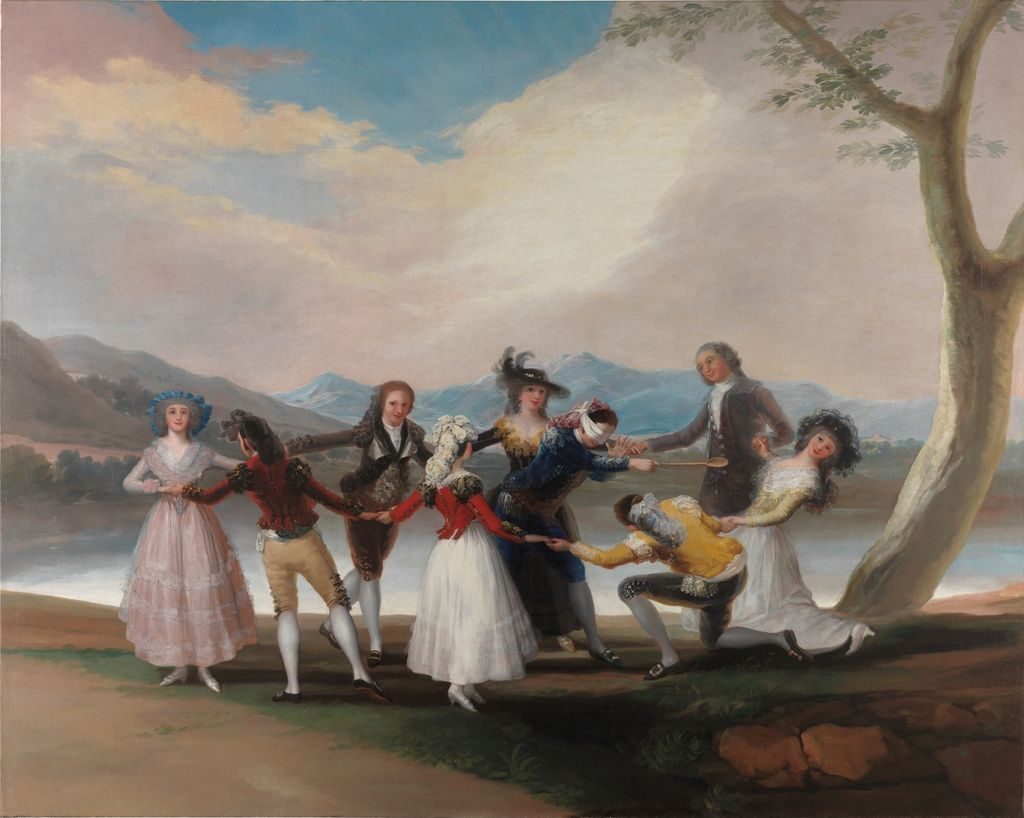
The surviving designs for Blind Man’s Bluff show one decision Goya made when he took another subject in the set to full size. The sketch includes little figures and carriages across the river. In the cartoon, those distant details have given way to open riverbank and hills, making the ring of players easier to read. The Meadow gives that kind of distant activity a far larger role. To imagine the work of enlarging it, consider the thin strips of ground between the carriages and the people. A change to the size or spacing of those marks would affect how easily a viewer could follow the routes through the crowd. [1] [8]
Charles III died in December 1788 and work on the El Pardo set was interrupted. Blind Man’s Bluff was the only design in the group to reach the full-size cartoon stage and be woven. Goya’s panorama survives at the sketch stage. The Duke and Duchess of Osuna acquired it from him in 1798 and kept it in the duchess’s cabinet at La Alameda. When the family’s collection was sold in 1896, the Spanish Ministry of Development bought it for the Prado, where it entered the collection that June. The canvas still rests on its original stretcher. [1] [9]
Artworks directory
| Name | Date | Medium |
|---|---|---|
| And There’s No Help for It, Plate 15 | Printed 1863 | |
| Asmodea | c. 1820–23 | Wall painting transferred to canvas |
| Boys Inflating a Bladder | 1777–78 | Tapestry cartoon |
| Boys Picking Fruit | 1778 | Tapestry cartoon |
| Bullfight in a Divided Ring | 1825 | Lithograph |
| Card Players | 1777–78 | Tapestry cartoon |
| Card Players (sketch) | 1777–78 | Painted sketch |
| Dance on the Banks of the Manzanares | 1777 | Tapestry cartoon |
| Duel with Cudgels | c. 1820–23 | Wall painting transferred to canvas |
| Heads in a Landscape | c. 1820–23 | Easel painting |
| Judith and Holofernes | c. 1820–23 | Wall painting transferred to canvas |
| Leocadia | c. 1820–23 | Wall painting transferred to canvas |
| Maja and Cloaked Men | 1777 | Tapestry cartoon |
| Maja and Cloaked Men (sketch) | 1777 | Painted sketch |
| Majo Clapping in Time to the Music | 1777 | Drawing |
| Men Reading | c. 1820–23 | Wall painting transferred to canvas |
| Out Hunting for Teeth, Plate 12 | 1799 | Etching, burnished aquatint and burin |
| Picnic in the Countryside (sketch) | 1776–78 | Painted sketch |
| Picnic on the Banks of the Manzanares | 1776 | Tapestry cartoon |
| Pilgrimage to San Isidro | c. 1820–23 | Wall painting transferred to canvas |
| Preparatory study for The Sleep of Reason Produces Monsters | c. 1796–97 | Drawing |
| Procession of the Holy Office | c. 1820–23 | Wall painting transferred to canvas |
| Quarrel at the Cockerel Inn (sketch) | 1777 | Painted sketch |
| Quarrel in the New Tavern | 1777 | Tapestry cartoon |
| Saturn Devouring His Son | c. 1820–23 | Wall painting transferred to canvas |
| Seated Majo Smoking | c. 1776 | Drawing |
| The Dog | c. 1820–23 | Wall painting transferred to canvas |
| The Drinker | 1777 | Tapestry cartoon |
| The Fates | c. 1820–23 | Wall painting transferred to canvas |
| The Great He-Goat | c. 1820–23 | Wall painting transferred to canvas |
| The Kite | 1777–78 | Tapestry cartoon |
| The Parasol | 1777 | Oil on canvas, tapestry cartoon |
| The Second of May 1808 | 1814 | Oil on canvas |
| The Sleep of Reason Produces Monsters, Plate 43 | 1799 | Etching and aquatint |
| The Third of May 1808 | 1814 | Oil on canvas |
| Thou Who Canst Not, Plate 42 | 1799 | Etching and burnished aquatint |
| Three Figures | 1776 | Drawing (lost) |
| Two Old Men | c. 1820–23 | Wall painting transferred to canvas |
| Two Old Men Eating Soup | c. 1820–23 | Wall painting transferred to canvas |
| Two Women and a Man | c. 1820–23 | Wall painting transferred to canvas |
| Universal Language: The Author Dreaming | 1797 | Drawing |
| The Family of Charles IV | 1800 | Oil on canvas |
| Witches’ Sabbath (Osuna painting) | 1797–98 | Oil on canvas |
| The Nude Maja | 1795–1800 | Oil on canvas |
| The Clothed Maja | 1800–07 | Oil on canvas |
| Self-Portrait (Drawing) | c. 1796 | Brush and carbon black ink on laid paper |
| The Swing, Madrid Album B.21 | 1795–97 | Brush and carbon black washes |
| Majas Fighting, a Majo Observing, Madrid Album B.15 | 1796–97 | Brush, grey and black washes on laid paper |
| Majos and Majas Conversing, Madrid Album B.16 | c. 1794–97 | Ink wash on paper |
| Weeping Woman and Three Men, Madrid Album B.17 | 1795–97 | Brush, carbon black washes and black chalk |
| Maja Seated on a Chair and Two Companions Behind, Madrid Album B.18 | 1795–97 | Brush and carbon black washes |
| Girl and Bull, Madrid Album B.23 | 1796–97 | Brush and carbon black washes |
| Lovers Sitting on a Rock, Madrid Album B.24 | 1796–97 | Brush and carbon black washes |
| Mariano Ceballos Riding a Bull | 1825 | Crayon lithograph and scraper |
| Landscape (lifetime impression) | c. 1807–10 | Etching and aquatint |
| Self-Portrait (1815), Prado canvas | 1815 | Oil on canvas |
| Self-Portrait (1815), Academy panel | 1815 | Oil on panel |
| Self-Portrait with Dr Arrieta | 1820 | Oil on canvas |
| Christ Crucified | 1780 | Oil on canvas |
| The Last Communion of Saint Joseph of Calasanz | 1819 | Oil on canvas |
| Christ on the Mount of Olives | 1819 | Oil on panel |
| The Flower Girls, or Spring | 1786–87 | Oil on canvas |
| The Grape Harvest, or Autumn | 1786–87 | Oil on canvas |
| The Snowstorm, or Winter | 1786–87 | Oil on canvas |
| The Threshing Ground, or Summer | 1786–87 | Oil on canvas |
| Picnic on the Banks of the Manzanares | 1776 | Oil on canvas |
| The Kite | 1777–78 | Oil on canvas |
| Dance on the Banks of the Manzanares | 1777 | Oil on canvas |
| A Fight at the Venta Nueva | 1777 | Oil on canvas |
| Blind Man’s Bluff | 1788 | Oil on canvas |
| Dogs on a Lead | 1775 | Oil on canvas |
| Hunting with a Decoy | 1775 | Oil on canvas |
| Hunter Loading His Rifle | 1775 | Oil on canvas |
| The Angler | 1775 | Oil on canvas |
| The Hermitage of San Isidro on His Feast Day | 1788 | Oil on canvas |
| The Meadow of San Isidro | 1788 | Oil on canvas |
| The Straw Manikin | 1791–92 | Oil on canvas |
| Witches’ Flight | c. 1797–98 | Oil on canvas |
| A Scene from ‘The Forcibly Bewitched’ | 1798 | Oil on canvas |
| The Duchess of Alba in Black | 1797 | Oil on canvas |
| The Duchess of Alba in White | 1795 | Oil on canvas |
| Charles III in Hunting Dress | c. 1786 | Oil on canvas |
| The Duke and Duchess of Osuna and Their Children | 1787–88 | Oil on canvas |
| Manuel Osorio Manrique de Zúñiga | 1787–88 | Oil on canvas |
| The Marquesa de Pontejos | c. 1786 | Oil on canvas |
| Equestrian Portrait of the 1st Duke of Wellington | 1812 | Oil on canvas |
| The Duke of Wellington | 1812–14 | Oil on wood |
| Portrait of Ferdinand VII of Spain | 1814 | Oil on canvas |
| Gaspar Melchor de Jovellanos | 1798 | Oil on canvas |
| María Tomasa Palafox y Portocarrero | 1804 | Oil on canvas |
| Señora Sabasa García | c. 1806–11 | Oil on canvas |
| Don Juan Bautista de Muguiro | 1827 | Oil on canvas |
| Doña Isabel de Porcel | Before 1805 | Oil on canvas |
| The Colossus | After 1808 | Oil on canvas |
| The Burial of the Sardine | 1808–12 | Oil on panel |
| The Madhouse | 1808–12 | Oil on panel |
| A Procession of Flagellants | 1808–12 | Oil on panel |
| Portrait of Jacques Galos | 1826 | Oil on canvas |
| Portrait of Mariano Goya, the Artist’s Grandson | 1827 | Oil on canvas |
| Milkmaid of Bordeaux | c. 1827 | Oil on canvas |
| Portrait of Don Juan Antonio Cuervo | 1819 | Oil on canvas |
| María Luisa of Parma (Naples version) | c. 1800 | Oil on canvas |
| The Countess of Baena | 1819 | Oil on canvas |
| The Family of the Infante Don Luis | 1783–84 | Oil on canvas |
| The Holy Family | c. 1787 | Oil on canvas |
| Saint Barbara | c. 1773 | Oil on canvas |
| Saints Justa and Rufina | 1817 | Oil on canvas |
| El Tío Paquete | c. 1819–20 | Oil on canvas |
| The Forge | c. 1815–20 | Oil on canvas |
| Majas on a Balcony (Metropolitan Museum version) | c. 1800–10 | Oil on canvas |
| Maja and Celestina on a Balcony | c. 1808–12 | Oil on canvas |
| The Water Bearer | 1808–12 | Oil on canvas |
| Time and the Old Women | c. 1810 | Oil on canvas |
Frequently Asked Questions
Discussion
Look again at the images and ideas explored in The Meadow of San Isidro. These editorial prompts invite your observations.
Start at the pale parasol left of centre and trace the route your eye takes towards the river. At what point do individual people become a crowd, and which marks help you make that shift?
Reader Insights
Which marks let you follow the gathering across the meadow?
How does the geography of the feast change between the two sketches?
Join the Conversation
Share a detail, comparison or question about The Meadow of San Isidro below.
References
- Fundación Goya en Aragón, The Meadow of San Isidro (sketch), catalogue entry on the painting, its history, the planned stretcher and conservation. View source.
- Museo Nacional del Prado, La pradera de San Isidro, P000750, and Enrique Quintana’s commentary for Captive Beauty, on the view, feast and commission. View source 1. View source 2.
- Francisco de Goya, letter to Martín Zapater, 31 May 1788, Diplomatario de Goya. Addenda, Institución Fernando el Católico, document 143. View source.
- Ayuntamiento de Madrid, Madrid representado, annex to the Plan Director del Paisaje Urbano de Madrid, ‘El Madrid de Goya’. View source.
- Fundación Goya en Aragón, The Chapel of San Isidro on his Feast Day (sketch), catalogue entry for Prado P002783. View source.
- Ayuntamiento de Madrid, Madrid Río histórico, pp. 26–27, on the feast, pilgrimage and spring. View source.
- Francisco de Goya, account to the Royal Tapestry Factory, 30 April 1788, Francisco de Goya. Diplomatario, Institución Fernando el Católico, document 145, pp. 289–90. View source.
- Fundación Goya en Aragón, La gallina ciega (boceto) and La gallina ciega, catalogue entries comparing the oil sketch and the full-size cartoon. View source 1. View source 2.
- Galería de las Colecciones Reales, La gallina ciega, catalogue entry for the woven tapestry. View source.


