



 by Tom Gurney
Tom Gurney BSc (Hons) is an art history expert with over 20 years experience
Published on June 19, 2020 / Updated on November 20, 2026
Email: tomgurney1@gmail.com / Phone: +44 7429 011000
Introduction
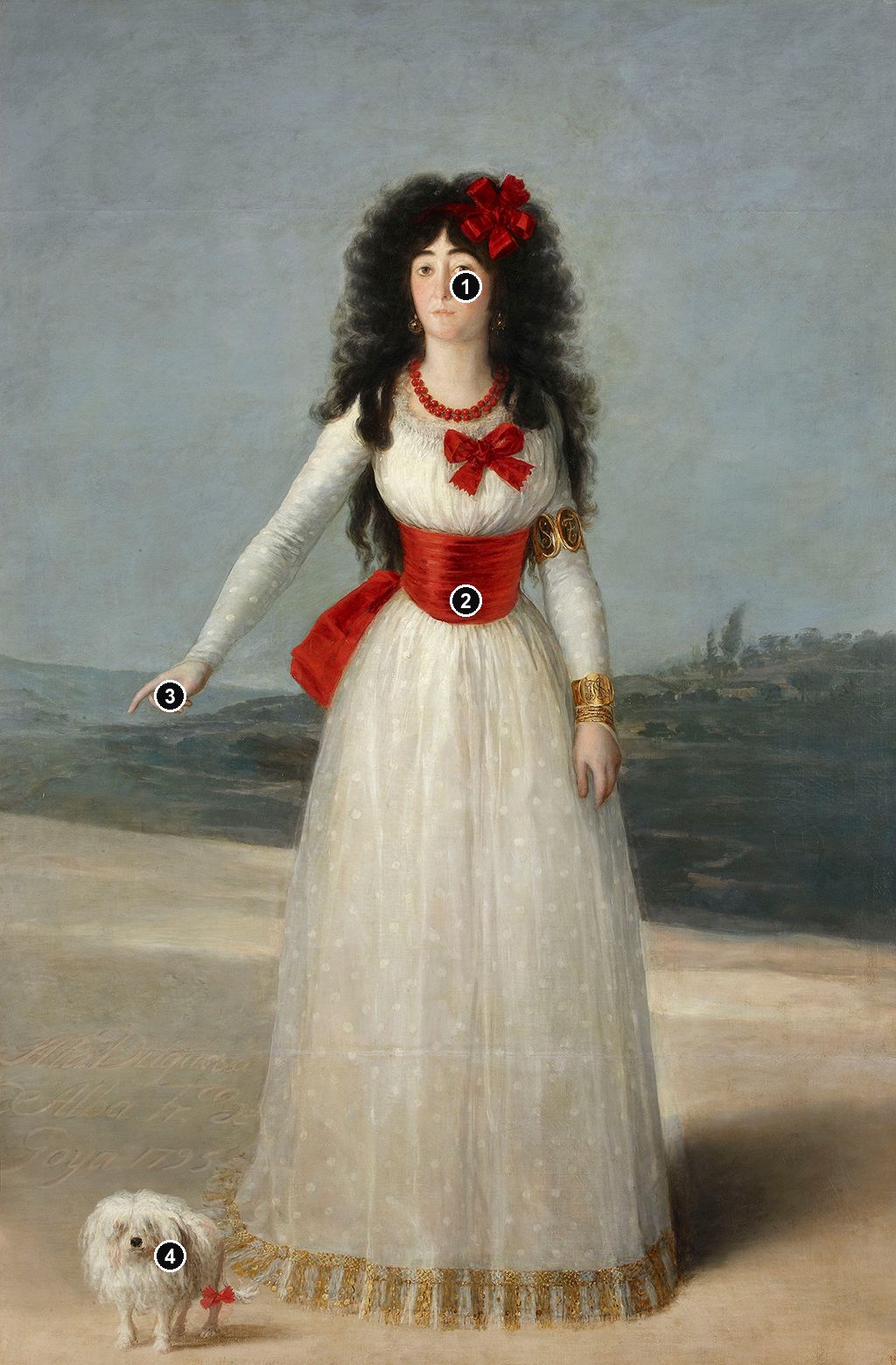
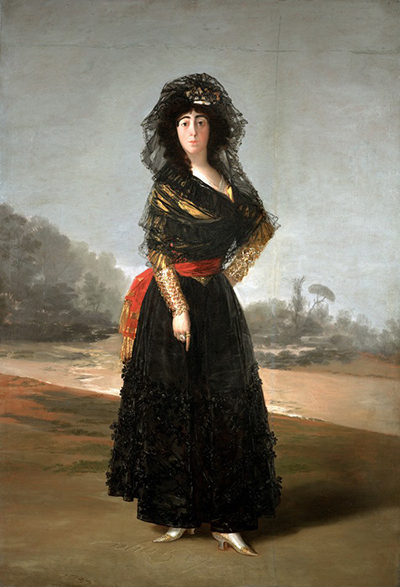
A woman in a white dress stands on a broad stretch of pale ground. Her right arm extends towards the lower left, where Francisco de Goya has painted a dedication in the sand. Her face remains raised. The sweep of the arm leads away from her eyes, past the dark band of landscape and down to a small white dog at the edge of her skirt. A red ribbon on its hind leg repeats the red of the sash, the bow at her breast and the ornament in her hair. At nearly two metres high, the canvas gives this arrangement of fabric, gesture and lettering the scale of an encounter with the sitter. [1] [2]
The sitter is María del Pilar Teresa Cayetana de Silva Álvarez de Toledo, the thirteenth Duchess of Alba in her own right. The white gown gives this portrait its familiar name and distinguishes it from a second full-length likeness painted by Goya in 1797. The two pictures show the same woman pointing towards words in the ground. The words differ, as do the dress, setting and histories of ownership. The 1795 canvas belongs to the Fundación Casa de Alba at the Palacio de Liria in Madrid. [1] [3] [4]
At a Glance
- ArtistFrancisco de Goya y Lucientes
- TitleThe Duchess of Alba in White (La duquesa de Alba de blanco), also known as The White Duchess
- SitterMaría del Pilar Teresa Cayetana de Silva Álvarez de Toledo, thirteenth Duchess of Alba
- Date1795, inscribed on the painting
- Medium and dimensionsOil on canvas, 194 × 130 cm (height × width)
- CollectionFundación Casa de Alba, Palacio de Liria, Madrid. [1] [3]
Works across Goya’s career
The Parasol
1777The Nude Maja
1795–1800Saturn Devouring His Son
c. 1820–23The Dog
c. 1820–23The white dress and its red accents
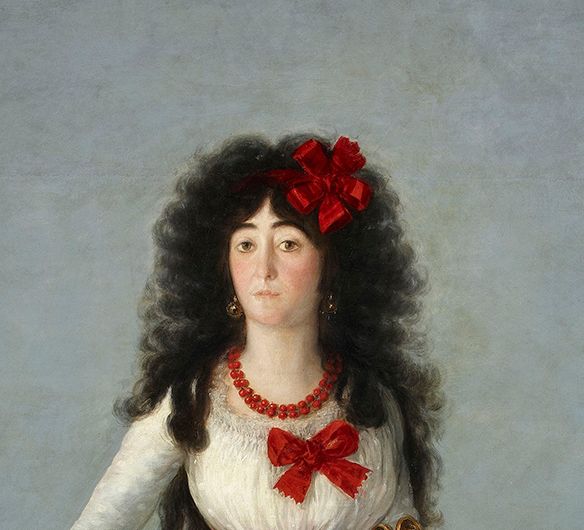
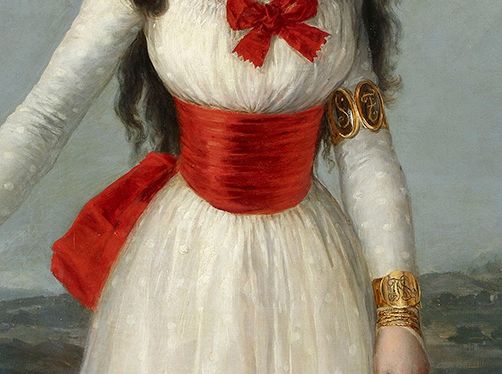
The broad sash is the strongest patch of colour in the painting. It tightens the silhouette high on the body and gathers the eye where the weight of the long skirt begins. Above it, the red decreases in scale from the bow on the bodice to the beads round the throat and gathers again in the hair ornament. Below the sash, most of the dress falls in narrow, pale folds. At the bottom, gold-coloured fringe runs along the hem at ground level and almost conceals the feet. The red and gold keep the dress legible from the opposite ends of the canvas. Between them, small marks that could disappear in a reproduction give the skirt a pattern and make the thin outer fabric look distinct from the layer beneath it. [1] [2]
Javier Martínez Molina and Arturo Ansón Navarro identify the outfit as a robe en chemise, a high-waisted gown made here with sheer dotted white tulle over an underlayer. They relate its cut to the French-influenced fashions that came to prominence in the years of the Directory. The red silk sash, gold thread and jewellery show how richly that light silhouette could be dressed. The Frist Art Museum identifies the beads as coral. At the upper arm on the right of the picture, two lettered medallions catch the light against the edge of a sleeve. The initials S and T have been read as Silva and Toledo, referring to the duchess’s family name and her husband’s. Those small markings identify kinship as precisely as the materials signal wealth. [2] [5] [6]
The Fundación Goya en Aragón suggests that the combination of red and white might refer to the Alba arms. The painting itself gives the colours a visible job. The red concentrates attention on the sitter’s head and upper body, then returns near the ground in the dog’s ribbon. The loose dark curls are another kind of outline. They spread above the shoulders and break into wisps against the cooler sky, while the bright skirt holds its continuous shape beside the patch of shadow on the ground. Compare the hair, with its many turns and separate strokes, to the ribbon drawn taut around the waist. Goya makes the materials recognisable by how differently they carry light at their edges. [1] [2]
Annotated Details from The Duchess of Alba in White
Look from the ribbons on the white dress to the pointing hand and the dog.
Details from THE DUCHESS OF ALBA IN WHITE
Details from the 1795 portrait in the Fundación Casa de Alba.
Ribbons at the head and neck
Red ribbons stand out against the black hair and the pale neckline.
The red sash
The sash gives the otherwise pale dress a block of colour at the waist.
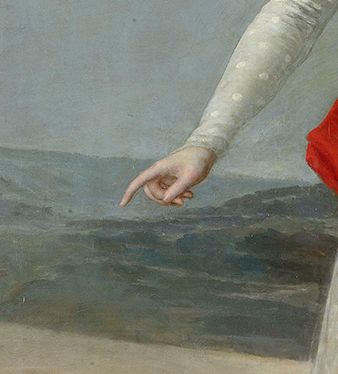
The extended hand
The hand extends away from the body against the receding landscape.
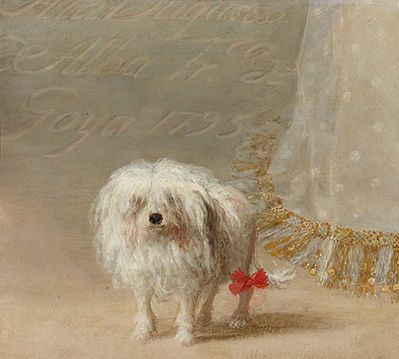
The dog at the hem
A small dog stands close to the gold-trimmed skirt.
The pointing hand, the inscription and the dog
The index finger directs the eye towards an inscription that is much lower than the hand and faint in reproductions. The specialist catalogue transcribes it as “A la Duquesa / de Alba Frco. De / Goya 1795”, meaning “To the Duchess of Alba, Francisco de Goya, 1795”. The first words address the sitter by her title. The name and year also sign and date the painting. Goya has put these particulars inside the scene on the ground where the duchess stands. At her shoulder the gold initials belong to an object she wears. Below her hand, the letters look as if they have been traced in a surface that could be scuffed or blown away. The gesture gives the dedication a place in her pose even when the words take a moment to find. [1] [6]
The dog stands just forward of that writing. Its head turns out towards us while its body angles back towards the dress, so that the bow shows beside the hem. At the scale of the whole canvas it appears as a small pale shape beside the mass of the skirt. On a closer view, loose strands of fur interrupt the firm line of gold fringe. The Fundación Goya calls it a poodle and says it was added later. Martínez Molina and Ansón Navarro identify the animal as a Maltese. The surviving painted detail makes the relationship between the costume and the bow much easier to establish than the breed or the timing of the addition. [1] [2]
The Fondation Beyeler’s exhibition guide reads the attentive dog as a possible allusion to the painter’s faithful service. The dress scholars connect the dog with fidelity and social distinction. Its ribbon also gives the detail a particular wit. Dressing the animal in a bow to match the duchess places it within her carefully coordinated appearance. Its face, low on the picture plane, briefly catches our eye before the angle of the arm draws attention to the written dedication behind it. [2] [6]
Goya on film
Five films explore Goya’s portraits, prints, Black Paintings and painting techniques.
The Duke of Wellington by Goya
The portrait, its military decorations and its later theft.
Watch on YouTubeThe Duke’s portrait and the Alba household
Goya also painted the duchess’s husband, José Álvarez de Toledo, in a full-length portrait dated 1795 and now at the Museo Nacional del Prado. In that picture the duke leans against a piece of furniture in a light-filled room, holding a volume whose cover names Joseph Haydn. An instrument and a hat sit nearby. His attention seems to have moved from the volume to something beyond it. The duchess’s attention is expressed through the different directions of her eyes and extended hand. Both works require a close look at words embedded in the portrait. In the duke’s picture, those words identify his musical interests. In the duchess’s picture, they identify the recipient and the painter. [1] [7]
The paintings are close in height, date and family connection. The Fundación Goya en Aragón treats their traditional identification as a designed pair as disputed. Viewing them side by side brings out the effects of their separate settings. The duke has something solid to lean against, and the pale room lets Goya show where the furniture and figure stand in depth. The duchess stands free against a low strip of land, so the open sky supplies nearly all the space around her head and shoulders. The Fondation Beyeler situates the landscape at Sanlúcar, the duchess’s summer residence, and places the painting’s making in Goya’s Madrid studio. The thinly described background leaves the association with Sanlúcar to the interpretation of the setting. [1] [6] [7]
A letter to Goya’s friend Martín Zapater gives a first-person glimpse of the relationship at a time when aristocratic patrons were central to his career. Goya jokes about the duchess arriving at his studio to have her face painted and mentions plans to paint her full length. Francisco Calvo Serraller discusses the letter in the National Gallery of Art’s exhibition catalogue, dating it provisionally to 1794. The resulting portraits can be considered alongside the small paintings involving members of the Alba household. In The Duchess of Alba and “the Sanctimonious”, the painter shows the duchess teasing an older woman who holds up a crucifix. The two women have the space for a quick exchange of gestures. The large portrait gives a single gesture time to register, drawing the encounter out for as long as it takes a viewer to follow the hand to the ground. [8] [9]
The later portrait in black
José died in 1796. In the 1797 portrait, now at the Hispanic Society Museum & Library in New York, the widowed duchess wears a black lace mantilla and a black skirt, with a red sash. The Hispanic Society identifies this as maja attire, a style associated with urban popular dress that also appealed to the elite. The lace now breaks up the outline around her head and shoulders. Her left arm bends towards her hip, raising the elbow and broadening her silhouette. The gesture with the other hand is steeper, bringing the pointing fingers down towards the words “Solo Goya”, meaning “Only Goya”. The two rings are inscribed “Alba” and “Goya”. [4] [8]
The repeated gesture has encouraged readers to interpret the two portraits together. At Madrid, the writing names the duchess first and takes the form of a dedication to her. In the later canvas, the writing gives the painter’s name precedence and the rings bring the two names together. Goya kept the later portrait in his possession, and its phrasing has fed speculation about an affair. The letter to Zapater, the portraits and the household paintings attest to familiarity and patronage. The nature of their private relationship remains uncertain. Each canvas gives the sitter a convincing bodily presence and gives her hand the job of directing attention to the painter’s words. [1] [4] [8]
How the white portrait entered the Liria collection
The 1795 dedication is on the painting itself. Its route into the collection of Carlos Miguel Fitz-James Stuart, seventh Duke of Berwick and fourteenth Duke of Alba, is less clear. The Fundación Casa de Alba identifies the earliest notice as entry number four in an undated list of paintings in the Duke of Berwick’s gallery, which it dates to about 1825. The dimensions recorded there agree with the canvas. It is absent from the list of thirty-two paintings transferred to him by the heirs of property that was free to be bequeathed separately from the title. The historian Ángel M. de Barcia therefore suggested that it may have been purchased. The Fundación Goya en Aragón gives a later point of documentation, 1834–40, at the Palacio de Liria. Together the records place it with the Berwick-Alba family in the nineteenth century and leave the way it reached them unresolved. [1] [3]
The Casa de Alba records several copies and considers them the work of other hands. The original has also travelled on exhibition, including to the Meadows Museum in Dallas in 2015 for a survey of the family’s collecting and patronage. There the portrait belonged to a section about Goya’s relationship with the duchess and the family around her. That context gives particular weight to the two kinds of naming in the painting, the initials attached to dress and the dedication worked into the ground. One records the family names she carries. The other records the encounter that brought her image into being. [2] [3] [10]

Artworks directory
| Name | Date | Medium |
|---|---|---|
| And There’s No Help for It, Plate 15 | Printed 1863 | |
| Asmodea | c. 1820–23 | Wall painting transferred to canvas |
| Boys Inflating a Bladder | 1777–78 | Tapestry cartoon |
| Boys Picking Fruit | 1778 | Tapestry cartoon |
| Bullfight in a Divided Ring | 1825 | Lithograph |
| Card Players | 1777–78 | Tapestry cartoon |
| Card Players (sketch) | 1777–78 | Painted sketch |
| Dance on the Banks of the Manzanares | 1777 | Tapestry cartoon |
| Duel with Cudgels | c. 1820–23 | Wall painting transferred to canvas |
| Heads in a Landscape | c. 1820–23 | Easel painting |
| Judith and Holofernes | c. 1820–23 | Wall painting transferred to canvas |
| Leocadia | c. 1820–23 | Wall painting transferred to canvas |
| Maja and Cloaked Men | 1777 | Tapestry cartoon |
| Maja and Cloaked Men (sketch) | 1777 | Painted sketch |
| Majo Clapping in Time to the Music | 1777 | Drawing |
| Men Reading | c. 1820–23 | Wall painting transferred to canvas |
| Out Hunting for Teeth, Plate 12 | 1799 | Etching, burnished aquatint and burin |
| Picnic in the Countryside (sketch) | 1776–78 | Painted sketch |
| Picnic on the Banks of the Manzanares | 1776 | Tapestry cartoon |
| Pilgrimage to San Isidro | c. 1820–23 | Wall painting transferred to canvas |
| Preparatory study for The Sleep of Reason Produces Monsters | c. 1796–97 | Drawing |
| Procession of the Holy Office | c. 1820–23 | Wall painting transferred to canvas |
| Quarrel at the Cockerel Inn (sketch) | 1777 | Painted sketch |
| Quarrel in the New Tavern | 1777 | Tapestry cartoon |
| Saturn Devouring His Son | c. 1820–23 | Wall painting transferred to canvas |
| Seated Majo Smoking | c. 1776 | Drawing |
| The Dog | c. 1820–23 | Wall painting transferred to canvas |
| The Drinker | 1777 | Tapestry cartoon |
| The Fates | c. 1820–23 | Wall painting transferred to canvas |
| The Great He-Goat | c. 1820–23 | Wall painting transferred to canvas |
| The Kite | 1777–78 | Tapestry cartoon |
| The Parasol | 1777 | Oil on canvas, tapestry cartoon |
| The Second of May 1808 | 1814 | Oil on canvas |
| The Sleep of Reason Produces Monsters, Plate 43 | 1799 | Etching and aquatint |
| The Third of May 1808 | 1814 | Oil on canvas |
| Thou Who Canst Not, Plate 42 | 1799 | Etching and burnished aquatint |
| Three Figures | 1776 | Drawing (lost) |
| Two Old Men | c. 1820–23 | Wall painting transferred to canvas |
| Two Old Men Eating Soup | c. 1820–23 | Wall painting transferred to canvas |
| Two Women and a Man | c. 1820–23 | Wall painting transferred to canvas |
| Universal Language: The Author Dreaming | 1797 | Drawing |
| The Family of Charles IV | 1800 | Oil on canvas |
| Witches’ Sabbath (Osuna painting) | 1797–98 | Oil on canvas |
| The Nude Maja | 1795–1800 | Oil on canvas |
| The Clothed Maja | 1800–07 | Oil on canvas |
| Self-Portrait (Drawing) | c. 1796 | Brush and carbon black ink on laid paper |
| The Swing, Madrid Album B.21 | 1795–97 | Brush and carbon black washes |
| Majas Fighting, a Majo Observing, Madrid Album B.15 | 1796–97 | Brush, grey and black washes on laid paper |
| Majos and Majas Conversing, Madrid Album B.16 | c. 1794–97 | Ink wash on paper |
| Weeping Woman and Three Men, Madrid Album B.17 | 1795–97 | Brush, carbon black washes and black chalk |
| Maja Seated on a Chair and Two Companions Behind, Madrid Album B.18 | 1795–97 | Brush and carbon black washes |
| Girl and Bull, Madrid Album B.23 | 1796–97 | Brush and carbon black washes |
| Lovers Sitting on a Rock, Madrid Album B.24 | 1796–97 | Brush and carbon black washes |
| Mariano Ceballos Riding a Bull | 1825 | Crayon lithograph and scraper |
| Landscape (lifetime impression) | c. 1807–10 | Etching and aquatint |
| Self-Portrait (1815), Prado canvas | 1815 | Oil on canvas |
| Self-Portrait (1815), Academy panel | 1815 | Oil on panel |
| Self-Portrait with Dr Arrieta | 1820 | Oil on canvas |
| Christ Crucified | 1780 | Oil on canvas |
| The Last Communion of Saint Joseph of Calasanz | 1819 | Oil on canvas |
| Christ on the Mount of Olives | 1819 | Oil on panel |
| The Flower Girls, or Spring | 1786–87 | Oil on canvas |
| The Grape Harvest, or Autumn | 1786–87 | Oil on canvas |
| The Snowstorm, or Winter | 1786–87 | Oil on canvas |
| The Threshing Ground, or Summer | 1786–87 | Oil on canvas |
| Picnic on the Banks of the Manzanares | 1776 | Oil on canvas |
| The Kite | 1777–78 | Oil on canvas |
| Dance on the Banks of the Manzanares | 1777 | Oil on canvas |
| A Fight at the Venta Nueva | 1777 | Oil on canvas |
| Blind Man’s Bluff | 1788 | Oil on canvas |
| Dogs on a Lead | 1775 | Oil on canvas |
| Hunting with a Decoy | 1775 | Oil on canvas |
| Hunter Loading His Rifle | 1775 | Oil on canvas |
| The Angler | 1775 | Oil on canvas |
| The Hermitage of San Isidro on His Feast Day | 1788 | Oil on canvas |
| The Meadow of San Isidro | 1788 | Oil on canvas |
| The Straw Manikin | 1791–92 | Oil on canvas |
| Witches’ Flight | c. 1797–98 | Oil on canvas |
| A Scene from ‘The Forcibly Bewitched’ | 1798 | Oil on canvas |
| The Duchess of Alba in Black | 1797 | Oil on canvas |
| The Duchess of Alba in White | 1795 | Oil on canvas |
| Charles III in Hunting Dress | c. 1786 | Oil on canvas |
| The Duke and Duchess of Osuna and Their Children | 1787–88 | Oil on canvas |
| Manuel Osorio Manrique de Zúñiga | 1787–88 | Oil on canvas |
| The Marquesa de Pontejos | c. 1786 | Oil on canvas |
| Equestrian Portrait of the 1st Duke of Wellington | 1812 | Oil on canvas |
| The Duke of Wellington | 1812–14 | Oil on wood |
| Portrait of Ferdinand VII of Spain | 1814 | Oil on canvas |
| Gaspar Melchor de Jovellanos | 1798 | Oil on canvas |
| María Tomasa Palafox y Portocarrero | 1804 | Oil on canvas |
| Señora Sabasa García | c. 1806–11 | Oil on canvas |
| Don Juan Bautista de Muguiro | 1827 | Oil on canvas |
| Doña Isabel de Porcel | Before 1805 | Oil on canvas |
| The Colossus | After 1808 | Oil on canvas |
| The Burial of the Sardine | 1808–12 | Oil on panel |
| The Madhouse | 1808–12 | Oil on panel |
| A Procession of Flagellants | 1808–12 | Oil on panel |
| Portrait of Jacques Galos | 1826 | Oil on canvas |
| Portrait of Mariano Goya, the Artist’s Grandson | 1827 | Oil on canvas |
| Milkmaid of Bordeaux | c. 1827 | Oil on canvas |
| Portrait of Don Juan Antonio Cuervo | 1819 | Oil on canvas |
| María Luisa of Parma (Naples version) | c. 1800 | Oil on canvas |
| The Countess of Baena | 1819 | Oil on canvas |
| The Family of the Infante Don Luis | 1783–84 | Oil on canvas |
| The Holy Family | c. 1787 | Oil on canvas |
| Saint Barbara | c. 1773 | Oil on canvas |
| Saints Justa and Rufina | 1817 | Oil on canvas |
| El Tío Paquete | c. 1819–20 | Oil on canvas |
| The Forge | c. 1815–20 | Oil on canvas |
| Majas on a Balcony (Metropolitan Museum version) | c. 1800–10 | Oil on canvas |
| Maja and Celestina on a Balcony | c. 1808–12 | Oil on canvas |
| The Water Bearer | 1808–12 | Oil on canvas |
| Time and the Old Women | c. 1810 | Oil on canvas |
Frequently Asked Questions
She points towards Goya’s dedication in the ground near the dog. It names the duchess as the recipient and gives Goya’s name and the year 1795. [1]
Discussion
Look again at the images and ideas explored in The Duchess of Alba in White. These editorial prompts invite your observations.
Follow the line of the duchess’s arm towards the ground, then return to her eyes. How does the painted dedication change your reading of her gesture once you know whose names it contains?
Reader Insights
Where do the red accents lead your eye?
How does the pointing gesture work in the later portrait?
Join the Conversation
Share a detail, comparison or question about The Duchess of Alba in White below.
References
- Fundación Goya en Aragón, María del Pilar Teresa Cayetana de Silva Álvarez de Toledo, XIII duquesa de Alba, catalogue entry 371. View source.
- Javier Martínez Molina and Arturo Ansón Navarro, ‘Sensibilidad, realismo y moda en los retratos femeninos de Goya del periodo ilustrado (1783–1808)’, pp. 146–149, figs. 37–40. View source.
- Fundación Casa de Alba, Doña María del Pilar Teresa Cayetana de Silva Álvarez de Toledo, XIII duquesa de Alba, collection record and provenance. View source.
- Hispanic Society of America, The Duchess of Alba, 1797, in A Collection in Context, Columbia University. View source.
- Frist Art Museum, Treasures from the House of Alba: 500 Years of Art and Collecting, exhibition guide. View source.
- Fondation Beyeler, Goya, exhibition room guide, room 4, no. 9. View source.
- Fundación Goya en Aragón, José Álvarez de Toledo, Duke of Alba, catalogue entry 350, Prado P002449. View source.
- Francisco Calvo Serraller, ‘Goya: Images of Women’, in Janis A. Tomlinson, ed., Goya: Images of Women (National Gallery of Art, 2002), pp. 38–41, figs. 5–6. View source.
- Fundación Goya en Aragón, The Duchess of Alba and “the Sanctimonious”, catalogue entry 539. View source.
- Fundación Casa de Alba, Treasures from the House of Alba: 500 Years of Art and Collecting, Meadows Museum exhibition overview. View source.


