 by Tom Gurney
Tom Gurney BSc (Hons) is an art history expert with over 20 years experience
Published on June 19, 2020 / Updated on October 27, 2026
Email: tomgurney1@gmail.com / Phone: +44 7429 011000
Autumn in North America: Introduction
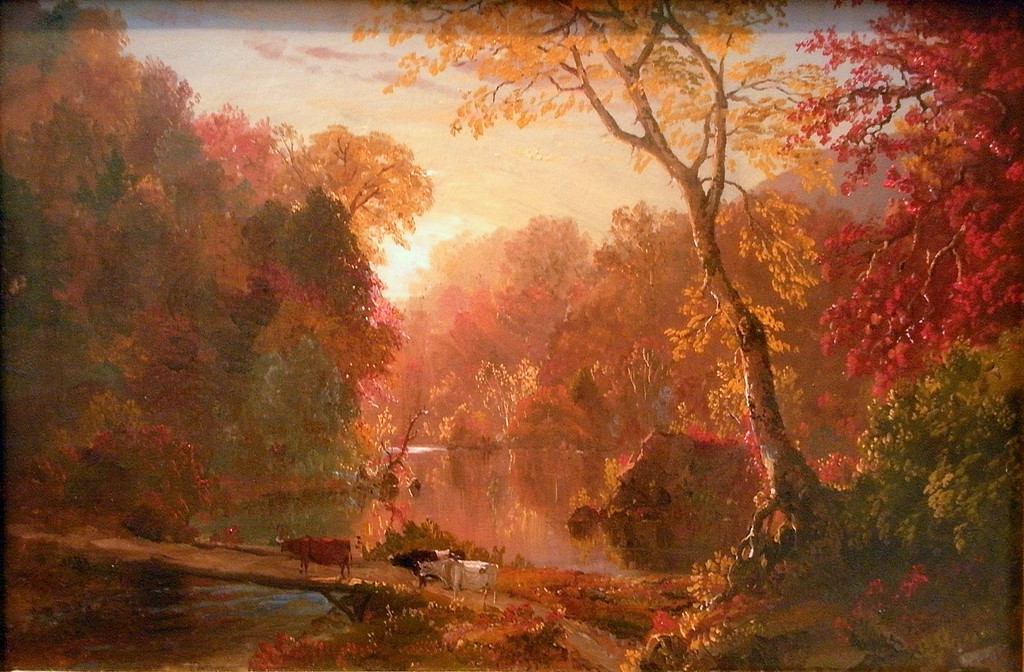
Three cattle stand near a woodland crossing in Frederic Edwin Church’s Autumn in North America. Around them, red and gold foliage encloses a quiet stretch of water. This painting, dated around 1856, belongs to the Frances Lehman Loeb Art Center at Vassar College, where it forms part of the founding collection given by Matthew Vassar. Its intimate forest scene offers a different encounter with American landscape from Church’s expansive mountain panoramas.[1][2]
At a Glance
- ArtistFrederic Edwin Church
- TitleAutumn in North America
- DateCirca 1856
- MediumOil on board
- CollectionFrances Lehman Loeb Art Center, Vassar College
- CreditGift of Matthew Vassar
- Accession number1864.1.16
- SubjectAutumn woodland, water and three cattle
This work across Church’s career
Tamaca Palms
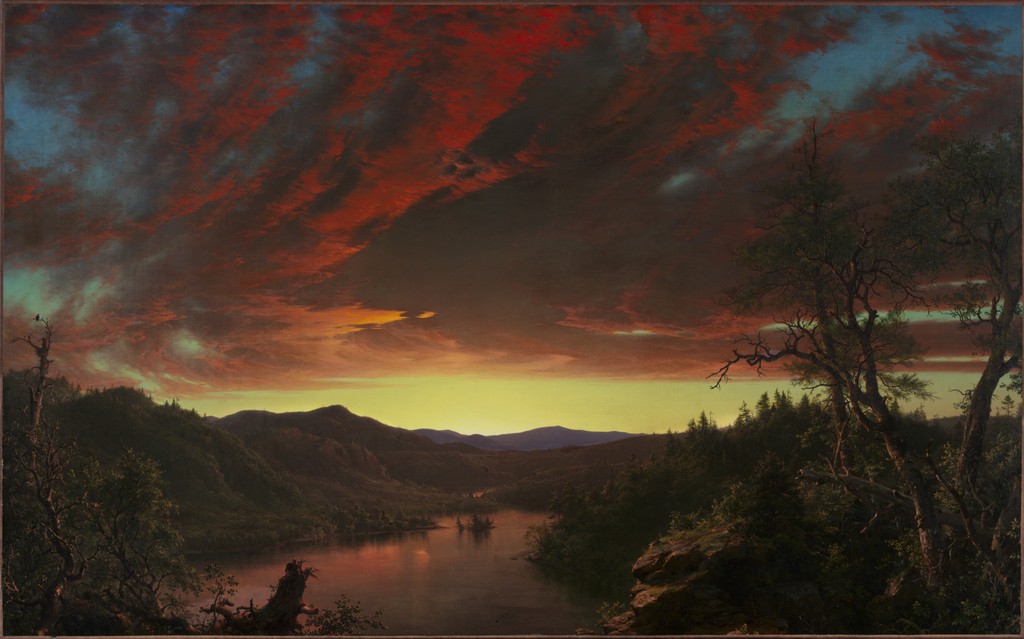
1854Autumn in North America (current work)
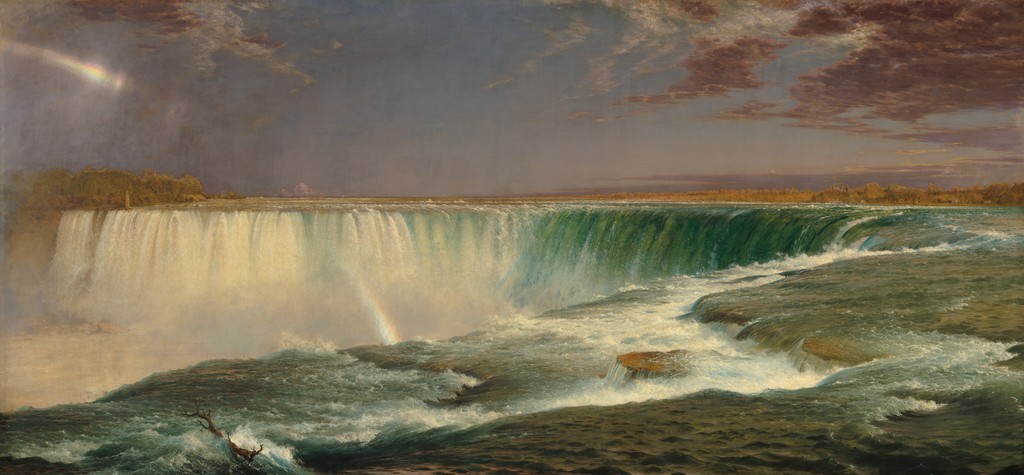
Circa 1856Niagara
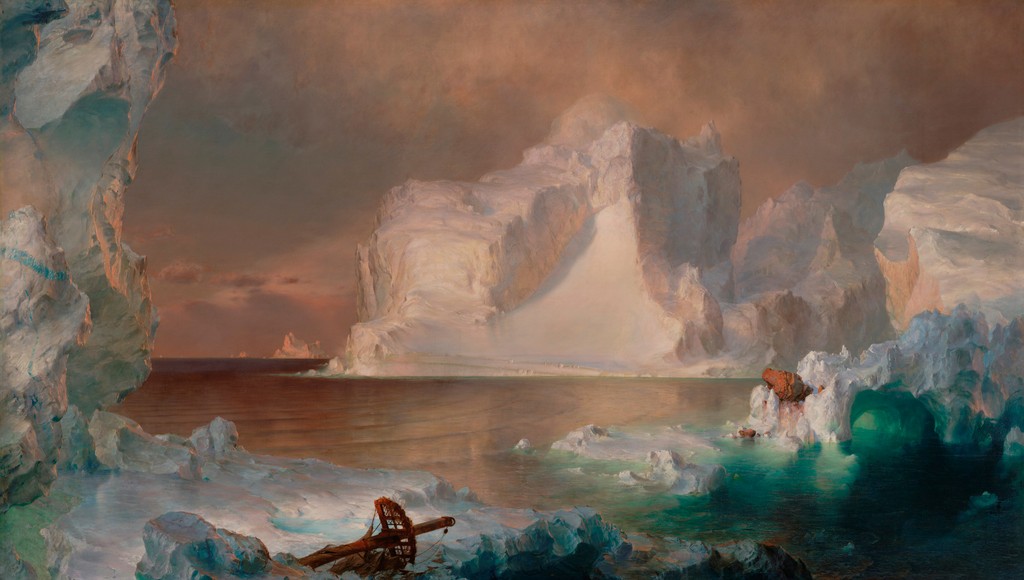
1857The Icebergs
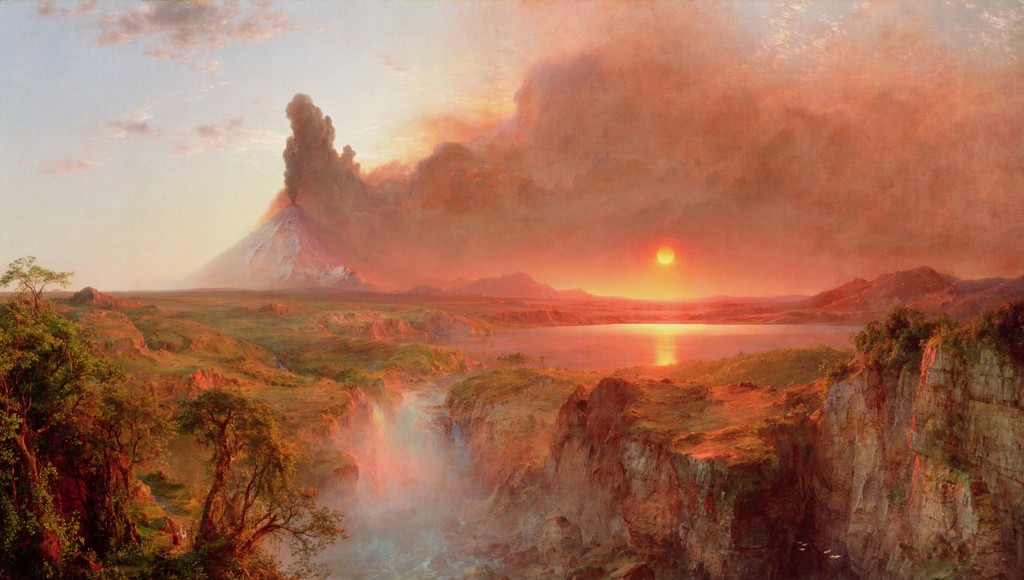
1861; foreground mast added between mid-1862 and early 1863Cotopaxi
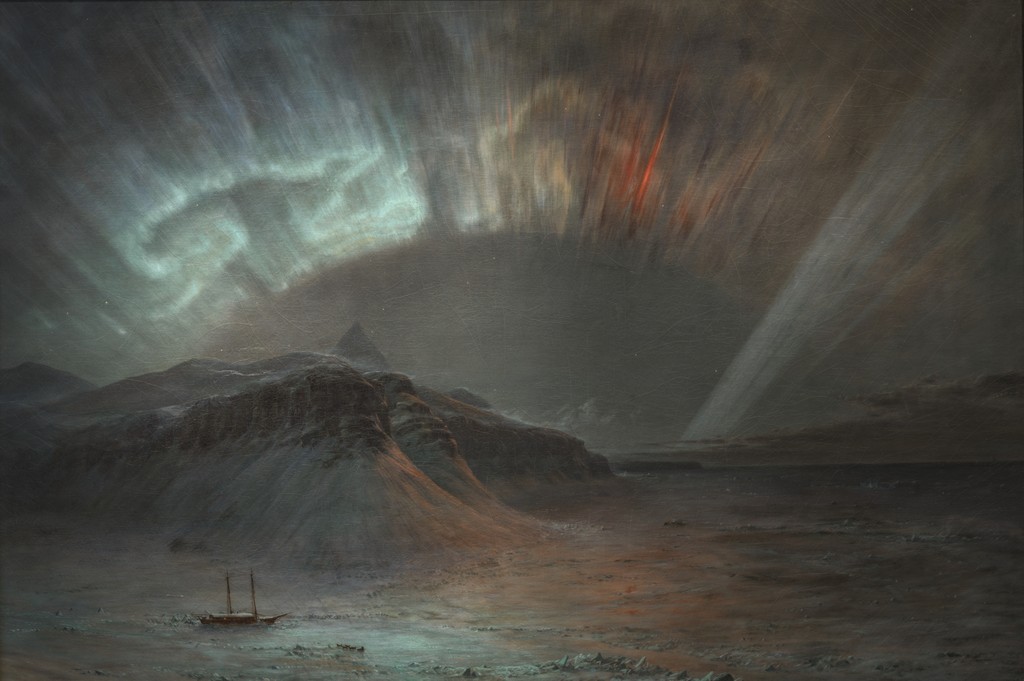
1862Aurora Borealis
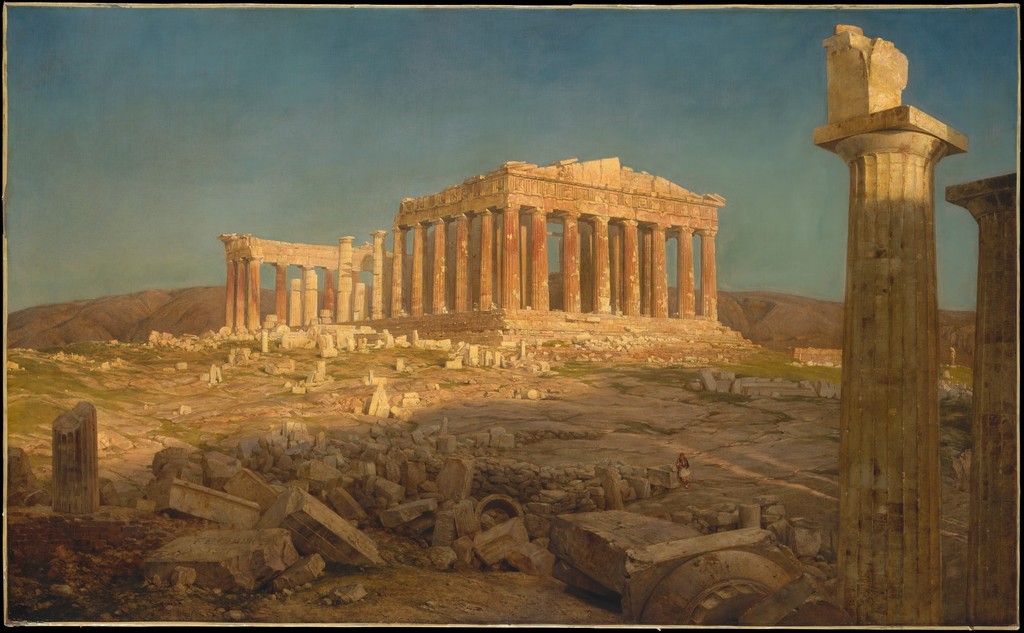
1865The Parthenon
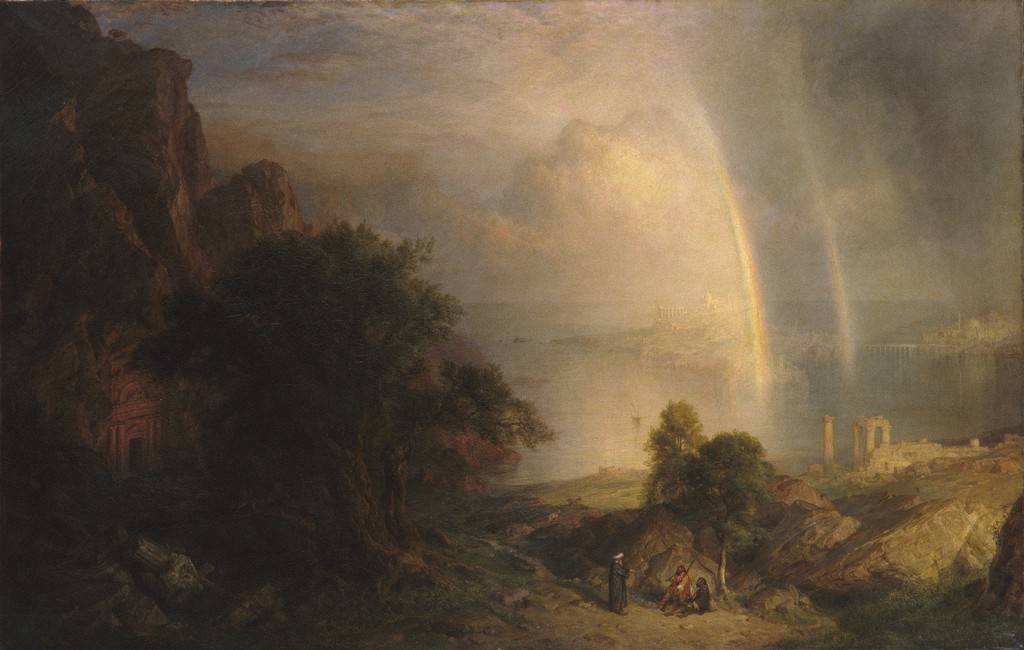
1871The Aegean Sea
About 1877Contents
- A forest interior rather than a distant panorama
- Trees, water and the movement of the eye
- The cattle and the woodland crossing
- Autumn colour and reflected light
- A sketch in Vassar’s founding collection
- Autumn in North America and Summer in South America
- Reading landscape as a historical choice
- Annotated details
A forest interior rather than a distant panorama
The landscape is organised around an opening within the trees. Dense foliage fills the left side, while a prominent trunk rises from the lower right and sends branches across the upper part of the picture. Between these masses lies a lighter passage of sky and woodland. The enclosure directs attention inward, toward water and illuminated leaves.
The spectator’s position feels close to the ground. We look across the foreground crossing and toward the stiller water behind it, rather than down from a summit. Church offers enough space to imagine moving into the scene, but the trees restrict how much of the surrounding country can be seen. The view’s attraction depends on that balance between invitation and concealment.
Vassar educator Nicole M. Roylance describes the setting as a generic American wood. Her description is useful because the painting’s continental title does not identify an exact river, village or mountain. The image can evoke a familiar kind of autumn landscape without serving as a precise topographical record.[1]
The title also gives the wooded interior a broader frame. A relatively contained scene stands for a season within North America. Church does not need a long horizon or a monumental peak to suggest the character of a landscape. Leaves, bark, water and animals establish the encounter at a scale closer to everyday experience.
Annotated Details from Autumn in North America
The numbered points draw attention to visible features discussed in this article. Look from each detail back to the full composition. Frederic Edwin Church, Autumn in North America, circa 1856. Oil on board. Frances Lehman Loeb Art Center, Vassar College, Gift of Matthew Vassar, 1864.1.16. Public-domain reproduction via Wikimedia Commons (source Artes Magazine; uploaded by Rsberzerker). Frederic Edwin Church, Autumn in North America, circa 1856. Frances Lehman Loeb Art Center, Vassar College, Gift of Matthew Vassar, 1864.1.16. Public-domain reproduction via Wikimedia Commons, source Artes Magazine; uploaded by Rsberzerker.. Source image. Public domain / faithful reproduction of a two-dimensional public-domain painting. Numbered overview resized; detail crops added from the source master. No recolouring.
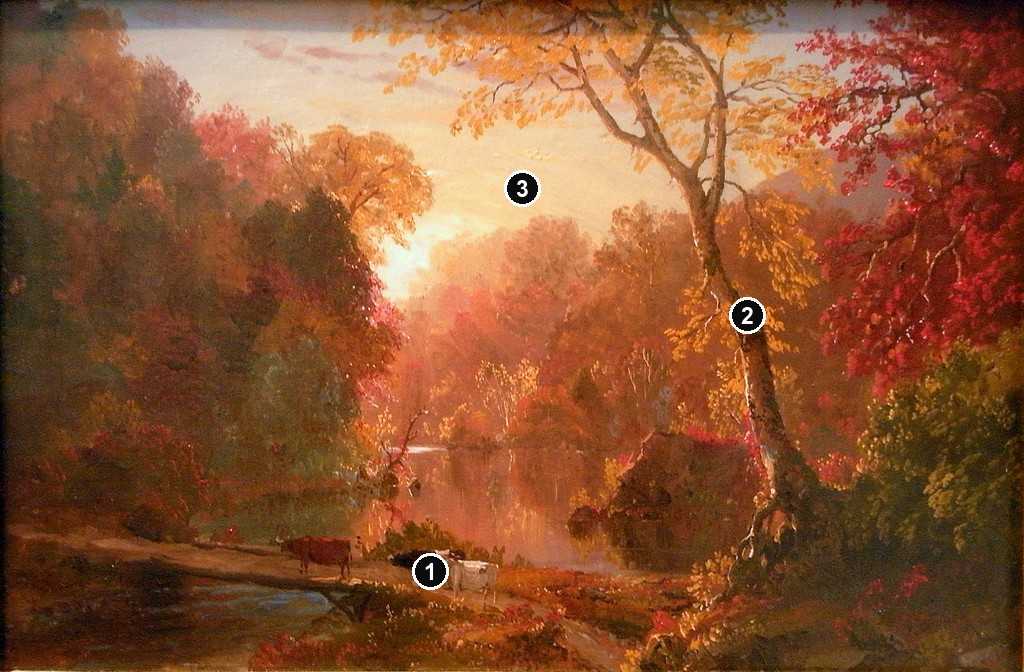
Details from AUTUMN IN NORTH AMERICA
These crops come directly from the verified source images. They preserve the original colours or printed tones; the numbered overview is a separate aid to looking.
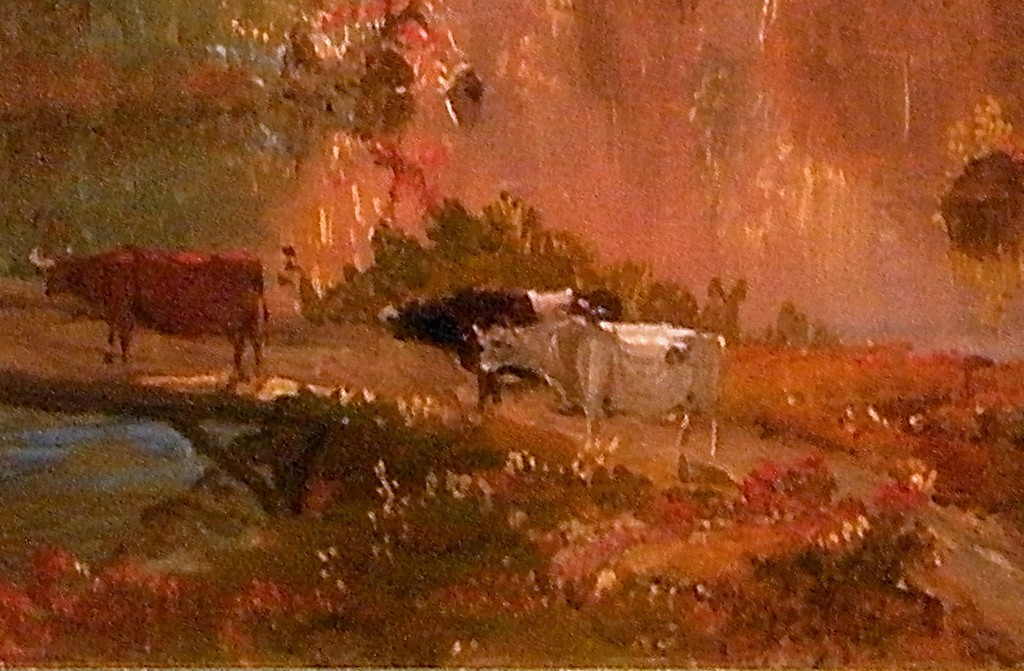
Woodland crossing
The cattle and rough crossing occupy the near woodland. Their small forms bring movement and scale into the landscape.
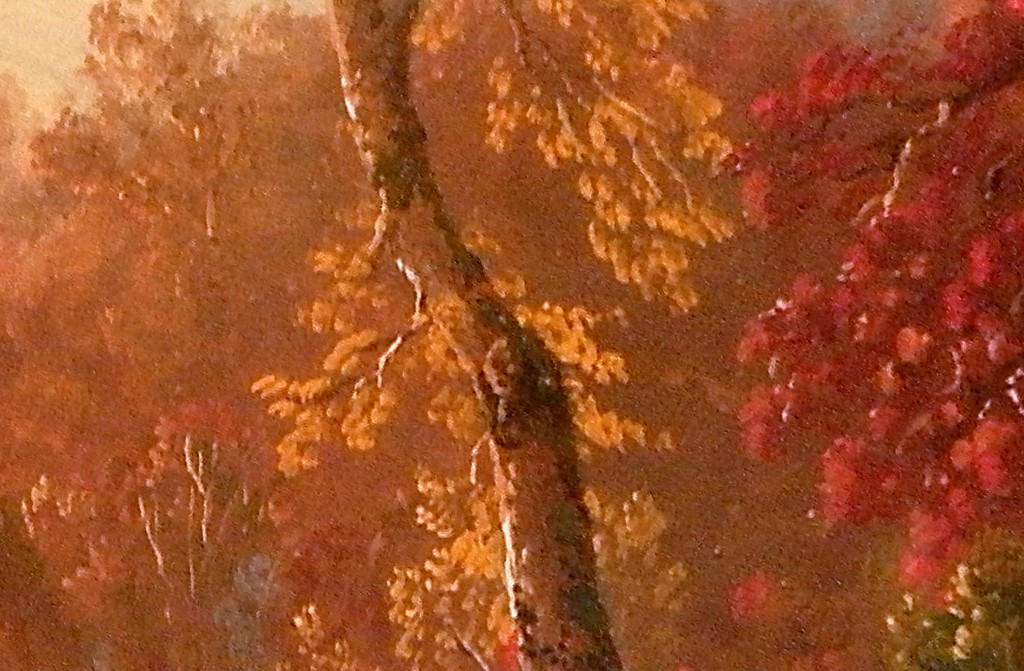
Leaning tree
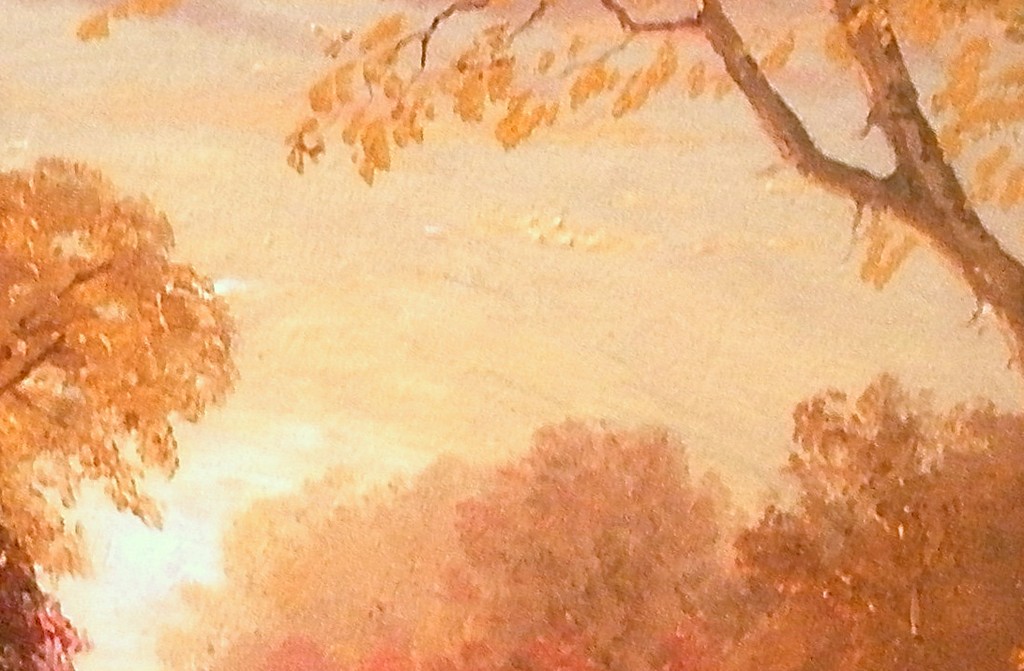
A sloping trunk and branches carry the eye upward into yellow leaves. Their direction joins the foreground to the canopy.
Opening toward the sky
A brighter interval appears between masses of foliage. The opening gives the enclosed forest a farther distance.
Trees, water and the movement of the eye
The large tree on the right supplies the strongest vertical element. Its trunk leans across the bank, with roots and lower branches drawing attention toward the foreground. Higher branches carry yellow leaves across the sky. Their irregular shapes break up the opening and prevent it from becoming a simple, empty patch of light.
Dark green growth remains among the warmer colours. On the left, deep shadow gives the foliage weight; nearer the centre, the trees become softer and less distinct. These changes create depth within the forest. Church does not distribute red and gold evenly across the surface: bright accents emerge from shaded masses and gather around the lighter opening.
Water provides a quieter counterpart to the canopy. Vertical reflections extend the trees downward, while the relatively open surface lets the eye rest between the densely worked banks. The nearer water runs beside the crossing; farther back, the scene becomes broader and more still. Following this passage is one way to understand how the composition leads into the woodland.
The near tree, the dark left bank and the foreground ground form an enclosing arrangement. Within it, the illuminated distance seems less solid, with foliage losing the definition visible nearby. That difference makes the centre feel farther away without turning it into an expansive mountain vista. The painting rewards close looking through changes of visibility as much as through individual objects.
The cattle and the woodland crossing
Roylance identifies three cattle in the scene, a count confirmed by looking closely at the foreground. A brown animal stands farther left, with a darker and a pale animal nearer the right. Their small bodies provide a measure of scale for the trees and the width of the passage.[1]
The animals occupy the area around a rough plank crossing. This detail matters to the character of the landscape. Although no conspicuous person directs the cattle, domestic animals and a constructed passage indicate human use. The woods are not presented as an environment entirely separated from habitation or work.
Their presence also changes the picture’s pace. The cattle draw attention to a short movement across the foreground instead of a dramatic journey toward the horizon. Looking from one animal to another brings the viewer back to the ground after following the branches into the sky. The foreground becomes a place of ordinary passage within an elaborate display of seasonal colour.
Autumn colour and reflected light
The palette combines golden yellow, orange and red with areas of muted green and brown. A pale, warm sky reinforces the glow around the central opening. The darker banks give the lighter leaves something to stand against, making the colour feel concentrated rather than uniformly bright.
Roylance’s account connects the painting with the vivid autumn foliage she observed in the Hudson Valley. That response describes a continuing point of recognition: Church’s woodland can recall a seasonal experience even when its precise location is unknown. The appeal comes from relationships of colour and light, as well as the identification of autumn leaves.[1]
A modern photograph of Vermont foliage provides a useful regional comparison. Its wooded hillside contains reds and yellows alongside persistent greens, with colours repeated in the water below. Church arranges similar contrasts within a much more enclosed view. The photograph helps distinguish the variety of an autumn landscape from the particular selection and emphasis that give the painting its form.
The comparison does not locate Church’s scene in Vermont. Its purpose is to show how familiar seasonal materials can be organised differently: a broad lakeside panorama in the photograph, a sheltered woodland passage in the painting. The modern houses and boats belong to the photographed setting and should not be read back into Church’s image.
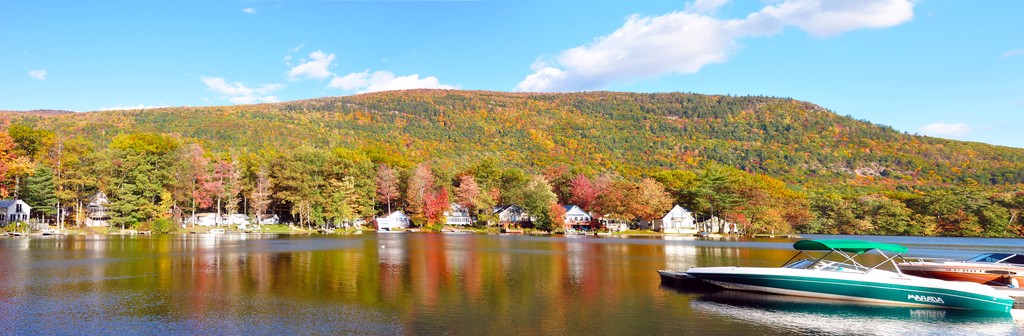
Modern autumn foliage and water in Vermont, photograph by Chensiyuan, via Wikimedia Commons. CC BY-SA4.0. A regional comparison of seasonal colour and reflections; not Church’s exact viewpoint. Resize credit to be added when exported. Autumn foliage and water in Vermont, photograph by Chensiyuan, via Wikimedia Commons, CC BY-SA4.0. Regional comparison; not Church’s exact viewpoint.. Image source. Creative Commons Attribution-ShareAlike 4.0 International. Resized; full source proportions retained.
Watch: Frederic Edwin Church
Choose a film to explore the artist’s work, its interpretation and its wider setting.
Frederic Edwin Church's "The Icebergs" on the Move at the DMA
Follow the Dallas Museum of Art as it moves Church’s large painting The Icebergs.
Watch on YouTubeA sketch in Vassar’s founding collection
The painting’s history at Vassar is documented by more than recent museum discussion. A catalogue published in 1869 describes the art collection presented by Matthew Vassar to the college on 28 June 1864. In its Church entry, Autumn in North-America appears as number 37 and is identified as a “Sketch.” The same entry lists Summer in South-America and Evening in Vermont.[3]
The catalogue’s wording gives the work a place within an early educational collection. Its publication date and the gift date are different: 1869 records the collection presented in 1864. The historical number 37 also differs from the painting’s current accession number, 1864.1.16.
Calling the work a sketch does not, by itself, establish that it was preparation for a larger canvas. The catalogue records a category without explaining the painting’s intended relationship to another version. The visible scene can still be considered as a coherent composition, with the cattle, crossing and light opening working together.
Student docent Joe Brichacek discusses the founding collection in relation to Matthew Vassar and collector Elias Magoon’s belief that original art should contribute to a college education. In that setting, Church’s landscape became material for observation, comparison and historical inquiry, alongside its appeal as a painted woodland.[2]
Autumn in North America and Summer in South America
Vassar’s Summer in South America, dated around 1853, provides a revealing comparison. Brichacek discussed the two paintings together in 2012, and both featured in the institution’s 2026 display Splitting the Horizon: Frederic Church Between Border and Bridge. Their titles connect season and continent, while their shared founding-collection history brings them into a common institutional setting.[2][4]
The tropical scene opens across water toward distant land, with palms and hanging vegetation giving its foreground a different character. Autumn concentrates warmer leaf colours around a forest opening. Viewed together, the works encourage comparison between distinct environments and between the ways Church made them available to the spectator.
That relationship does not require the pictures to have been commissioned as an original pair. The surviving catalogue lists both, and later Vassar interpretation brings them into dialogue. Those are documented connections; a specific shared commission would require further evidence.
Reading landscape as a historical choice
The 2026 display, organised by student researcher Ashleigh McDermott, examined Church’s landscapes in relation to hemispheric identity and expansionist ways of viewing South America. This is an attributed interpretation of the pictures’ wider historical setting, rather than proof of a single message Church intended every spectator to receive.[4]
For Autumn, the question begins with what the picture shows: a wooded environment shaped into a coherent scene, with cattle and a crossing inside it. Its quietness does not settle a political argument, but it offers grounds for asking how landscape painting represents the relationship between people and nature. That question connects this intimate work with the broader career explored in Church’s biography.
Artworks directory
A documented selection of Church’s works discussed across these articles, together with identified prints after his designs. This is not a catalogue raisonné. Repeated titles and aliases are reconciled; studies remain distinct from finished paintings. Some dates remain unconfirmed. Other makers are named where a print adapts Church’s work.
| Name | Date | Medium |
|---|---|---|
| Above the Clouds at Sunrise | 1849 | Oil on canvas |
| The Aegean Sea | About 1877 | Oil on canvas |
| The Andes of Ecuador | 1855 | Oil on canvas |
| Aurora Borealis | 1865 | Oil on canvas |
| Autumn in North America | Circa 1856 | Oil on board |
| Coast Scene | 1852 | Oil on canvas |
| Cotopaxi | 1862 | Oil on canvas |
| A Country Home | 1854 | Oil on canvas |
| El Khasné, Petra | 1874 | Oil on canvas |
| El Rio de Luz | 1877 | Oil on canvas |
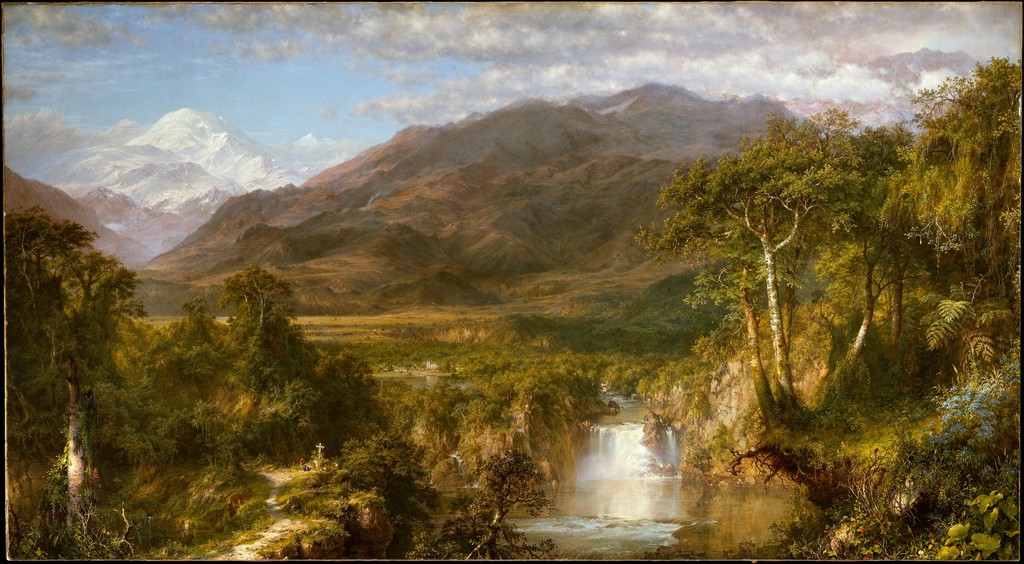
| The Heart of the Andes | 1859 | Oil on canvas |
| The Icebergs | 1861; foreground mast added between mid-1862 and early 1863 | Oil on canvas |
| Jerusalem from the Mount of Olives | 1870 | Oil on canvas |
| Mount Ktaadn | 1853 | Oil on canvas |
| Our Banner in the Sky | 1861 | Oil paint over lithograph on paper, laid down on cardboard |
| The Parthenon | 1871 | Oil on canvas |
| Rainy Season in the Tropics | 1866 | Oil on canvas |
| Storm in the Mountains | 1847 | Oil on canvas |
| Syria by the Sea | 1873 | Oil on canvas |
| Tamaca Palms | 1854 | Oil on canvas |
| Tropical Scenery | 1873 | Oil on canvas |
| Twilight in the Tropics | 1874; signed and dated, according to Bonhams’ catalogue | Oil on canvas |
| Twilight in the Wilderness | 1860 | Oil on canvas |
| View of Cotopaxi | 1857 | Oil on canvas |
| Niagara | 1857 | Oil on canvas |
| Magdalena River, New Granada, Equador | 1853 | Graphite heightened with white on wove paper |
| Tamaca Palm, Colombia or Ecuador | May–October 1853 | Graphite on gray laid paper |
| Mixed Sketches with a Champan, Río Magdalena, Colombia | May 1853 | Graphite on gray laid paper |
| Study for Rainy Season in the Tropics | 1865–1866 | Graphite on ruled notepad paper |
| Al-Khazneh, Petra (study) | February–March 1868 | Oil and graphite on tan paperboard |
| The Great Fall, Niagara (Charles Risdon, after Church) | 1874 impression | Hand-coloured chromolithograph on paperboard |
| The Heart of the Andes (William Forrest, after Church) | 1862 | Engraving in black on wove paper |
| Our Heaven Born Banner (William Bauly, adapting Church’s motif) | circa 1861 | Colour lithograph |
| A Tropical Moonlight (wood engraving after Church) | 1879 publication | Wood engraving in American Painters |
| Off Iceberg, Newfoundland | June 1859 | Oil and graphite on paperboard |
| Parthenon at Night, Athens | April 1869 | Oil and graphite on tan paperboard |
| Jerusalem from the Mount of Olives (study) | 1 April 1868 | Oil and graphite study |
| Horseshoe Falls (study) | December 1856–January 1857 | Oil on paper mounted to canvas |
| Niagara Falls, from the American Side | 1867 | Oil on canvas |
| Study for The Heart of the Andes | 1858 | Oil study |
| Mount Chimborazo through Rising Mist and Clouds | 1857 | Oil study |
| Cotopaxi Erupting, Viewed from Quito, Ecuador | June 1857 | Oil and graphite on tan paperboard |
| Cotopaxi (painted for Cyrus Field) | 1855 | Painting |
| Chimborazo | 1864 | Painting |
| Twilight, A Sketch | 1858 | Oil on canvas |
| View of Baalbek | 1868 | Oil and pencil on board |
| Three Bedouins | Date unconfirmed | Oil study |
| Coast Scene, Mount Desert (later canvas) | 1863 | Painting |
| The Wreck | Date unconfirmed | Painting |
| Grand Manan Island, Bay of Fundy | Date unconfirmed | Painting |
| Summer in South America | circa 1853 | Painting |
| Evening in Vermont | Date unconfirmed | Painting |
| Home by the Lake | Date unconfirmed | Painting |
| Storm in the Blue Mountains, Jamaica | August 1865 | Painting |
| The Natural Bridge, Virginia | 1852 | Painting |
| The Vale of St. Thomas, Jamaica | 1867 | Painting |
| Tequendama Falls, near Bogota, New Granada | Date unconfirmed | Painting |
| Sunrise in Syria | Before the 1876 exhibition | Painting |
| Cuernavaca (oil study; descriptive title) | 1898 | Oil study |
| Olana window design (descriptive title) | Date unconfirmed | Watercolour and graphite |
| Olana dining-room stencil sketch (descriptive title) | Date unconfirmed | Oil and graphite |
| Olana house (with Calvert Vaux) | 1870–1872; later additions | Architecture |
| Olana designed landscape | From 1860; developed over decades | Designed landscape |
Frequently Asked Questions
Vassar dates it to around 1856.
The Frances Lehman Loeb Art Center at Vassar College holds it as part of the gift of Matthew Vassar, accession 1864.1.16.
Three cattle stand near the woodland crossing.
Vassar’s educational discussion describes a generic American wood. The sources cited here do not establish an exact location.
The works share Vassar’s founding-collection history and have been discussed and exhibited together. That evidence does not establish an original paired commission.
Discussion
Look again at the images and ideas explored in Autumn in North America. These editorial prompts invite your own observations.
Reader Insights
Where do the trees open a route for your eye through the forest?
How do the cattle and water crossing change the scale of the scene?
Which reflected colour seems most important to the atmosphere?
Join the Conversation
Share a detail, comparison or question about Autumn in North America below.
References
- Nicole M. Roylance, Connections: Fall Break, Vassar Art Center education, 20 October 2010.
- Joe Brichacek, Summer in South America, Vassar Art Center education, 3 April 2012.
- A Catalogue of the Art Collection Presented by Matthew Vassar to Vassar College, June 28, 1864, published 1869, title page and pp. 5–6, 21.
- Frances Lehman Loeb Art Center, Splitting the Horizon: Frederic Church Between Border and Bridge, 21 February–30 August 2026.
- Splash image source.
Frederic Edwin Church, Autumn in North America, circa 1856. Oil on board. Frances Lehman Loeb Art Center, Vassar College, Gift of Matthew Vassar, 1864.1.16. Public-domain reproduction via Wikimedia Commons (source Artes Magazine; uploaded by Rsberzerker). Frederic Edwin Church, Autumn in North America, circa 1856. Frances Lehman Loeb Art Center, Vassar College, Gift of Matthew Vassar, 1864.1.16. Public-domain reproduction via Wikimedia Commons, source Artes Magazine; uploaded by Rsberzerker.. Image source. Public domain / faithful reproduction of a two-dimensional public-domain painting. Resized; full source proportions retained.