 by Tom Gurney
Tom Gurney BSc (Hons) is an art history expert with over 20 years experience
Published on June 19, 2020 / Updated on October 27, 2026
Email: tomgurney1@gmail.com / Phone: +44 7429 011000
Our Banner in the Sky: Introduction
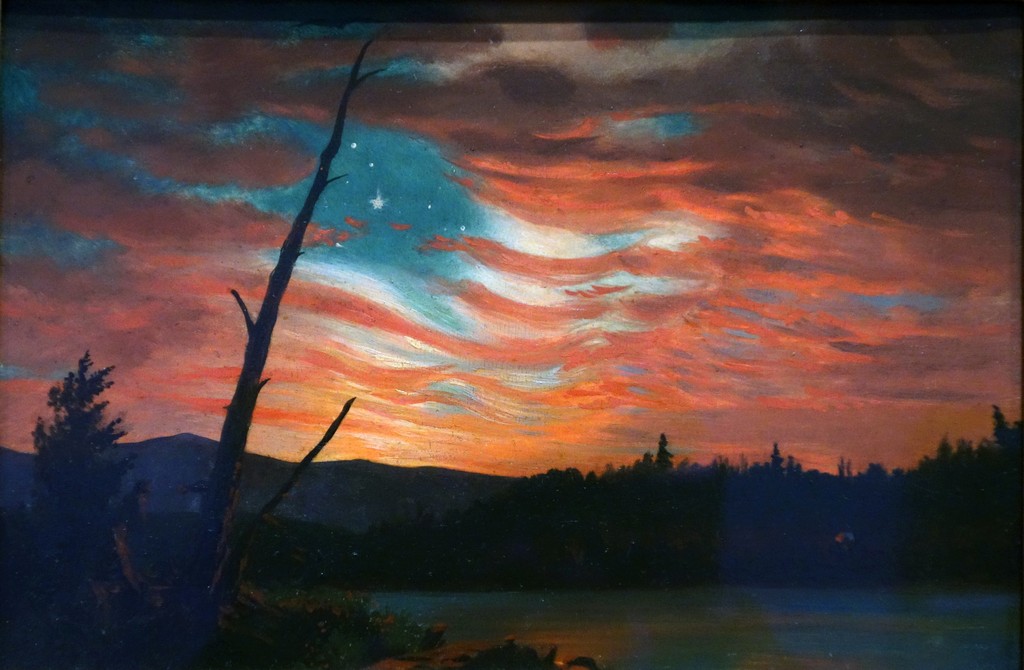
Frederic Edwin Church’s Our Banner in the Sky turns the American flag into a formation of clouds and stars. A bare tree appears to hold up its blue field, while red and pale bands of cloud extend across a luminous sky. Created in 1861, at the beginning of the American Civil War, the design made landscape a direct expression of support for the Union. The version illustrated here belongs to the Terra Foundation for American Art. Its medium is unusually revealing: oil paint over a lithograph on paper, laid down on cardboard. It preserves a meeting between painting and printmaking that helped the image reach wartime viewers.[1]
At a Glance
- ArtistFrederic Edwin Church (1826–1900)
- TitleOur Banner in the Sky
- Date1861
- Illustrated versionTerra Foundation for American Art, Daniel J. Terra Collection, 1992.27
- MediumOil paint over lithograph on paper, laid down on cardboard
- Image dimensions19.0 × 28.9 cm
- SubjectA celestial American flag and the Union cause at the outbreak of the Civil War
- Other formsAn initial oil sketch, printed reproductions and versions with paint applied over prints
This work across Church’s career
Tamaca Palms
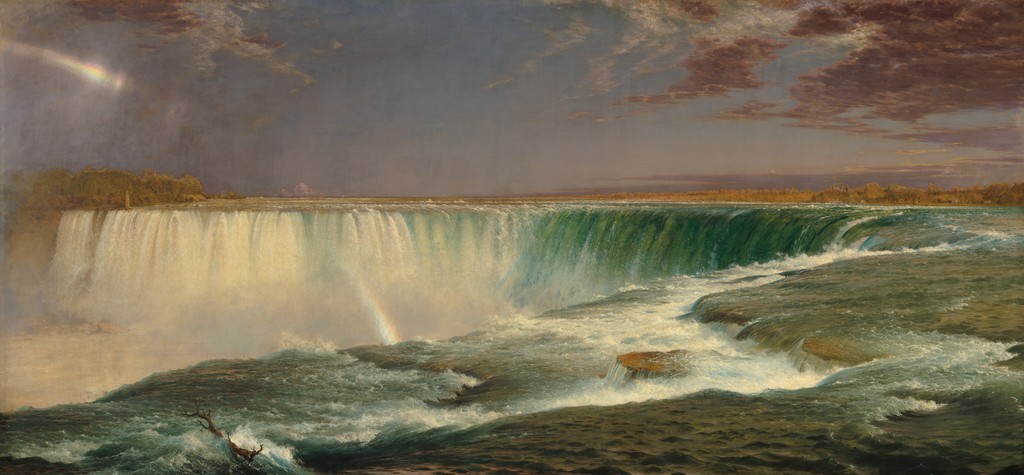
1854Niagara
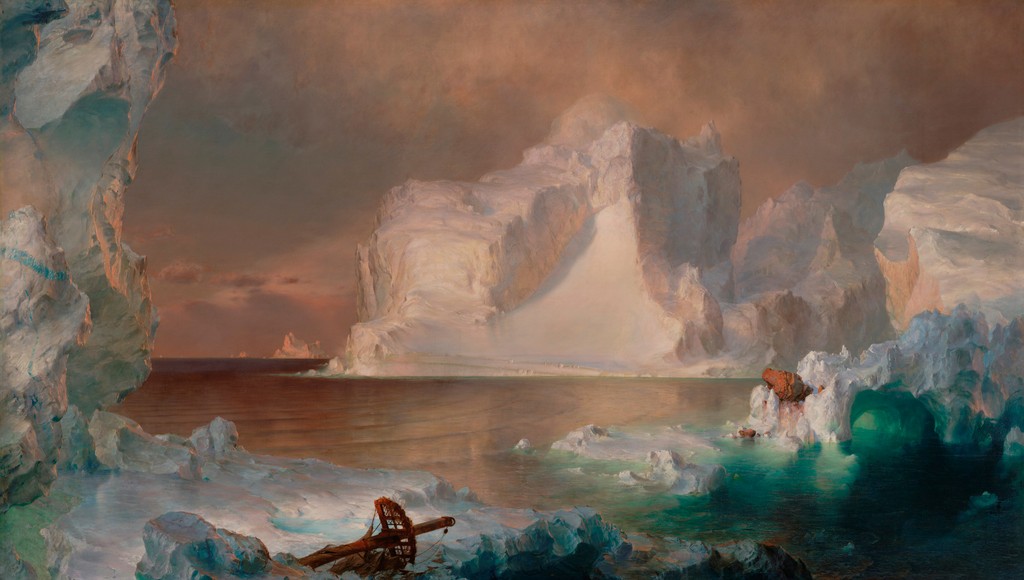
1857The Icebergs
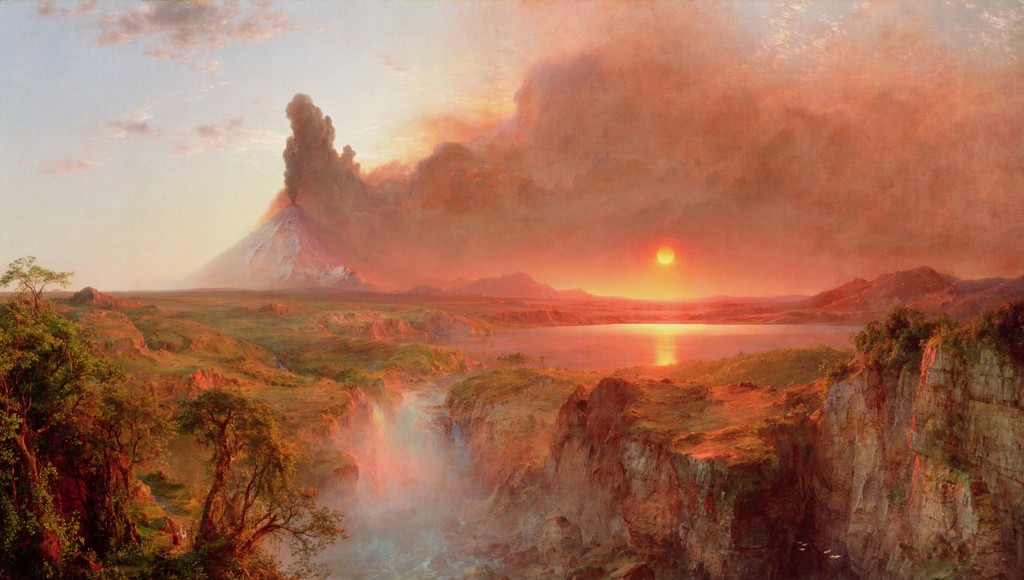
1861; foreground mast added between mid-1862 and early 1863Cotopaxi
1862Aurora Borealis
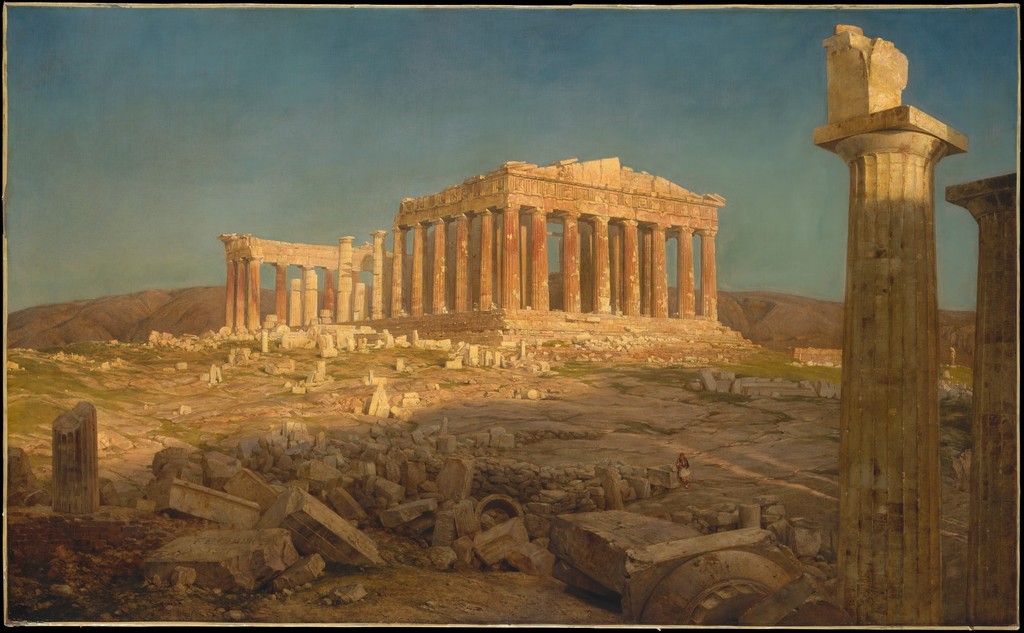
1865The Parthenon
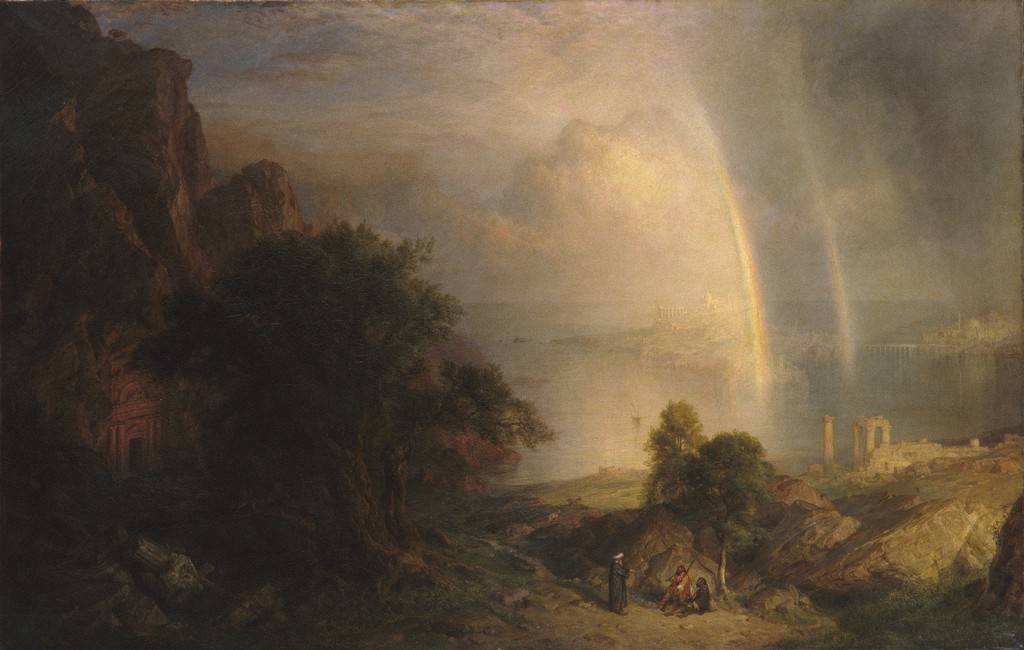
1871The Aegean Sea
About 1877Contents
- How the sky becomes a flag
- Fort Sumter and the significance of the flag
- Dawn, light and hope
- From oil sketch to published print
- What the Olana version reveals
- Patriotism, circulation and a separate fundraiser
- A soldier replaces the tree
- Looking alongside Church’s other skies
- Annotated details
How the sky becomes a flag
The design works through a sequence of recognitions. First comes a landscape with water, wooded banks and a brilliant sky. Then the arrangement of colour resolves into a flag: the blue opening contains stars, and the long red and light cloud bands suggest stripes. The tree on the left makes the connection clearer. Its stripped trunk rises diagonally from the foreground and serves visually as a flagstaff. Terra describes the flag as a temporary arrangement of sky, clouds and stars, seemingly supported by that barren tree.[1]
Church leaves the cloud forms irregular. Their edges fray, their widths vary, and the light passes between them. The flag is recognisable without becoming a rigid rectangle laid over the landscape. This is central to the image’s appeal: natural effects seem to assemble themselves into a national emblem. The viewer can move between reading the sky as weather and reading it as a symbol.
The darker ground helps that transformation. Low hills and silhouetted trees make a base beneath the brighter sky; water occupies the lower part of the Terra version. The tall bare trunk links these two areas, carrying the eye upward from a quiet foreground towards the stars. Because the scene contains no large human figure, the political message depends on the landscape itself. That absence becomes especially noticeable when the design is compared with its wartime adaptations.
Annotated Details from Our Banner in the Sky
The numbered points draw attention to visible features discussed in this article. Look from each detail back to the full composition. Frederic Edwin Church, Our Banner in the Sky, 1861. Oil paint over lithograph on paper, laid down on cardboard, 19.0 × 28.9 cm. Terra Foundation for American Art, Daniel J. Terra Collection, 1992.27; photograph Choliamb, via Wikimedia Commons. Faithful 2D public-domain reproduction. Exact Terra version, presumably hand-painted by Church as the foundation qualifies. Source image. Public domain: PD-old-100-expired / faithful 2D reproduction PD-Art / Public Domain Mark. Numbered overview resized; detail crops added from the source master. No recolouring.
.jpg)
Details from OUR BANNER IN THE SKY
These crops come directly from the verified source images. They preserve the original colours or printed tones; the numbered overview is a separate aid to looking.
Stars and blue opening
Small pale stars appear within a blue opening. Their arrangement helps turn the sky’s colours into the suggestion of a flag.
 Detail 01 stars-and-blue-opening.jpg)
Cloud stripes
Alternating reddish and pale cloud bands extend across the sky. Their edges remain cloud-like even as they suggest stripes.
 Detail 02 cloud-stripes.jpg)
Bare tree
The bare trunk rises across the illuminated sky like a flagstaff. Its dark irregular branches keep the motif connected to the natural setting.
 Detail 03 bare-tree.jpg)
Fort Sumter and the significance of the flag
The composition belongs to the first months of the Civil War. Confederate batteries began bombarding Fort Sumter in Charleston Harbor on 12 April 1861. Major Robert Anderson surrendered the Union garrison on 13 April, and the soldiers evacuated on 14 April. The National Archives preserves a transcription of Anderson’s 18 April telegram reporting the withdrawal, the damage to the fort and the departure with the flag. These dates place Church’s design in an immediate wartime setting.[2]
For Union supporters, the flag carried a particular emotional charge after the loss of the fort. In his study of Church and the Civil War, art historian Kevin J. Avery describes the public response in New York, including the great Union Square rally at which the Sumter flag was displayed. Church’s celestial banner emerged in the weeks following this mobilisation. It offered a form of patriotic reassurance that could be understood without depicting the bombardment or a battlefield.[3]
The flag in the picture appears above a landscape that has not itself been destroyed. Its survival in the heavens can be read as a hopeful answer to the threatened national symbol on the ground. That reading belongs to the work’s pro-Union context. Terra emphasises its appeal to Northern wartime audiences; such enthusiasm should not be confused with a shared response across a country at war. The title’s possessive word, Our, invites viewers to identify with a particular national allegiance.[1]
Dawn, light and hope
The glowing reds and yellows might initially suggest either morning or evening. Olana’s account of Church’s wartime art identifies the design with sunrise, placing its making in May 1861. Dawn gives the patriotic image a forward-looking emphasis: the country’s emblem appears as light returns. This is an interpretive setting for the composition rather than a record of an exact hour observed outdoors.[4]
The blue area and bright points retain something of night even as the lower sky brightens. Their relationship to the lighter bands makes the celestial flag possible. Church uses the transition between darkness and illumination to join atmospheric spectacle with a political meaning. A scientifically identified star is unnecessary to that effect; the points work primarily as the flag’s stars.
The damaged-looking tree also matters visually. A living leafy canopy would obscure the blue field and break the resemblance to a flagstaff. Here the exposed trunk supplies the necessary vertical support while preserving the appearance of a natural object. Its stark silhouette and the glowing sky allow the viewer to associate vulnerability on earth with endurance above. This is a way of reading the composition, rather than evidence that every branch carried a separately documented message.
From oil sketch to published print
Our Banner in the Sky is the name of a design represented by several objects. Terra explains that Church made an initial oil sketch after the April attack on Fort Sumter. In June 1861 he was commissioned to produce a chromolithograph after it. The oil sketch and the published reproduction therefore belong to the same early wartime sequence, although they are different physical works.[1]
Chromolithography offered a means of reproducing the design in colour. Goupil & Co. was associated with its publication, and Avery reports that the lithographs sold briskly in the months that followed. The small image could circulate beyond the audience able to visit an exhibition or purchase an original painting. Its clear emblem and dramatic lighting made it suited to this movement from an artist’s composition into a reproducible patriotic picture.[3]
The Terra object adds another stage to that history. Oil paint lies over a printed image, so calling it simply an oil painting leaves out part of its construction. The foundation describes it as one of several lithographs presumably painted by Church himself. That qualification is significant: the association with his design is secure, while his personal application of paint is expressed as probable. The object should be identified by its collection and medium whenever it is reproduced.[1]
Watch: Frederic Edwin Church
Choose a film to explore the artist’s work, its interpretation and its wider setting.
Frederic Edwin Church's "The Icebergs" on the Move at the DMA
Follow the Dallas Museum of Art as it moves Church’s large painting The Icebergs.
Watch on YouTubeWhat the Olana version reveals
A separate version at Olana illustrates why close material study can change the understanding of a familiar image. Karen Zukowski’s Historic Furnishings Report identifies object OL.1976.29 as a painting over a chromolithograph. According to the report, the work had previously been considered an original oil sketch, but microscopic examination in 1998 revealed the printed layer. It attributes the painting over the print probably to Church.[5]
The report also records two other forms of the design at Olana: a chromolithograph and a print with paint applied to part of it. Together, these objects show that the boundary between an original image and its reproduction can involve further artistic work. A print might remain a print, receive limited additions or become the support for a more extensive painted version. Those distinctions are useful when comparing colour, surface and detail across reproductions.[5]
This finding concerns the Olana object. It should not be used to transfer Olana’s accession number or dimensions to the Terra version illustrated here. Both belong to the history of Church’s composition, and both combine printing and paint, but their collection records identify separate works. A caption that supplies only the title and year can conceal that difference.
Patriotism, circulation and a separate fundraiser
Church’s response to the war extended beyond this small banner image. In April 1861 he exhibited The Icebergs in New York. As troops passed the exhibition venue, he retitled the painting The North and arranged for admission receipts to support the Patriotic Fund for soldiers’ families. Avery and Olana discuss this exhibition as part of his engagement with the Union cause.[3][4]
That fundraiser and the circulation of Our Banner in the Sky are related expressions of wartime allegiance, but the documented donation concerns the exhibition receipts. It does not establish that every sale of the banner print financed the same fund. The distinction makes Church’s activity more precise: a monumental painting could generate contributions through admission, while a compact patriotic design could spread through published copies.
The contrast in scale is striking. The Icebergs depends on an imposing expanse of Arctic scenery, while the banner composition communicates through a few immediately recognisable forms. In both cases Church used the audience for landscape art within the circumstances of the war. The smaller image gave that connection its most overt emblem.
A soldier replaces the tree
The accompanying historic print, Our Heaven Born Banner, shows how another image-maker adapted the idea. The Library of Congress catalogue description, reproduced on its Commons image record, credits the painting to William Bauly, the lithography to Sarony, Major & Knapp, and publication to William Schaus. It dates the print to about 1861 and records its deposit for copyright on 6 September that year. The catalogue considers it based on Church’s painting or the Goupil reproduction.[6]
A sentry now stands on the rocky foreground, facing the luminous sky. His upright rifle and bayonet replace the tree’s function as the apparent flagstaff. The celestial stripes and star field remain, but the addition of a soldier makes the relationship to military service explicit. Beyond him are water, wooded shores and a small fort, identified by the catalogue as probably Fort Sumter. The reproduced picture area makes these compositional changes easy to compare.
The catalogue also records eight lines of verse accompanying the print. The illustration here shows the picture area, with the printed margins and verse absent. Even without that verbal framing, the soldier, weapon and distant fort make the adaptation more specific to war. It is a separate patriotic print drawing on Church’s motif, with its own makers and publisher.[6]
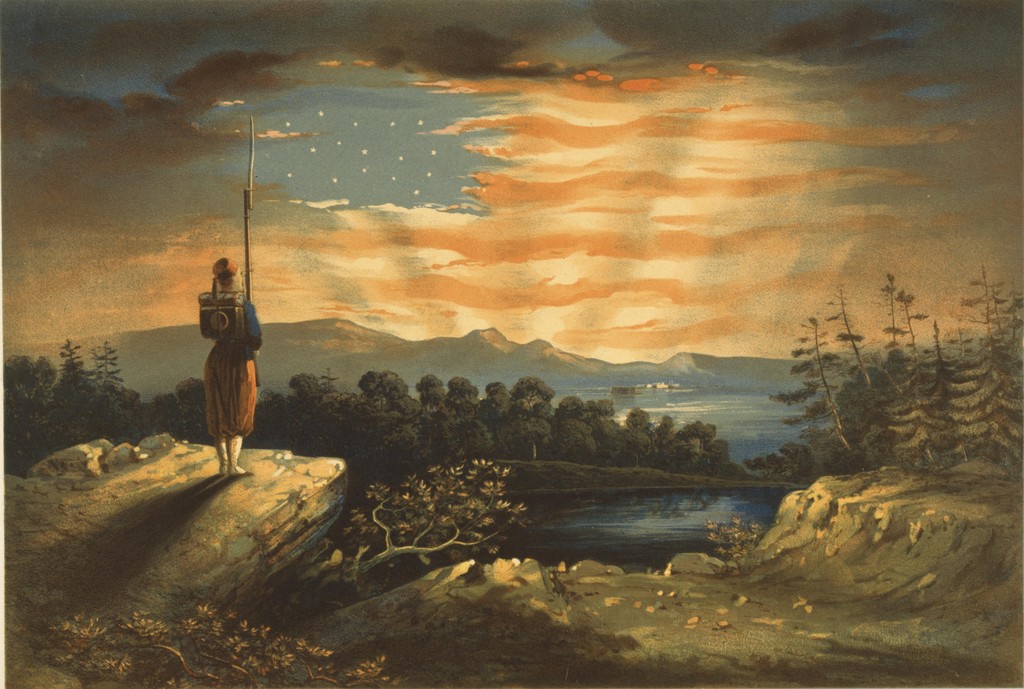
Our Heaven Born Banner, circa 1861, picture detail. Painting credited to William Bauly; lithography by Sarony, Major & Knapp; published by William Schaus. A separate print adapting Church’s motif. Library of Congress, cph.3g12417, via Wikimedia Commons. Image source. Public domain: US publication circa 1861, expired copyright; faithful reproduction of historic 2D print. Resized; full source proportions retained.
Looking alongside Church’s other skies
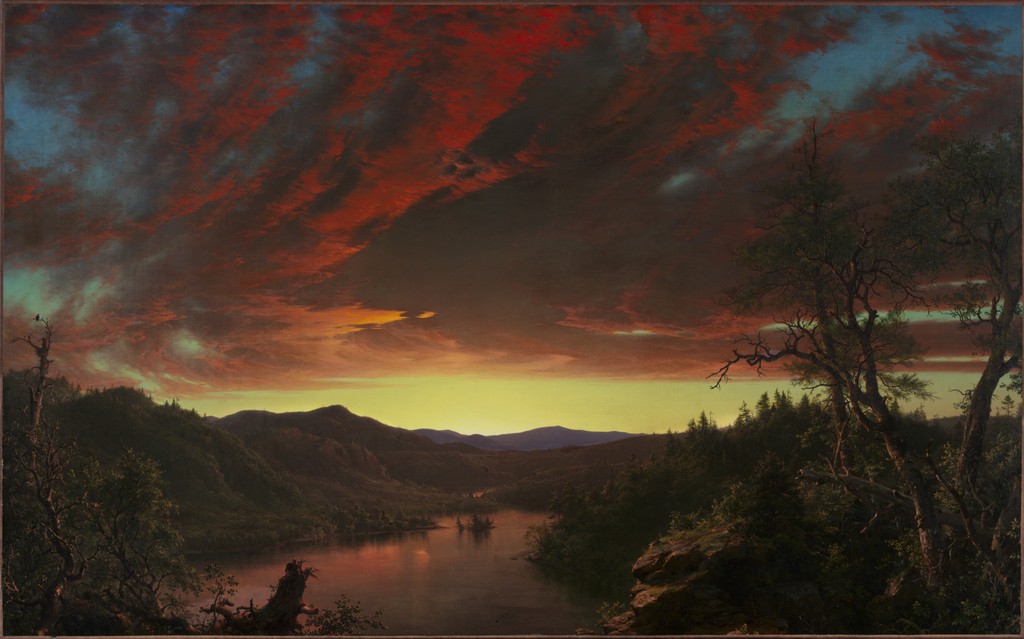
Comparison with Twilight in the Wilderness helps explain how Church could make an emblem out of atmospheric colour. Both compositions give substantial space to cloud bands and brilliant illumination above darker land. In Our Banner in the Sky, however, the blue opening, stars and tree organise that familiar landscape vocabulary into a clearly identifiable national image. Avery links the design to Church’s earlier twilight studies and distinguishes its unusually direct patriotism from the more interpretive political readings of later landscapes.[3]
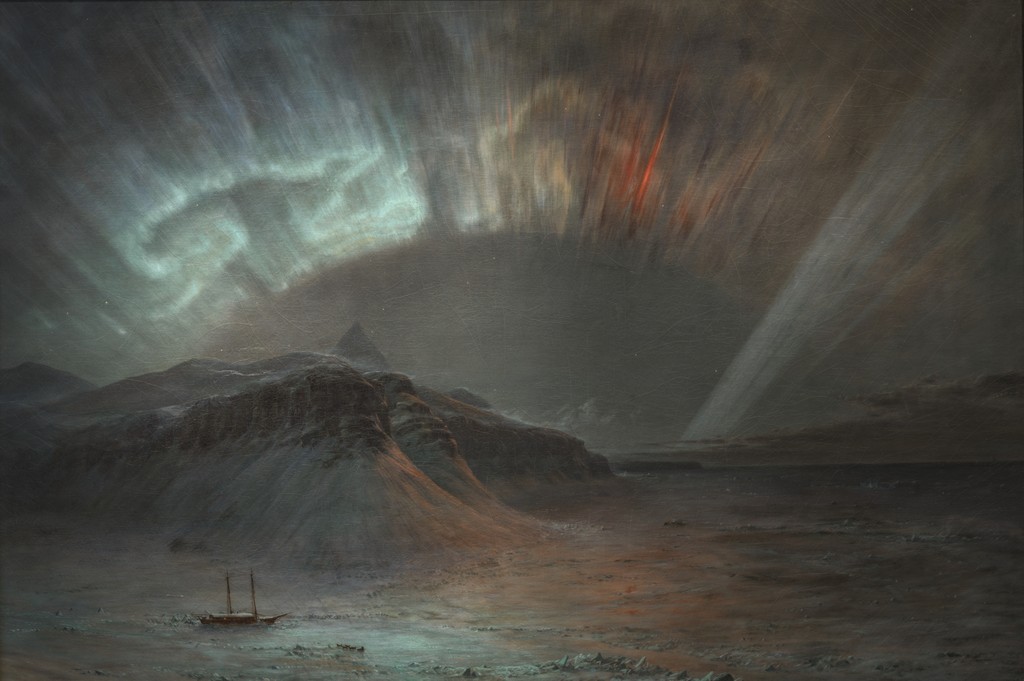
Aurora Borealis offers a further comparison: luminous phenomena again dominate the scene, but they do not form such a plainly readable flag. Keeping that difference in view allows the banner picture to retain its particular character. It is a small, topical composition whose power comes from making a natural spectacle carry an immediately recognisable public symbol, and whose print history helped that symbol travel.
Artworks directory
A documented selection of Church’s works discussed across these articles, together with identified prints after his designs. This is not a catalogue raisonné. Repeated titles and aliases are reconciled; studies remain distinct from finished paintings. Some dates remain unconfirmed. Other makers are named where a print adapts Church’s work.
| Name | Date | Medium |
|---|---|---|
| Above the Clouds at Sunrise | 1849 | Oil on canvas |
| The Aegean Sea | About 1877 | Oil on canvas |
| The Andes of Ecuador | 1855 | Oil on canvas |
| Aurora Borealis | 1865 | Oil on canvas |
| Autumn in North America | Circa 1856 | Oil on board |
| Coast Scene | 1852 | Oil on canvas |
| Cotopaxi | 1862 | Oil on canvas |
| A Country Home | 1854 | Oil on canvas |
| El Khasné, Petra | 1874 | Oil on canvas |
| El Rio de Luz | 1877 | Oil on canvas |
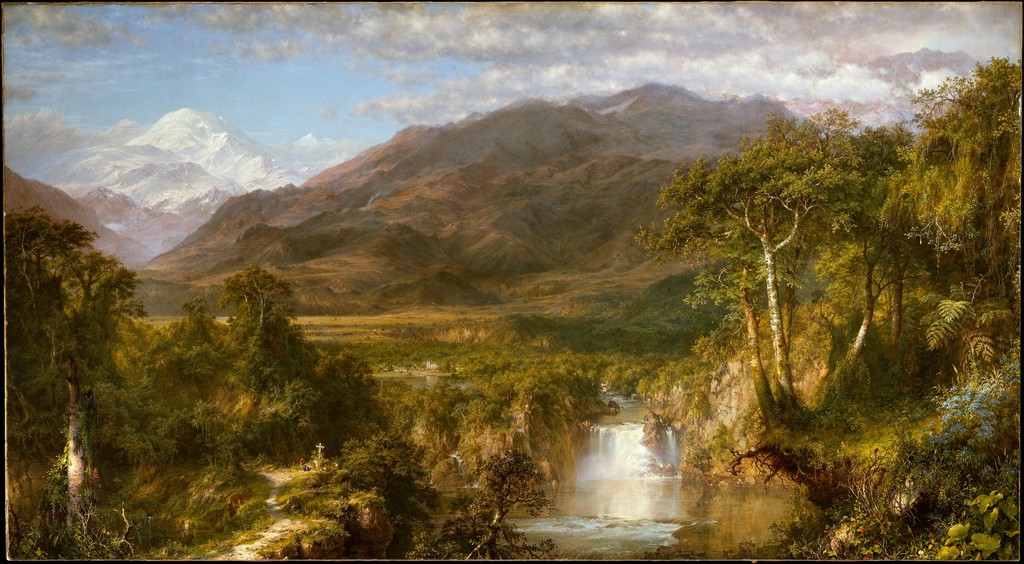
| The Heart of the Andes | 1859 | Oil on canvas |
| The Icebergs | 1861; foreground mast added between mid-1862 and early 1863 | Oil on canvas |
| Jerusalem from the Mount of Olives | 1870 | Oil on canvas |
| Mount Ktaadn | 1853 | Oil on canvas |
| Our Banner in the Sky | 1861 | Oil paint over lithograph on paper, laid down on cardboard |
| The Parthenon | 1871 | Oil on canvas |
| Rainy Season in the Tropics | 1866 | Oil on canvas |
| Storm in the Mountains | 1847 | Oil on canvas |
| Syria by the Sea | 1873 | Oil on canvas |
| Tamaca Palms | 1854 | Oil on canvas |
| Tropical Scenery | 1873 | Oil on canvas |
| Twilight in the Tropics | 1874; signed and dated, according to Bonhams’ catalogue | Oil on canvas |
| Twilight in the Wilderness | 1860 | Oil on canvas |
| View of Cotopaxi | 1857 | Oil on canvas |
| Niagara | 1857 | Oil on canvas |
| Magdalena River, New Granada, Equador | 1853 | Graphite heightened with white on wove paper |
| Tamaca Palm, Colombia or Ecuador | May–October 1853 | Graphite on gray laid paper |
| Mixed Sketches with a Champan, Río Magdalena, Colombia | May 1853 | Graphite on gray laid paper |
| Study for Rainy Season in the Tropics | 1865–1866 | Graphite on ruled notepad paper |
| Al-Khazneh, Petra (study) | February–March 1868 | Oil and graphite on tan paperboard |
| The Great Fall, Niagara (Charles Risdon, after Church) | 1874 impression | Hand-coloured chromolithograph on paperboard |
| The Heart of the Andes (William Forrest, after Church) | 1862 | Engraving in black on wove paper |
| Our Heaven Born Banner (William Bauly, adapting Church’s motif) | circa 1861 | Colour lithograph |
| A Tropical Moonlight (wood engraving after Church) | 1879 publication | Wood engraving in American Painters |
| Off Iceberg, Newfoundland | June 1859 | Oil and graphite on paperboard |
| Parthenon at Night, Athens | April 1869 | Oil and graphite on tan paperboard |
| Jerusalem from the Mount of Olives (study) | 1 April 1868 | Oil and graphite study |
| Horseshoe Falls (study) | December 1856–January 1857 | Oil on paper mounted to canvas |
| Niagara Falls, from the American Side | 1867 | Oil on canvas |
| Study for The Heart of the Andes | 1858 | Oil study |
| Mount Chimborazo through Rising Mist and Clouds | 1857 | Oil study |
| Cotopaxi Erupting, Viewed from Quito, Ecuador | June 1857 | Oil and graphite on tan paperboard |
| Cotopaxi (painted for Cyrus Field) | 1855 | Painting |
| Chimborazo | 1864 | Painting |
| Twilight, A Sketch | 1858 | Oil on canvas |
| View of Baalbek | 1868 | Oil and pencil on board |
| Three Bedouins | Date unconfirmed | Oil study |
| Coast Scene, Mount Desert (later canvas) | 1863 | Painting |
| The Wreck | Date unconfirmed | Painting |
| Grand Manan Island, Bay of Fundy | Date unconfirmed | Painting |
| Summer in South America | circa 1853 | Painting |
| Evening in Vermont | Date unconfirmed | Painting |
| Home by the Lake | Date unconfirmed | Painting |
| Storm in the Blue Mountains, Jamaica | August 1865 | Painting |
| The Natural Bridge, Virginia | 1852 | Painting |
| The Vale of St. Thomas, Jamaica | 1867 | Painting |
| Tequendama Falls, near Bogota, New Granada | Date unconfirmed | Painting |
| Sunrise in Syria | Before the 1876 exhibition | Painting |
| Cuernavaca (oil study; descriptive title) | 1898 | Oil study |
| Olana window design (descriptive title) | Date unconfirmed | Watercolour and graphite |
| Olana dining-room stencil sketch (descriptive title) | Date unconfirmed | Oil and graphite |
| Olana house (with Calvert Vaux) | 1870–1872; later additions | Architecture |
| Olana designed landscape | From 1860; developed over decades | Designed landscape |
Frequently Asked Questions
The design dates to 1861, following the April attack on Fort Sumter. Terra records a June commission for a chromolithograph after Church’s oil sketch.
The Terra version combines both: oil paint over a lithograph on paper laid down on cardboard. It is distinct from the initial oil sketch and from other printed or painted-over versions.
Its clouds and stars form a patriotic image associated with the Union cause. Northern viewers embraced it during the early Civil War, according to Terra’s interpretation.
It belongs to the Terra Foundation for American Art, Daniel J. Terra Collection, accession 1992.27.
It is a separate print credited to William Bauly, Sarony, Major & Knapp and publisher William Schaus, adapting the motif of Church’s celestial flag.
Discussion
Look again at the images and ideas explored in Our Banner in the Sky. These editorial prompts invite your own observations.
What changes when the bare tree becomes a soldier’s rifle? Compare how the two pictures connect the flag to landscape and to human action.
Reader Insights
At what point does the arrangement of clouds begin to look like a flag?
How do dawn light and dark trees affect the image’s mood?
What changes when you compare the oil sketch with its published print?
Join the Conversation
Share a detail, comparison or question about Our Banner in the Sky below.
References
- Terra Foundation for American Art, Our Banner in the Sky, Conversations with the Collection. Exact Terra object, medium, dimensions, sketch and print sequence, qualified hand painting and Northern reception.
- National Archives, Telegram Announcing the Surrender of Fort Sumter (1861). Historical explanation and transcription of Anderson’s 18 April telegram.
- Kevin J. Avery, Rally ’round the Flag: Frederic Edwin Church and the Civil War, Antiques & Fine Art, Spring 2011, pp. 208–213. Wartime context, print circulation and comparisons.
- Olana, Rally Round the Flag: Frederic Edwin Church and the Civil War. Historical exhibition account, dawn interpretation and separate Icebergs fundraiser.
- Karen Zukowski, Historic Furnishings Report for Olana State Historic Site, April 2001, part 2, pp. 431–432. Olana OL.1976.29 and the reported 1998 examination.
- Our Heaven Born Banner, Wikimedia Commons image record with Library of Congress catalogue description. Makers, approximate date, copyright deposit, subject and accompanying verse; picture-area reproduction in the public domain.
- Splash image source.
Frederic Edwin Church, Our Banner in the Sky, 1861. Oil paint over lithograph on paper, laid down on cardboard, 19.0 × 28.9 cm. Terra Foundation for American Art, Daniel J. Terra Collection, 1992.27; photograph Choliamb, via Wikimedia Commons. Image source. Public domain: PD-old-100-expired / faithful 2D reproduction PD-Art / Public Domain Mark. Resized; full source proportions retained.