 by Tom Gurney
Tom Gurney BSc (Hons) is an art history expert with over 20 years experience
Published on June 19, 2020 / Updated on October 27, 2026
Email: tomgurney1@gmail.com / Phone: +44 7429 011000
Storm in the Mountains: Introduction
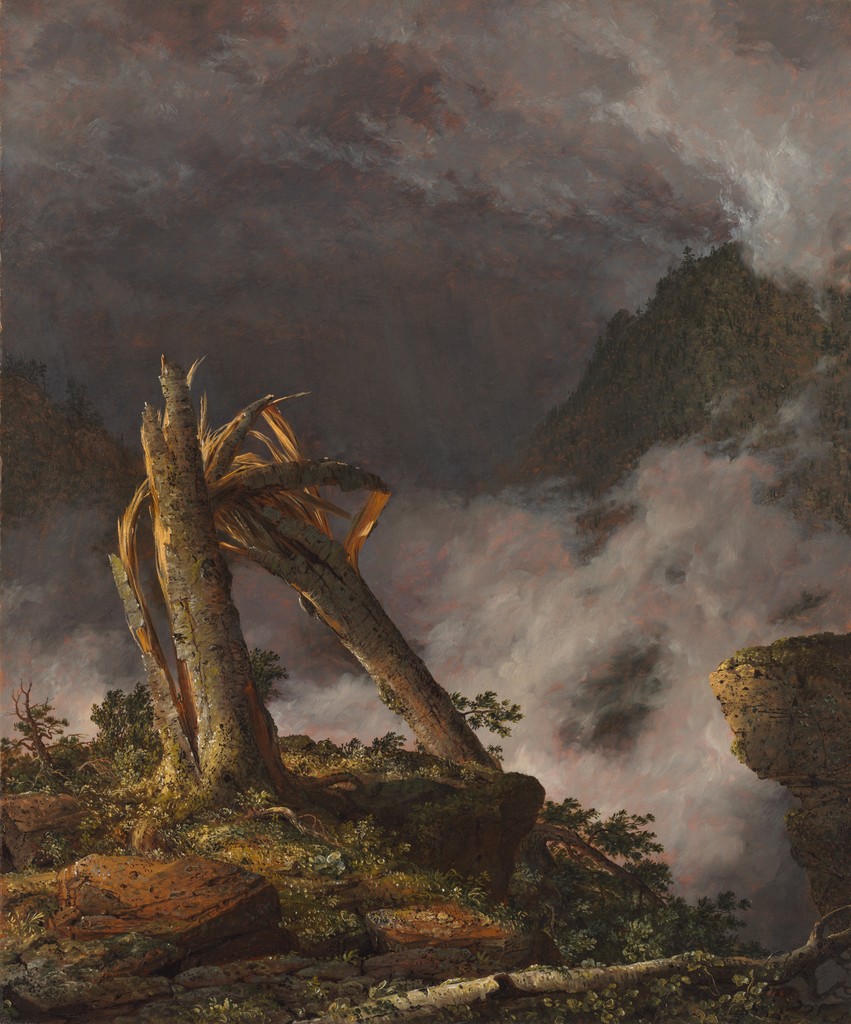
A broken tree commands the foreground of Frederic Edwin Church’s Storm in the Mountains. Its torn wood catches the light, while clouds pass across a deep, shadowed ravine behind it. Painted in 1847, this upright landscape brings the spectator close to the damage and leaves the surrounding mountains partly concealed.
The canvas belongs to the Cleveland Museum of Art. It is an early work in which a forceful arrangement of tree, rock and cloud already makes looking into the landscape an absorbing experience.[1]
At a Glance
- ArtistFrederic Edwin Church
- TitleStorm in the Mountains
- Date1847
- MediumOil on canvas
- Dimensions, unframed75.5 × 62.8 cm; 29¾ × 24¾ inches
- CollectionCleveland Museum of Art
- Accession number1969.52
- CreditGift of various donors by exchange and Purchase from the J. H. Wade Fund
This work across Church’s career
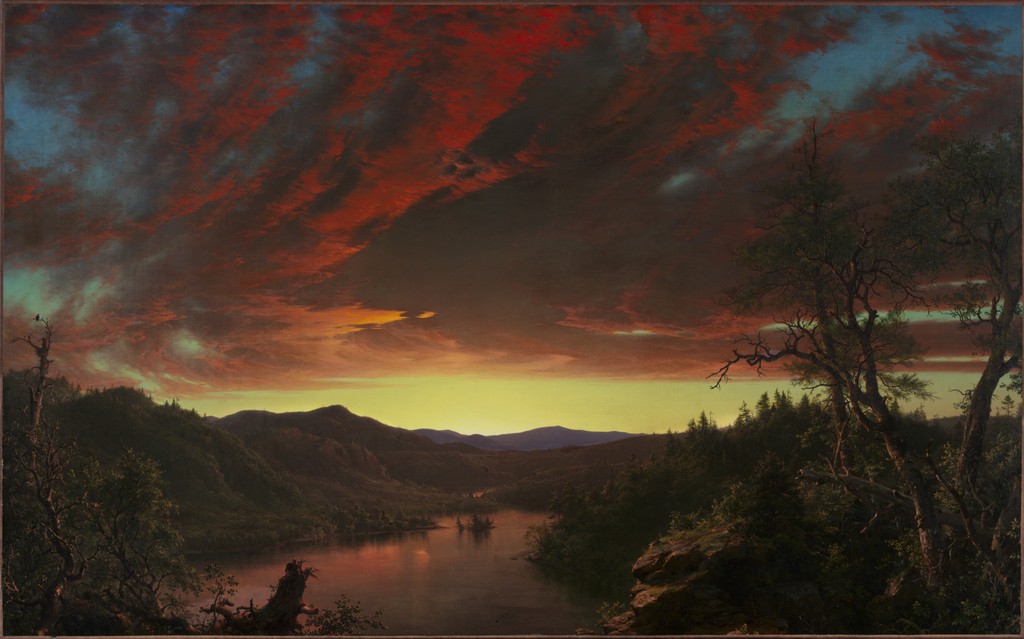
Tamaca Palms
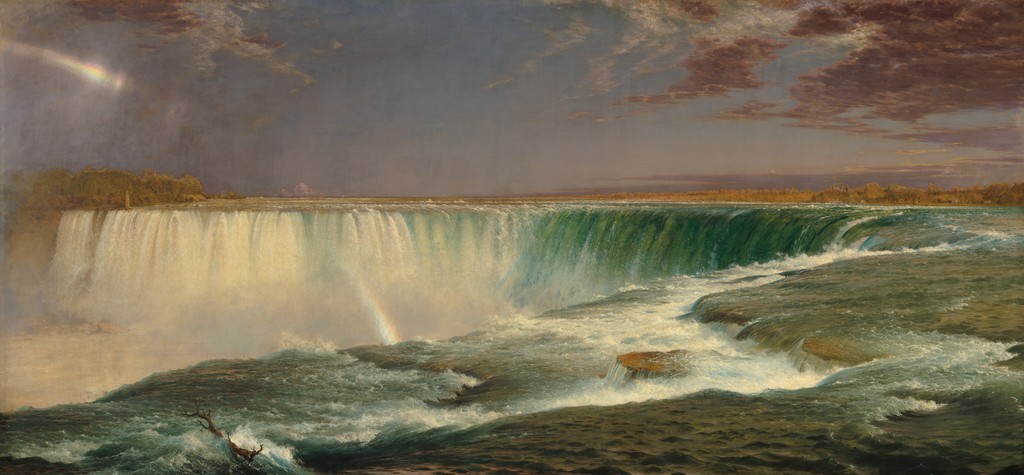
1854Niagara
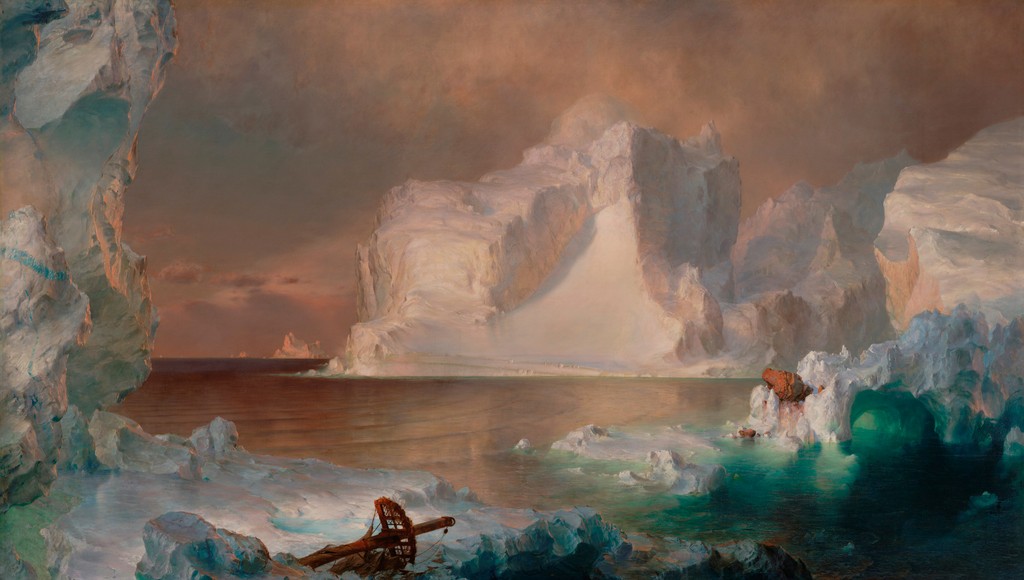
1857The Icebergs
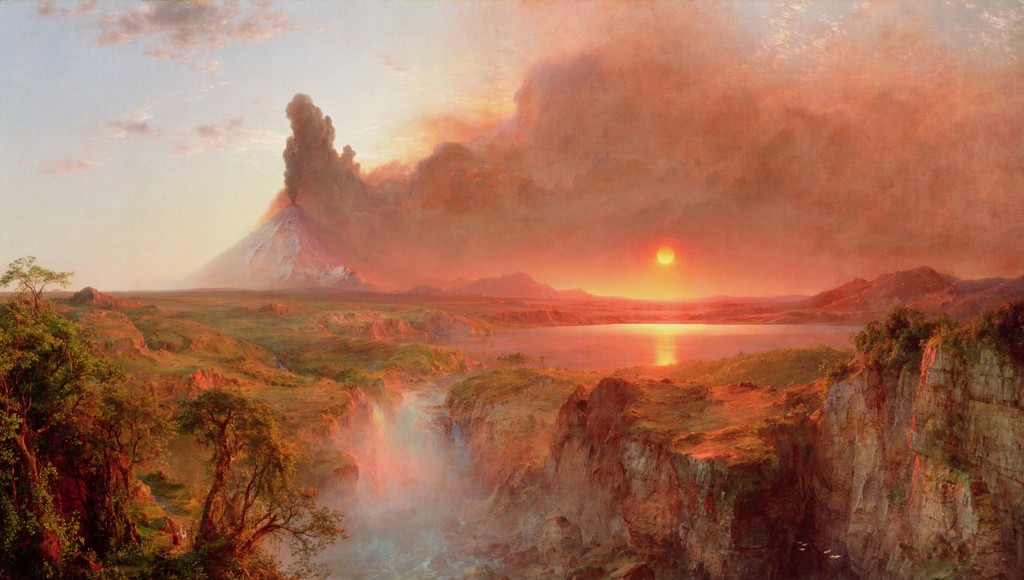
1861; foreground mast added between mid-1862 and early 1863Cotopaxi
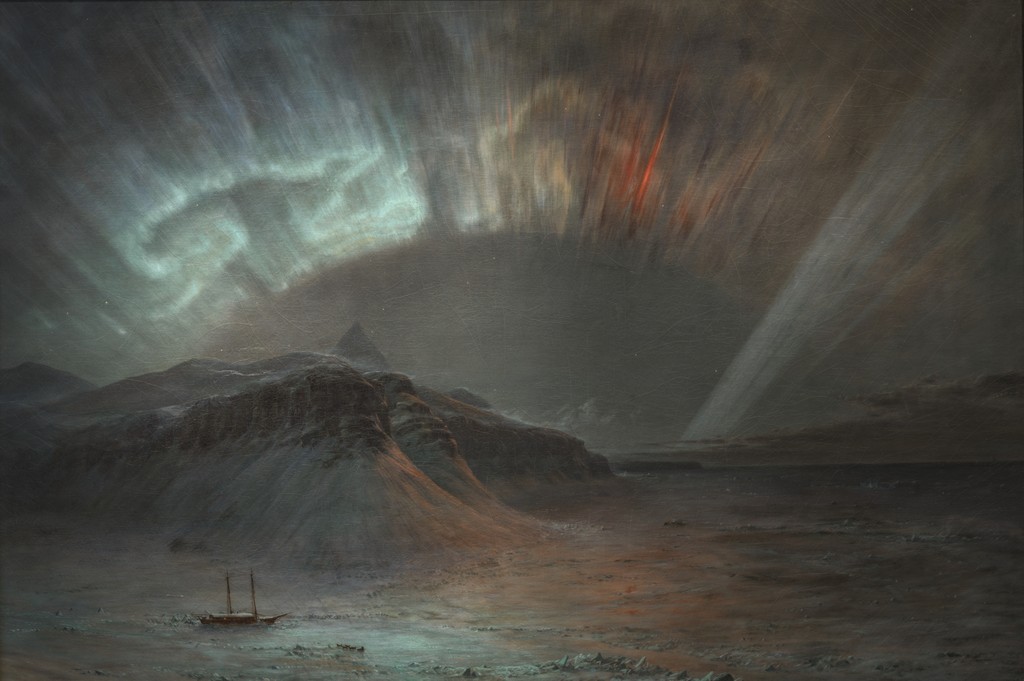
1862Aurora Borealis
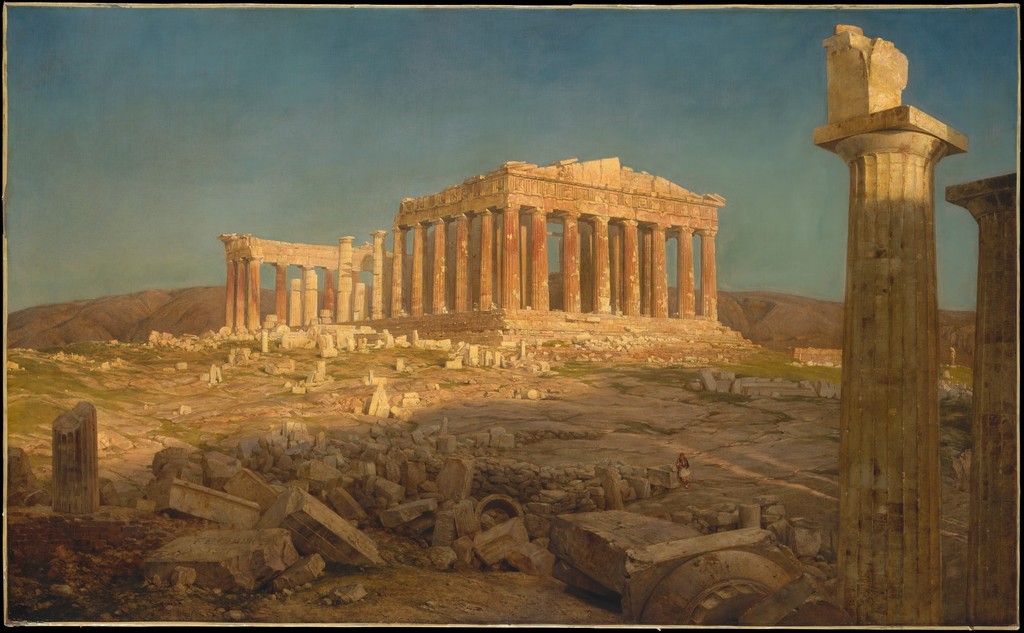
1865The Parthenon
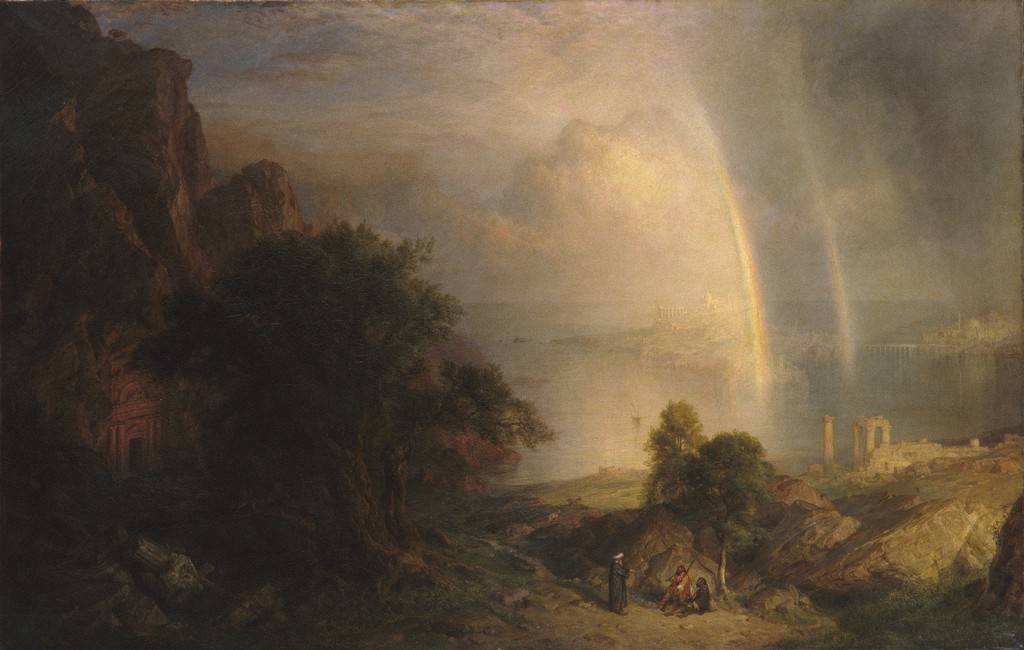
1871The Aegean Sea
About 1877Contents
- The broken tree brings the storm close
- Clouds conceal the mountain ravine
- Small plants and exposed rock
- A comparison with Cole’s The Whirlwind
- Church’s early career and the Art-Union
- From the Merrick family to Cleveland
- A different opening in Above the Clouds at Sunrise
- Discussion Questions
- Annotated details
The broken tree brings the storm close
The tree stands to the left of centre, rising from a rocky ledge. Part of its trunk remains upright, ending in sharp splinters. Another substantial section has folded over and slopes toward the ground on the right. Long strips of exposed wood connect the broken parts, making the injury both dramatic and unusually specific.
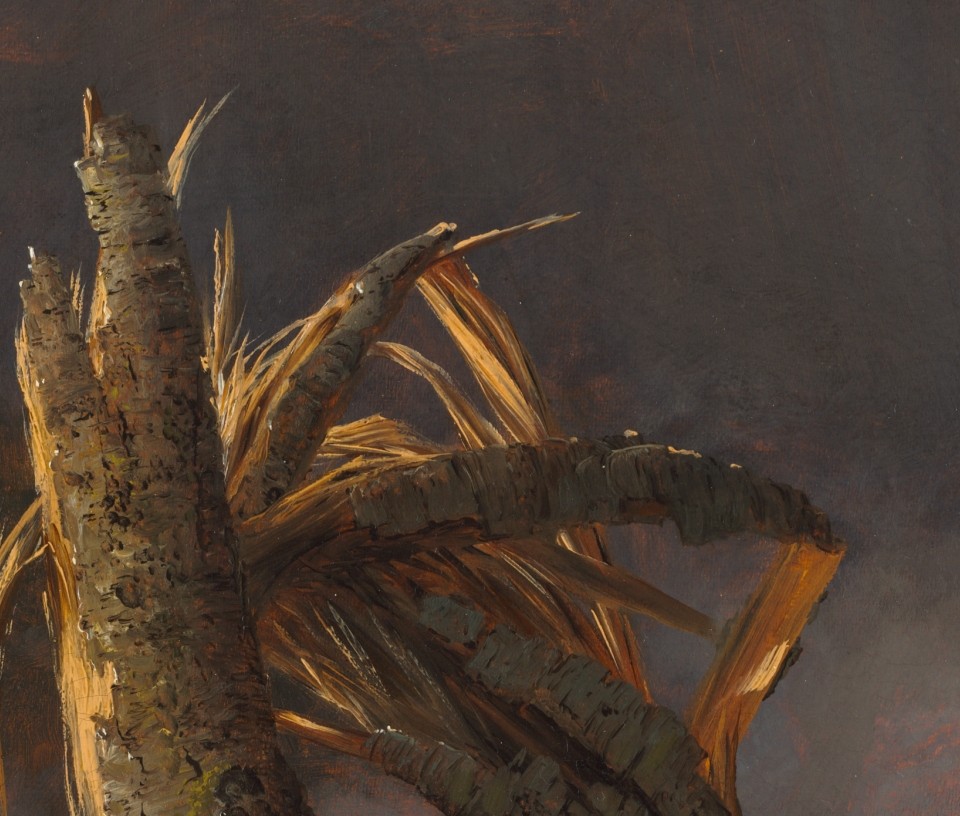
Warm yellow and golden brown distinguish these strips from the rougher bark. The brightest passages occur around the break, where thin fibres spread in several directions. Their narrow, pointed shapes interrupt the heavier outlines of the trunk. Church makes the spectator notice how the tree has come apart, rather than simply registering a dead tree within a larger view.
Its position also determines our sense of distance. The trunk is close enough for bark, moss and small knots to become separate features. Behind it, slopes and clouds merge into broader areas of colour. The tree therefore provides a firm place to begin looking, even as the space beyond becomes difficult to measure.
The leaning section reaches diagonally across the foreground. Following it carries the eye down toward plants and broken ground, while the standing trunk draws attention upward into darker air. Those opposing movements make the damaged tree an active part of the composition. Its apparent instability gives urgency to a scene that contains no prominent human witness.
Annotated Details from Storm in the Mountains
The numbered points draw attention to visible features discussed in this article. Look from each detail back to the full composition. Frederic Edwin Church, Storm in the Mountains, 1847. Oil on canvas, 75.5 × 62.8 cm, unframed. Cleveland Museum of Art, Gift of various donors by exchange and Purchase from the J. H. Wade Fund, 1969.52. Cleveland Open Access, CC0. Source image. CC0 / Cleveland Museum of Art Open Access. Numbered overview resized; detail crops added from the source master. No recolouring.
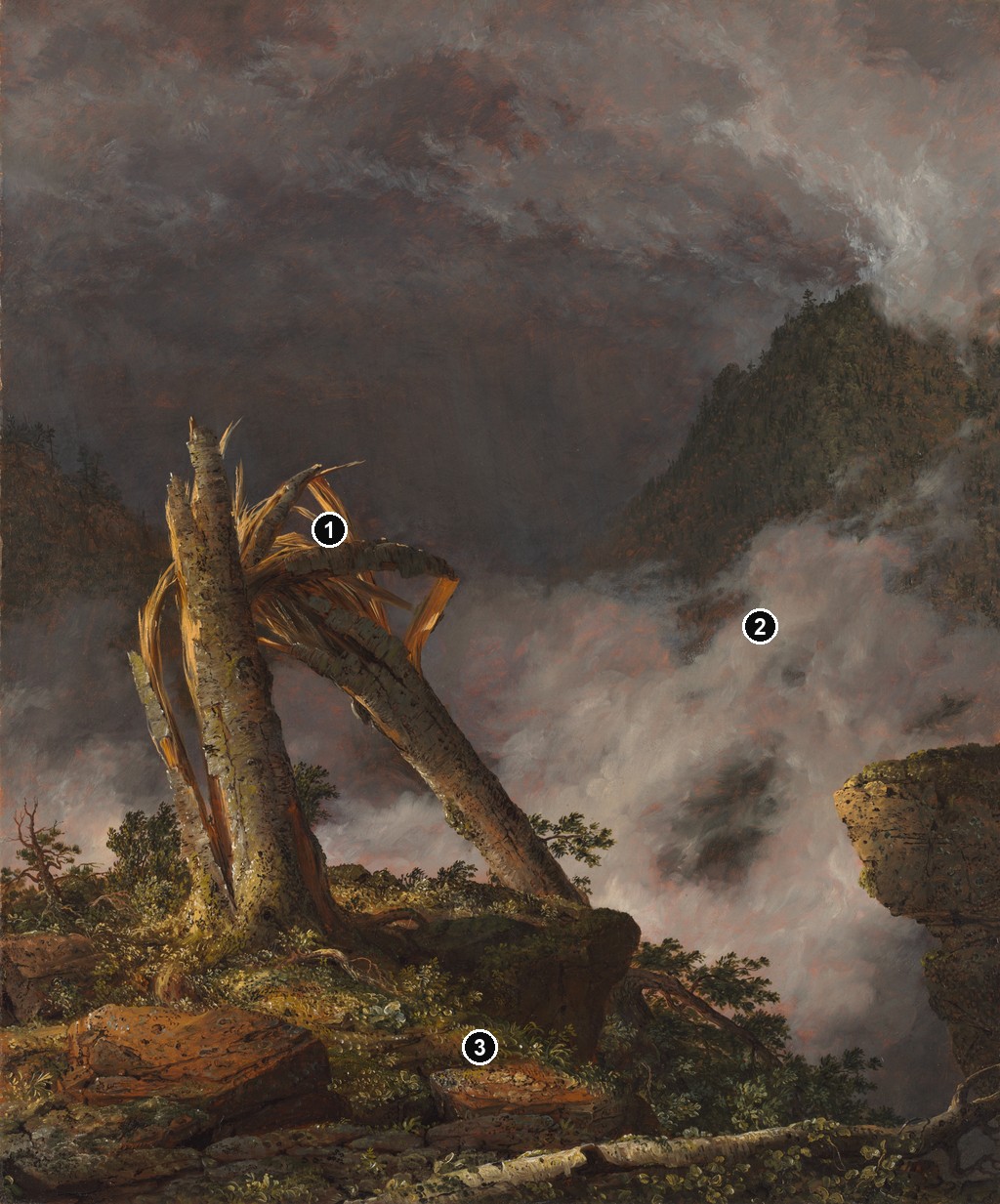
Details from STORM IN THE MOUNTAINS
These crops come directly from the verified source images. They preserve the original colours or printed tones; the numbered overview is a separate aid to looking.
Broken trunk
Golden splinters stand out against darker wood and cloud. The damaged trunk brings the storm into the nearby space.
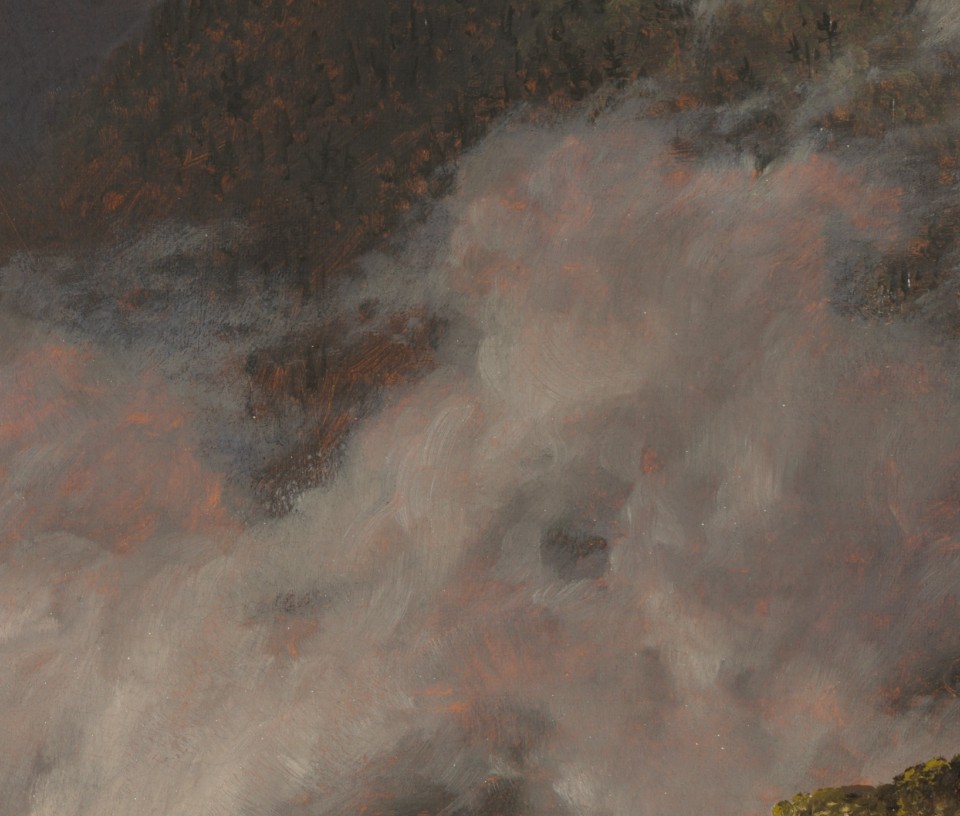
Clouds in the ravine
Lighter ribbons of cloud interrupt the darker mountain forms. Their partial concealment makes the depth of the ravine change as you look.
Foreground ledges
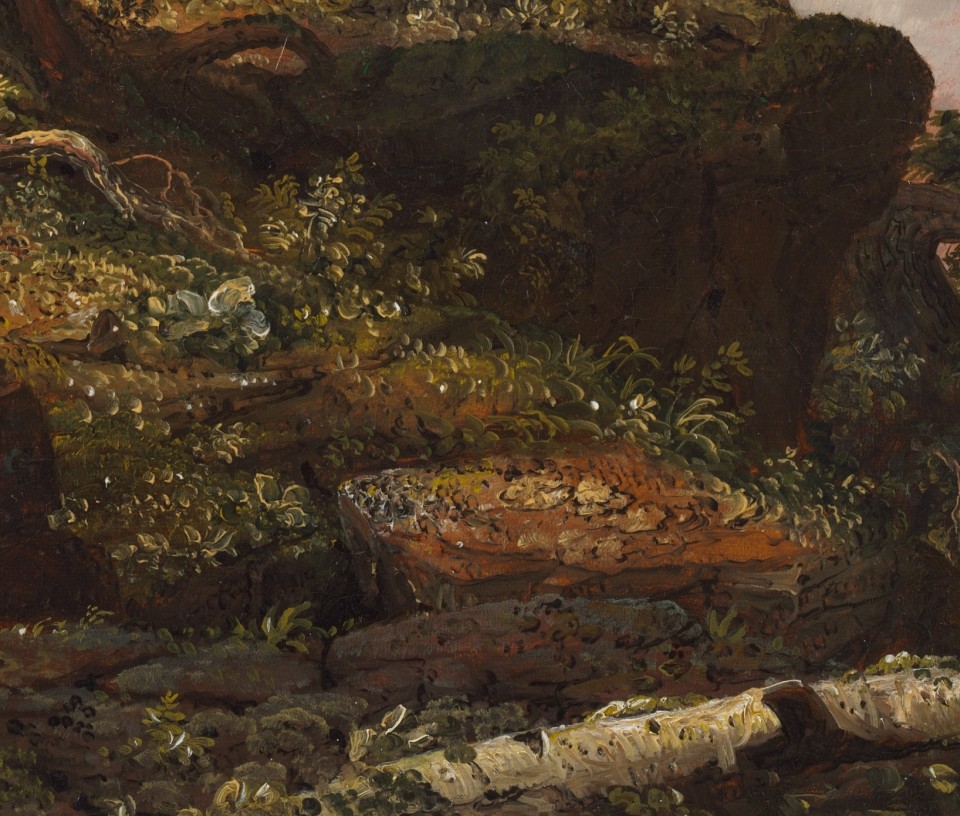
Rock, moss and fallen wood gather near the lower edge. Their different surfaces give the foreground more concentrated detail than the veiled distance.
Clouds conceal the mountain ravine
Church offers no broad, uninterrupted horizon. A forested ridge emerges on the right, with an irregular summit and a steep side that disappears behind pale vapour. Darker forms occupy the centre and upper left. Together they suggest considerable depth, but the intervening clouds prevent a clear survey of the terrain.
The lightest cloud passages sweep diagonally through the middle of the painting. Their soft edges contrast with the tree’s sharply described splinters and the projecting rock at the right. In places, the vapour thins enough to reveal fragments of slope; elsewhere, it closes the view. Distance is presented as something the spectator must piece together.
This concealment helps establish the painting’s atmosphere. The foreground feels tangible, while the mountains appear extensive and uncertain. An abrupt drop seems to separate the near ledge from the ridge across the ravine. The clouds cross that gap, linking the two sides visually without making the space easy to enter.
The upright canvas strengthens the effect. Instead of spreading out across a wide panorama, the landscape rises above the spectator. Much of the upper area remains dark and unsettled. The broken tree is large within our immediate surroundings, yet the sky and obscured mountains suggest forces operating on a much greater scale.
Small plants and exposed rock
Closer inspection finds considerable variety around the tree’s base. Moss covers portions of the ledge, low plants grow between stones, and small shrubs reach into the space beyond. A fallen length of pale wood lies across the bottom of the picture. These details make the foreground an uneven surface with its own history of growth and decay.
The rock projecting from the right edge forms a second nearby anchor. Its lit face is set against the cloud-filled opening, giving the drop between the two foreground ledges particular emphasis. The spectator can look across that opening, but Church supplies no bridge or clear path through it.
Living vegetation also complicates the scene’s destructive mood. The shattered trunk dominates, while green growth continues around it. The Cleveland Museum of Art interprets the lightning-blasted tree as an expression of nature’s power and the recurring relationship between life and death. That reading draws attention to the coexistence of damage and renewal within the foreground.[1]
The visible evidence remains concentrated on the aftermath. The split trunk suggests a violent event; the canvas itself offers no clearly depicted lightning bolt. Church allows the injury, troubled air and enclosing terrain to carry the drama, without requiring a precisely timed account of a particular storm.
A comparison with Cole’s The Whirlwind
In the National Gallery of Art’s 1989 Church catalogue, Franklin Kelly compares Storm in the Mountains with Edward Gallaudet’s engraving after Thomas Cole’s The Whirlwind. He identifies a strong compositional relationship while distinguishing Church’s precise handling and attention to light and atmosphere.[2]
The engraving provides a useful visual comparison. A large, torn trunk occupies the foreground, its splintered wood curling upward against the sky. Smaller trees bend farther back, and a jagged flash of lightning appears above them. The close tree and turbulent surroundings make natural violence immediately legible.
Gallaudet’s lines describe bark, fibres, foliage and cloud through differences of direction and density. Church’s canvas can use colour as well as light and dark: warm exposed wood, green plants and grey-brown atmosphere distinguish its materials. The comparison brings out the different means through which a printed image and an oil painting can make a damaged tree convincing.
The National Gallery dates its impression of Gallaudet’s engraving to 1836; its bibliography records publication in The Token and Atlantic Souvenir for 1837. The engraving reproduced here is the National Gallery’s impression, whereas Kelly illustrated an impression in the Museum of Fine Arts, Boston.[3]
These distinctions matter when comparing the images. The print shows a composition after Cole, mediated through Gallaudet’s engraving. Its resemblance to Church’s canvas supports Kelly’s discussion of an artistic precedent, but does not establish a step-by-step copying procedure. Looking between them is most revealing when it includes their differences: Church’s more upright remaining trunk, illuminated fibres and cloud-obscured depth.
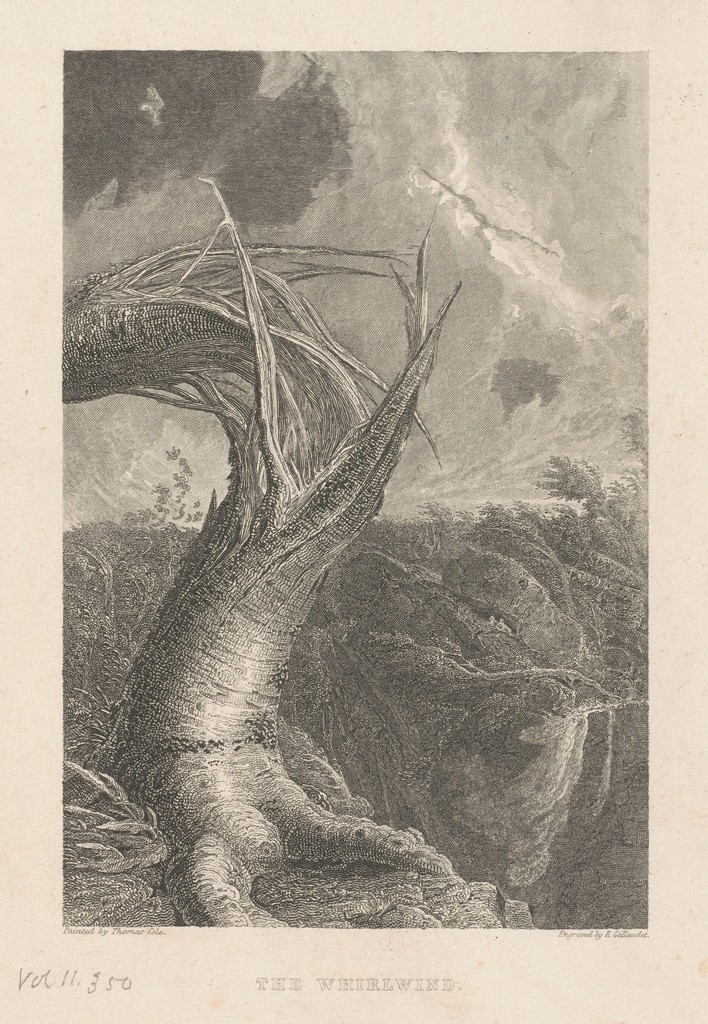
Edward Gallaudet after Thomas Cole, The Whirlwind, 1836. Engraving in black on wove paper. National Gallery of Art, Washington, Corcoran Collection (Gift of Alice F. Williams, 1958), 2015.19.920; digital image via Rawpixel, CC0. This NGA impression differs from the MFA impression illustrated in Kelly’s catalogue. Courtesy National Gallery of Art, Washington, Corcoran Collection (Gift of Alice F. Williams, 1958), 2015.19.920; digital image via Rawpixel. Image source. CC0 1.0 Universal; explicit Rawpixel Free for Personal and Business use / public-domain image. Resized; full source proportions retained.
Watch: Frederic Edwin Church
Choose a film to explore the artist’s work, its interpretation and its wider setting.
Frederic Edwin Church's "The Icebergs" on the Move at the DMA
Follow the Dallas Museum of Art as it moves Church’s large painting The Icebergs.
Watch on YouTubeChurch’s early career and the Art-Union
Debora Rindge’s chronology in the same catalogue records Church’s study with Cole from June 1844 until 1846. In autumn 1847, Church moved to the Art-Union Building at 497 Broadway in New York. Storm in the Mountains was exhibited at the American Art-Union that year as number 120.[2]
This places the painting shortly after his tuition, at the beginning of an independent career. The close relationship with Cole’s work is therefore understandable, while the handling of light and material gives the young artist a means of developing his own approach. His biography follows that development into the journeys and larger paintings of later years.
The Art-Union offered an important setting for American artists to reach an audience. The Metropolitan Museum of Art explains its combination of a public Free Gallery, annual five-dollar subscriptions, an engraved print for members and a year-end lottery distributing artworks. Its national network helped create a market for landscapes and other contemporary American art.[4]
Exhibiting there put Church’s mountain scene within that growing culture of viewing and collecting. Its arresting foreground could attract an initial glance, while the smaller plants, changing cloud edges and distant ridge rewarded sustained attention. The painting joins an imposing subject to details that invite the spectator to keep exploring.
From the Merrick family to Cleveland
The Cleveland museum’s provenance records a sale to E. G. Merrick of Clayton, New York, followed by ownership within the family until 1967. It then lists Adams Davidson and Company in Washington, and Hirschl and Adler in New York, which sold the canvas to Cleveland in 1969.[1]
That history connects the early landscape with its present collection. It also separates the painting’s 1847 exhibition from the later transfers through which it reached the museum. An exhibition date alone does not supply the date or circumstances of every change of ownership.
A different opening in Above the Clouds at Sunrise
Church’s Above the Clouds at Sunrise, dated 1849, offers another way of arranging trees and vapour. Its horizontal canvas opens toward a bright distant band, with dark trees framing a more expansive sky. The work is now identified as belonging to a private collection in New York.[5]
Set beside Storm in the Mountains, it makes the earlier painting’s enclosure especially apparent. In the storm scene, the spectator remains close to broken wood and looks into a dark, partly hidden ravine. In the sunrise, the eye can travel farther across an illuminated opening. Both landscapes use nearby trees to establish our position, but the surrounding atmosphere produces a different experience of distance.
Return finally to the torn fibres in the 1847 canvas, then follow the pale clouds toward the right-hand ridge. That movement connects a sharply defined fragment with an immense, obscured setting. It captures the painting’s particular balance: the storm becomes comprehensible through the damage to one tree, while the wider landscape retains its scale and uncertainty.
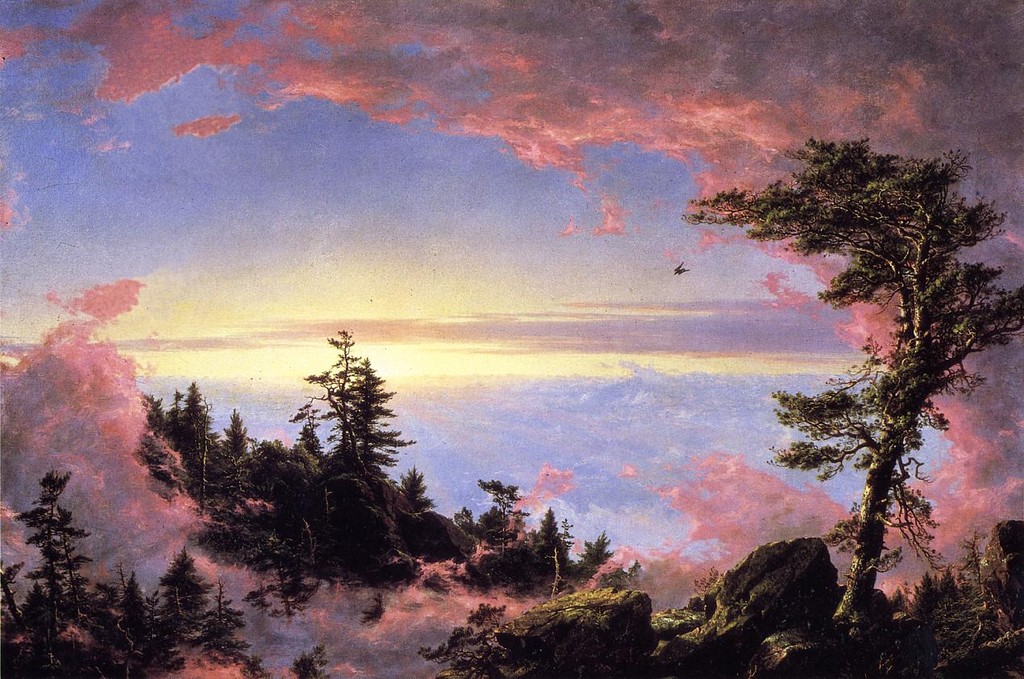
Frederic Edwin Church, Above the Clouds at Sunrise, 1849. Oil on canvas, 69.2 × 102.2 cm. Private Collection, New York, c/o Fine Art Brokers. Faithful public-domain reproduction via Wikimedia Commons, source ArtRenewal.com; PD-old-100-expired / Public Domain Mark 1.0. Frederic Edwin Church, Above the Clouds at Sunrise, 1849. Private Collection, New York, c/o Fine Art Brokers. Public-domain reproduction via Wikimedia Commons, source ArtRenewal.com; uploaded by Keraunoscopia.. Image source. Public domain: faithful 2D reproduction; PD-old-100-expired. Resized; full source proportions retained.
Discussion Questions
- How does the tree’s sharp detail affect the apparent distance of the clouds and ridge?
- What changes when the torn trunk is described through engraved lines rather than colour?
- How does the upright format shape your experience of the ravine?
Artworks directory
A documented selection of Church’s works discussed across these articles, together with identified prints after his designs. This is not a catalogue raisonné. Repeated titles and aliases are reconciled; studies remain distinct from finished paintings. Some dates remain unconfirmed. Other makers are named where a print adapts Church’s work.
| Name | Date | Medium |
|---|---|---|
| Above the Clouds at Sunrise | 1849 | Oil on canvas |
| The Aegean Sea | About 1877 | Oil on canvas |
| The Andes of Ecuador | 1855 | Oil on canvas |
| Aurora Borealis | 1865 | Oil on canvas |
| Autumn in North America | Circa 1856 | Oil on board |
| Coast Scene | 1852 | Oil on canvas |
| Cotopaxi | 1862 | Oil on canvas |
| A Country Home | 1854 | Oil on canvas |
| El Khasné, Petra | 1874 | Oil on canvas |
| El Rio de Luz | 1877 | Oil on canvas |
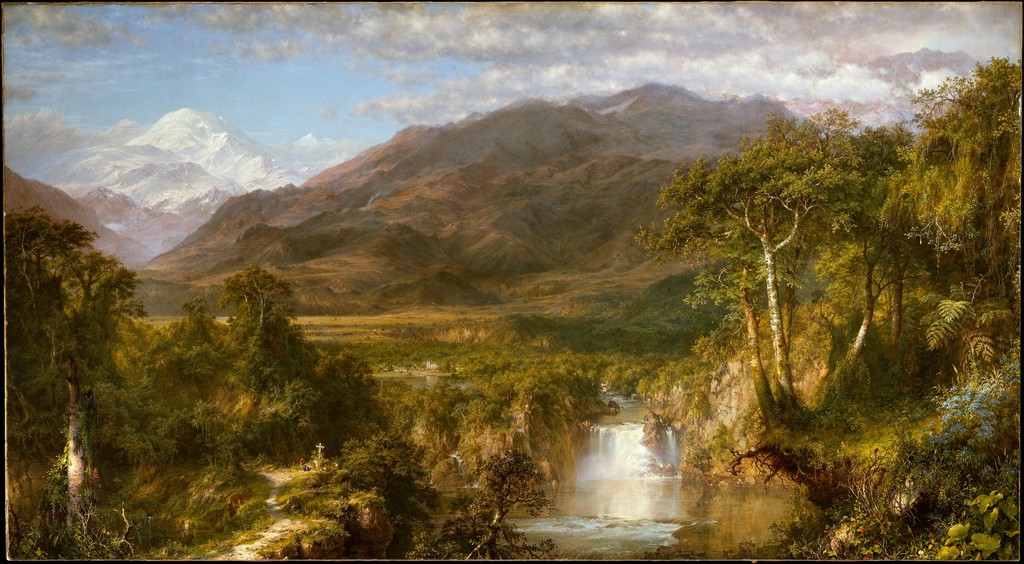
| The Heart of the Andes | 1859 | Oil on canvas |
| The Icebergs | 1861; foreground mast added between mid-1862 and early 1863 | Oil on canvas |
| Jerusalem from the Mount of Olives | 1870 | Oil on canvas |
| Mount Ktaadn | 1853 | Oil on canvas |
| Our Banner in the Sky | 1861 | Oil paint over lithograph on paper, laid down on cardboard |
| The Parthenon | 1871 | Oil on canvas |
| Rainy Season in the Tropics | 1866 | Oil on canvas |
| Storm in the Mountains | 1847 | Oil on canvas |
| Syria by the Sea | 1873 | Oil on canvas |
| Tamaca Palms | 1854 | Oil on canvas |
| Tropical Scenery | 1873 | Oil on canvas |
| Twilight in the Tropics | 1874; signed and dated, according to Bonhams’ catalogue | Oil on canvas |
| Twilight in the Wilderness | 1860 | Oil on canvas |
| View of Cotopaxi | 1857 | Oil on canvas |
| Niagara | 1857 | Oil on canvas |
| Magdalena River, New Granada, Equador | 1853 | Graphite heightened with white on wove paper |
| Tamaca Palm, Colombia or Ecuador | May–October 1853 | Graphite on gray laid paper |
| Mixed Sketches with a Champan, Río Magdalena, Colombia | May 1853 | Graphite on gray laid paper |
| Study for Rainy Season in the Tropics | 1865–1866 | Graphite on ruled notepad paper |
| Al-Khazneh, Petra (study) | February–March 1868 | Oil and graphite on tan paperboard |
| The Great Fall, Niagara (Charles Risdon, after Church) | 1874 impression | Hand-coloured chromolithograph on paperboard |
| The Heart of the Andes (William Forrest, after Church) | 1862 | Engraving in black on wove paper |
| Our Heaven Born Banner (William Bauly, adapting Church’s motif) | circa 1861 | Colour lithograph |
| A Tropical Moonlight (wood engraving after Church) | 1879 publication | Wood engraving in American Painters |
| Off Iceberg, Newfoundland | June 1859 | Oil and graphite on paperboard |
| Parthenon at Night, Athens | April 1869 | Oil and graphite on tan paperboard |
| Jerusalem from the Mount of Olives (study) | 1 April 1868 | Oil and graphite study |
| Horseshoe Falls (study) | December 1856–January 1857 | Oil on paper mounted to canvas |
| Niagara Falls, from the American Side | 1867 | Oil on canvas |
| Study for The Heart of the Andes | 1858 | Oil study |
| Mount Chimborazo through Rising Mist and Clouds | 1857 | Oil study |
| Cotopaxi Erupting, Viewed from Quito, Ecuador | June 1857 | Oil and graphite on tan paperboard |
| Cotopaxi (painted for Cyrus Field) | 1855 | Painting |
| Chimborazo | 1864 | Painting |
| Twilight, A Sketch | 1858 | Oil on canvas |
| View of Baalbek | 1868 | Oil and pencil on board |
| Three Bedouins | Date unconfirmed | Oil study |
| Coast Scene, Mount Desert (later canvas) | 1863 | Painting |
| The Wreck | Date unconfirmed | Painting |
| Grand Manan Island, Bay of Fundy | Date unconfirmed | Painting |
| Summer in South America | circa 1853 | Painting |
| Evening in Vermont | Date unconfirmed | Painting |
| Home by the Lake | Date unconfirmed | Painting |
| Storm in the Blue Mountains, Jamaica | August 1865 | Painting |
| The Natural Bridge, Virginia | 1852 | Painting |
| The Vale of St. Thomas, Jamaica | 1867 | Painting |
| Tequendama Falls, near Bogota, New Granada | Date unconfirmed | Painting |
| Sunrise in Syria | Before the 1876 exhibition | Painting |
| Cuernavaca (oil study; descriptive title) | 1898 | Oil study |
| Olana window design (descriptive title) | Date unconfirmed | Watercolour and graphite |
| Olana dining-room stencil sketch (descriptive title) | Date unconfirmed | Oil and graphite |
| Olana house (with Calvert Vaux) | 1870–1872; later additions | Architecture |
| Olana designed landscape | From 1860; developed over decades | Designed landscape |
Frequently Asked Questions
Church painted it in 1847, soon after studying with Thomas Cole. It was exhibited at the American Art-Union that year.
The canvas belongs to the Cleveland Museum of Art, accession number 1969.52.
Its illuminated splinters draw attention to the foreground. The museum interprets it as a lightning-blasted tree associated with nature’s power and the cycle of life and death.
It is Edward Gallaudet’s engraving after Cole’s The Whirlwind, dated 1836 by the National Gallery of Art. It is a printed interpretation of Cole’s composition.
Discussion
Look again at the images and ideas explored in Storm in the Mountains. These editorial prompts invite your own observations.
Reader Insights
How does the broken tree bring the storm into the nearby space?
Which glimpses through the clouds help you understand the ravine?
What does the comparison with Cole’s storm scene help you notice about Church’s arrangement?
Join the Conversation
Share a detail, comparison or question about Storm in the Mountains below.
References
- Cleveland Museum of Art. Storm in the Mountains, 1847, accession 1969.52: object record, interpretation, provenance and exhibition history.
- National Gallery of Art. Frederic Edwin Church, exhibition catalogue, 1989: Franklin Kelly, pp. 36–37; Debora Rindge, chronology p. 158.
- National Gallery of Art. Edward Gallaudet after Thomas Cole, The Whirlwind, 1836, accession 2015.19.920.
- Metropolitan Museum of Art. Distribution of the American Art-Union Prizes, at the Tabernacle, Broadway, December 24, 1847; lithograph published 1848.
- Metropolitan Museum of Art. Above the Clouds at Sunrise, 1849, loan record L.2026.3.
- Splash image source.
Frederic Edwin Church, Storm in the Mountains, 1847. Oil on canvas, 75.5 × 62.8 cm, unframed. Cleveland Museum of Art, Gift of various donors by exchange and Purchase from the J. H. Wade Fund, 1969.52. Cleveland Open Access, CC0. Image source. CC0 / Cleveland Museum of Art Open Access. Resized; full source proportions retained.