



 by Tom Gurney
Tom Gurney BSc (Hons) is an art history expert with over 20 years experience
Published on June 19, 2020 / Updated on November 2, 2026
Email: tomgurney1@gmail.com / Phone: +44 7429 011000
Dahlias at Petit Gennevilliers: Introduction
The dahlias stand so close that their leaves and flowers seem almost to press against the picture's surface. Beyond them, a narrow path leads past a woman and a small dog towards a house with a red roof. A large greenhouse rises behind the flowers, its pale curved roof answering the roofline of the house. Gustave Caillebotte painted this view in 1893; the canvas now belongs to the National Gallery of Art in Washington. [1]
The picture brings several kinds of order into a single garden: the growth of plants, the geometry of buildings and paths, and the measured recession of the painted space. Its unusually prominent foreground makes flowers the first encounter, while the woman gives the distant part of the garden a human scale. This is a particular view of a place Caillebotte cultivated and repeatedly painted, rather than a general image of an Impressionist garden. Marie Berhaut's catalogue distinguishes it from a smaller version of the same arrangement without the woman and dog. [2]
At a Glance
- ArtistGustave Caillebotte
- Date1893
- MediumOil on canvas
- Dimensions157 × 114 cm
- CollectionNational Gallery of Art, Washington
- Accession2016.48.1; gift of the Scharffenberger Family. [1]
- CatalogueBerhaut 462, Les Dahlias, jardin du Petit Gennevilliers. [2]
This work across Gustave Caillebotte’s career
Contents
- Entering the garden
- The greenhouse and the house
- A woman, a dog and a pause on the path
- A garden made over time
- Variations on a cultivated view
- Light and the painted surface
- From a private garden to a public collection
- Annotated details
Entering the garden
The first obstacle to an easy survey is the dahlia bed itself. It occupies most of the lower right of the painting and continues beyond both the lower and right edges. Several coral-red flower heads are clearly separated against their surroundings, but below them the foliage thickens into a mass of overlapping dark and light strokes. Yellow blooms appear nearer the edge and farther down the canvas. The eye can identify individual flowers without being able to count or disentangle all the plants.
Against that abundance, the strip of lawn on the left has a remarkably simple shape. Its straight clipped edge confines the path, which enters at the bottom and narrows towards the house. The contrast makes the garden legible. One side supplies a continuous boundary; the other repeatedly interrupts the route with projecting leaves. We see enough of the path to imagine moving through the scene, yet the flowers keep drawing attention back to the foreground.
The woman stands well along this route. Although she is a substantial figure within the garden, she is smaller in the picture than the nearby mass of dahlias. That disparity tells us how close the painter's viewpoint is to the bed. Her hat and long blue skirt help measure the distance between the large flowers and the house, while the little dark dog marks an intermediate point on the path. Depth is established through differences of size as much as through converging lines.
The upper half gives the composition more air. The house is surrounded by trees rather than exposed in isolation, and clouds cross a blue sky above its chimneys. The broad space of sky prevents the lower half's crowded growth from closing over the whole image. At the same time, the greenhouse sweeps upwards to the right edge. Its rise counters the path's movement into the distance, setting two strong directions against one another.
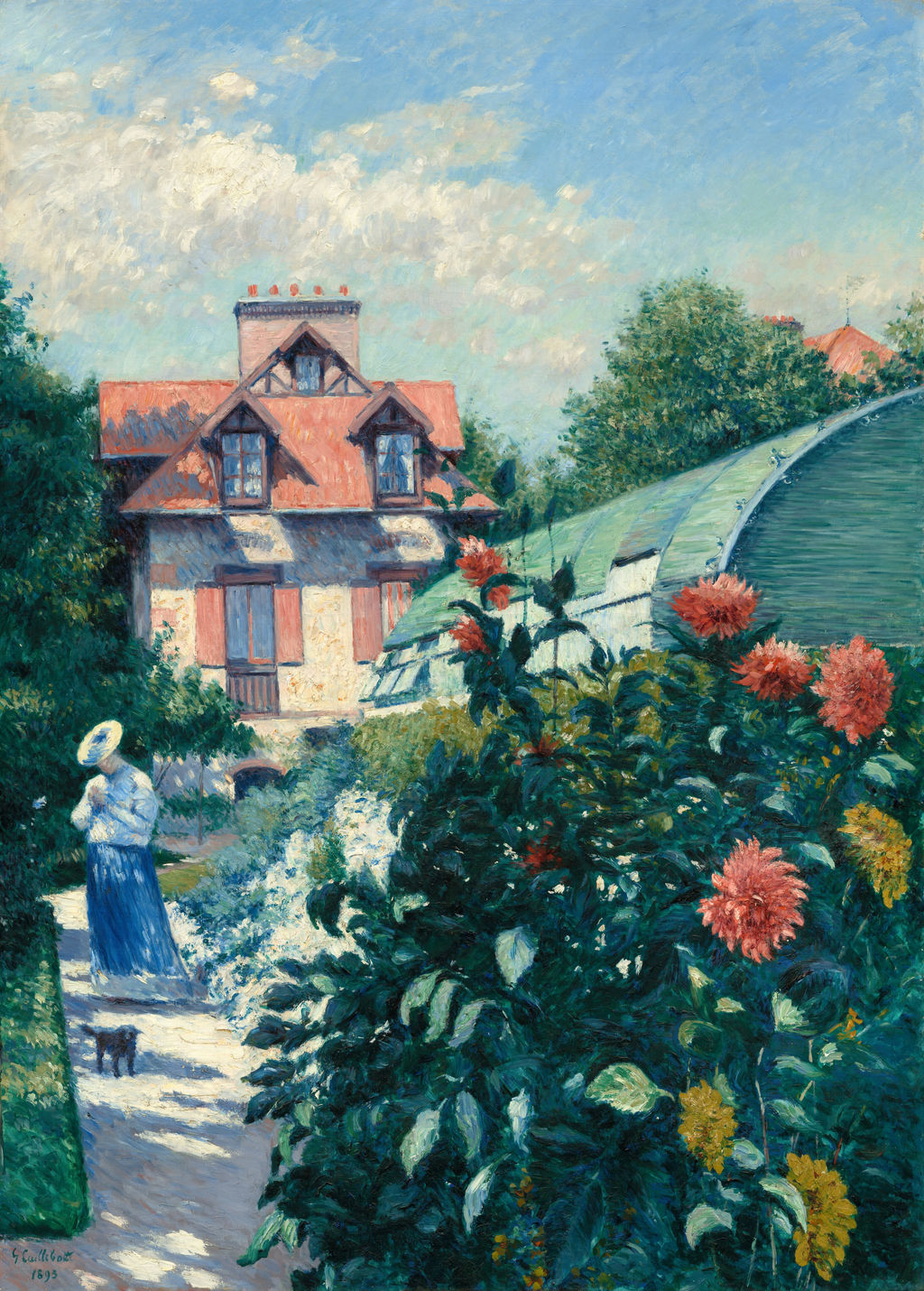
Dahlias at Petit Gennevilliers,1893; catalogue462. Gift of the Scharffenberger Family. Image source. Public domain. Resized only; source appearance preserved.
The greenhouse and the house
The greenhouse is essential to the picture's identity. Its great curved end and segmented roof occupy much more space than a casual glance at the flowers might suggest. Several panes along its lower side are tilted open. These small angular shapes interrupt the pale roof's continuous slope and make the building visibly functional. It is part of the apparatus of cultivation, situated between the outdoor flower bed and the dwelling.
Berhaut's entry for the related smaller composition specifically identifies the greenhouse as the place where Caillebotte cultivated flowers himself. The adjacent entry describes the larger painting as a return to that composition, with the woman and small dog added to the garden path. Together, the entries establish a useful relationship: the buildings and flower bed form a motif that Caillebotte could reconsider, changing the scale and the human presence within it. [2]
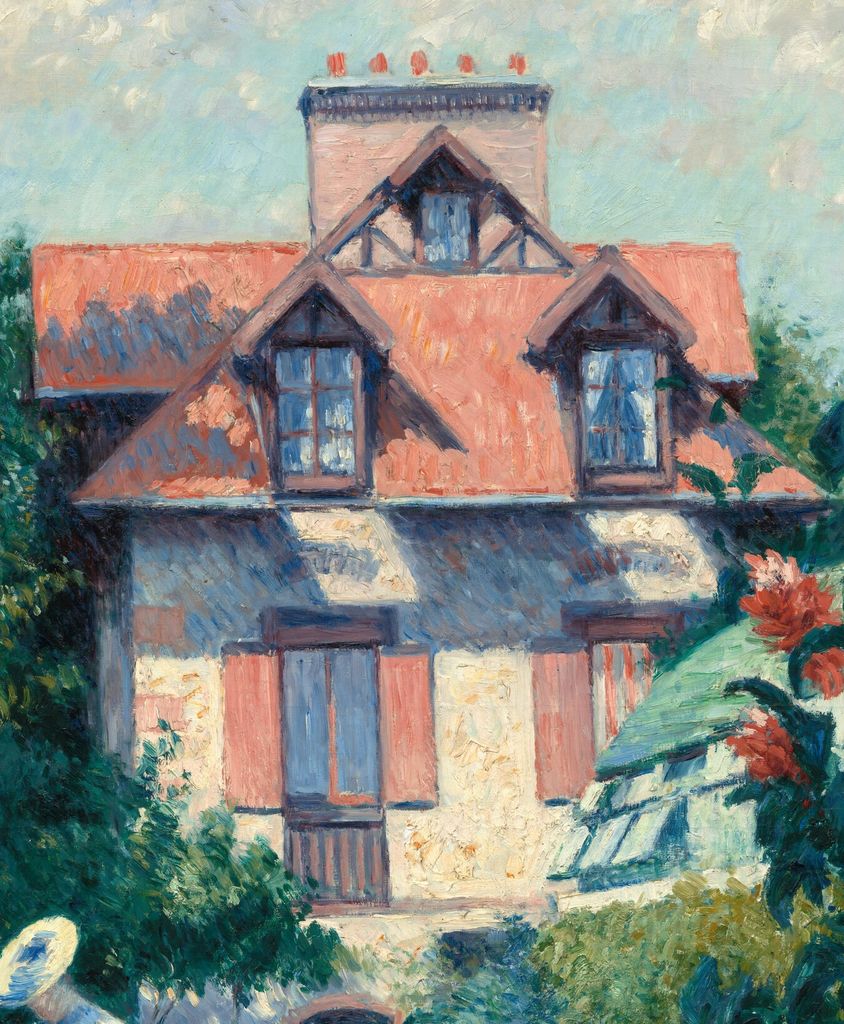
The house offers a contrasting architecture. Its triangular dormers, upright chimney and rectangular windows are sharply differentiated from the greenhouse's long curve. Orange-red roof tiles and shutters provide warm areas behind the cooler greens and blues. In the foreground, the red dahlias pick up that warmth in much smaller, more concentrated patches. This colour relationship helps connect a nearby plant to a distant building without making either lose its distinct form.
There is also a difference in how much of each structure we can see. The house presents a recognisable façade, whereas the greenhouse continues out of the frame. The cropping makes it feel large and close, sharing the flower bed's capacity to exceed the picture's limits. Both buildings anchor the view, but they do so differently: the house supplies a destination for the path; the greenhouse forms an expansive backdrop to the flowers.
Annotated Details from Dahlias at Petit Gennevilliers
The numbered points identify visible features discussed in this article. Return from each detail to the whole composition. Dahlias at Petit Gennevilliers,1893; catalogue462. Gift of the Scharffenberger Family. Image source. Public domain. Resized only; source appearance preserved.
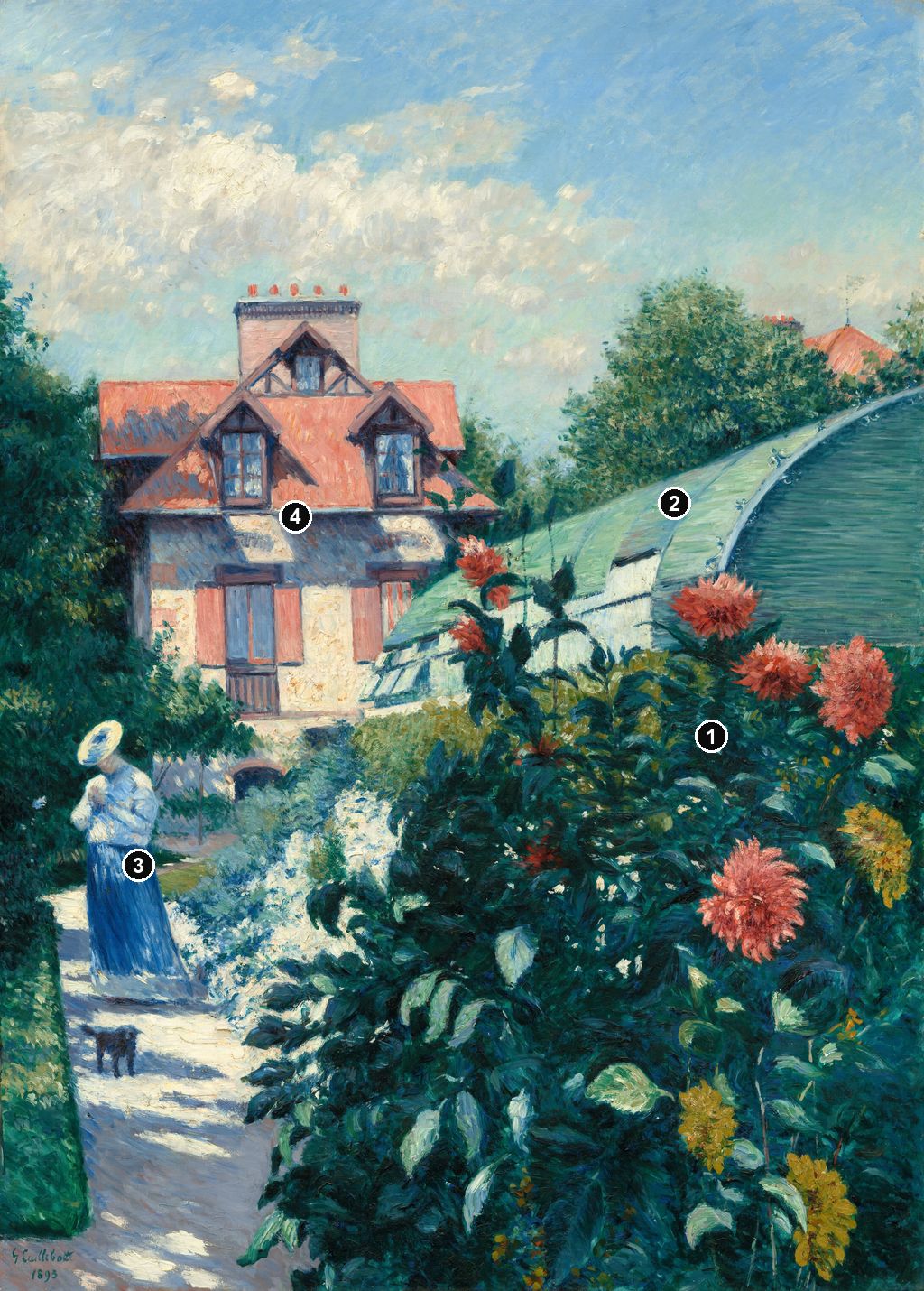
Details from DAHLIAS AT PETIT GENNEVILLIERS
Compare the cropped details with the complete images above. Notice how their colours, shapes and positions contribute to the larger compositions.
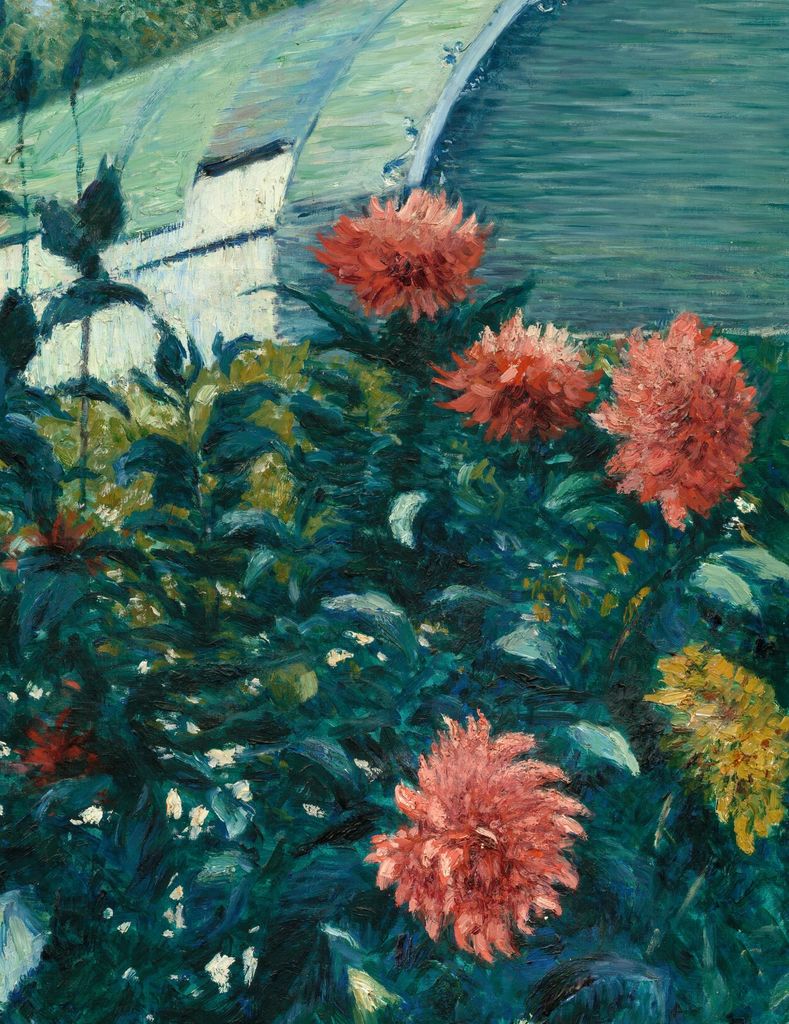
Flowers close to the spectator
Large flower heads rise close to the picture surface. Their warm colours and broken shapes stand against a dense field of darker leaves.
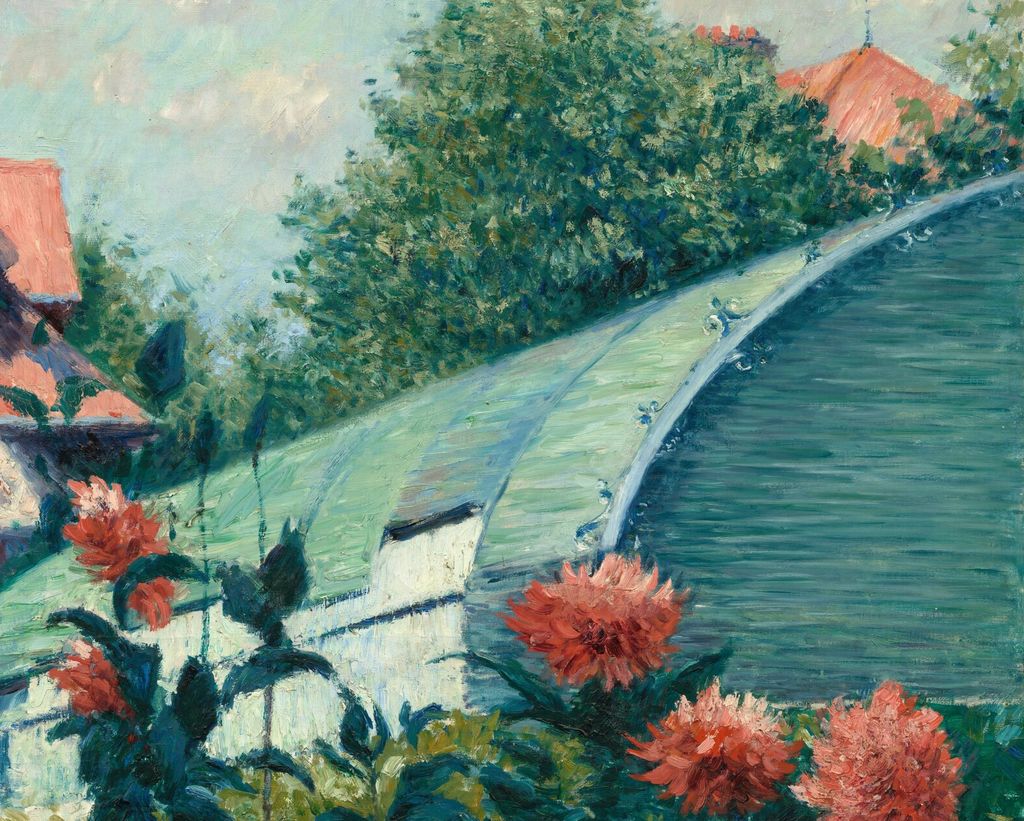
The long roof behind the flowers
The pale green roof cuts a broad diagonal behind the plants. Straight roof divisions provide a different rhythm from the crowded leaves and flower heads.
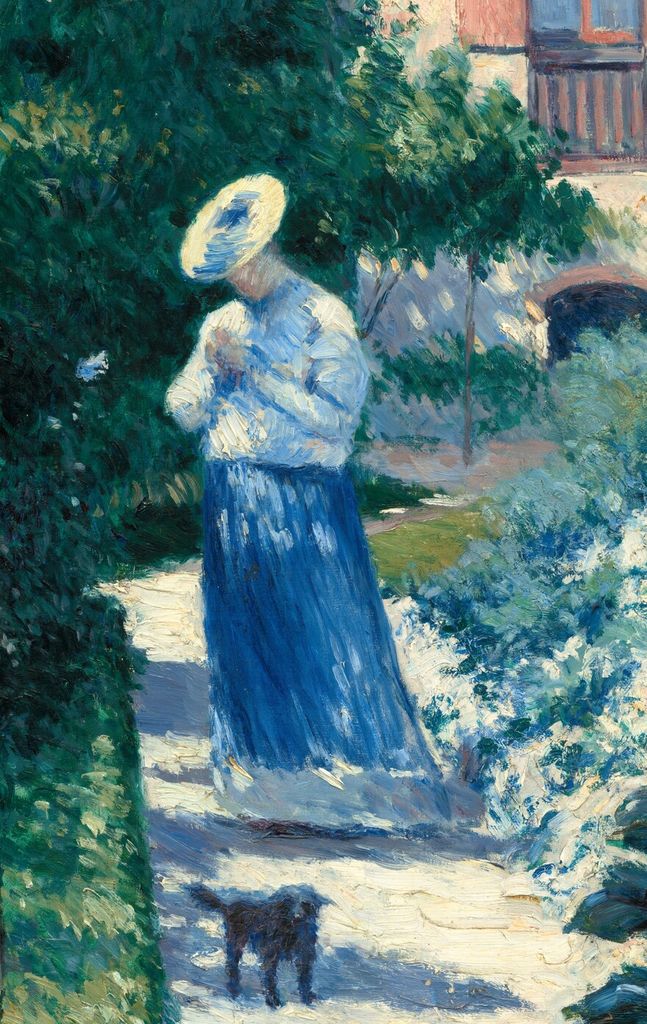
A figure and a sunlit path
The pale-clothed figure stands farther away beside the winding path. Bright ground and a small dog guide attention around the dense planting.
The house beyond the planting
The house introduces windows, brickwork and red roof planes behind the garden. Its smaller scale establishes a distance against which the tall flowers appear especially close.
A woman, a dog and a pause on the path
The woman's bent head directs attention towards her hands. The brim of her hat partly conceals her face, and her arms gather close to her upper body. The pose suggests a moment of close inspection, but the object of that inspection remains too small to identify. The painting gives us an action without turning it into a detailed anecdote.
Her pale blouse catches the light and her blue skirt descends in long strokes, with a light band at the hem. The skirt is particularly useful to the composition: its narrow vertical form stands out against the spreading, irregular foliage around it. The hat supplies another small pale accent among the garden's light patches. She belongs to the view while remaining easy to locate within it.
The current National Gallery account cautiously associates her with Caillebotte's companion. Berhaut identified her as Charlotte Berthier, also linking her with the figure in The Roses, Garden at Petit Gennevilliers. Charlotte is therefore a likely identification, rather than a securely demonstrated portrait identity. [1] [2]
The dog offers a different kind of attention. Its small black silhouette stands clearly against the bright path, and its head is turned towards the viewer. The woman's lowered gaze and the dog's outward gaze create a quiet difference within this tiny group. One appears absorbed in something close at hand; the other faces the space from which the garden is being seen.
Compared with an empty path, the pair makes the garden feel occupied at a particular moment. Yet neither takes command of the painting. They remain beside the plants, small enough for the flowers, greenhouse and house to retain their extraordinary weight. The scene's interest lies partly in this balance between a human episode and a cultivated setting that extends far beyond it.
Watch: Gustave Caillebotte
Explore a museum overview and two discussions of Paris Street; Rainy Day. This shared selection offers wider context for the artist’s work.
"Who Is Gustave Caillebotte?" - HD version
An introduction to Caillebotte from the Kimbell Art Museum.
Watch on YouTubeA garden made over time
The property at Petit Gennevilliers belonged to a later phase of Caillebotte's life. Gustave and his brother Martial acquired it in 1881, near the Seine and the sailing club. The Giverny museum's account describes the construction of a house and boat shed, followed by flower beds and a substantial kitchen garden. Gustave bought Martial's share when his brother married in 1887 and subsequently enlarged the property. [4]
The shift towards living there was a process. The Getty's gallery text connects permanent settlement with the 1887 buyout, while the Giverny teaching dossier dates the establishment of the principal residence to 1888. These accounts place the convergence of ownership, residence and the garden's development in the late 1880s. By the time of this 1893 painting, Petit Gennevilliers was an established centre of Caillebotte's horticulture and painting. [5] [4]
This history changes what the abundance in the foreground means at a practical level. The flowers grew within an arranged property with paths, buildings and facilities for cultivation. The visible greenhouse and clipped lawn make that work perceptible even though nobody in this scene is digging, pruning or watering. The painting presents the results of care through the forms of the place itself.
An exchange with Monet gives the dahlias a more specific history. In a letter dated 12 May 1890, reproduced in Berhaut's catalogue, Monet told Caillebotte, in translation, “I have received the dahlias.” The letter then turns to news of fellow artists. Plants and painting belonged to the same continuing friendship. The acknowledgement documents an actual exchange of dahlias, although it does not identify the plants depicted in the 1893 canvas. [2]
Giverny's 2016 exhibition placed Caillebotte's gardens within four settings: Paris, Yerres, the Seine and Normandy, and Petit Gennevilliers. That framework helps distinguish the garden here from his earlier family surroundings at Yerres. At Petit Gennevilliers he was developing his own property and returning to its changing subjects. The dahlia view belongs to that sustained local attention, alongside pictures of other flowers and the nearby river. [4]
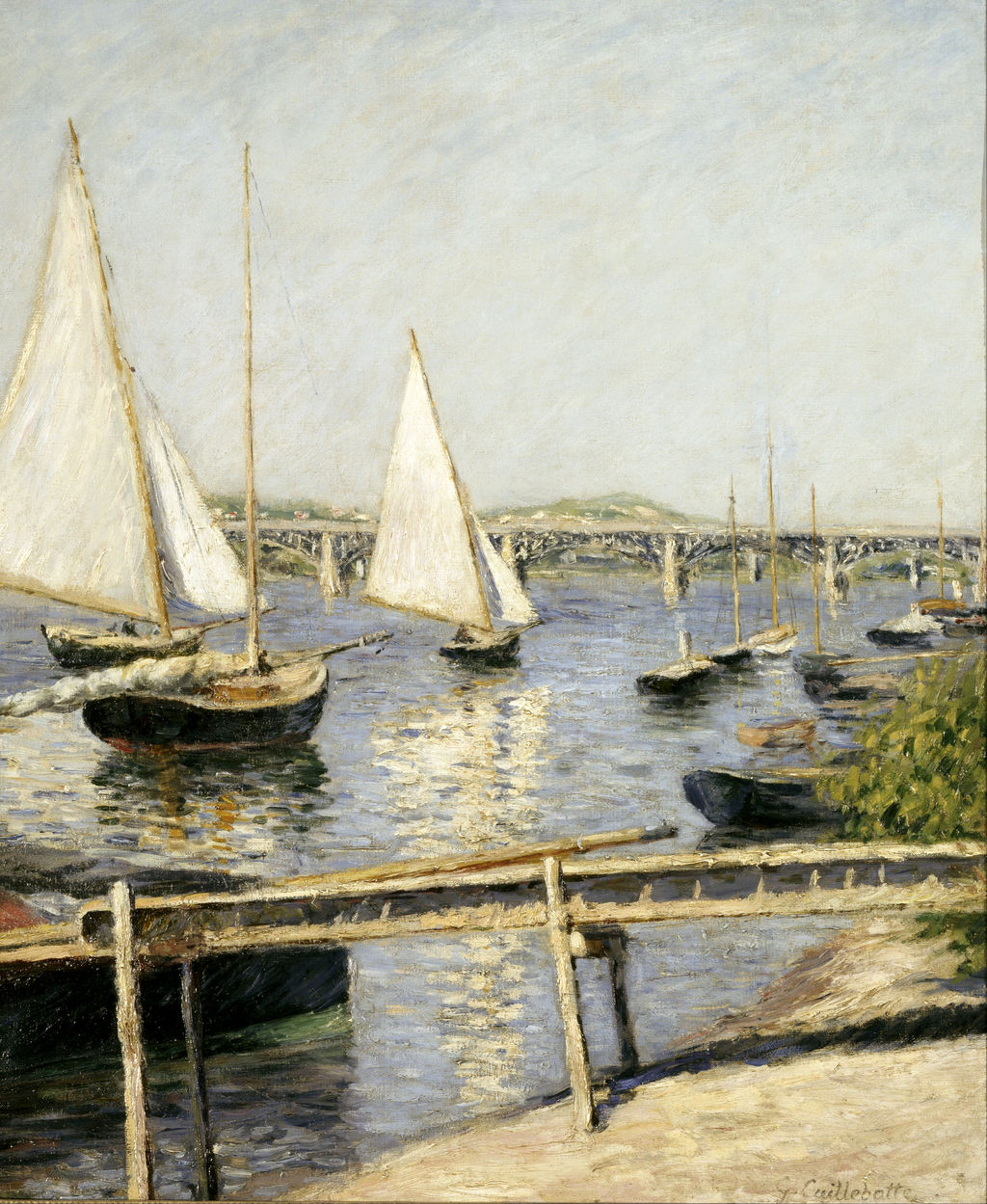
Sailing Boats at Argenteuil,about1888; separate riverside canvas. Google Arts & Culture — 7wF0nCHN0GPPzw. Image source. Public domain. Resized only; source appearance preserved.
Variations on a cultivated view
The closest comparison is the other Dahlias, Garden at Petit Gennevilliers catalogued by Berhaut as number 461. That canvas measures 116 × 90 cm; the Washington picture, number 462, is 157 × 114 cm. Both show the flower bed, greenhouse and house. The larger version's woman and dog are decisive additions, visible in the catalogue's paired illustrations. [2]
The comparison clarifies why a broad title such as The Garden at Petit Gennevilliers can be misleading. The site generated several distinct pictures. Even two closely related dahlia views have different dimensions and a different balance of figures and setting. The present canvas can be recognised through the woman in blue, the dog on the path and the signed date at the lower left. Its greater height also gives the movement from foreground plants to sky a particularly extended field. [2]
The Roses, Garden at Petit Gennevilliers, painted in 1886, provides another useful comparison. Giverny's teaching dossier explains how the aligned rose stems and the wide path organise that earlier view, in which a woman and dog also appear. The connection is more precise than a shared interest in flowers: garden design supplies the framework for the painted scene, and a small human presence helps us read its scale. [4]
Caillebotte's late decorative projects carried floral painting in another direction. The Giverny press dossier describes an unfinished scheme for the dining room at Petit Gennevilliers, including the work now presented as four panels of Parterre de marguerites. Those panels preserve selected completed portions of a larger, partly damaged canvas. They are surviving elements of an ambitious room decoration that Caillebotte left unfinished at his death. [6]
The distinction makes the dahlia painting's spatial construction more apparent. Here the plants remain in a garden with a navigable path, buildings and a horizon beneath the sky. The foreground can feel enveloping, but it is held within a clearly articulated view. Readers interested in the different demands of floral subjects can also turn to Caillebotte's White and Yellow Chrysanthemums.
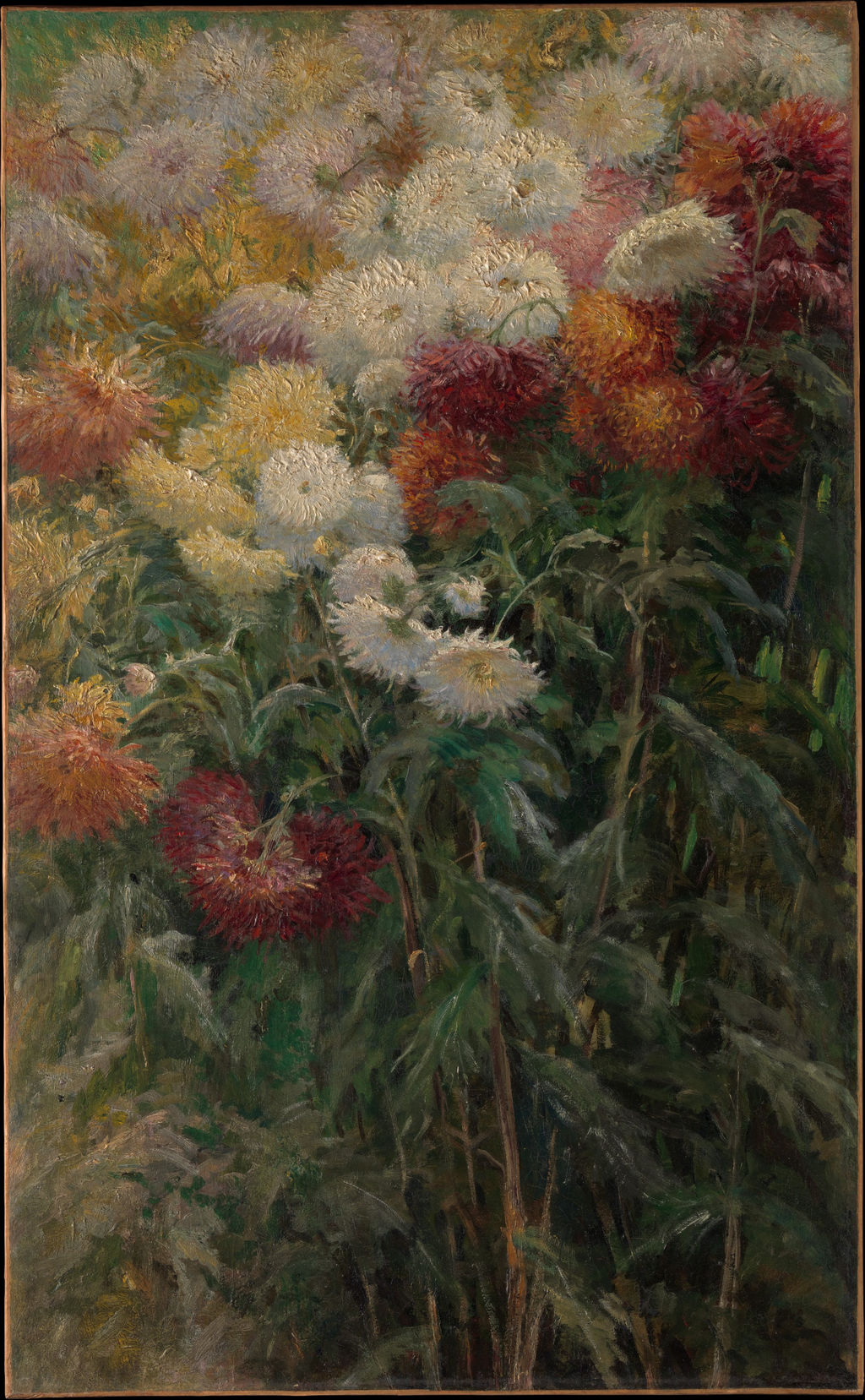
A separate late flower canvas by Caillebotte; Metropolitan Museum of Art. Gift of the Honorable John C. Whitehead, 2014. Image source. CC0 / Public domain. Resized only; source appearance preserved.
Light and the painted surface
Look closely at the path and its apparent whiteness breaks into cream, pale pink, blue and violet. The shadows cut across it in bands that vary in width and direction. Their irregularity matters: the path is geometrically simple, but the light falling across it makes it an active surface. The dog occupies one of its bright passages, so its dark body remains conspicuous despite its small size.
The leaves are equally varied. Some have pale, almost silvery centres or edges; others merge into deep blue-green passages. Their changes in direction prevent the dahlia bed from becoming one uniform dark block. The red flower heads stand above and among these marks, with short radiating strokes giving their margins a fringed appearance. There is enough differentiation to suggest petals and leaves without tracing every contour continuously.
Farther away, the roof and sky are made from broader areas whose colours mingle through visible strokes. The roof's orange is broken by darker marks, while the clouds contain warmer and cooler lights. Across the greenhouse, bands of pale green and blue follow the sloping panes, giving a different rhythm to the strokes among the leaves below.
That combination of clear structure and shifting marks is central to the picture's effect. The path and buildings make the scene easy to orientate; within those divisions, the eye moves through a busy field of light and colour. A reader familiar with Paris Street, Rainy Day may recognise Caillebotte's interest in organising an encounter with space. Here the close dahlia bed makes that encounter unusually intimate and obstructed.
From a private garden to a public collection
Berhaut records the painting's appearance in the 1894 retrospective held after Caillebotte's death, as well as later exhibitions in Paris, London and New York. It therefore had a public exhibition history long before entering a public collection. The catalogue's historical ownership summary moves from the artist's family through Wildenstein to a private collection in California. [2]
The National Gallery's provenance makes the later sequence precise: Mr and Mrs George T. Scharffenberger bought it from Wildenstein in April 1969; it passed through Scharffenberger family trusts and was given to the Gallery in 2016. The museum also records loans to The Impressionists at Argenteuil in 2000 and the 2015–2016 Caillebotte exhibition, shown at Washington, Fort Worth and Giverny. [1]
These records show the same canvas being considered in different company: as a Caillebotte, as a picture connected with Argenteuil, and as an image of a garden. Each emphasis brings something useful into view. Its subject is rooted in a private property, but its visual argument can be followed without knowing the people who lived there. The flower bed comes close, the path draws away, and the woman stands between the two. Those relationships continue to organise the encounter wherever the painting is seen.
Catalogue and documented works
This directory brings together 578 entries in the revised 1994 catalogue, 11 further documented records and three groups of study descriptions. It is a directory of records, not a total of authenticated individual works. Albums, print states and surviving decorative panels are grouped. English labels retain the French titles as searchable aliases; dates are supplied only where checked. Numbered entries link to the relevant article or the historical catalogue. Pastels appear under the Drawing filter; original prints remain searchable under All media.
Frequently Asked Questions
He signed and dated the painting 1893 at the lower left. Berhaut lists it as catalogue number 462. [2]
Yes. Berhaut number 461 is a smaller canvas with the same main garden arrangement, without the woman and dog found in number 462. [2]
It belongs to the National Gallery of Art in Washington, accession 2016.48.1, a gift of the Scharffenberger Family. [1]
Discussion
Look again at the images and ideas explored in Dahlias at Petit Gennevilliers. These editorial prompts invite your observations.
Reader Insights
The path creates a route through a dense arrangement of flowers and leaves.
The figure, dog and buildings give different scales to the cultivated space.
Where would you pause if you could enter this garden?
Join the Conversation
Share a detail, comparison or question about Dahlias at Petit Gennevilliers below.
References
- National Gallery of Art, Dahlias, Garden at Petit Gennevilliers, 1893, accession 2016.48.1. Current object record: dimensions, interpretation, provenance and exhibition history. View source.
- Marie Berhaut, with Sophie Pietri, Gustave Caillebotte: Catalogue raisonné des peintures et pastels (1994), p. 242, nos. 461–462; p. 278, letter 42, Monet to Caillebotte, 12 May 1890. Public digitisation, Wildenstein Plattner Institute. View source. (in French).
- Marie Berhaut with Sophie Pietri; Wildenstein Plattner Institute, Gustave Caillebotte Catalogue raisonné des peintures et pastels, 1994. View source. (in French).
- Musée des impressionnismes Giverny, Caillebotte, peintre et jardinier: Dossier pédagogique (2016), PDF pp. 3–5, 10–14: exhibition framework, Les Roses and property chronology. View source. (in French).
- J. Paul Getty Museum, Gustave Caillebotte: Painting Men, gallery text (2025), PDF p. 7: Petit Gennevilliers and the 1887 property buyout. View source. (in en/es).
- Musée des impressionnismes Giverny, Caillebotte, peintre et jardinier: Dossier de presse (2016), PDF pp. 15–16: Parterre de marguerites and the unfinished dining-room decoration. View source. (in French).
- Art Institute of Chicago, Caillebotte Paintings and Drawings at the Art Institute of Chicago, 2015. View source.
- Petit Palais / Paris Musées, Portrait de Paul Hugot, original print, PPG2319, current. View source. (in French).
- Paul Perrin, Musée d’Orsay, Transcription de l’entretien commissaire Caillebotte, 2024. View source. (in French).
- Cleveland Museum of Art, Caillebotte collection records: 2020.260, 2009.157 and 2020.105, current. View source.
- Splash image, Dahlias at Petit Gennevilliers, 1893.


