



 by Tom Gurney
Tom Gurney BSc (Hons) is an art history expert with over 20 years experience
Published on June 19, 2020 / Updated on November 2, 2026
Email: tomgurney1@gmail.com / Phone: +44 7429 011000
The Gardeners: Introduction
Two men water a kitchen garden with an efficiency that gives Gustave Caillebotte’s The Gardeners its subject and its structure. The nearer man tips two watering cans towards the young plants; farther away, his colleague continues among the receding rows. Their activity takes place within a remarkably ordered enclosure of paths, beds, glass covers and a high wall. Painted in 1877, this oil on canvas measures 90 × 117 cm and represents the productive garden at the Caillebotte family’s property in Yerres. [1]
The painting makes cultivation unusually tangible. We see the distance between individual plants, the space needed to walk beside them and the repeated movement that carries water across the soil. Caillebotte gives those practical arrangements the visual force of a carefully constructed perspective. At the same time, the workers keep the garden from becoming a diagram: their weight, bent arms and uneven positions turn its geometry into a place being used.
At a Glance
- ArtistGustave Caillebotte.
- TitleThe Gardeners; French title Les Jardiniers.
- Date1877, as placed in the catalogue raisonné’s chronological sequence.
- MediumOil on canvas.
- Dimensions90 × 117 cm.
- SettingThe kitchen garden of the family property at Yerres.
- CatalogueMarie Berhaut, 1994, no. 80; a G. C. monogram is recorded on the reverse.
- CollectionRecorded in a private collection in France in the 1994 catalogue; present ownership is not independently established. [1]
This work across Gustave Caillebotte’s career
Contents
- A productive corner of Yerres
- How the rows build the picture
- Water, glass and interrupted sunshine
- Giving labour a visible scale
- From the parquet floor to the garden bed
- One garden, several paintings
A productive corner of Yerres
The kitchen garden belonged to a larger landscape with several different uses. In its 2016 exhibition dossier, the Musée des impressionnismes Giverny describes Caillebotte’s exploration of Yerres between 1872 and 1878: the English-style park, with winding paths and carefully maintained planting; the potager, or kitchen garden; and the river, where bathing and boating supplied further subjects. These were neighbouring environments within his experience of the family estate, each offering a different arrangement of people and space. [3]
The potager had a distinct boundary. Berhaut’s catalogue describes a wall separating it from the rest of the domain on three sides, while its fourth side adjoined the property’s southern limit. This helps explain the force of the pale wall in The Gardeners. It is a working enclosure with a place in the estate’s organisation, as well as a long illuminated surface against which the figures and plants stand out. The catalogue’s account of the garden’s extent also emphasises the need for at least two gardeners. [1]
This setting changes the meaning of the apparently peaceful scene. The open earth and small, regularly spaced plants belong to a garden maintained for growth and production. Walking space is carefully apportioned; cultivation is divided into manageable strips. The men are necessary to the scene in a practical sense. Their watering explains how this orderly patch of ground remains productive, while the length of the rows makes the amount of work visible.
A comparison with The Park at Yerres clarifies Caillebotte’s choice. The catalogue illustrates that park view with a curving path and dense trees; the potager imposes straighter, more repetitive divisions. Both are cultivated landscapes, yet they organise movement differently. The park path invites a winding progress through shade, while the kitchen-garden rows direct attention towards the next plant, the next strip of ground and the next task. Caillebotte found pictorial variety within the same property by attending to these differences. [1]
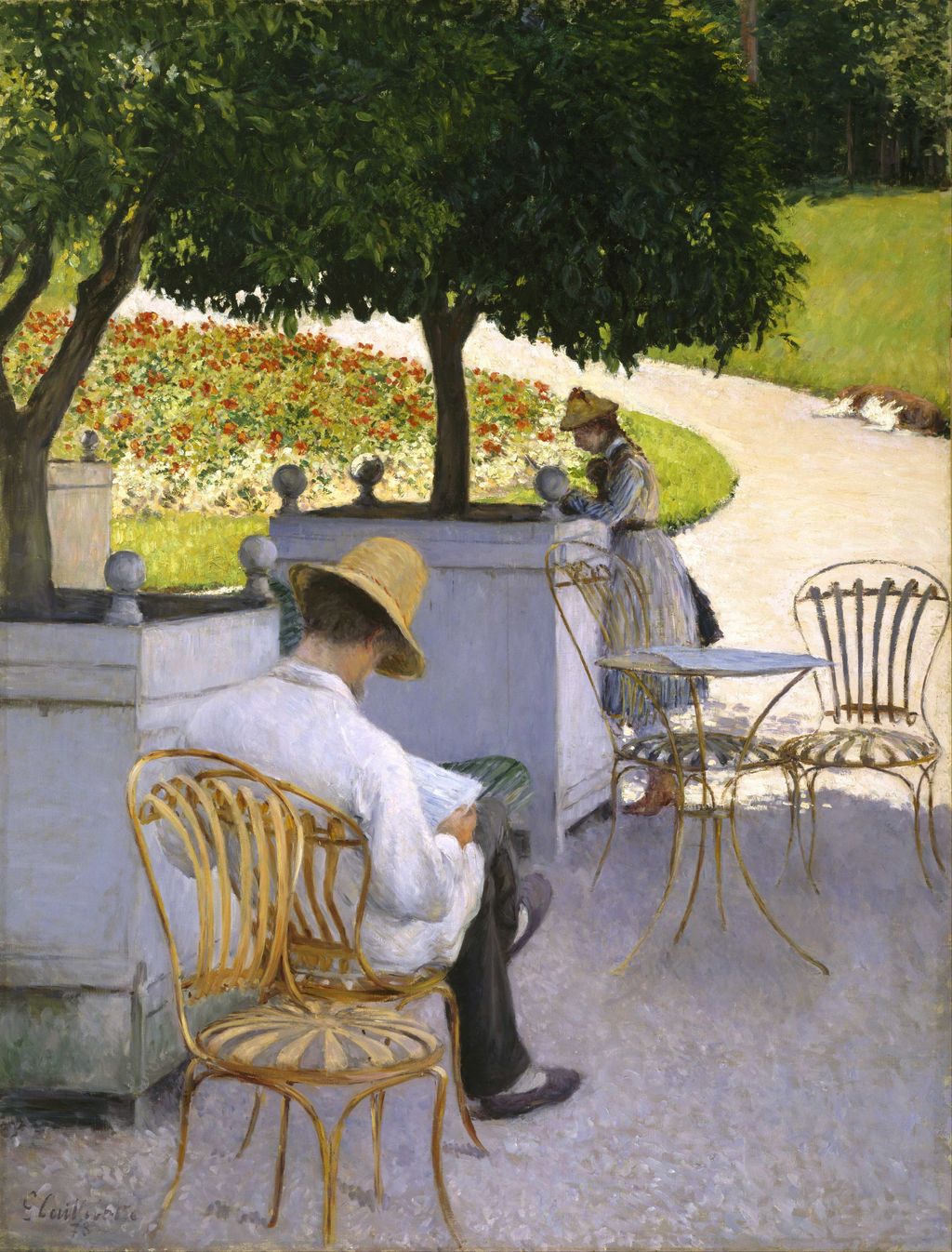
The Orange Trees, 1878; leisure in another part of the family’s Yerres grounds. 3QHnQ99LLC7m3A at Google Cultural Institute maximum zoom level. Image source. Public domain. Resized only; source appearance preserved.
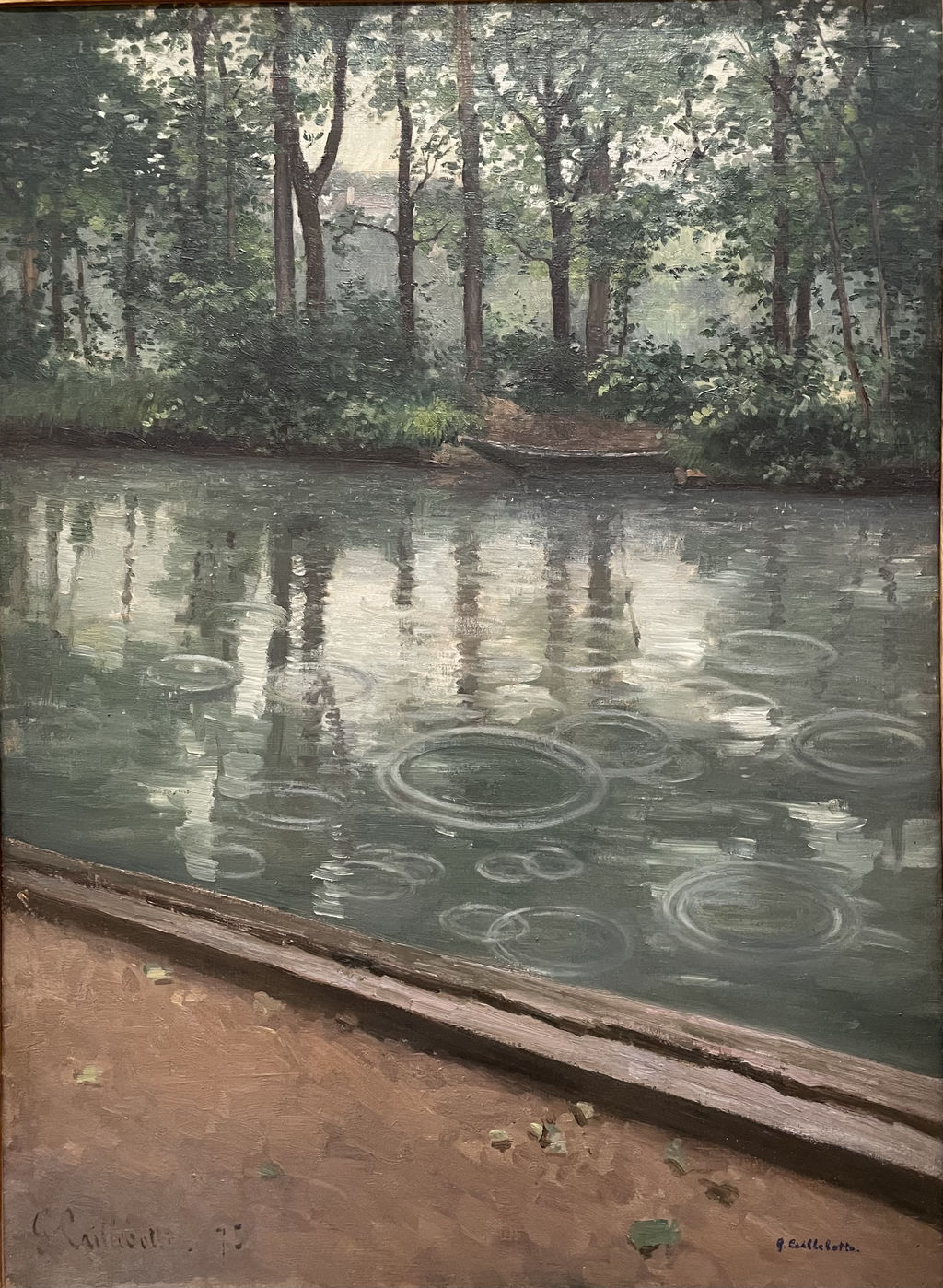
The Yerres, Effect of Rain, 1875; another environment beside the family property.
How the rows build the picture
Long bands of reddish earth begin at the lower edge and narrow sharply into the left distance, opening the garden out towards us. Successive plants become smaller and closer together as the rows recede. We can read depth from this diminishing scale without needing a road, a building façade or a broad horizon. Ordinary cultivation supplies the whole apparatus of perspective.
The row of bell-shaped covers provides a second measure. Large, separate forms occupy the right foreground; farther away they compress into an almost continuous pale band. Their repeated profiles make the recession unusually easy to follow. Because they sit just behind the nearer gardener, they also establish his position within the grid. His legs stand in front of one series of forms while his arms and watering cans reach across another.
Above this ground pattern, the wall runs at a much shallower angle. Its coping creates a firm division between the garden and the sky. Beyond it, a succession of tall, narrow trees becomes increasingly prominent towards the right. Their uprights answer the strong diagonals below, so that the image contains two kinds of rhythm: the rapid movement into depth across the beds and the measured vertical succession along the skyline.
The two men connect these systems. The nearer figure occupies the right half of the canvas, but his bent body and outstretched equipment lead towards the left. The second stands much farther back, near the garden’s narrowing lines. He gives the distance a human scale. Following the route from one figure to the other, we register how much ground separates them and how small a portion of it a person can tend at a time.
Caillebotte’s viewpoint lets us see the surface of the beds clearly. There is enough elevation to expose the arrangement of the plants, yet the nearer worker remains a substantial standing figure. That balance matters: the composition makes the garden comprehensible without reducing the gardener to a tiny accessory within an extensive landscape.
Water, glass and interrupted sunshine
The most conspicuous action is the divided stream of water falling from the foreground cans. Light catches the spray, which spreads into two pale fans against the darker ground. The cans are paired, but their angles differ slightly. Arms, handles, spouts and water make a compact sequence of connected curves and diagonals across the man’s body. The eye can follow the transfer from his hands to the soil.
The use of two cans gives the pose its particular character. He must hold and tip both while keeping his balance beside the plants. His head inclines towards the task, his shoulders turn and his elbows project away from his torso. The movement is ordinary enough to be immediately legible, yet complex enough to reward attention. His stance records an adjustment to the tools and to the narrow strip of ground on which he stands.
Beside him, the cloches—bell-shaped plant covers—introduce a quieter kind of care. Their regular spacing turns gardening equipment into a compositional motif. Each rounded top rises from a broad base, and each catches the light differently. Some appear almost white, while others have cooler, grey-blue faces. They punctuate the earth with compact volumes, contrasting with the open, spreading forms of the growing plants. Exposed plants and covered ground remain clearly distinct, even where the crops cannot be identified.
Colour also divides the scene into practical and pictorial units. Warm earth lies beside small green leaves; the pale wall carries irregular patches of foliage; cool shadows interrupt the sunlit beds. The foreground gardener’s light shirt and straw-coloured hat make his upper body prominent, while his dark clothing below the waist places a dense shape across the patterned ground. There is no need for an emphatic facial expression. The arrangement of light and dark gives his working posture sufficient clarity.
Look especially at the difference between repeated objects and repeated plants. The covers form a procession of similar silhouettes. The leaves are more irregular: individual clusters lean, spread and catch brightness unevenly. That variation prevents the orderly planting from becoming mechanically uniform. The garden’s planned structure remains unmistakable, but living growth and changing light continually disturb its exactness.
Watch: Gustave Caillebotte
Explore a museum overview and two discussions of Paris Street; Rainy Day. This shared selection offers wider context for the artist’s work.
"Who Is Gustave Caillebotte?" - HD version
An introduction to Caillebotte from the Kimbell Art Museum.
Watch on YouTubeGiving labour a visible scale
The title names an occupation, and the picture explains it through action. Neither man turns towards the viewer. The nearer worker’s face is largely obscured by the tilt of his head and the brim of his hat; the farther figure is too small for individual features to dominate. We recognise them through what they do and how they occupy the garden. Their names are not securely established by the evidence for this painting.
It is tempting to treat any sunny garden scene as an image of leisure. Here, however, the cans, streams of water and considerable expanse of planted ground give a more specific account. Someone has to carry the water, distribute it and continue along the rows. The painting’s bright appearance does not remove that bodily requirement. Indeed, the contrast between the extensive garden and the two figures lets the viewer estimate it.
Samuel Raybone’s study of Caillebotte’s interiors offers a useful comparison. He examines the artist’s sustained attention to hands manipulating implements, linking representations of manual labour with scenes of music, meals and other activities. He also distinguishes Caillebotte’s inherited financial independence from the necessity under which employed workers laboured. Raybone develops this argument through the interiors; applying that distinction to The Gardeners helps us keep the estate owner’s access to a garden separate from the workers’ task within it. [4]
The image allows us to examine that relationship without deciding the men’s feelings. Their concentration is visible, but contentment, exhaustion or resentment would require evidence beyond a lowered head and a bent arm. What the painting does establish is the dependence of cultivated order on continuous physical attention. The straight rows are the setting of labour and its result.
From the parquet floor to the garden bed
The Floor Scrapers, painted in 1875, provides the clearest comparison within Caillebotte’s work. The Musée d’Orsay emphasises that painting’s close study of gestures, tools and accessories, together with the perspective generated by the aligned floorboards. Its account connects Caillebotte’s exact description of contemporary work with the compositional rigour of his academic training. [5]
The visible correspondences are strong. Floorboards and planted rows both form long, narrowing strips. In each picture the workers bend into their tasks, and their tools direct attention towards the surface being altered. The setting does more than locate the action: its repeated divisions organise our understanding of the action. A scraper works along the grain and alignment of the floor; a gardener moves beside a row and waters successive plants.
There are differences in the way the bodies meet those surfaces. The floor scrapers kneel close to the boards, their arms braced as they push against resistance. The foreground gardener stands and tips his cans, sending water downwards. One task depends visibly on pressure; the other on carrying, balance and controlled release. Looking between them makes the specificity of each occupation clearer.
Raybone reads the floor painting’s manipulation of surfaces in relation to Caillebotte’s own work of painting, while also questioning what its polished visual spectacle permits us to understand about labour. His interpretation gives the comparison a useful edge: a beautifully organised image can describe workers closely while still leaving much of their experience inaccessible. The Gardeners likewise supplies abundant information about posture, tools and surroundings, without becoming a complete account of the men’s working lives. [4]
The garden picture therefore extends a sustained interest in work into a different environment. Its sunlight, foliage and distant trees change the atmosphere, while the patient observation of bodies performing practical actions remains central. The resemblance to The Floor Scrapers is most revealing at the level of these visible relationships, where geometry and labour continually explain one another.
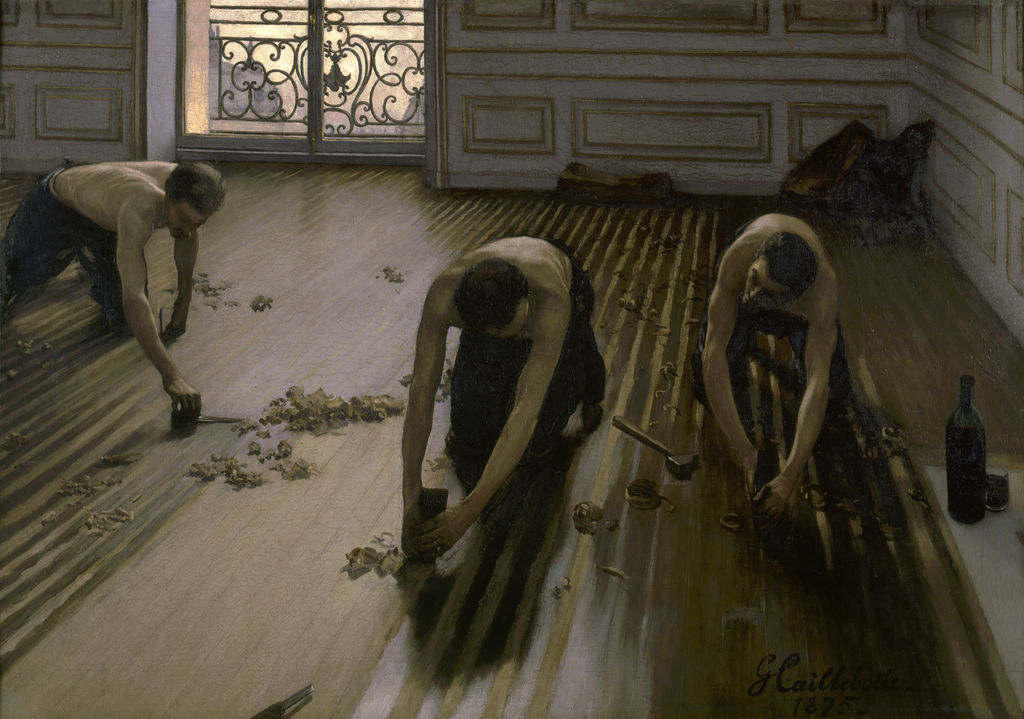
The Floor Scrapers, 1875; Musée d’Orsay. Google Arts & Culture — 0wHXxVpb7UjLNA. Image source. Public domain. Resized only; source appearance preserved.
One garden, several paintings
Caillebotte returned to the potager through different viewpoints. The catalogue places The Gardeners beside a smaller canvas entitled The Gardener, which shows a single worker near a greenhouse, and The Kitchen Garden, Yerres, organised around a central path and a foreground watering basin. These are separate paintings. The plural title belongs specifically to the larger, two-figure composition discussed here. [1]
The neighbouring works also show how selectively he could describe a familiar place. A wall could become the main subject; an entrance could frame a view; a path could divide the beds symmetrically. In The Gardeners, the more oblique arrangement allows the repeated covers and rows to spread across the canvas while leaving a substantial area for the nearer worker. Familiar surroundings supplied opportunities for new structures rather than a single definitive view. [1]
The catalogue gives only a short ownership history. Berhaut records it in a private collection in France and lists it as no. 20 in the Paris–Chicago Caillebotte exhibition of 1994–95. That historical record supports its identification and exhibition history, though it does not establish a present owner or a current place to see it. [1]
Within the image, the most revealing passage remains the meeting of the nearest streams of water with the planted ground. The spacious garden contracts there into a small, immediate task. Its rows and boundaries make the whole enclosure legible, but this particular act shows how the larger order is maintained: one person, using familiar tools, attending to the plants in front of him.
Catalogue and documented works
This directory brings together 578 entries in the revised 1994 catalogue, 11 further documented records and three groups of study descriptions. It is a directory of records, not a total of authenticated individual works. Albums, print states and surviving decorative panels are grouped. English labels retain the French titles as searchable aliases; dates are supplied only where checked. Numbered entries link to the relevant article or the historical catalogue. Pastels appear under the Drawing filter; original prints remain searchable under All media.
Frequently Asked Questions
The painting is placed in 1877 in Marie Berhaut’s 1994 catalogue raisonné. The entry records a G. C. monogram on the reverse, rather than a dated signature on the front. [1]
It is the kitchen garden of the Caillebotte family’s property at Yerres. The productive garden was separated from the rest of the estate by a wall on three sides. [1]
They are distinct works. The Gardeners is the 90 × 117 cm canvas with two men watering. The Gardener is a smaller, 60 × 73 cm canvas showing one worker near a greenhouse. [1]
No museum ownership is established by the consulted object record. The 1994 catalogue places it in a private collection in France; its present ownership has not been independently verified. [1]
Discussion
Look again at the images and ideas explored in The Gardeners. These editorial prompts invite your observations.
Reader Insights
The planted rows organise the space before the figures enter it.
The workers’ bent bodies connect an ordinary task with the garden’s geometry.
How does outdoor labour feel different from the work in The Floor Scrapers?
Join the Conversation
Share a detail, comparison or question about The Gardeners below.
References
- Marie Berhaut, with the assistance of Sophie Pietri. Gustave Caillebotte: Catalogue raisonné des peintures et pastels (1994), pp. 100–102, nos. 73, 75–81; especially no. 80, Les Jardiniers, p. 102. Digitised by the Wildenstein Plattner Institute. View source. (in French).
- Marie Berhaut with Sophie Pietri; Wildenstein Plattner Institute, Gustave Caillebotte Catalogue raisonné des peintures et pastels, 1994. View source. (in French).
- Musée des impressionnismes Giverny. Caillebotte, peintre et jardinier: Dossier pédagogique (2016), pp. 3–5, especially “Villégiatures à Yerres”, p. 4. View source. (in French).
- Samuel Raybone. “Gustave Caillebotte’s Interiors: Working Between Leisure and Labor”, nonsite.org, issue 26 (2018), especially repository PDF pp. 4–8, 12–16 and 19–21. View source.
- Musée d’Orsay. “Raboteurs de parquets”, collection record RF 2718, introductory discussion of gestures, tools, academic training and perspective. View source. (in French).
- Art Institute of Chicago, Caillebotte Paintings and Drawings at the Art Institute of Chicago, 2015. View source.
- Petit Palais / Paris Musées, Portrait de Paul Hugot, original print, PPG2319, current. View source. (in French).
- Paul Perrin, Musée d’Orsay, Transcription de l’entretien commissaire Caillebotte, 2024. View source. (in French).
- Cleveland Museum of Art, Caillebotte collection records: 2020.260, 2009.157 and 2020.105, current. View source.
- Splash image, The Gardeners, 1877.


