



 by Tom Gurney
Tom Gurney BSc (Hons) is an art history expert with over 20 years experience
Published on June 19, 2020 / Updated on November 2, 2026
Email: tomgurney1@gmail.com / Phone: +44 7429 011000
The House Painters: Introduction
A ladder occupies the pavement, a man looks upwards, and another works high against a shopfront. In The House Painters, Gustave Caillebotte turns the ordinary business of maintaining a Paris building into an unusually absorbing street encounter. The figures are close enough to interrupt our imagined walk, while the street beside them seems to run almost indefinitely into the distance.
Painted in 1877, the oil on canvas measures 89.3 × 116 cm. It is privately owned and on deposit at the Musée d’Orsay, under the deposit number DO 2023 2. The museum’s 2024 exhibition documentation places it alongside The Floor Scrapers as a major example of Caillebotte’s attention to urban workers. [1]
The picture brings two of his strongest subjects together: skilled manual activity and the changing streets of Paris. Its apparent casualness is deceptive. Surviving drawings and a smaller oil study reveal a sustained examination of the workers’ positions, their relation to the ladders, and the way a person passing along the pavement would encounter them. [2]
At a Glance
- ArtistGustave Caillebotte
- TitleThe House Painters; French title, Les Peintres en bâtiment
- Date1877
- MediumOil on canvas
- Dimensions89.3 × 116 cm
- CollectionPrivate collection, on deposit at the Musée d’Orsay, Paris
- Deposit numberDO 2023 2
- CatalogueBerhaut 1994, no. 53
- ExhibitedThird Impressionist Exhibition, Paris, 1877, no. 6. [1] [2]
This work across Gustave Caillebotte’s career
Contents
- A working space on the pavement
- Perspective that asks us to move
- The body learns the task
- From studies to a seemingly casual encounter
- Painting workers, painting surfaces
- A place within Impressionism
A working space on the pavement
The nearest worker stands in profile at the lower left. His pale smock makes him conspicuous against the darker figure behind him, but his attention belongs to the activity above. Caillebotte cuts off his legs at the bottom edge. We consequently encounter him at the scale of someone standing beside us, rather than as a small, complete figure arranged within a distant street view.
Above and to the right, the painter on the ladder reaches towards the dark band across the shopfront. The straw-coloured hat, light coat and bent leg make his body easy to distinguish, even where it overlaps the wooden structure. Farther back, another worker appears through the ladders. Part of the interest lies in this unequal visibility: one body is presented clearly, another is elevated, and a third must be found among the rungs and uprights.
The ladders make an intricate framework. Their sloping sides cross the verticals of the façade and the horizontals of the shopfront. Seen together, these ordinary tools divide the picture into a succession of narrow openings. Looking through them becomes part of looking at the workers. The trade is inseparable from the equipment that enables it, obstructs our view of it, and temporarily reorganises the pavement.
At the right, the red-brown panels occupy a considerable area of the canvas. Their broad, comparatively simple shapes give weight to this close side of the composition. The street at the left does the opposite: its small pedestrians and diminishing buildings carry the eye away. Between the two lies a thin corridor of pavement, filled with people and ladders precisely where a passer-by might expect a clear route.
The eye moves up the nearest figure’s line of sight, across the working painter, through the equipment and out along the street. Bodies, tools and the spaces between them give the scene its activity, even though there is little dramatic movement.
Perspective that asks us to move
The curb is one of the painting’s most effective lines. Starting close to the bottom edge, it runs towards a vanishing point well to the left of the composition’s centre. The upper edges of the shopfront and the repeated architecture pull in the same general direction. The result is a strong contrast between a wall that presses close on the right and an opening that draws the viewer away to the left.
Galina Olmsted describes the viewpoint as that of someone stepping aside to pass the painters and their ladders. She connects the cropped foreground figure with the picture’s immersive effect: the viewer seems poised to enter a space already occupied by other people. This reading explains why the scene feels more immediate than a distant survey of an urban trade. We have arrived at an obstruction in our own path. [4]
Yet Caillebotte leaves enough open street for the encounter to breathe. A few small figures inhabit the distance, but they do not compete with the painters. Their reduced size makes the foreground bodies and equipment seem especially substantial. The pavement also appears to rise as it recedes, increasing the sensation that space has been opened out for inspection. The sharp recession and the near figure’s abrupt cropping work together: one establishes depth, while the other holds us at the surface where the encounter takes place.
Olmsted relates this arrangement to Le Pont de l’Europe and Paris Street, Rainy Day. All three appeared in Caillebotte’s 1877 exhibition submission and combine an off-centre recession with a powerful architectural presence on the right. She proposes that The House Painters was the first stage in a progression towards the larger and more complex city pictures. That sequence is an argument based on their subjects, scale and construction; their dates alone do not establish the order in which Caillebotte began them. [4]
The comparison is valuable even without accepting a definite sequence. In each picture, a public place is experienced through proximity to other bodies. Crossing a bridge, passing a couple with umbrellas and negotiating a painter’s ladder become different versions of the same visual problem: how to place the spectator within the movement of a city.
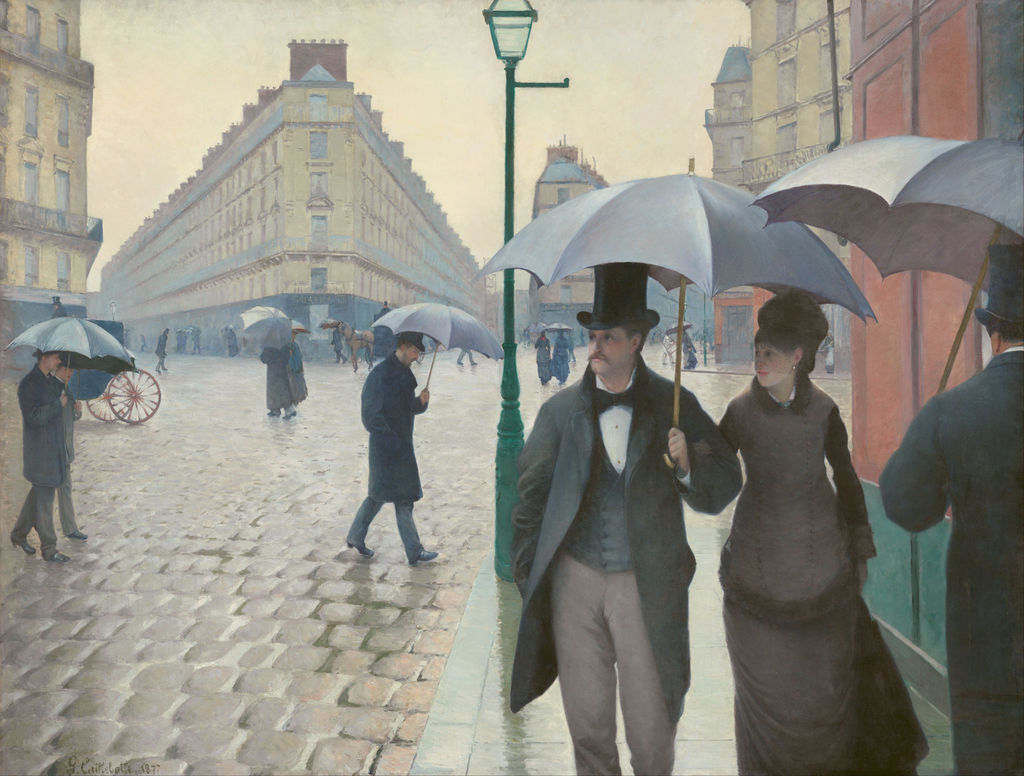
Paris Street; Rainy Day, 1877; Art Institute of Chicago. 5wEUCOlEf-EaVQ at Google Cultural Institute maximum zoom level. Image source. Public domain. Resized only; source appearance preserved.
The body learns the task
The workers’ clothing covers most of their bodies, but their postures remain precise. The standing figure’s raised chin directs attention upwards. The elevated painter balances his weight on a ladder, with the bend of a knee and the angle of his torso registering the conditions of his task. The partially concealed worker introduces another posture into the mesh of equipment. Each figure occupies a different relation to the building, to gravity and to the others.
Paul Perrin, curator of the Musée d’Orsay’s Caillebotte: Painting Men exhibition, places the representation of effort at the centre of these labour subjects. Discussing The House Painters and The Floor Scrapers, he emphasises the preparatory drawings’ attention to gestures, postures, silhouettes and the way work leaves its impression on the body. This is a useful way to look at the finished painting: the figures become legible through the particular demands of what they are doing. [5]
The surviving sheets show how much could be examined separately. Perrin’s accompanying captions identify studies of a standing man in right profile, a man high on a ladder with an arm and leg raised, a man mixing paint with additional hand studies, and men leaning forwards to paint. Other sheets study a man on a ladder from different directions. Together they make the apparently simple scene look like the outcome of many small decisions about balance, reach and visibility. [5]
These are studies of people performing actions, rather than interchangeable figures waiting to fill a space. A raised arm changes the shoulder and coat; a bent knee changes the fall of the fabric; a ladder determines where feet can rest. In the completed composition those adjustments are absorbed into an easy rhythm. The viewer notices the working situation before noticing how carefully its bodily components have been resolved.
Watch: Gustave Caillebotte
Explore a museum overview and two discussions of Paris Street; Rainy Day. This shared selection offers wider context for the artist’s work.
"Who Is Gustave Caillebotte?" - HD version
An introduction to Caillebotte from the Kimbell Art Museum.
Watch on YouTubeFrom studies to a seemingly casual encounter
Marie Berhaut’s catalogue distinguishes the finished canvas, no. 53, from a smaller preparatory oil, no. 52, measuring 60 × 73 cm. The smaller picture already brings together the façade, the receding street and the painters with their ladders. It is a separate work, not an alternative measurement for the finished painting. The catalogue illustrates both, making it possible to see the broad compositional idea alongside its more developed form. [2]
Three drawings catalogued as nos. 52A–C sharpen the relationship between individual study and final placement. No. 52B concerns the worker seen through the ladder rungs, while no. 52C concerns the painter at the top. The standing figure in no. 52A does not appear in that form in the finished picture; Berhaut suggests that it may represent an early idea for the foreground painter. The difference is instructive. A drawing can belong to the making of a painting without recording a figure that was transferred unchanged. [2]
The studies alter our understanding of the picture’s immediacy. The seemingly chance arrangement of bodies has been subjected to sustained attention. So has their relation to the equipment: a ladder can enable a painter’s action while concealing it from the spectator. Caillebotte makes that partial visibility part of the experience of passing the shopfront.
Perrin argues more broadly that Caillebotte often conceived a forceful image and then developed the drawings, sketches and perspective studies needed to realise it. He sees cropping, decentralised subjects, strong contrasts and diagonals as strategies that produce an impression of naturalness and draw the spectator in. This is Perrin’s account of Caillebotte’s compositional practice, rather than a documented sequence for every canvas. Here, however, it helps explain why careful preparation and a passing, spontaneous appearance can coexist so convincingly. [5]
Painting workers, painting surfaces
The closest comparison is The Floor Scrapers, painted two years earlier. Berhaut treats the two compositions as major representations of working life, while observing that The House Painters brings professional activity into the outdoor setting of the Paris street. The comparison joins the workers’ bodily actions to the larger surroundings in which those actions take place. [2]
In The Floor Scrapers, the workers’ movement is directed along the surface beneath them. In The House Painters, the task extends vertically, up the façade. The change creates a different relation between bodies and space. The ladders lift the action above the pavement, while the standing figure gives the viewer an accessible point from which to look upwards. Caillebotte’s workers are consequently more than incidental inhabitants of a setting: their activity determines how the setting can be organised and seen.
There is also a particularly close connection between the subject and the means of representing it. These men apply paint to a surface, and Caillebotte makes them visible by applying paint to another. Samuel Raybone, in his study of work and leisure in Caillebotte’s art, draws attention to this connection. In a note on The House Painters, he summarises Anthea Callen’s discussion of the picture’s tactile paint and visible brushwork, and records an association between the French term for a house painter’s first coat and Impressionist painting. This is a scholarly account of a productive parallel between trades, rather than proof of a private message from the artist. [6]
The parallel is most useful when it returns us to the picture. The broad painted panels, the dark strip being worked on and the light smocks all make surfaces conspicuous. A street trade becomes a subject through which painting can display other people’s skilled handling of the same basic material. At the same time, the men remain engaged with a job whose practical conditions differ from the artist’s work at an easel.
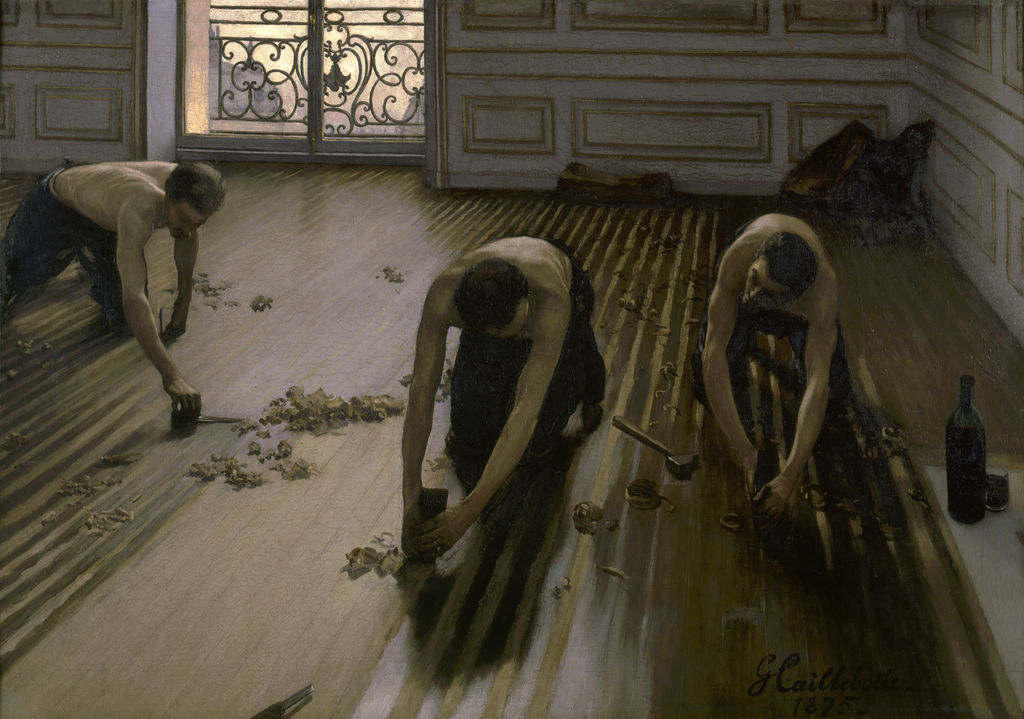
The Floor Scrapers, 1875; Musée d’Orsay. Google Arts & Culture — 0wHXxVpb7UjLNA. Image source. Public domain. Resized only; source appearance preserved.
A place within Impressionism
The House Painters was exhibited as no. 6 at the Third Impressionist Exhibition in Paris in 1877. Caillebotte contributed six paintings, including Le Pont de l’Europe, Paris Street, Rainy Day and three compositions concerned with figures in domestic or country settings. The street tradesmen therefore formed part of a wider selection, rather than an isolated declaration of interest in labour. [2] [4]
Olmsted reconstructs the exhibition as a setting in which Caillebotte’s city pictures could be considered alongside Monet’s views of the Gare Saint-Lazare. She argues that his selection and the arrangement of works helped articulate his place within the group, following criticism of the perspective and artistic affiliations of his 1876 submissions. Her interpretation connects formal ambition with the practical work of exhibiting. It gives The House Painters a role in a collective presentation of modern Paris as well as in Caillebotte’s own development. [4]
Contemporary responses also made the idea of work relevant to the painter himself. Raybone cites Georges Rivière’s description of Caillebotte as a worker and bold investigator in a review of the 1877 exhibition. The language matters because the artist’s financial independence could otherwise encourage a dismissive picture of painting as a wealthy man’s pastime. It recognises effort in the making of the images, even as those images represent other forms of effort. [6]
Soon after the exhibition, on 28 May 1877, The House Painters entered an Impressionist auction at the Hôtel Drouot. Berhaut records it as lot 3 and states that it was taken back by Caillebotte. Its presence in an auction therefore does not establish a successful sale to an independent buyer. The catalogue traces its subsequent history through the artist’s family to a private collection in France. [2]
The Musée d’Orsay’s later documentation preserves the distinction between ownership and deposit: the picture belongs to a private collection and is deposited at the museum. Its inclusion in Painting Men brought the canvas into a curatorial account that linked workers with other modern male figures, including urban pedestrians and sportsmen. Perrin’s attention to the studies made the physical specificity of these painters particularly clear. [1] [5]
Returning to the canvas after that history, the obstruction on the pavement feels consequential. Caillebotte gives a modest working situation the visual force needed to hold the spectator beside it. The distant street promises movement onwards; the ladders and concentrated figures delay that movement. For a moment, seeing Paris means attending to the people who are working on its surfaces.
Catalogue and documented works
This directory brings together 578 entries in the revised 1994 catalogue, 11 further documented records and three groups of study descriptions. It is a directory of records, not a total of authenticated individual works. Albums, print states and surviving decorative panels are grouped. English labels retain the French titles as searchable aliases; dates are supplied only where checked. Numbered entries link to the relevant article or the historical catalogue. Pastels appear under the Drawing filter; original prints remain searchable under All media.
Frequently Asked Questions
He painted it in 1877. Berhaut records the signature and date at the lower right as “G. Caillebotte 77”. It appeared in the Third Impressionist Exhibition that year. [2]
The museum’s 2024 documentation identifies it as privately owned and on deposit at the Musée d’Orsay, with deposit number DO 2023 2. [1]
Both give sustained attention to manual workers. The House Painters moves the subject into the street, where ladders, a shopfront and deep perspective create a different relationship between work and the viewer’s position. Berhaut discusses them together, as did the Musée d’Orsay’s Painting Men exhibition. [2] [5]
Discussion
Look again at the images and ideas explored in The House Painters. These editorial prompts invite your observations.
Reader Insights
The pavement and the workers’ equipment compete for space in the foreground.
The men’s different postures make the task readable through the body.
What does this street scene share with the enclosed room of The Floor Scrapers?
Join the Conversation
Share a detail, comparison or question about The House Painters below.
References
- Musée d’Orsay; Paul Perrin, Scott Allan and Gloria Groom. Caillebotte: Painting Men, institutional press presentation and displayed work captions (2024), curatorial presentation and caption for Peintres en bâtiments, including dimensions and deposit number DO 2023 2. View source. (in en/fr).
- Marie Berhaut, with Sophie Pietri. Gustave Caillebotte: Catalogue raisonné des peintures et pastels (1994), pp. 6–7, 39–41 and 86–89, especially nos. 52, 52A–C and 53; digital edition, Wildenstein Plattner Institute. View source. (in French).
- Marie Berhaut with Sophie Pietri; Wildenstein Plattner Institute, Gustave Caillebotte Catalogue raisonné des peintures et pastels, 1994. View source. (in French).
- Galina Olmsted. Making and Exhibiting Modernism: Gustave Caillebotte in Paris, New York, and Brussels (PhD dissertation, University of Delaware, 2019), pp. 98–105, on the 1877 selection, perspective, proposed production sequence and exhibition arrangement. View source.
- Paul Perrin, Musée d’Orsay. Transcription de l’entretien commissaire Caillebotte (2024), pp. 2–3 and 5–6, with study captions on pp. 11–12. View source. (in French).
- Samuel Raybone. “Gustave Caillebotte’s Interiors: Working Between Leisure and Labor”, nonsite.org, no. 26 (2018), repository PDF pp. 13–14 and 32–34, especially notes 21 and 43, on contemporary descriptions of Caillebotte’s work and the relation between artistic and house painting. View source.
- Art Institute of Chicago, Caillebotte Paintings and Drawings at the Art Institute of Chicago, 2015. View source.
- Petit Palais / Paris Musées, Portrait de Paul Hugot, original print, PPG2319, current. View source. (in French).
- Paul Perrin, Musée d’Orsay, Transcription de l’entretien commissaire Caillebotte, 2024. View source. (in French).
- Cleveland Museum of Art, Caillebotte collection records: 2020.260, 2009.157 and 2020.105, current. View source.
- Splash image, The House Painters, 1877.


