



 by Tom Gurney
Tom Gurney BSc (Hons) is an art history expert with over 20 years experience
Published on June 19, 2020 / Updated on November 2, 2026
Email: tomgurney1@gmail.com / Phone: +44 7429 011000
On the Pont de l’Europe: Introduction
A man in a top hat has stopped beside an immense metal bridge. He looks towards the railway beyond it, while another passer-by is already disappearing through the left edge of the picture. In On the Pont de l’Europe, Gustave Caillebotte brings the machinery of modern Paris so close that its riveted surfaces almost fill our view. Painted in 1876–77, this is the canvas now in the Kimbell Art Museum, Fort Worth. [1]
Three men occupy the left side; the bridge extends across the whole painting. The contrast makes the structure feel enormous, yet the people refuse to become a symmetrical arrangement within it. One moves away, one bends towards the railing and one stands upright. Their different directions give life to an image whose architecture seems, at first, to prescribe everything.
This close view is a separate composition from Le Pont de l’Europe, the more expansive Geneva painting with its strolling couple and dog. Marie Berhaut’s catalogue distinguishes the Kimbell canvas as number 51 and the smaller oil study for it as number 50. Recognising that difference changes what we look for: here Caillebotte concentrates our attention on a fragment of the bridge and the experience of standing immediately beside it. [2]
At a Glance
- ArtistGustave Caillebotte.
- Date1876–77.
- MediumOil on canvas.
- Dimensions105.7 × 130.8 cm.
- CollectionKimbell Art Museum, Fort Worth; accession AP 1982.01. [1] [3]
- CatalogueBerhaut 1994, number 51; related oil study, number 50. [2]
- SettingPont de l’Europe, above the approaches to the Gare Saint-Lazare in Paris. [1]
This work across Gustave Caillebotte’s career
Contents
- A bridge that becomes the picture’s framework
- Three figures, three ways of occupying the bridge
- Blue-grey metal, dark cloth and white steam
- A different problem from the Geneva painting
- The railway and the exhibition of 1877
- Men within an engineered city
- From the artist’s family to Fort Worth
A bridge that becomes the picture’s framework
The most forceful movement begins above the central man’s hat. A broad diagonal rises towards the upper edge, carrying rows of rivets with it. Another diagonal descends towards the right, crossing the pale opening through which we see the station. The bridge supplies both the subject and the main lines of the composition. Its members divide the view into compartments before the eye can travel into the distance.
At the bottom, a parapet runs almost straight across the canvas. Its long, rounded openings repeat with the regularity of a manufactured pattern. Through them appear slanting lines and patches of light below the bridge. These apertures offer tantalising pieces of a deeper space, but their heavy borders keep returning our attention to the metal surface in front. We alternate between looking at the bridge and looking through it.
The central upright does not announce itself as a clean dividing line from top to bottom. The standing figure overlaps the lower structure, while diagonal members converge above and beside him. That interference matters. Human and architectural forms are layered together, so the geometry has to be discovered through the bodies occupying it. The view feels inhabited before it becomes a diagram.
Berhaut described the composition as a restricted framing, effectively a close-up of part of the bridge’s metal lattice. Her distinction is useful because it shifts attention away from a general panorama of Paris towards an encounter with one of the city’s constructed surfaces. The bridge continues beyond every boundary of the canvas. Caillebotte gives enough of it to establish scale and repetition while leaving its complete shape outside the picture. [2]
The resulting pressure is unusually strong. There is little foreground pavement on which the spectator might mentally stand and almost no open sky into which the gaze can escape. The upper beam and lower railing hold the distant view between them. Yet the painted scene never becomes wholly flat: small openings admit enough information about the railway to make us conscious of the space being obstructed.
Three figures, three ways of occupying the bridge
The upright man is the clearest human presence. His tall black hat, long dark coat and light hand form a conspicuous sequence from top to bottom. His profile is only partly available, and his attention leads away from us. We see a person looking without gaining full access to what he sees. His body becomes a measure of the structure beside him: the beam above seems larger because it passes so close to his head.
His hand is an especially useful detail. Against the coat and blue-grey metal, its small pale shape is immediately legible. It interrupts the long dark silhouette without becoming a gesture directed towards another figure. The hand simply hangs. That quietness suits the paused posture, though it gives us no secure explanation of his thoughts or destination.
Behind and to his left, a man in a rounded hat bends towards the parapet. His blue clothing brings him close in colour to the bridge, while the angle of his head and shoulders differs from the more vertical stance in front. His presence can be missed at first because the figures overlap. Once noticed, he makes the picture less like a solitary portrait and more like a public place in which different people use the same railing.
The third man is cut off by the left edge. We see portions of a top hat, face and long coat, enough to infer a body continuing beyond the canvas. His turned-up collar and movement towards the boundary contrast with the principal man’s exposed profile and apparent pause. The edge becomes an active event: someone is leaving our field of vision while the structure remains.
Lynn Kellmanson Matheny’s National Gallery of Art brochure places such encounters within Caillebotte’s recurring interest in vision. People in his pictures look from windows, balconies and bridges; the spectator is often positioned as though already among them. That account helps explain the immediacy here. We are close enough to share the men’s space but receive none of the introductions that would turn them into a conventional group portrait. [5]
There is also a significant difference between physical proximity and social contact. These men stand near one another, yet their visible attention does not form a conversation. Their bodies create separate lines of interest: out of the picture, down towards the railway, across the bridge. The painting holds those directions together without supplying an anecdote that reconciles them.
Blue-grey metal, dark cloth and white steam
Colour binds the people to their surroundings. Blue-grey extends from the parapet into the girders and distant station; dark hats and coats deepen that range rather than introducing a competing brilliance. A little light skin and a pale collar become more noticeable because so much of the picture lies within closely related cool tones.
The Kimbell connects the blue tonality with the cold. The raised collar supports that reading, though this subdued palette should not be taken as a rule for Caillebotte’s entire career. [1]
Within that restricted range, the surfaces remain differentiated. The standing man’s coat forms a broad, comparatively continuous shape; rivets punctuate the bridge at regular intervals; the plume at the right dissolves into irregular pale marks. Repetition makes the manufactured structure legible, while the steam offers a form whose outline seems liable to change.
The steam is small in relation to the bridge, but it has considerable visual importance. It is one of the brightest passages and draws the eye through the right-hand opening. Its softness also brings the distant railway into a different visual register. The bridge can be understood through edges, joints and repeated parts; the vapour cannot be assembled in the same way.
Looking from the rivets to the plume reveals how the picture makes different kinds of modernity coexist. The viewer encounters a fixed supporting structure, men passing or pausing on it, and a railway whose activity is suggested through a changing atmospheric trace. Those differences can be read directly in the forms. They require no assumption that every rivet or cloud carries a hidden symbolic message.
The close framing is equally important to the apparent precision. It makes each large member of the bridge easy to follow while denying us a comprehensive account of its construction. We know a great deal about the visible fragment and comparatively little about the whole. That balance allows an image of massive engineering to remain a sharply limited human view.
Watch: Gustave Caillebotte
Explore a museum overview and two discussions of Paris Street; Rainy Day. This shared selection offers wider context for the artist’s work.
"Who Is Gustave Caillebotte?" - HD version
An introduction to Caillebotte from the Kimbell Art Museum.
Watch on YouTubeA different problem from the Geneva painting
The two finished bridge compositions offer distinct ways of entering the modern city. In the Geneva Le Pont de l’Europe, the pavement leads far into the distance, the structure recedes along the right and a dog moves through the foreground. The Kimbell canvas brings us against the side of the bridge. Its three figures and dominant cross-bracing organise a much shallower encounter. Berhaut treated it as a new view of the subject. The differences in setting and figures distinguish two finished compositions. [2] [5]
That change alters the spectator’s movement. The Geneva composition offers a route along the bridge, with bodies and perspective encouraging us to imagine advancing. Here the prominent figure has stopped. We encounter the men almost sideways, and the metalwork blocks easy passage into the distance. The implied experience is closer to turning towards a railing during a walk than to continuing straight ahead.
The smaller oil study, number 50 in Berhaut’s catalogue, already establishes this second composition’s essential arrangement. Its hat-wearing figure, framing bridge members and perforated parapet identify the same pictorial problem. It measures 65 × 81 cm, making it a separate, substantially smaller object than the Kimbell painting. Its ownership history must also be kept distinct from that of the finished canvas. [2]
Seeing the study beside the finished work helps us recognise that an abruptly bounded scene can still be carefully developed. A clipped figure or a beam running out of the frame need not be an accidental result of looking quickly. These are features that can be tested and retained as a composition grows. The study gives evidence for preparation without establishing every stage of execution or the amount of work undertaken outdoors.
The comparison also makes a useful connection with Paris Street, Rainy Day. Galina Olmsted examines how that painting and the Geneva bridge view create immersive encounters through perspective, scale and cropping. The Kimbell composition redirects those interests towards a more frontal architectural barrier. It expands Caillebotte’s investigation of urban viewing beyond the plunging street spaces for which he is especially familiar. [6]
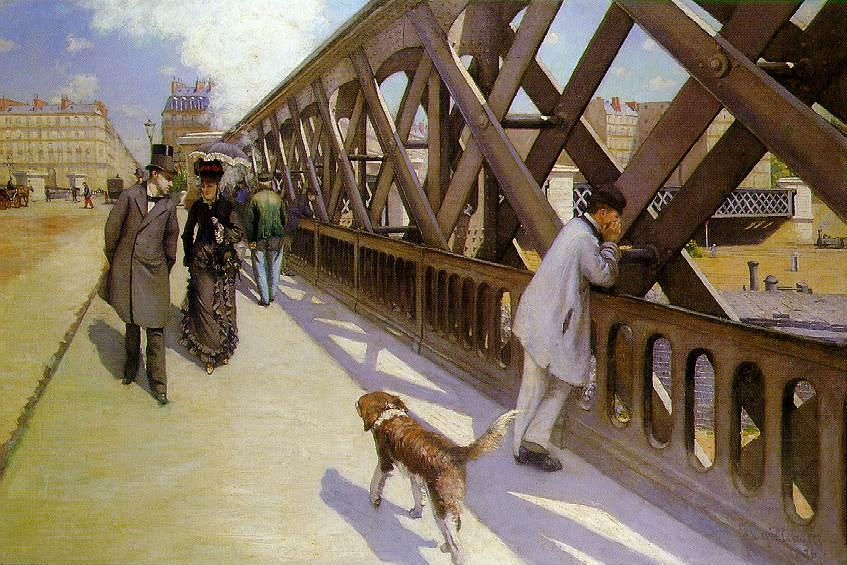
Le Pont de l’Europe, 1876; Geneva. Separate composition with a strolling couple and dog.
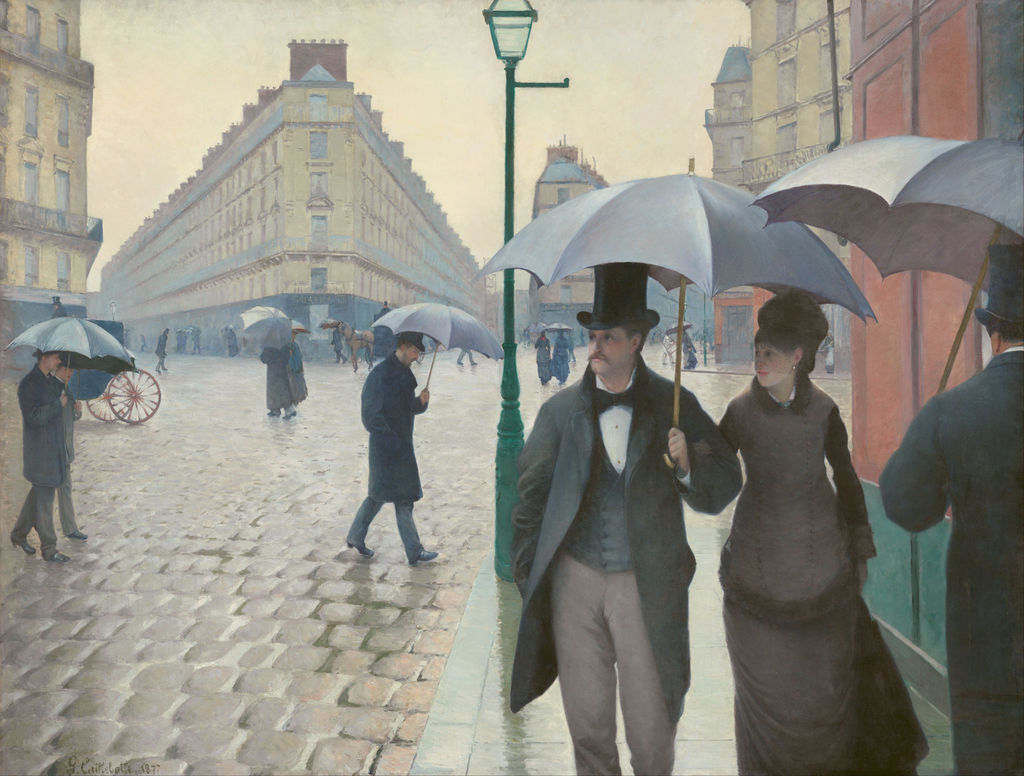
Paris Street; Rainy Day, 1877; Art Institute of Chicago. 5wEUCOlEf-EaVQ at Google Cultural Institute maximum zoom level. Image source. Public domain. Resized only; source appearance preserved.
The railway and the exhibition of 1877
The Gare Saint-Lazare gave Caillebotte and Claude Monet a shared modern subject. Monet painted the station in early 1877, and his railway views appeared in the third Impressionist exhibition alongside Caillebotte’s city paintings. The bridge painting shown there was the Geneva composition. The Kimbell canvas was absent. Olmsted’s reconstruction of the exhibition makes that distinction central to understanding the different roles of the two works. [6]
For the Kimbell picture, the station is an interrupted background rather than an open spectacle. Its roof and rail approaches are broken into pieces by the bridge. Monet’s presence in this discussion is useful because it encourages us to notice the steam and the railway setting, but it does not require us to turn the painting into an imitation of Monet. The solid foreground gives those distant effects a particular scale and position.
Why Caillebotte withheld this canvas remains uncertain. The Kimbell suggests that he may have wished to avoid competing with Monet’s station views. Olmsted proposes a different emphasis: the shallow, frontal composition may have suited the exhibition less well than the ambitious perspectival spaces Caillebotte selected. Both explanations concern a documented absence; neither supplies a documented statement of his motive. [1] [6]
Olmsted also considers whether the severely cropped figure might have invited renewed comparisons with Degas. Her argument depends on possible studio encounters and inferred artistic strategy, so it should remain a proposal. Its value for looking at the work is more direct: the man disappearing at the edge belongs to a wider Impressionist interest in partial, interrupted views, even as the enormous bridge makes this composition unmistakably Caillebotte’s own. [6]
The exhibition history prevents a tempting mistake. Responses to Caillebotte’s bridge painting in the 1877 show cannot automatically be applied to this canvas. Nor does its absence establish that he considered it unsuccessful. Olmsted dates its first public exhibition to 1951, a date also recorded in Berhaut’s entry. Its early place in Caillebotte’s work and its much later public visibility belong to different histories. [6] [2]
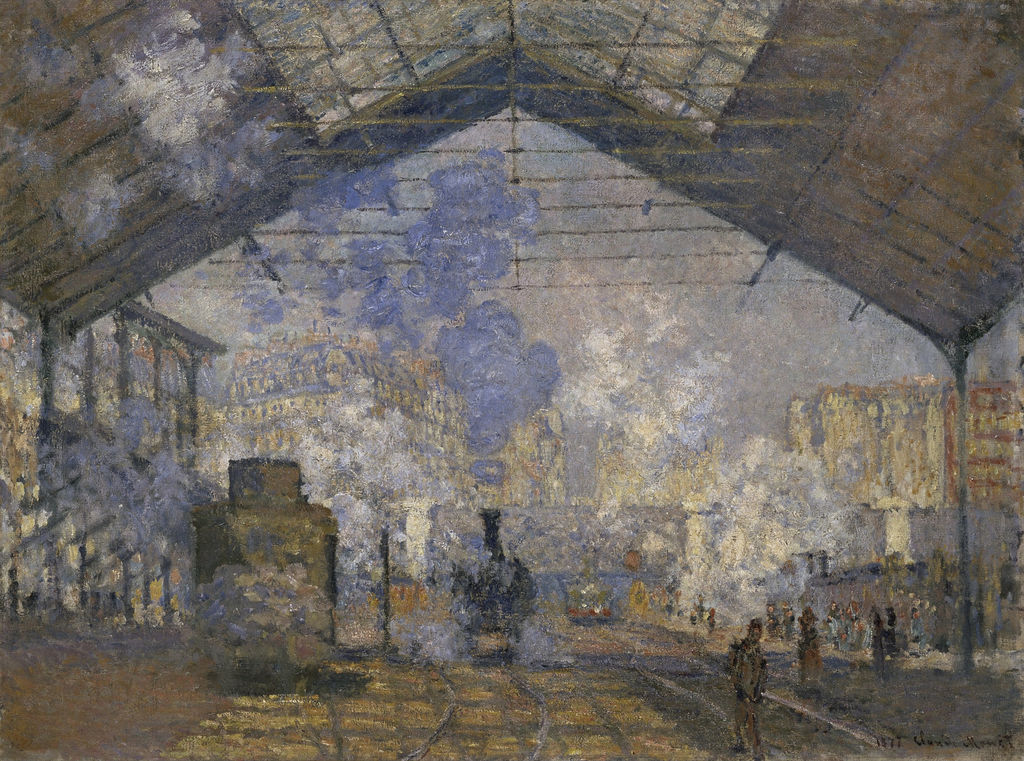
Claude Monet, The Saint-Lazare Station, 1877. wAHOCsl09dhUPw at Google Cultural Institute maximum zoom level. Image source. Public domain. Resized only; source appearance preserved.
Men within an engineered city
The two top-hatted men offer one of the painting’s most suggestive repetitions. Similar dark clothing establishes a resemblance, while opposing orientations break it. The Kimbell proposes an analogy between standardised engineering and urban society, offset by the men’s freedom from symmetry. [1]
The visible arrangement supports the question without settling it. Clothing makes public distinctions legible, but these bodies never become interchangeable units. The standing man’s profile, the bent figure’s downward attention and the cropped passer-by’s departure give each a different relation to the same place. Our attention moves between the regular parapet openings and these irregular human intervals.
A broader curatorial perspective appeared in the Musée d’Orsay’s Caillebotte: Painting Men. Paul Perrin, Scott Allan and Gloria Groom framed the artist’s male figures through the changing experience of masculinity, work, leisure and sociability. Their presentation included this Kimbell painting among his images of men inhabiting public space. That approach encourages attention to the figures as an essential part of the subject, rather than convenient measures placed before an architectural achievement. [3]
It also helps us resist attaching a complete personal story to a small visible gesture. The men’s identities and relationships are not established by their hats or proximity. What the picture gives with unusual clarity is their occupation of a shared urban environment: how they stop, turn, pass and look. The bridge imposes a powerful order upon the view, while their movements make that order feel temporary and lived in.
From the artist’s family to Fort Worth
The painting’s later history reinforces its distinction from the related study. The Kimbell’s provenance traces it through Martial Caillebotte and descendants, an extended loan to the National Gallery of Ireland in 1964–71, a Paris private collection and P. Borgognon & Fils in Geneva, before its purchase by the Kimbell Art Foundation in 1982. [1]
Berhaut’s 1994 catalogue records the finished canvas’s family history, Dublin loan and arrival in Fort Worth; its adjacent entry gives a different sequence of owners for the smaller study. The catalogue’s pairing is therefore useful in two ways. It reveals the development of a composition while also showing why images, dimensions and histories must be attached to the correct object. [2]
For the viewer, the finished painting’s lasting force lies in the economy of its encounter. A fragment of bridge, three partly withheld figures and a distant burst of steam are enough to make the city feel vast. The structure occupies almost everything we see, yet the human actions remain unresolved. Looking beside the standing man, we share his restricted opening onto Paris without ever seeing the whole city he inhabits.
Catalogue and documented works
This directory brings together 578 entries in the revised 1994 catalogue, 11 further documented records and three groups of study descriptions. It is a directory of records, not a total of authenticated individual works. Albums, print states and surviving decorative panels are grouped. English labels retain the French titles as searchable aliases; dates are supplied only where checked. Numbered entries link to the relevant article or the historical catalogue. Pastels appear under the Drawing filter; original prints remain searchable under All media.
Frequently Asked Questions
It belongs to the Kimbell Art Museum in Fort Worth, Texas, accession AP 1982.01. [3]
No. The Kimbell canvas is the close view with three men and dominant cross-bracing. The Geneva composition has a strolling couple, a dog and a longer view along the bridge. Berhaut catalogued them separately as numbers 51 and 49. [2]
It was not. The Geneva bridge painting was exhibited; proposed explanations for withholding the Kimbell canvas remain interpretations. [6]
Yes. Berhaut identifies a smaller oil on canvas, 65 × 81 cm, as the study for this composition, catalogue number 50. [2]
Discussion
Look again at the images and ideas explored in On the Pont de l’Europe. These editorial prompts invite your observations.
Reader Insights
The bridge structure occupies a striking amount of the painted surface.
The cropped figures turn a public crossing into a close encounter.
How does this view change when compared with the Geneva bridge painting?
Join the Conversation
Share a detail, comparison or question about On the Pont de l’Europe below.
References
- Kimbell Art Museum, On the Pont de l’Europe, collection interpretation, object details and provenance, institutional record republished on Google Arts & Culture; date 1876–77. View source.
- Marie Berhaut, with Sophie Pietri, Gustave Caillebotte: Catalogue raisonné des peintures et pastels (1994), p. 86, entries 50–51 and illustrations; entry 51’s comparison with number 49. Digitised by the Wildenstein Plattner Institute. View source. (in French).
- Musée d’Orsay; Paul Perrin, Scott Allan and Gloria Groom, Caillebotte: Painting Men (2024), institutional exhibition presentation and caption for the Kimbell Le Pont de l’Europe. View source. (in en/fr).
- Marie Berhaut with Sophie Pietri; Wildenstein Plattner Institute, Gustave Caillebotte Catalogue raisonné des peintures et pastels, 1994. View source. (in French).
- Lynn Kellmanson Matheny, National Gallery of Art, Gustave Caillebotte: The Painter’s Eye (2015), exhibition brochure, PDF pp. 3–5, discussion of viewing, cropping and urban compositions. View source.
- Galina Olmsted, Making and Exhibiting Modernism: Gustave Caillebotte in Paris, New York, and Brussels (PhD dissertation, University of Delaware, 2019), pp. 98–112, especially pp. 105–109, exhibition reconstruction and interpretation of the Kimbell composition. View source.
- Art Institute of Chicago, Caillebotte Paintings and Drawings at the Art Institute of Chicago, 2015. View source.
- Petit Palais / Paris Musées, Portrait de Paul Hugot, original print, PPG2319, current. View source. (in French).
- Paul Perrin, Musée d’Orsay, Transcription de l’entretien commissaire Caillebotte, 2024. View source. (in French).
- Cleveland Museum of Art, Caillebotte collection records: 2020.260, 2009.157 and 2020.105, current. View source.
- Splash image, On the Pont de l’Europe, 1876–77.


