



 by Tom Gurney
Tom Gurney BSc (Hons) is an art history expert with over 20 years experience
Published on June 19, 2020 / Updated on November 2, 2026
Email: tomgurney1@gmail.com / Phone: +44 7429 011000
The Orange Trees: Introduction
A man reads in the shade while another reader stands with a book farther along the terrace. Beyond them, a pale path curves past flowers into the sun. In The Orange Trees, Gustave Caillebotte makes an uneventful summer afternoon feel spacious, bright and almost tangible. Painted in 1878, the canvas belongs to the Museum of Fine Arts, Houston. [1]
The scene is the Caillebotte family's garden at Yerres. Marie Berhaut's catalogue identifies the two figures as Martial Caillebotte and Zoé, familiar presences in the artist's paintings of the estate. Their reading gives the picture its quiet human centre, although the trees occupy much of the canvas and supply its title. [2]
Look longer and the apparent ease becomes more complicated. The foreground chair is enormous, the distant reader seems unexpectedly close to the furniture, and the path rises sharply towards the upper right. Caillebotte's garden offers rest to its occupants while keeping the viewer's eye in motion.
At a Glance
- ArtistGustave Caillebotte
- TitleThe Orange Trees (Les Orangers)
- Date1878
- MediumOil on canvas
- Dimensions154.9 × 116.8 cm
- CollectionMuseum of Fine Arts, Houston
- Accession98.273
- CreditJohn A. and Audrey Jones Beck Collection, gift of Audrey Jones Beck. [1]
- Catalogue raisonnéBerhaut 114. [2]
This work across Gustave Caillebotte’s career
Man at His Bath
1884 [3]Contents
- A Garden Arranged for Summer
- The Two Readers
- Shade Has Colour
- A Terrace That Tilts Towards Us
- Other Gardens, Other Ways of Placing People
- Shown in 1879, Beyond the Printed Catalogue
- From the Family Collection to Houston
- Annotated details
A Garden Arranged for Summer
The garden at Yerres was an essential setting for Caillebotte's early work. The Musée des impressionnismes Giverny's study of his gardens places his exploration of the estate between 1872 and 1878. Its English-style park combined winding paths, carefully maintained beds and ornamental buildings; the kitchen garden and neighbouring river offered further subjects. Giverny's account stresses how boldly framed views and the presence of people distinguish Caillebotte's response to this cultivated landscape. [4]
Here, those two interests meet at the terrace. The picture gives us very little sky and no sweeping view of the house. Instead, we encounter a place through objects close enough to touch: the curved back of a chair, a broad planter rim, a straw hat and the small round table to the right. The distant lawn and trees appear through and around this furnished space. The garden opens from the position of someone already inside it.
The orange trees grow in large, pale, square tubs. Their trunks rise from boxes whose straight sides and ball-topped corners are emphatically visible. The container at the left is cut by the edge of the picture, making it seem to continue into our own space. Another stands almost centrally, separating the seated reader from Zoé behind it. These are substantial pieces of garden architecture. They anchor the leafy crowns and divide the terrace into places where a person can sit, read or pass through.
The title directs attention upwards, towards the dense foliage, yet the trees also shape everything beneath them. Their low canopy creates an outdoor ceiling over the readers. At the top, leaves merge into a dark, continuous mass; lower down, individual branches and light-catching marks become easier to distinguish. The narrow opening beside the central trunk offers a sudden view of the flowers. The tree thus works simultaneously as a screen and a frame.
Across the tubs, a flower bed spreads in red, cream and green. Beyond it, the bright lawn ends against a darker stand of trees. The view contains several kinds of boundary: solid boxes, the curved edge of a bed and a screen of distant trunks. The eye crosses them more easily than a person could walk through them.
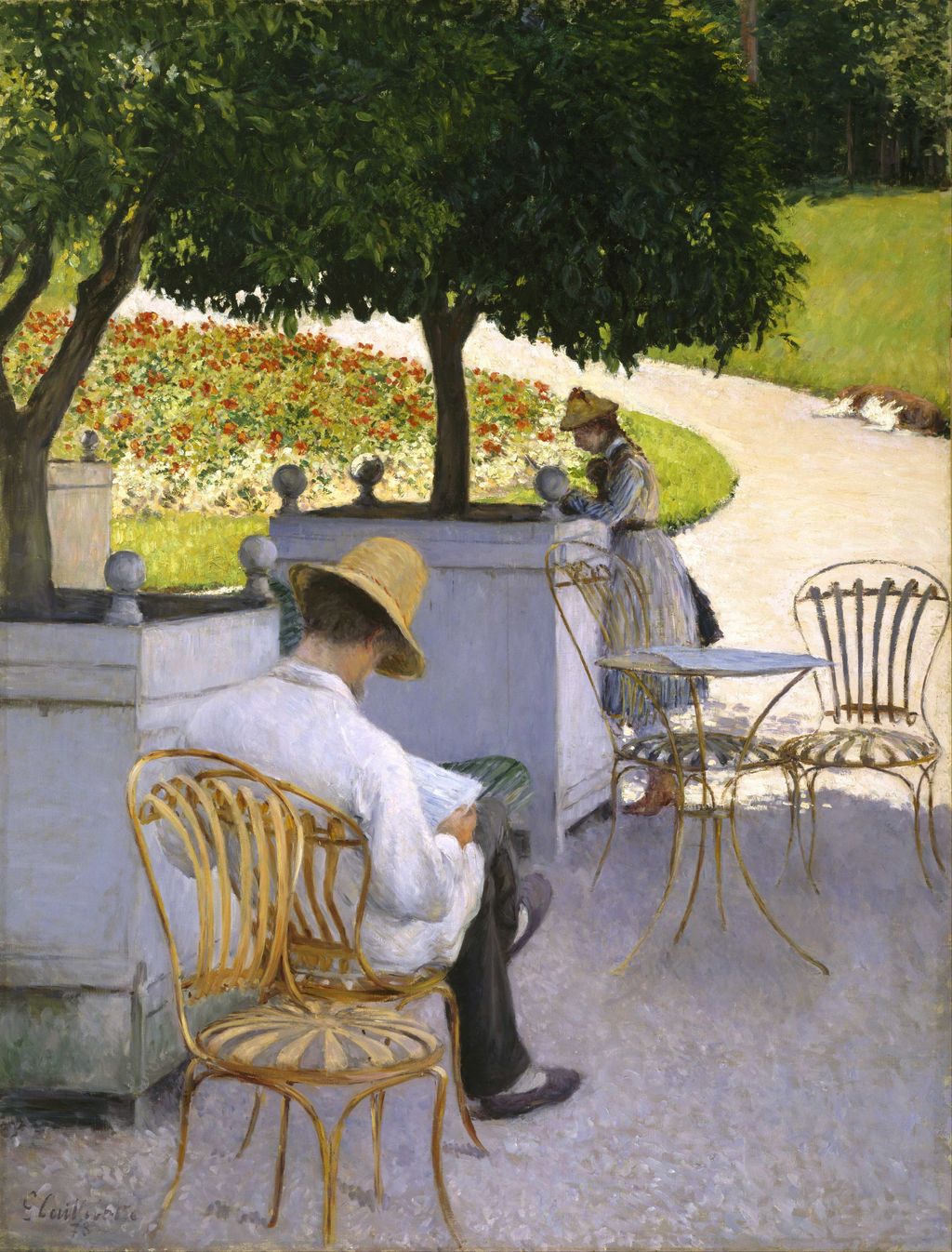
The Orange Trees,1878; Museum of Fine Arts,Houston,98.273. 3QHnQ99LLC7m3A at Google Cultural Institute maximum zoom level. Image source. Public domain. Resized only; source appearance preserved.
The Two Readers
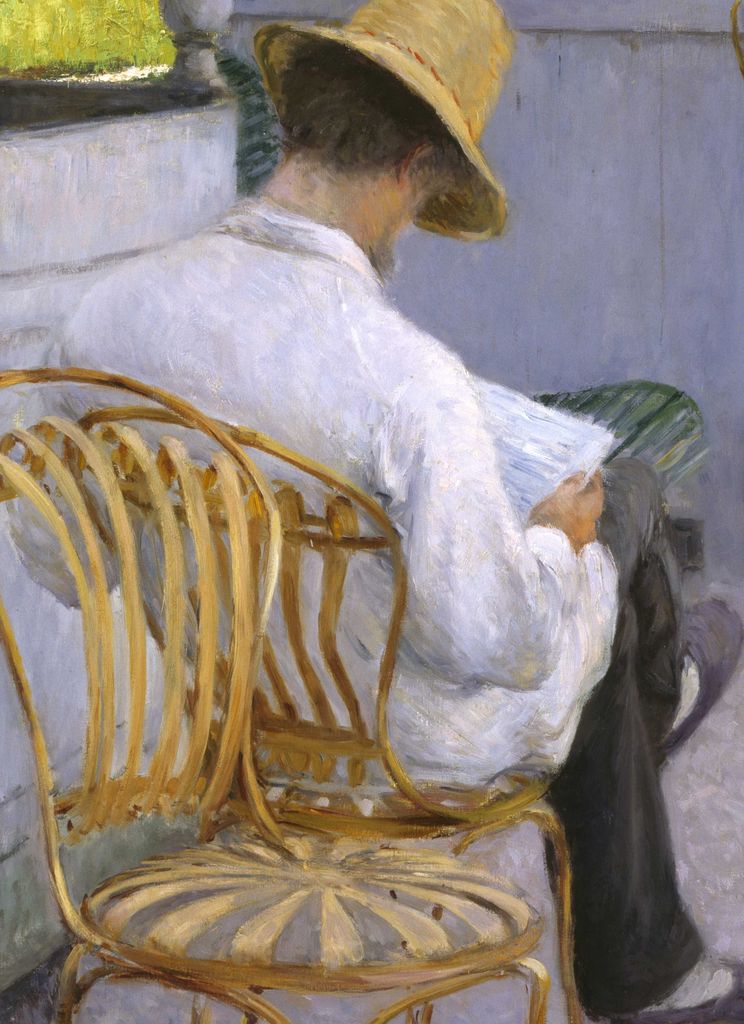
Martial sits nearest us, with his back turned and his head lowered. Houston's catalogue identifies what he holds as a newspaper. [1] His hat prevents us from seeing his face, and the turn of his shoulders directs attention towards his hands. The broad white shirt is therefore more immediately legible than the person wearing it. Its sleeve swells over his arm, catching cool lilac and grey tones, while his dark trousers and shoe close the figure below.
This viewpoint puts the spectator beside a private activity. We can see enough to recognise reading, but cannot join it: the page offers no legible text and the reader offers no returning glance. His posture is ordinary and convincing precisely because it does not seem adjusted to our presence. The chair's open framework, by contrast, is fully exposed. Its looping rods give the eye an intricate object to examine while the sitter remains absorbed.
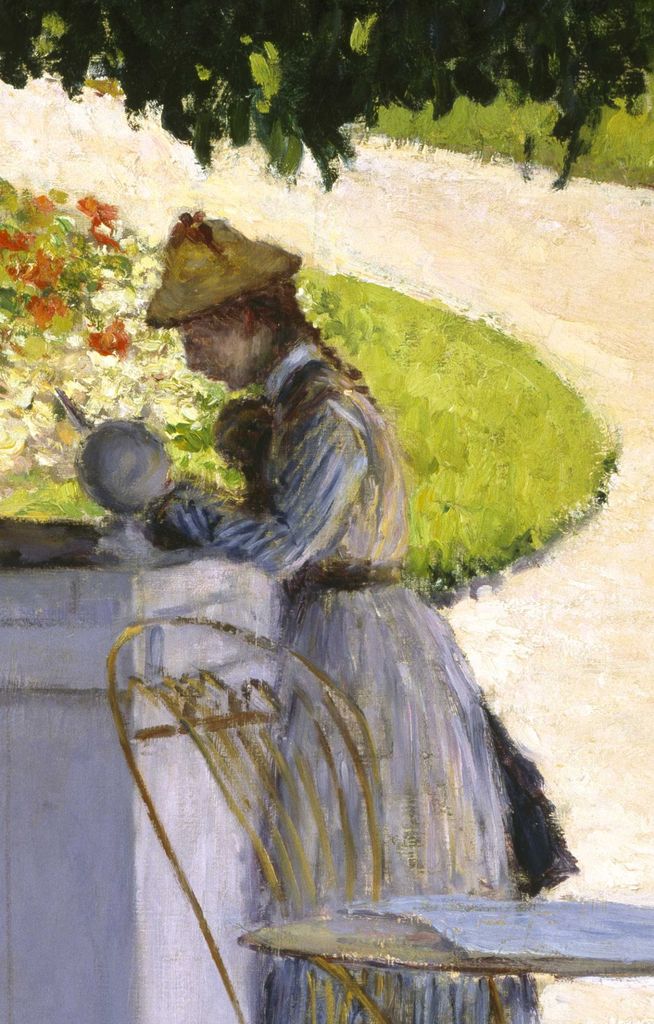
Zoé stands farther away, also looking down. She is Caillebotte's cousin: the Musée d'Art et d'Histoire Baron Gérard at Bayeux identifies her and her sister Marie within the family, clarifying a relationship sometimes given differently in accounts of The Orange Trees. [5] She appears beyond the central tub, with the light path beside her and the tree canopy above. The narrow stripes of her dress make a delicate vertical pattern between the solid box and the slender furniture.
The figures share an activity without making a group portrait in the conventional sense. Neither turns towards the other. No gesture links their hands or faces, and the planter interrupts the space between them. Yet nothing in their positions requires a story of estrangement. Two people reading separately in a familiar garden can suggest comfortable companionship. Houston's curator Helga Kessler Aurisch reads their absorption as characteristic of Caillebotte's quiet, self-contained groupings. [1] The visible evidence supports absorption; the emotional character of that silence remains open.
We are not told what they read, whether they have just spoken or how long they will remain. The furniture supplies several places for people who are absent. To the right, an empty chair faces obliquely towards the little table, while another stands nearer Zoé. These vacant places enlarge the human setting without introducing an incident.
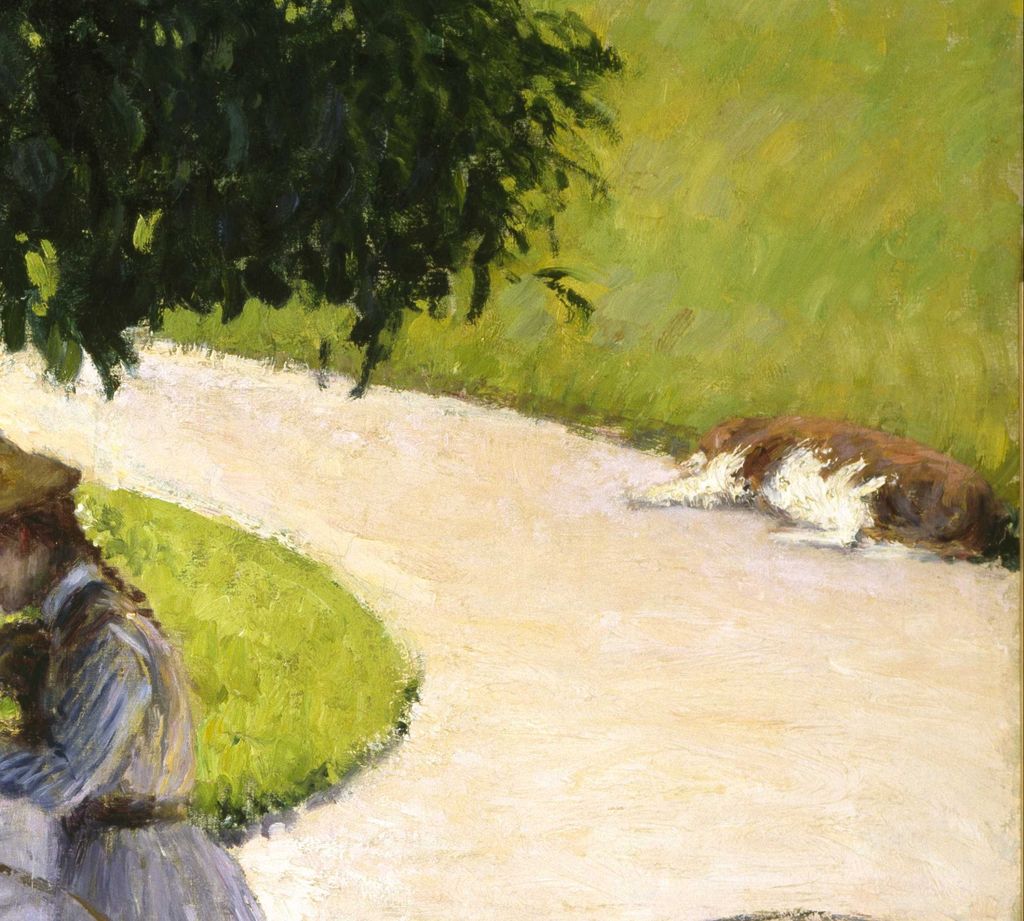
There is one more occupant, easy to overlook. At the far right, a brown-and-white dog lies along the sunlit edge of the path. Its horizontal body is compressed into a small patch between the lawn and gravel. Once noticed, it changes the balance of the scene: the two upright readers are joined by an animal entirely at rest. Its position also draws attention to the curve that carries the garden away from the terrace.
Annotated Details from The Orange Trees
The numbered points identify visible features discussed in this article. Return from each detail to the whole composition. The Orange Trees,1878; Museum of Fine Arts,Houston,98.273. 3QHnQ99LLC7m3A at Google Cultural Institute maximum zoom level. Image source. Public domain. Resized only; source appearance preserved.
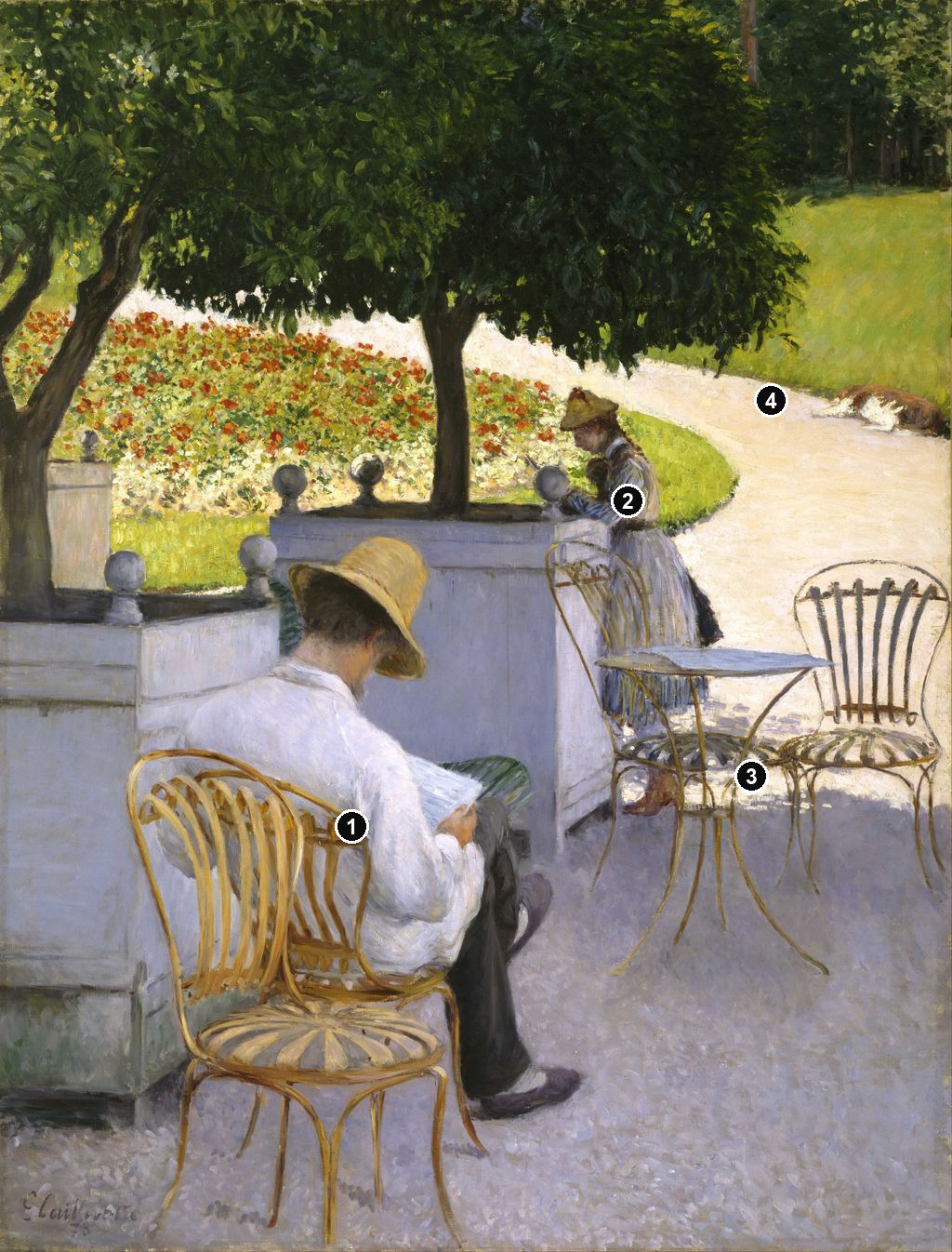
Details from THE ORANGE TREES
Compare the cropped details with the complete images above. Notice how their colours, shapes and positions contribute to the larger compositions.
Martial and his newspaper
Martial sits near the front of the terrace, absorbed in his newspaper. The broad white shirt and angled hat give his quiet activity a strong place in the foreground.
Zoé reading beyond the tub
Zoé reads farther away, partly separated from the foreground by the orange-tree tub. Her smaller figure carries the reader’s attention into another depth of the garden.
The open iron furniture
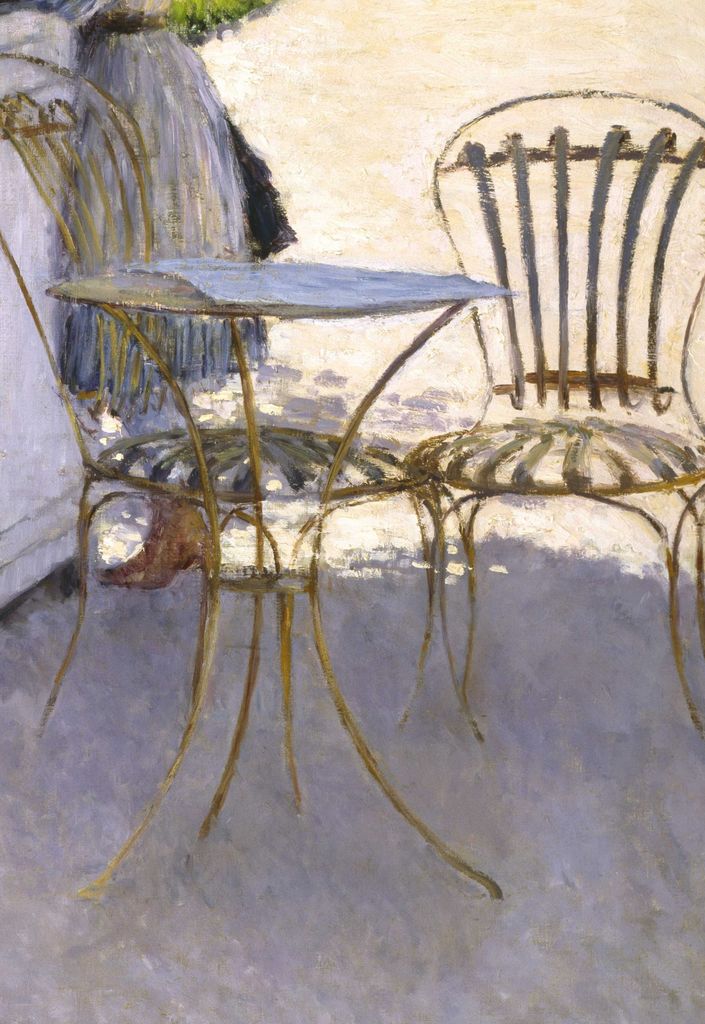
Curving chair backs, thin legs and the tabletop leave much of the terrace visible between them. Their open pattern sets a lighter rhythm beside the heavy tubs.
The curved path in sunlight
The pale path curves behind the trees and past the reclining dog. Its brightness separates the shaded terrace from the lawn and flowerbed.
Shade Has Colour
The boundary between light and shade is the picture's strongest division. The terrace occupies much of the lower half in grey, violet and muted pink. The path beyond is much lighter and warmer. It turns behind Zoé, then widens towards the right edge, where it seems almost to pour sunlight into the composition. Between these areas, the pale planters make a stepped transition in both space and tone.
Caillebotte gives the shaded foreground enough variation to prevent it becoming a dark platform beneath a bright landscape. Small strokes break up the gravel. The white shirt contains blue and lavender; the tubs have cooler sides and warmer edges; the golden furniture carries darker lines where its rods overlap. A viewer who concentrates on the foreground gradually finds colour everywhere within the shade.
The shirt is especially useful for understanding the effect. It is unmistakably white, although large passages are painted in colours that would seem much darker and cooler if isolated. Against the trousers, the cloth glows. Against the path, its light becomes subdued. The picture allows the same object to belong to the shaded terrace and still function as a major source of brightness within it.
Red and green become more assertive beyond the tubs. The flowers are made from numerous separate touches, loosely gathered into a bed whose boundary is clearer than its individual plants. Near the dark canopy, the reds appear particularly insistent. The grassy curve beside Zoé is a sharper yellow-green, while the distance becomes quieter and darker again. The garden's colour changes with its different surfaces and levels of illumination.
The handling also changes as we look around the canvas. The nearest chair retains a legible network of curves, and the planter faces have firm edges. The flowers resolve into clusters of marks; leaves become short, varied strokes within a larger silhouette. Even in the foreground, however, the paint does not suppress its own movement. The gravel remains a field of small touches, and the shirt's folds are built from strokes broader than the dress stripes farther away.
These variations give different things different kinds of presence. The box feels heavy; the chair feels open and springy; the flowers appear numerous without being counted. The orange trees have dark, substantial crowns, yet scattered lighter strokes keep their surface lively. The painting's material interest lies in this responsiveness to what is being represented. Close viewing reveals decisions about edges, intervals and colour inside an image that first seemed to offer only a tranquil afternoon.
Watch: Gustave Caillebotte
Explore a museum overview and two discussions of Paris Street; Rainy Day. This shared selection offers wider context for the artist’s work.
"Who Is Gustave Caillebotte?" - HD version
An introduction to Caillebotte from the Kimbell Art Museum.
Watch on YouTubeA Terrace That Tilts Towards Us
The furniture makes the picture's space unusually active. Nearest the viewer, Martial's chair spreads across the lower left. Its curved back overlaps his shirt, while the seat and legs extend far below him. The chair is almost as commanding as its occupant. Because its rods leave gaps, it can occupy a large area without entirely shutting out what lies beyond.
On the other side of the central tub, another chair back rises close to Zoé. The circular table is compressed into a thin oval, with long curved legs reaching into the shaded ground. The rightmost chair presents a broad back and a comparatively narrow seat. These objects make the eye estimate distance repeatedly. Their interlocking curves are clear individually, yet do not settle into a perfectly effortless route through the terrace.
Aurisch notes earlier criticism of the chairs' scale and the path's rising perspective. [1] The effect can be tested by following the path from right to left. It recedes around the bed, but its pale surface is also a broad shape on the canvas, pushing upwards towards the wooded background. A gently winding walk becomes a steep pictorial diagonal.
The planters answer that movement with straight lines. Their upper edges, corner posts and flat faces divide the scene into short, measurable intervals. They seem stable beside the irregular silhouettes of the leaves. At the same time, their height conceals the ground behind them, so they interrupt our ability to judge exactly where the distant reader stands. Caillebotte gives us strong landmarks while withholding a continuous floor plan.
These spatial pressures make a useful distinction between the occupants' experience and ours. The readers appear settled. The viewer must negotiate overlapping objects, changes of scale and a path that turns abruptly into brightness. The picture's quietness belongs to the people; its composition keeps asking us to look again.
Other Gardens, Other Ways of Placing People
An earlier family scene helps explain what Caillebotte was pursuing. In Portraits in the Countryside, painted in 1876, three women work at needlework while a fourth reads farther back. Bayeux's account identifies relatives and a family friend gathered in the Yerres garden. [5] Berhaut likewise places the group beside the main house and emphasises the prominence of its figures among the artist's garden paintings. [2]
The comparison brings the activity of reading into focus. In the earlier work it is one occupation among several; in The Orange Trees it becomes the shared action of the two principal figures. Caillebotte can therefore vary distance, posture and lighting around a repeated gesture. Martial's lowered head and Zoé's lowered gaze rhyme across the central planter. Their separation becomes part of the composition's rhythm.
Aurisch also connects the painting to Monet's outdoor Luncheon of 1873, which Caillebotte owned: both combine garden furniture, shade and a bright curving path. [1] This is a different work from the indoor Luncheon of 1868–69 now in Frankfurt's Städel Museum. [6] The comparison helps place the terrace within an artistic conversation about making figures belong to an outdoor setting. A person need not be the largest or brightest thing in a picture to remain essential to its organisation.
Berhaut's broader account of the Yerres paintings describes Caillebotte's simultaneous interest in recognisable portraits and outdoor light, extending from garden scenes to bathers, anglers and boaters. [2] The connection with Skiffs is therefore more than a common location. In one setting, recreation is active and mobile; on the terrace, it takes the form of stillness. Both subjects give the artist people engaged in something other than posing, surrounded by changing light and vegetation.
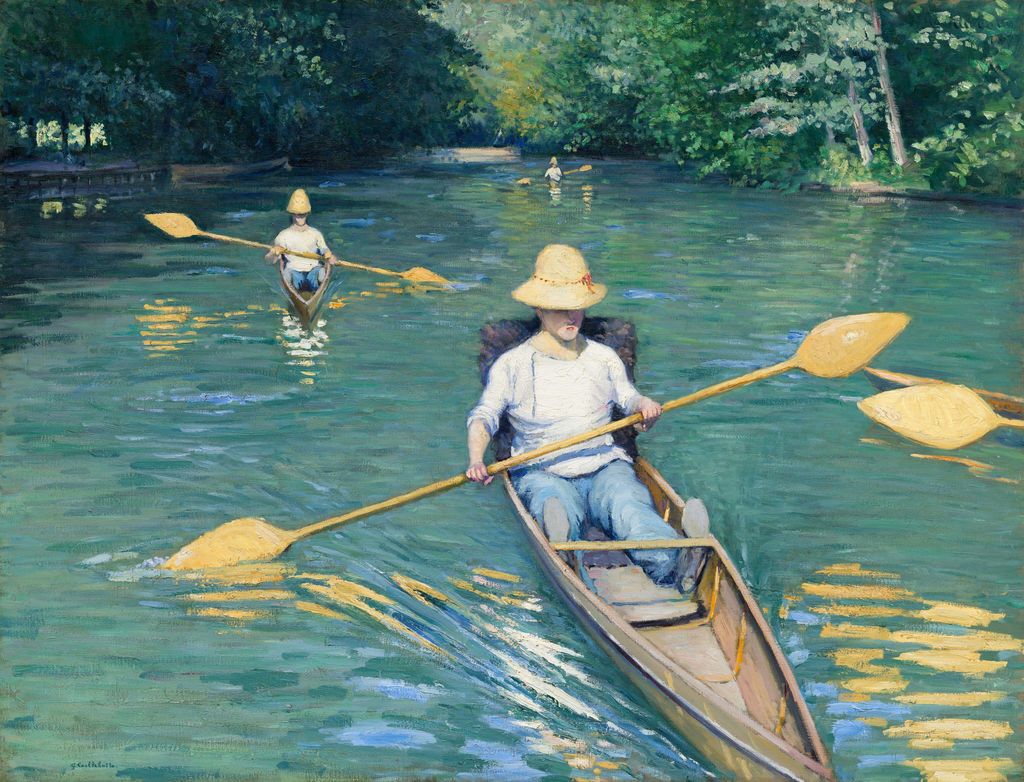
Skiffs,1877; National Gallery of Art,Washington. Collection of Mr. and Mrs. Paul Mellon. Image source. Public domain. Resized only; source appearance preserved.
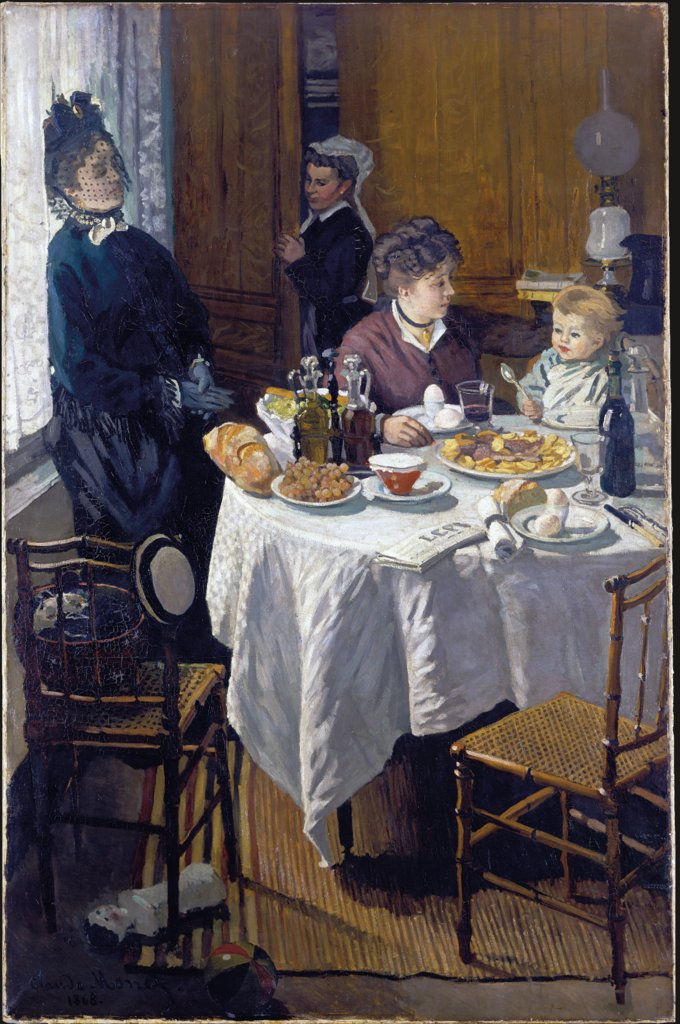
Claude Monet,The Luncheon,1868–69; Städel Museum,SG170. This indoor canvas is distinct from Monet’s outdoor1873Luncheon. Städel Museum, Frankfurt am Main. Image source. Public domain. Whole supplied image retained; resized only.
Shown in 1879, Beyond the Printed Catalogue
The Orange Trees was exhibited at the fourth Impressionist exhibition in 1879, although it did not receive an entry in the printed catalogue. Berhaut records the showing as hors catalogue. Her entry also cites Léon Bec's cartoon, published in Le Monde parisien on 17 May 1879, which provides contemporary evidence of the work's public appearance. [2]
That history is useful when approaching the image today. The terrace may feel secluded, but the painting itself entered a public exhibition where its arrangement could be scrutinised and caricatured. Its sharp contrasts and conspicuous furniture were available to viewers as formal choices. The scene's domestic familiarity did not make its presentation conventional.
The date also places it near the end of Caillebotte's years at Yerres. His mother died in October 1878, and the estate was sold in 1879. Giverny's account follows his later garden painting to Petit Gennevilliers, where he and Martial acquired property in 1881. [4] The Orange Trees can consequently be seen as a late statement about a place he knew intimately. Its calm need not be made into a premonition of those changes: the chronology is poignant without requiring the painting to predict it.
From the Family Collection to Houston
The canvas descended through Martial, his widow Marie and their daughter Geneviève Chardeau. After passing through the market, it reached John and Audrey Jones Beck in the late 1960s; the museum's provenance gives 1968, its essay 1969. Audrey gave it to Houston in 1998. [1]
Berhaut's exhibition record includes the Beck Collection display in Houston in 1974 and the Caillebotte retrospective in Houston and New York in 1976–77. [2] These public appearances gave the family garden a new audience long after its original occupants and setting had passed into history. The composition could now be assessed beside a much wider range of Caillebotte's work.
The painting rewards that sustained attention. At first, sunlight and leisure dominate. Then the distinct forms become insistent: the heavy boxes, the airy furniture, the partly concealed faces, the dark canopy over the bright flowers. Each is ordinary in itself. Their combination makes this afternoon both immediately recognisable and spatially surprising, offering a quiet view of the garden that never becomes visually inert.
Catalogue and documented works
This directory brings together 578 entries in the revised 1994 catalogue, 11 further documented records and three groups of study descriptions. It is a directory of records, not a total of authenticated individual works. Albums, print states and surviving decorative panels are grouped. English labels retain the French titles as searchable aliases; dates are supplied only where checked. Numbered entries link to the relevant article or the historical catalogue. Pastels appear under the Drawing filter; original prints remain searchable under All media.
Frequently Asked Questions
The setting is the park of the Caillebotte family's estate at Yerres. Berhaut dates the scene to the summer before the property was sold. [2]
Yes. It appeared at the fourth Impressionist exhibition in 1879, outside the printed catalogue. Berhaut records the showing and the contemporary cartoon by Léon Bec. [2]
Discussion
Look again at the images and ideas explored in The Orange Trees. These editorial prompts invite your observations.
Reader Insights
The pots and terrace make firm shapes within the garden’s broken light.
The two readers occupy the same setting without sharing the same pose.
Does the tilted terrace draw you into the shade or keep you outside it?
Join the Conversation
Share a detail, comparison or question about The Orange Trees below.
References
- Helga Kessler Aurisch / Museum of Fine Arts, Houston. “The Orange Trees,” The Beck Collection, online catalogue, current; object 98.273, essay, notes 12–25 and provenance. View source.
- Marie Berhaut, with Sophie Pietri. Gustave Caillebotte: Catalogue raisonné des peintures et pastels (1994), introduction, pp. 32–33; entries 40 and 114, pp. 80–81 and 117. Digital edition, Wildenstein Plattner Institute. View source.
- Marie Berhaut with Sophie Pietri; Wildenstein Plattner Institute, Gustave Caillebotte Catalogue raisonné des peintures et pastels, 1994. View source. (in French).
- Musée des impressionnismes Giverny. Caillebotte, peintre et jardinier: Dossier pédagogique (2016), “Villégiatures à Yerres,” pp. 4–5, and chronology, p. 14. View source. (in French).
- Musée d'Art et d'Histoire Baron Gérard, Bayeux. “Portraits à la campagne,” collection account, current; sitter identifications and family history. View source. (in French).
- Städel Museum. “The Luncheon, 1868–1869,” digital collection, current; Claude Monet, inventory SG 170, object data and description. View source. (in en/de).
- Art Institute of Chicago, Caillebotte Paintings and Drawings at the Art Institute of Chicago, 2015. View source.
- Petit Palais / Paris Musées, Portrait de Paul Hugot, original print, PPG2319, current. View source. (in French).
- Paul Perrin, Musée d’Orsay, Transcription de l’entretien commissaire Caillebotte, 2024. View source. (in French).
- Cleveland Museum of Art, Caillebotte collection records: 2020.260, 2009.157 and 2020.105, current. View source.
- Splash image, The Orange Trees, 1878.


