



 by Tom Gurney
Tom Gurney BSc (Hons) is an art history expert with over 20 years experience
Published on June 19, 2020 / Updated on November 2, 2026
Email: tomgurney1@gmail.com / Phone: +44 7429 011000
Portrait of Henri Cordier: Introduction
Gustave Caillebotte places us close to Henri Cordier's shoulder, looking past his bent arms towards a page. A pen, a beard, a white cuff and the edge of the paper converge in a small, intricate passage. Around them, books and furnishings occupy almost every available space. Painted in 1883, this oil on canvas measures 65 × 81.5 cm and belongs to the Musée d'Orsay. [1]
The portrait makes an unusually substantial part of its subject out of a man's back. Cordier's face appears in profile, while his jacket spreads across the foreground and interrupts our access to the desk. Looking at him involves looking around him. This close, oblique encounter gives the activity of writing a physical presence: the scholar has a particular way of inclining his body, approaching the paper and fitting himself among his possessions.
At a Glance
- ArtistGustave Caillebotte.
- Date1883.
- MediumOil on canvas.
- Dimensions65 × 81.5 cm, excluding the frame.
- CollectionMusée d'Orsay, Paris.
- AcquisitionGift of Mme Henri Cordier, 1926. [1]
- Catalogue numberBerhaut 251. [2]
- Museum accessionRF 2729. [3]
This work across Gustave Caillebotte’s career
Contents
- An encounter from the side
- Henri Cordier and the world of books
- The small drama of hands and paper
- A room assembled from competing surfaces
- Violet cloth and changing light
- A portrait in the company of Degas
- From Cordier's collection to the museum
- Annotated details
An encounter from the side
Cordier turns towards the left, away from our position behind and beside him. We see his ear, the contour of his forehead and nose, and the dark mass of his beard. The nearer shoulder projects towards us; the curved sleeve travels down and left towards the desk. His torso then runs out through the bottom edge. The pose gives no full account of how he is seated. It supplies enough of the body to make its weight convincing, while keeping the lower half outside the picture.
That cropping changes the relationship between sitter and viewer. There is no open stretch of floor across which we might approach him, and no chair offered as a guide to our own place. His jacket already occupies the position nearest us. We are admitted to a close view of his working space without receiving his attention. The lowered eye and forward inclination of the head keep the activity directed towards the paper.
Within the large brown and violet shape of the coat, the face is comparatively small. Its lightness is therefore crucial. The forehead, nose and ear emerge against the darker hair and background; the narrow white collar separates the neck from the jacket. Rather than allowing the shoulder to bury the head, Caillebotte uses these changes of colour and tone to bring it forward. The profile remains legible even as books, lamp and paper compete for our eye.
A conventional outline of a standing or seated figure would make the person's silhouette easy to grasp. Here, the silhouette is interrupted by the desk and cut by the frame. The portrait asks us to recognise Cordier through a combination of features, gesture and immediate surroundings. His body seems fitted to this particular corner, with the elbow held against the desktop and the head inclined over its contents. The physical arrangement is part of the likeness.
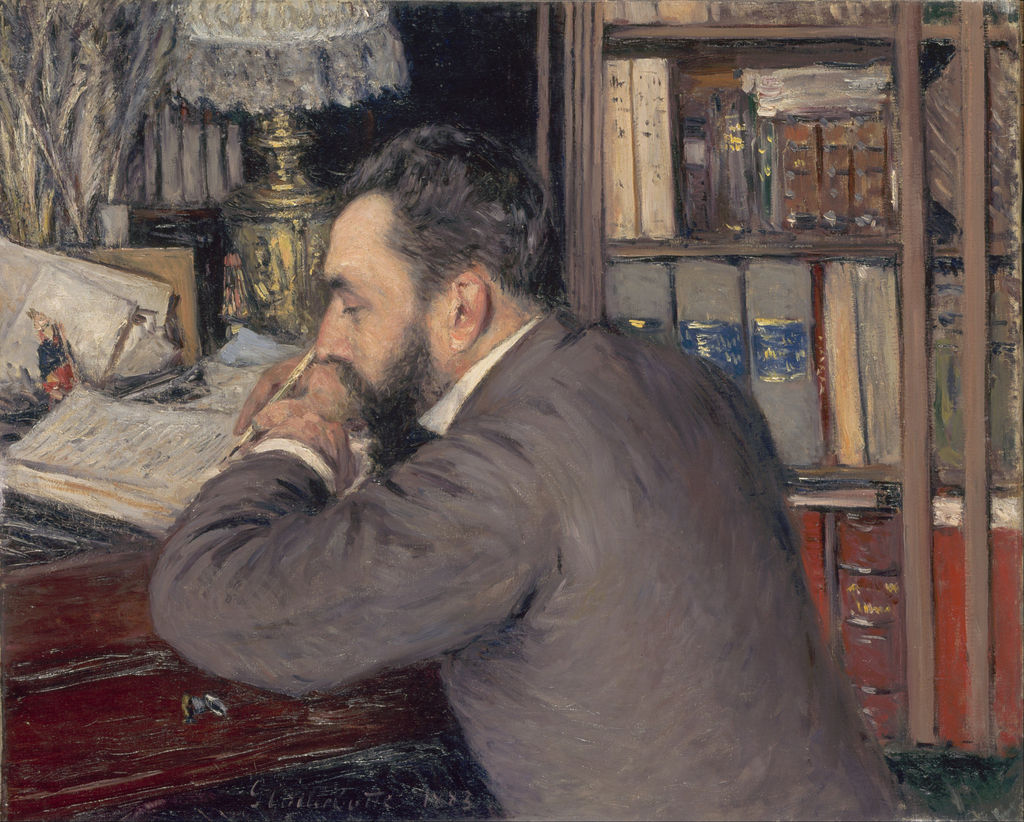
Henri Cordier, 1883; Musée d’Orsay, RF2729. Google Arts & Culture — zgECICokkDuXSg. Image source. Public domain. Resized only; source appearance preserved.
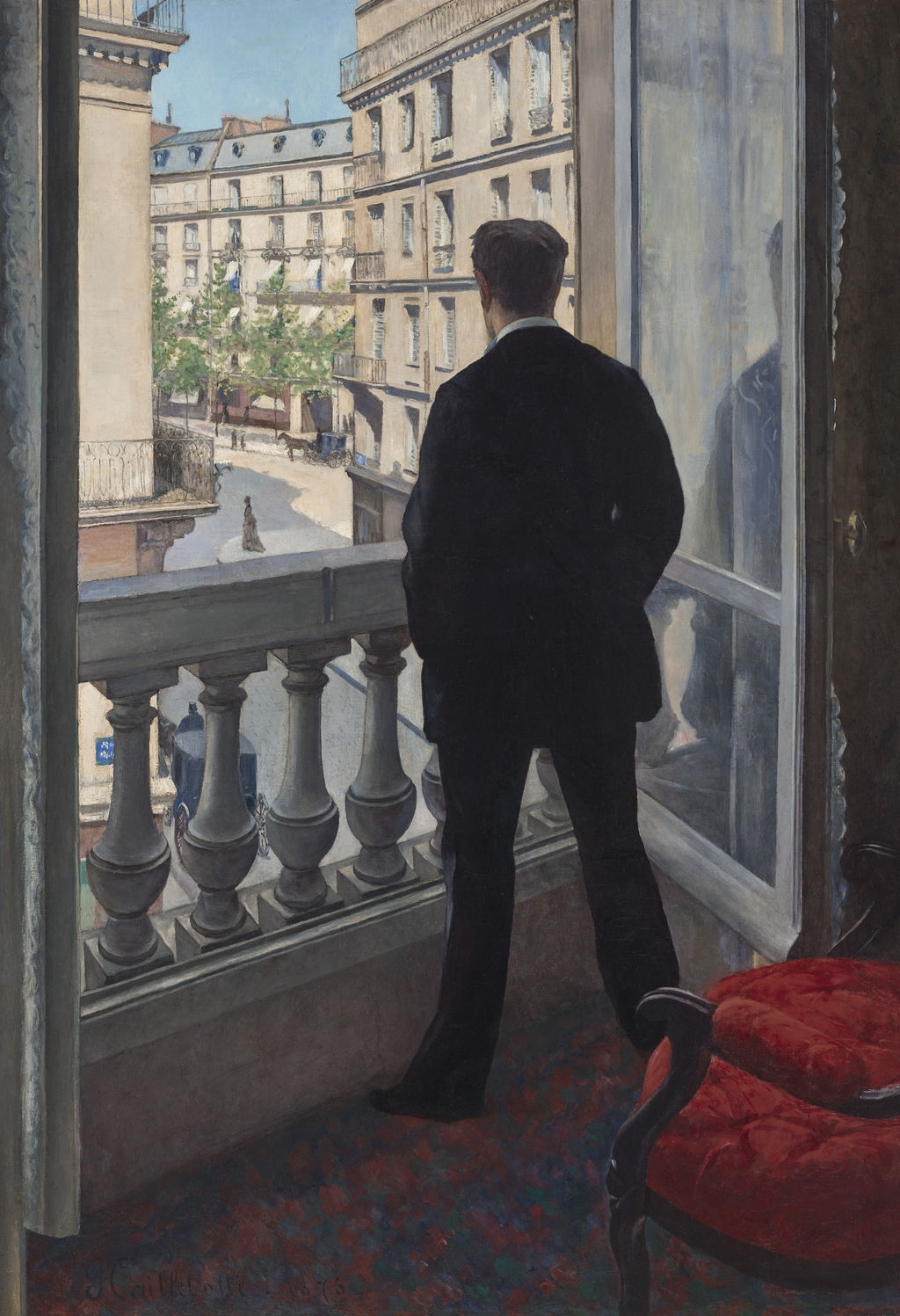
Young Man at His Window, 1876; another use of the back view in Caillebotte’s figure painting. www.christies.com. Image source. Public domain. Resized only; source appearance preserved.
Henri Cordier and the world of books
Henri Cordier lived from 1849 to 1925. A specialist in China, he taught history, geography and the legal systems of Far Eastern countries at the School of Oriental Languages in Paris. He had lived in China between 1869 and 1876 and helped found the Revue d'Extrême-Orient in 1882. The Musée d'Orsay identifies him as Caillebotte's friend, while acknowledging that the circumstances of their meeting are unknown. [3]
His major bibliography bears the title Bibliotheca sinica. Dictionnaire bibliographique des ouvrages relatifs à l'Empire chinois: a bibliographical dictionary of works relating to the Chinese Empire. The University of Vienna's bibliographical record dates the first edition to 1878–1895, listing a first volume in 1878, a second in 1885 and a supplement in 1895. The portrait therefore falls within the years in which this extensive publication was appearing. [5]
That context gives the books more specificity than a general suggestion of education. Bibliographical work involves other books: titles to locate, editions to distinguish and entries to arrange. A room densely occupied by volumes is an appropriate setting for someone whose scholarly practice depended on navigating published material. Yet the painting's own writing cannot securely be attached to a particular publication. The slanted marks on the paper show the appearance of text at this distance; they do not provide a readable title or passage.
Marie Berhaut's catalogue places the setting in Cordier's study on the rue de Rivoli. [2] It is an interior with working materials close at hand, but also with objects that make it more visually varied than an office defined solely by a task. The lampshade, reflective lamp base and small coloured figure on a propped sheet introduce different surfaces and scales. Cordier's profession helps explain why the books matter; it does not turn every object into a coded statement about his achievements.
Annotated Details from Portrait of Henri Cordier
The numbered points identify visible features discussed in this article. Return from each detail to the whole composition. Henri Cordier, 1883; Musée d’Orsay, RF2729. Google Arts & Culture — zgECICokkDuXSg. Image source. Public domain. Resized only; source appearance preserved.
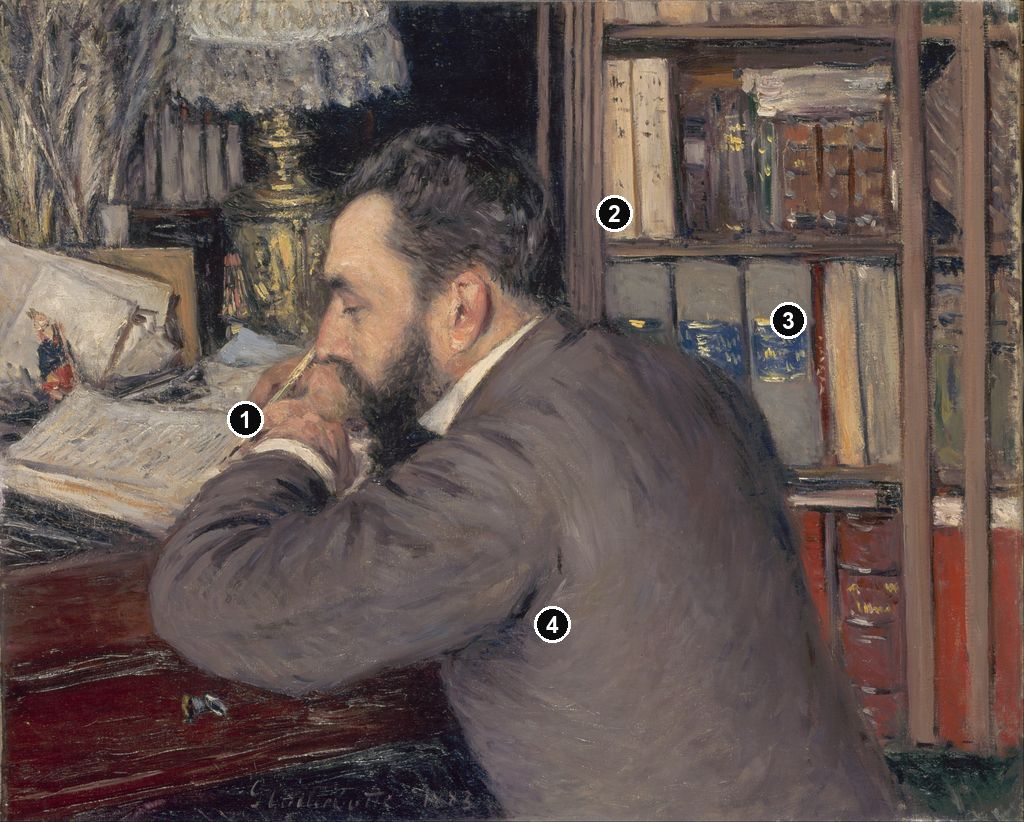
Details from PORTRAIT OF HENRI CORDIER
Compare the cropped details with the complete images above. Notice how their colours, shapes and positions contribute to the larger compositions.
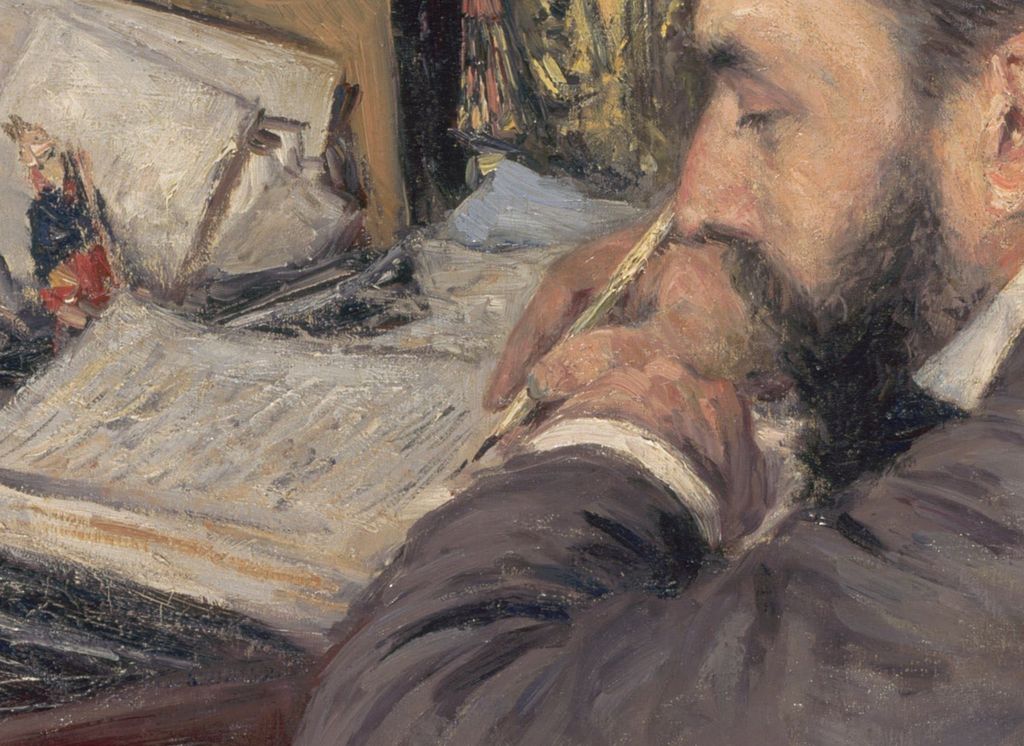
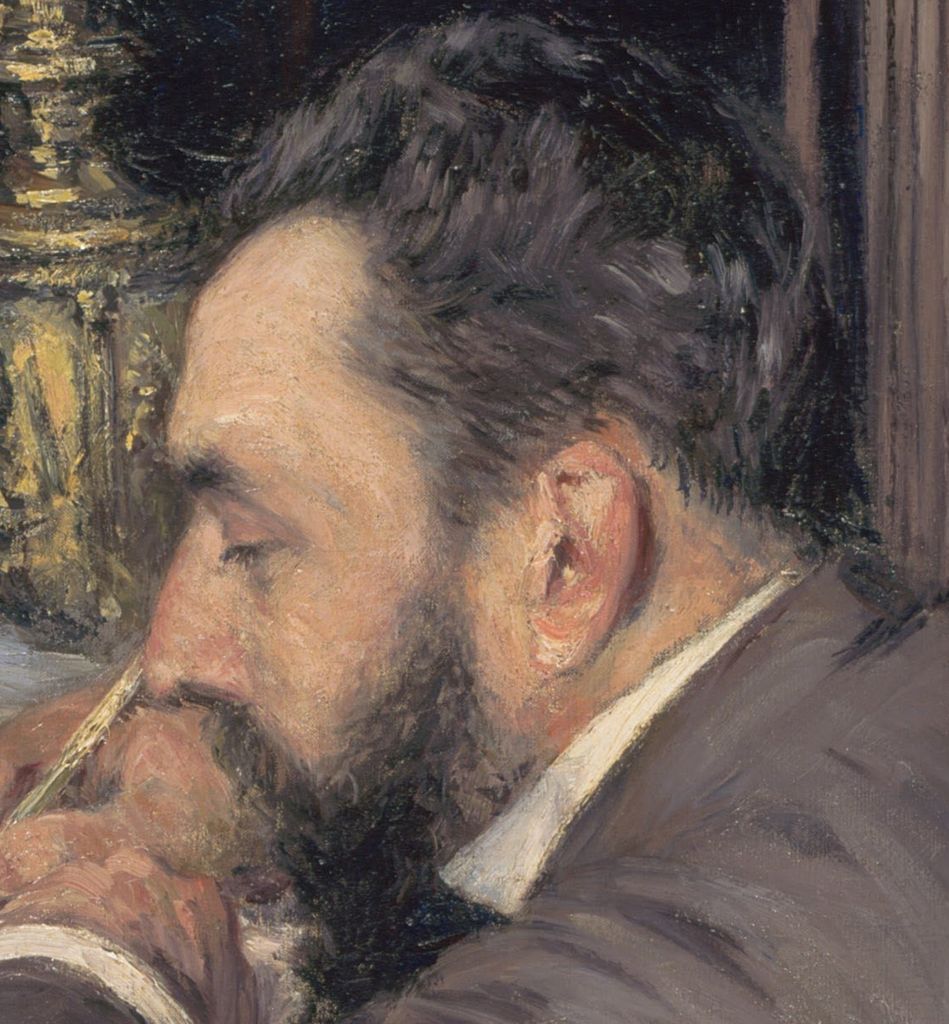
Hands, pen and the sloping page
The cuff, fingers and pen gather beside the open page. The surrounding marks suggest writing without securely identifying a particular text.
A profile within the crowded room
Cordier’s forehead, nose and beard remain distinct beside the books and lamp. Light on the profile directs attention back towards the page.
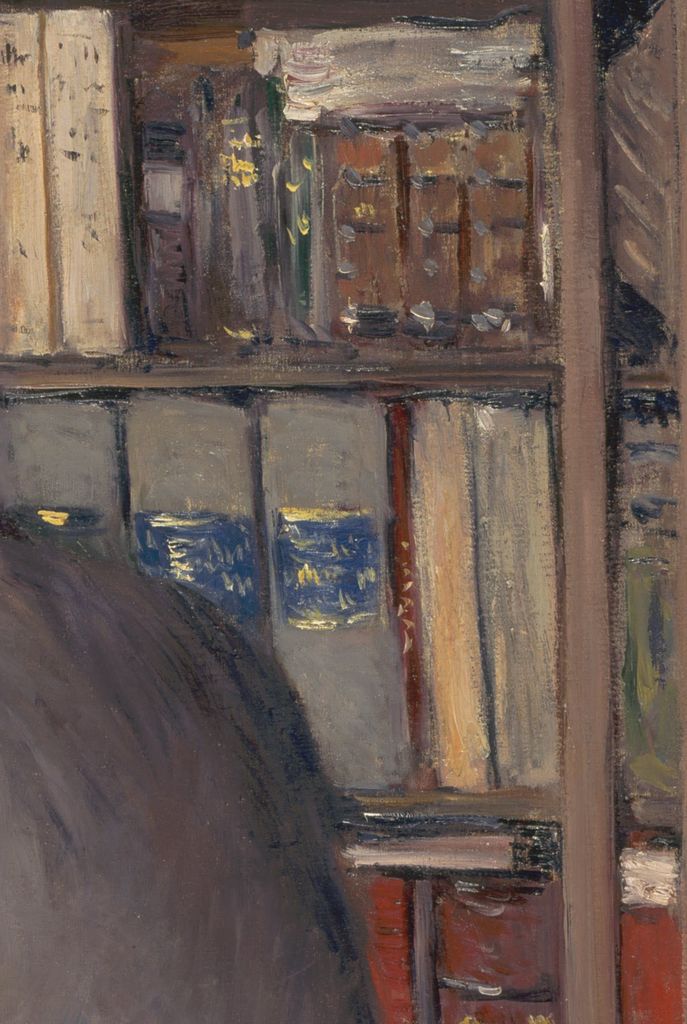
Books divided by shelves
Upright bindings, horizontal stacks and shelf edges form several nested patterns. Small pale and gold strokes distinguish their surfaces without making every title readable.
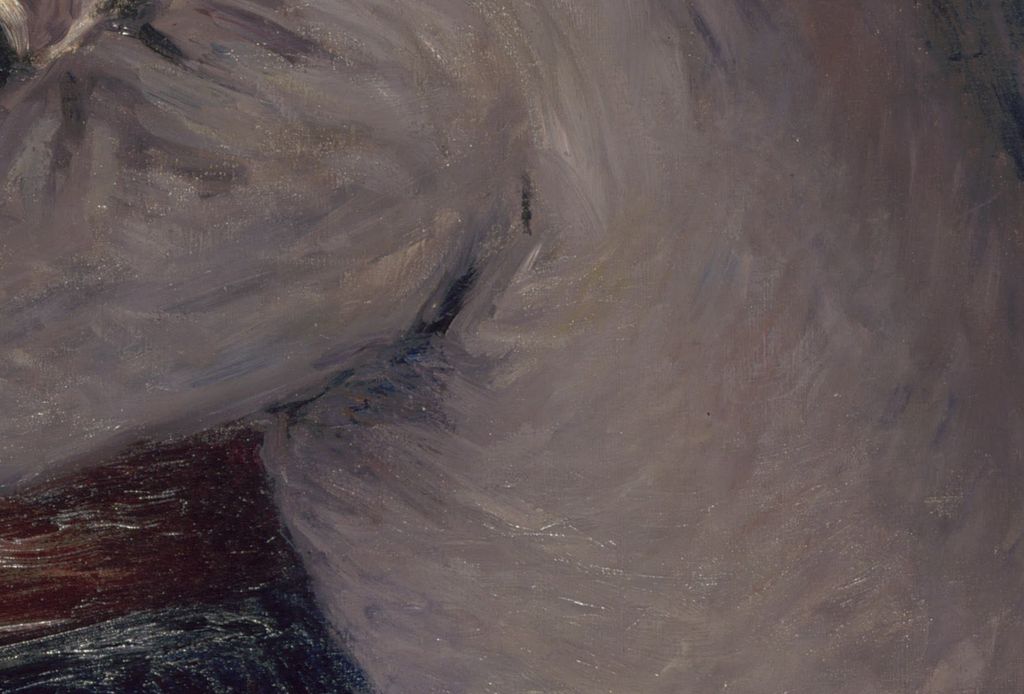
Violet and grey across the jacket
The large jacket is crossed by violet, grey and warmer strokes. Changes within this broad area keep the turned body active as a painted surface.
The small drama of hands and paper
The hands deserve a second look because they are easy to lose amid the cuff, beard and pen. They gather in the narrow interval between the head and the open surface on the desk. A pale, slender shaft cuts diagonally through this area, while the flesh colours approach the warm tones of the face. Caillebotte holds the action within a very small portion of the canvas. Much of the figure is given to the shoulder and back; the delicate business of making marks takes place close to the head.
The foreground sleeve helps lead us there. Its dark folds and long curved edge carry the eye towards the bright cuff. From that cuff, the fingers and pen take us towards the sheet. The movement is modest, but it supplies a route through a composition whose many books and upright divisions might otherwise scatter attention. The paper then opens out to the left in a pale, sloping shape, balancing the jacket's much larger expanse on the right.
Across the paper, short marks produce the impression of closely spaced writing. Their direction follows the tilt of the surface. The page is more than a white patch used to light the face: it has its own internal rhythm, made from repeated strokes and small changes in tone. At its lower edge, bands of warm cream and brown suggest the thickness of the material beneath. The writing has a tangible support, and that support rests among other things on a crowded desk.
Watch: Gustave Caillebotte
Explore a museum overview and two discussions of Paris Street; Rainy Day. This shared selection offers wider context for the artist’s work.
"Who Is Gustave Caillebotte?" - HD version
An introduction to Caillebotte from the Kimbell Art Museum.
Watch on YouTubeA room assembled from competing surfaces
The bookcase is the principal structure behind Cordier. Its uprights and shelf edges divide the right side into a series of compartments. Within those divisions, the books offer a smaller pattern of verticals. Their bindings vary from pale cream and grey to russet, brown and nearly black; blue labels with gold markings punctuate a row behind his shoulder. Higher up, horizontal piles interrupt the upright sequence. The collection feels accumulated and handled rather than arranged into a perfectly uniform display.
Caillebotte does not make every volume equally distinct. Some spines have a firm boundary, while neighbouring ones merge through similar colours. A pale stack near the upper right is indicated with horizontal strokes; elsewhere, brief yellow marks stand for gilding. The collection has a visual weight beyond the identity of any individual title. Differences in height and colour keep its surface varied, while the repeated shelf lines hold that variety together.
On the opposite side, the lamp provides a different kind of vertical. Its broad, fringed shade is cropped by the upper edge, and the base carries bright yellow accents over a darker body. The soft, broken edge of the shade contrasts with the hard rectangular divisions of the shelves. Tall branching forms at the far left further loosen this corner. The room thus contains both a rigid framework and objects whose outlines resist it.
Down below, the polished-looking red-brown desk crosses the picture at a slant. Pale streaks run over its front, and a small bright fitting interrupts the darker wood. The effect is quite different from the woolly greys and purples of the coat. The direction and spacing of the painted marks help distinguish these surfaces. Cloth, paper, wood, metal and bookbinding all contribute to the experience of the room.
The composition leaves little unoccupied background. Nevertheless, the space does not become a flat pattern of objects. Overlapping edges establish a sequence: desk before sleeve, sleeve before torso, torso before books. The head sits between the lamp and the bookcase, at the point where the objects of the room are most closely gathered. This repeated overlap gives the crowded picture its depth.
Violet cloth and changing light
The jacket appears brown at first, but it is threaded with violet and grey. Lighter strokes turn across the shoulder and sleeve; darker passages gather under the arm and between folds. The Musée d'Orsay draws attention to the work's purplish reflections and textural effects. [3] Their importance becomes clearer when the jacket is considered as the largest continuous colour area in the painting. What might have been a heavy, uniform shape is kept active by shifts within its surface.
The smaller warm notes around it also matter. The red-brown desk, orange-red books at lower right and gold flashes on the lamp and bindings prevent the room from settling into a single cool harmony. The face shares some of their warmth, making it belong to the setting even as its brightness distinguishes it. The white collar and cuffs offer sharper interruptions than the surrounding pale greys. They allow us to locate the body's turns within the comparatively loose handling of the coat.
The lamp is conspicuous, but its presence should not lead us to assume that we are looking at a night scene. The illumination can be read first through its effects: a light profile, pale paper, dark hair and recesses behind the head. The picture does not show a window or furnish a complete map of the room's lighting. What we experience is the selective visibility of surfaces, with some edges emerging clearly and others dissolving into adjacent tones.
This is one reason the painting rewards changes of viewing distance. Seen as a whole, Cordier's posture and the bright page dominate. Closer inspection turns the room into a network of coloured strokes: the brief gold marks on books, broken highlights on the desk and changing greys of the sleeve. The handling gives solidity to the figure while allowing the surrounding objects to retain the liveliness of painted marks. The portrait offers a particularly concentrated example of Caillebotte's style and technique.
A portrait in the company of Degas
Berhaut connected this portrait with Degas's Portrait of Edmond Duranty of 1879, discussing the way a sitter's surroundings could transform portrait composition. [2] Glasgow Museums, which holds the Degas, describes Duranty seated in his study amid the books and pamphlets that constituted his working equipment. It also draws attention to his characteristic gesture, with fingers pressed against his eye and forehead. [6]
The comparison is useful because it makes the relation between a face and a room the central question. Books establish more than a suitable background for a writer or scholar. They occupy space, shape the available gestures and help determine how much of the sitter we can see. In Caillebotte's painting, Cordier's forward turn gives the desk priority over the viewer. His shoulders establish a barrier at the same time as their proximity makes the scene intimate.
The Musée d'Orsay likewise associates the unusual cropping and densely filled space with Caillebotte's experimental affinity with Degas. [3] That observation helps explain why a quiet subject can produce such an unsettled composition. The person portrayed does not need a theatrical gesture. The angle from which we encounter him, and the unequal space assigned to body and face, are enough to make the act of looking unfamiliar.
In its Peindre les hommes exhibition, the Musée d'Orsay placed Caillebotte's portraits within his sustained attention to men around him, including brothers and friends. Its curators also emphasised his interest in the private, everyday activities of bourgeois men. [7] Cordier's study gives that broader theme a specific form. The familiar signs of male professional identity are present, but the painting remains interested in how a man bends, rests his arm and inhabits his clothes while he works. The surrounding books amplify those physical details rather than replacing them with a résumé.
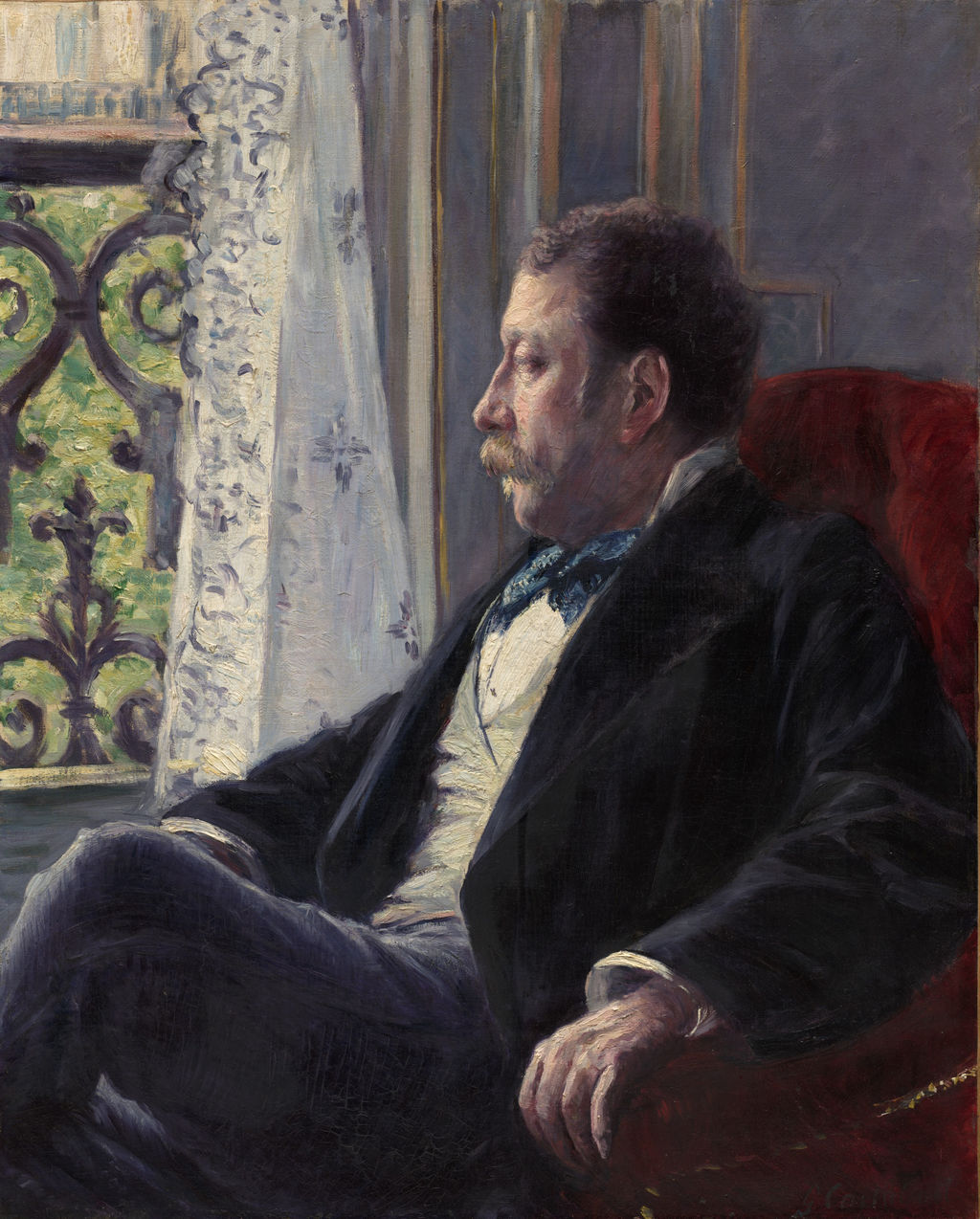
Portrait of a Man (Albert Courtier), 1880; Cleveland Museum of Art. The frontal sitter offers a different encounter from Cordier’s turned body. Bequest of Muriel Butkin. Image source. CC0 / Public domain. Resized only; source appearance preserved.
From Cordier's collection to the museum
The portrait's public history began through the sitter's family. Berhaut records its ownership by Henri Cordier and Mme Cordier's gift to the Musée du Luxembourg in 1926. The catalogue traces subsequent institutional transfers to the Louvre in 1929, the Jeu de Paume in 1947 and the Musée d'Orsay in 1986. It also records the painting in Caillebotte exhibitions at Chartres in 1965, Houston and New York in 1976–77, and the Paris–Chicago retrospective of 1994–95. [2]
The National Gallery of Art's illustrated checklist includes it in Gustave Caillebotte: The Painter's Eye in 2015, retaining the acknowledgement of Mme Henri Cordier's 1926 gift. [1] Across these changing contexts, the portrait has continued to offer something beyond an identifiable sitter. Its close viewpoint makes the reader of books himself an object of sustained attention. The page, hand and face form one focus; the jacket and packed room make another. Looking between them reveals how much a portrait can communicate through the practical arrangement of an ordinary activity.
Catalogue and documented works
This directory brings together 578 entries in the revised 1994 catalogue, 11 further documented records and three groups of study descriptions. It is a directory of records, not a total of authenticated individual works. Albums, print states and surviving decorative panels are grouped. English labels retain the French titles as searchable aliases; dates are supplied only where checked. Numbered entries link to the relevant article or the historical catalogue. Pastels appear under the Drawing filter; original prints remain searchable under All media.
Frequently Asked Questions
The picture shows him with writing materials at his desk, but the visible marks do not securely identify the document or a particular passage. His scholarly publications provide context for the activity without settling the identity of the page.
Caillebotte painted it in 1883. The work is signed and dated near the lower centre. [2]
It belongs to the Musée d'Orsay in Paris, accession RF 2729. Mme Henri Cordier donated it in 1926. [3]
Discussion
Look again at the images and ideas explored in Portrait of Henri Cordier. These editorial prompts invite your observations.
Reader Insights
Hands and paper make a small centre of activity within the room.
The patterned surroundings give the seated figure several competing edges.
What do you notice first: Cordier’s face, his hands or the objects around him?
Join the Conversation
Share a detail, comparison or question about Portrait of Henri Cordier below.
References
- National Gallery of Art. Gustave Caillebotte: The Painter's Eye, illustrated exhibition checklist (2015), entry “Portrait of Henri Cordier, 1883”, checklist cat. no. 26. View source.
- Marie Berhaut, with Sophie Pietri. Gustave Caillebotte: Catalogue raisonné des peintures et pastels (1994), introduction p. 42 and catalogue no. 251, p. 168; digital edition, Wildenstein Plattner Institute. View source. (in French).
- Musée d'Orsay. “Henri Cordier”, collection record RF 2729, main essay, object details and acquisition information (record updated 2026). View source. (in en/fr).
- Marie Berhaut with Sophie Pietri; Wildenstein Plattner Institute, Gustave Caillebotte Catalogue raisonné des peintures et pastels, 1994. View source. (in French).
- University of Vienna, Bibliotheca Sinica 2.0. “Cordier: Bibliotheca Sinica” (9 April 2010), bibliographical entry and first-edition publication details. View source. (in en/de/fr).
- Glasgow Museums. “Portrait of Edmond Duranty”, Edgar Degas, 1879, Burrell Collection, accession 35.232, collection description. View source.
- Musée d'Orsay. “Gustave Caillebotte: Peindre les hommes” (2024–25), exhibition presentation, introduction and “Portraits de célibataires”. View source. (in French).
- Art Institute of Chicago, Caillebotte Paintings and Drawings at the Art Institute of Chicago, 2015. View source.
- Petit Palais / Paris Musées, Portrait de Paul Hugot, original print, PPG2319, current. View source. (in French).
- Paul Perrin, Musée d’Orsay, Transcription de l’entretien commissaire Caillebotte, 2024. View source. (in French).
- Cleveland Museum of Art, Caillebotte collection records: 2020.260, 2009.157 and 2020.105, current. View source.
- Splash image, Portrait of Henri Cordier, 1883.


