



 by Tom Gurney
Tom Gurney BSc (Hons) is an art history expert with over 20 years experience
Published on June 19, 2020 / Updated on November 2, 2026
Email: tomgurney1@gmail.com / Phone: +44 7429 011000
Portraits in the Countryside: Introduction
A blue dress spreads across the foreground; beyond it, three darkly dressed women sit beside a house, beneath trees and an orange-striped awning. Their lowered eyes give this gathering its particular quiet. In Portraits in the Countryside, painted in 1876 and now in the Musée d’Art et d’Histoire Baron Gérard in Bayeux, Gustave Caillebotte makes the small occupations of an afternoon command an entire canvas. [1]
The setting is the family property at Yerres. The four women belong to Caillebotte’s circle, and the picture rewards attention to their separate positions: a cousin close enough for us to follow her hands, two women facing one another farther back, and his mother reading at the rear. Marie Berhaut’s catalogue describes the painting as exceptional among his Yerres scenes for the importance it gives its figures. The garden surrounds them, yet their presence determines how we enter and measure it. [2]
The picture appeared at the third Impressionist exhibition in 1877 before eventually entering the Bayeux museum in 1947. Its passage from an intimate family setting into public view reflects something already present in the composition: the sustained attention Caillebotte gives to familiar people and a familiar place. [2] [1]
At a Glance
- ArtistGustave Caillebotte.
- French titlePortraits à la campagne.
- Date and medium1876; oil on canvas.
- Dimensions98.5 × 111 cm in the current museum inventory record.
- CollectionMusée d’Art et d’Histoire Baron Gérard, Bayeux; inventory P0225. [1]
- CatalogueBerhaut 1994, no. 40.
- SettingThe Caillebotte family property at Yerres.
- ExhibitedThird Impressionist exhibition, Paris, 1877, no. 3. [2]
This work across Gustave Caillebotte’s career
Contents
- Four women, four places in the picture
- Entering the terrace through a blue dress
- A garden close to the house
- The concentration of leisure
- A family picture at the Impressionist exhibition
- Other afternoons at Yerres
- From a wedding present to the Bayeux collection
Four women, four places in the picture
The young woman nearest us is Marie Caillebotte, a cousin of the painter. Immediately beyond her, at the left of the table, sits Marie’s mother, Madame Charles Caillebotte. Facing her is Madame Hue, a family friend. At the far right, a little removed from the others, is the painter’s mother, Madame Martial Caillebotte. Berhaut places the group beside the north-east corner of the main house at Yerres. The apparently informal gathering therefore occupies a specific, familiar part of the estate. [2]
Bayeux identifies Madame Charles as Marie Amanda Chaumont and the painter’s mother as Céleste Daufresne. Its account distinguishes three needleworkers from Céleste, who reads. Calling all four knitters loses the reader and narrows the other women’s activities unnecessarily. [4]
No sitter returns our gaze. Marie’s profile is turned towards her raised hands; the woman beyond bends her head over her work; the facing figure’s dark silhouette keeps the circuit of attention within the group. At the rear, Céleste’s book gives her an independent focus. The composition brings its subjects together without making them perform together. We can follow each occupation, but we cannot turn the scene into a single shared conversation.
The plural Portraits is useful here. Each woman has an individual place and activity, even though no face receives the treatment of an isolated head study. The figures are identified through their relationships to chairs, clothing, work and one another. Familiarity is conveyed through proximity and accustomed occupation. The painting lets us see how these people inhabit a setting, with the family connections adding another dimension to what is already visible.
Entering the terrace through a blue dress
Marie’s dress is the picture’s largest light-coloured shape. Its folds, bands of trimming and long train spread diagonally from her upper body towards the lower centre of the canvas. The dress occupies considerably more space than her head or hands. Our first encounter is therefore with an expanse of cloth, its contours interrupted by the curved metal chair and by a small footstool near the hem.
The sequence from fabric to hands is particularly effective. The large blue surface initially catches the eye, then the light cuffs and the small piece of work held near Marie’s chest concentrate it. The same body offers both a broad area of colour and a tiny centre of activity. Caillebotte has made the scale of attention change within one seated figure: we notice the whole dress before beginning to look at the minute occupation taking place above it.
Beyond Marie, the ground appears to climb rapidly. The table is seen from above, and the rear figures rise on the picture surface as they recede. Chair legs, skirts and the pale terrace all compete to explain where bodies meet the ground. The distance from the foreground woman to the reader is quite short in physical terms, yet pictorially it becomes a progression through distinct layers. The pale foreground offers an open approach, while the figures themselves form a diagonal across it.
That arrangement also leaves the lower right relatively unoccupied. Rather than centring the table and distributing four sitters symmetrically around it, Caillebotte pushes the chief mass of the group towards the house. The vacant terrace gives the nearest figure room and makes the recession of the other three easier to read. It also places the viewer slightly outside the gathering. There is space to approach, but no empty chair directly facing us and no welcoming glance to complete the encounter.
The house provides an opposing kind of order. Its pale wall, shutters and window edges create strong straight divisions behind the women. The bench’s horizontal slats carry some of that architectural rhythm into the seating area. Against these lines, the curves of chair backs, bent arms and drapery become especially clear. Small domestic actions acquire definition because the surrounding space is so firmly articulated.
A garden close to the house
The countryside of the title is cultivated and furnished. Behind the sitters, a vivid red flower border extends along the garden; above it are grass, trees and a path. The women remain immediately beside the building, within an outdoor space shaped by domestic use. The garden is experienced from the house’s edge, where furniture, shade and room for handwork have made a place to sit.
The striped awning is easy to treat as a picturesque accessory, but it does important compositional work. Hanging into the upper left corner, it interrupts the light wall and repeats the fall of Marie’s dress in shorter, more regular strips. Its warm orange tones also answer the flower border behind the women. These two bright areas belong to different depths: one comes forward over the window, while the other runs behind the seated group. Colour links parts of the picture that perspective keeps apart.
There are equally consequential contrasts within the shade. Marie’s blue dress remains light enough to separate from the wall; the central women’s dark clothes join into a more continuous mass. Pale hands, faces and pieces of fabric punctuate that darkness. At the far right the reader is framed by the garden and the balustrade, her head and book emerging from the surrounding dark forms. The four women remain legible through different combinations of contour, colour and small lit details.
This is why the flowers do not take over the picture, despite their brilliance. Their repeated red marks make a lively band across the background, but the figures have weight and continuity. The garden supplies changing accents, whereas the women supply the large forms through which we organise our view. Berhaut’s emphasis on the exceptional prominence of the figures helps explain the balance: the estate becomes the setting for a collective portrait, with its plants and architecture actively shaping that portrait. [2]
Watch: Gustave Caillebotte
Explore a museum overview and two discussions of Paris Street; Rainy Day. This shared selection offers wider context for the artist’s work.
"Who Is Gustave Caillebotte?" - HD version
An introduction to Caillebotte from the Kimbell Art Museum.
Watch on YouTubeThe concentration of leisure
Needlework gives the gathering a structure of repeated gestures. Heads incline, forearms bend, and hands draw together around small objects. The women share a kind of activity while keeping its execution individual. Céleste’s reading continues the pattern of concentration through another action: the hands support a book, and the eyes follow something that remains unavailable to us. Occupation is visible; its precise content largely stays private.
Samuel Raybone’s study of Caillebotte’s interiors offers a useful comparison. Looking at paintings of piano playing, reading and needlework, he argues that bourgeois leisure in Caillebotte often requires disciplined bodies, sustained attention and skilled hands. His discussion concerns a wider group of pictures rather than an explanation supplied by this canvas itself. It nevertheless sharpens our awareness of what the women are doing: their rest is active, and the painter gives that activity an exact physical form. [5]
The comparison is especially close in Caillebotte’s Portrait of Madame Martial Caillebotte of 1877. There, the mother who reads at the back of the garden scene is brought forward into a single-figure portrait, working on a piece of embroidery. Berhaut records that the design for that embroidery was made by her son and that the family preserved several of his needlework designs. The connection gives handwork a tangible place in the family’s creative life. It does not identify what the women are making in Portraits in the Countryside, but it makes the activity more specific than a conventional sign of spare time. [2]
The comparison also changes how we look at the rear figure. Céleste is small here because she occupies a distant position, not because reading is incidental to the scene. Her separate activity completes the chain of absorbed figures. The painter’s attention reaches from the conspicuous blue dress to a much quieter person at the edge, preserving different degrees of visibility within one family gathering.
The lowered eyes and lack of exchange can give the picture an air of reserve. They also describe a perfectly recognisable way of spending time together: people need not look at one another continually to share a place. The visible arrangement supports both quiet companionship and individual absorption. Choosing one of these as the women’s definitive emotional condition would close a question that their poses leave open.
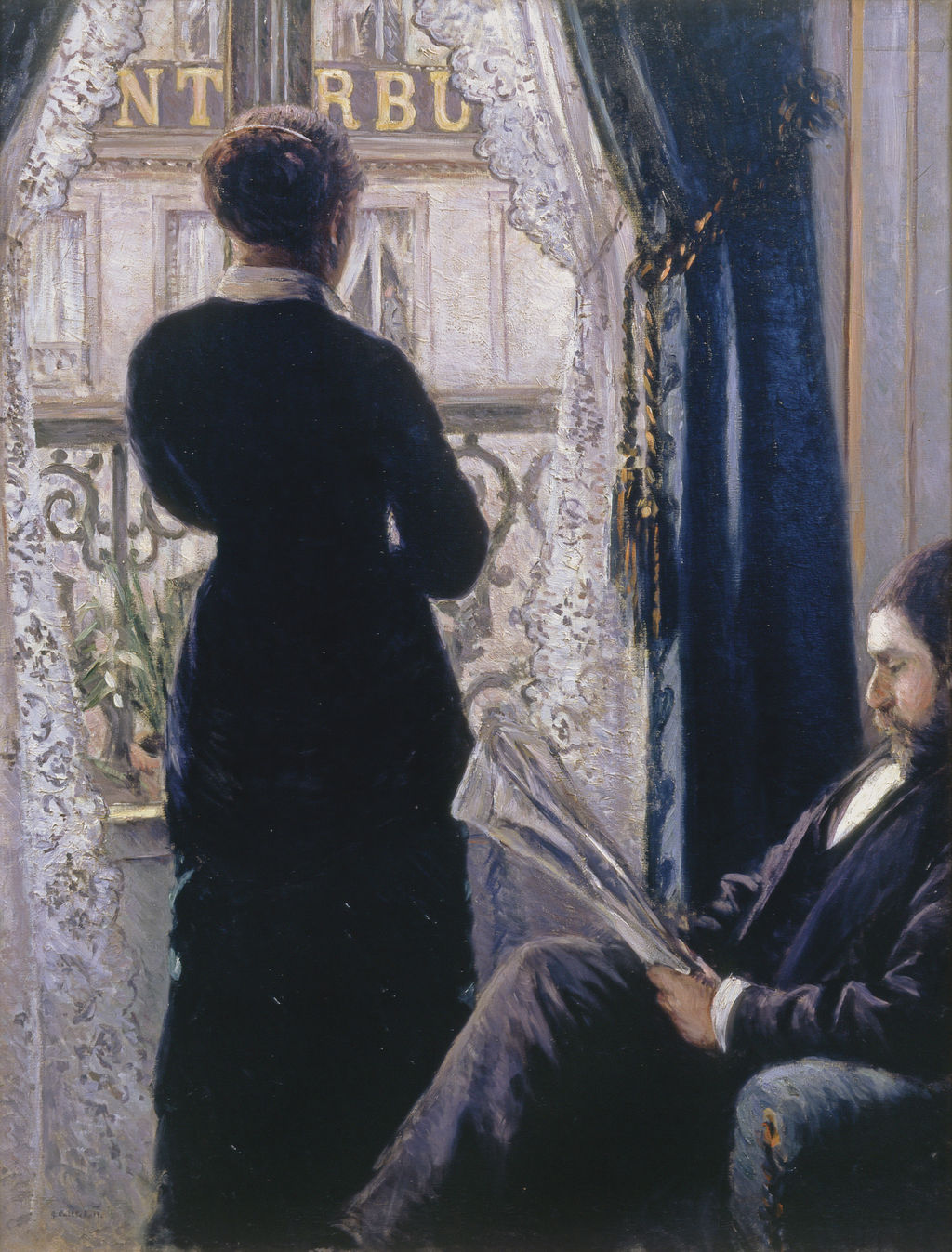
Interior, Woman at the Window, 1880; separate occupations in a shared domestic setting.
A family picture at the Impressionist exhibition
The painting’s domestic subject did not prevent Caillebotte from presenting it publicly. In the 1877 exhibition it appeared as no. 3, alongside works including Paris Street, Rainy Day, Le Pont de l’Europe and Portrait of Madame Martial Caillebotte. The garden scene belonged to a selection encompassing urban space, work and family portraiture. [2]
Galina Olmsted examines the six pictures Caillebotte exhibited that year as a considered ensemble. She links Portraits in the Countryside to the city paintings through its rising ground plane and deep recession, while distinguishing its brighter palette and country setting. She also reconstructs an installation in which Caillebotte’s portraits appeared with comparable works by Monet and Renoir, and his large urban paintings with Monet’s station scenes. Her broader argument is that making paintings and organising their exhibition became closely connected forms of artistic practice for Caillebotte. [6]
Seen within that argument, the terrace gains a useful relationship to the street. In each, a relatively open foreground leads towards smaller figures and more distant forms. The urban pictures use roads, pavements and bridge structures; the country portrait uses a wall, garden furniture and seated bodies. The methods differ in scale and subject, yet both ask the viewer to negotiate a conspicuously organised space. The apparently unhurried afternoon has a compositional ambition that links it to Caillebotte’s better-known images of Paris.
Olmsted proposes that his exhibition choices answered criticism and helped establish his place within the Impressionist group. That is a scholarly reconstruction of strategy. The documented selection alone already establishes something valuable: Caillebotte considered this family gathering suitable company for his most ambitious public work. Its private setting was part of the contemporary world he brought before an exhibition audience. [6]
Other afternoons at Yerres
The Orange Trees, signed and dated 1878, provides a revealing later comparison. Its tall composition places seated figures among large plant tubs, chairs and strong divisions of shade. In Portraits in the Countryside, Marie faces into the group and her blue dress spreads towards us. In The Orange Trees, the prominent seated man turns his back, and empty chairs help articulate the terrace. In both pictures, furniture locates bodies within a carefully divided outdoor space. [2]
The differences clarify the earlier painting. Four related acts of attention give Portraits in the Countryside a concentrated human rhythm, while the later terrace scene allows the planted setting and the spaces between chairs to assert themselves more strongly. Both make the garden a place used by particular people. The estate emerges through repeated encounters with its seats, paths and boundaries, rather than through a single comprehensive view.
The family portraits offer another route back into the group. Berhaut links Marie and Madame Charles to individual portraits, as well as connecting Céleste to her own portrait. These repetitions mean that the four-figure gathering belongs to a continuing study of familiar sitters. The same person can be a small presence in one picture and the organising centre of another. Here, the collective arrangement is the distinctive achievement. [2]
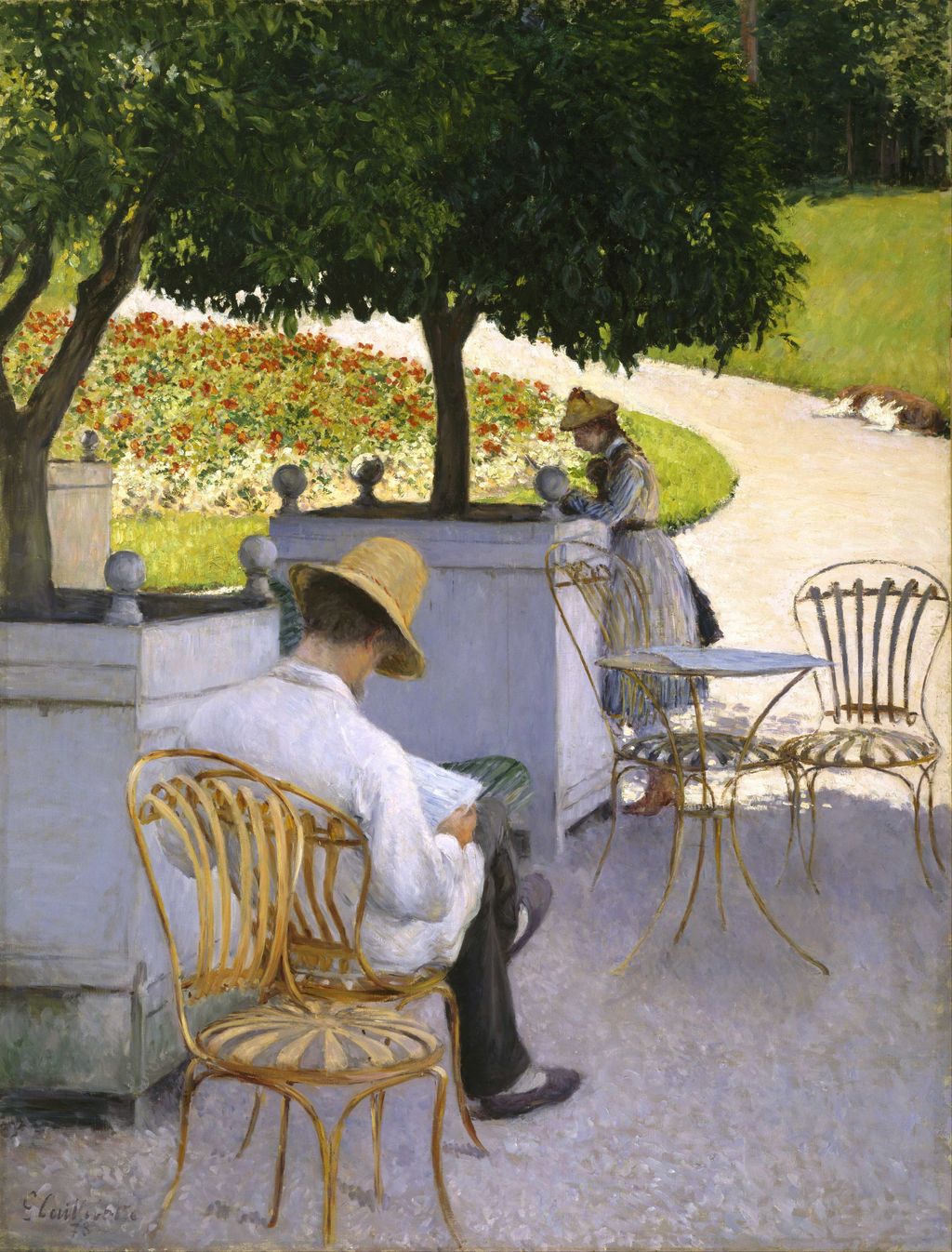
The Orange Trees, 1878; a separate terrace composition at Yerres. 3QHnQ99LLC7m3A at Google Cultural Institute maximum zoom level. Image source. Public domain. Resized only; source appearance preserved.
From a wedding present to the Bayeux collection
Zoé, Marie’s sister, is absent from the composition, yet she is central to its later history. Bayeux’s account records that Caillebotte gave her the painting for her marriage there on 17 June 1887 and participated in the ceremony as a witness. The wedding took place eleven years after the date on the canvas. It was an occasion for giving an existing painting, rather than the occasion represented. [4]
The 1947 museum acquisition was another event. The current inventory names René Chaplain and Marie, née Fermal, as the donors, giving the picture in memory of Madame Fermal, née Zoé Caillebotte. A family keepsake thus entered a public collection while retaining an explicit connection to the person who had received it from the artist. [1]
The museum records a lower-left signature and date, and dimensions of 98.5 × 111 cm. Berhaut’s 1994 catalogue gives 95 × 111 cm, explaining why different heights circulate. The present inventory supplies the measurement used here. [1] [2]
The family history adds something that close looking alone cannot supply: the woman who received this image of familiar people does not herself appear in it. For the viewer, the scene begins with Marie’s dress and moves back towards Céleste’s book. For Zoé, its associations would also have reached beyond the frame. The documented gift preserves that wider family connection without requiring us to invent a particular memory or message behind it.
Catalogue and documented works
This directory brings together 578 entries in the revised 1994 catalogue, 11 further documented records and three groups of study descriptions. It is a directory of records, not a total of authenticated individual works. Albums, print states and surviving decorative panels are grouped. English labels retain the French titles as searchable aliases; dates are supplied only where checked. Numbered entries link to the relevant article or the historical catalogue. Pastels appear under the Drawing filter; original prints remain searchable under All media.
Frequently Asked Questions
They are Marie Caillebotte, her mother Madame Charles Caillebotte, the family friend Madame Hue, and the painter’s mother, Céleste Daufresne, known as Madame Martial Caillebotte. [2]
No. The museum identifies the three nearer women as engaged in needlework and Céleste, at the back, as reading. Needlework is broader than knitting. [4]
It belongs to the Musée d’Art et d’Histoire Baron Gérard in Bayeux, inventory P0225, following the Chaplain gift of 1947. The current inventory gives its dimensions as 98.5 × 111 cm. [1]
Discussion
Look again at the images and ideas explored in Portraits in the Countryside. These editorial prompts invite your observations.
Reader Insights
The four women occupy distinct positions within one terrace.
The blue dress helps carry attention from the foreground towards the garden.
Does the arrangement suggest shared time, separate occupations or both?
Join the Conversation
Share a detail, comparison or question about Portraits in the Countryside below.
References
- Ministère de la Culture / MAHB Bayeux. Portraits à la campagne, Joconde notice M0655000140, inventory P0225; updated 10 September 2026. Object identification, dimensions, inscriptions, ownership and acquisition. View source. (in French).
- Marie Berhaut, with the assistance of Sophie Pietri. Gustave Caillebotte: Catalogue raisonné des peintures et pastels (1994), no. 40, p. 80; comparison entries no. 58, p. 94, and nos. 112–114, pp. 116–117. Illustrated entries consulted in the Wildenstein Plattner Institute’s public catalogue reader. View source. (in French).
- Marie Berhaut with Sophie Pietri; Wildenstein Plattner Institute, Gustave Caillebotte Catalogue raisonné des peintures et pastels, 1994. View source. (in French).
- MAHB Bayeux. Portraits à la campagne, collection essay, sections identifying the sitters and recounting the 1887 wedding gift and 1947 donation. View source. (in French).
- Samuel Raybone. “Gustave Caillebotte’s Interiors: Working Between Leisure and Labor,” nonsite.org, no. 26 (2018), opening discussion of hands and domestic occupations; repository PDF pp. 7–8. View source.
- Galina Olmsted. Making and Exhibiting Modernism: Gustave Caillebotte in Paris, New York, and Brussels (doctoral dissertation, University of Delaware, 2019), pp. 98–112, especially pp. 98–100, 105 and 109–111. View source.
- Art Institute of Chicago, Caillebotte Paintings and Drawings at the Art Institute of Chicago, 2015. View source.
- Petit Palais / Paris Musées, Portrait de Paul Hugot, original print, PPG2319, current. View source. (in French).
- Paul Perrin, Musée d’Orsay, Transcription de l’entretien commissaire Caillebotte, 2024. View source. (in French).
- Cleveland Museum of Art, Caillebotte collection records: 2020.260, 2009.157 and 2020.105, current. View source.
- Splash image, Portraits in the Countryside, 1876.


