



 by Tom Gurney
Tom Gurney BSc (Hons) is an art history expert with over 20 years experience
Published on June 19, 2020 / Updated on November 2, 2026
Email: tomgurney1@gmail.com / Phone: +44 7429 011000
Rower in a Top Hat: Introduction
A man grips two yellow oars, his knees filling the foreground and his tall black hat cutting into the pale sky. We see the inside of his boat so clearly that there seems to be a seat for us opposite him. Gustave Caillebotte painted Rower in a Top Hat, also known as Partie de bateau or Boating Party, in about 1877–78. Its immediate subject is a river outing; its great invention is the closeness with which we experience it. The oil painting belongs to the Musée d’Orsay. [1]
The setting is the Yerres, where Caillebotte made a series of boating pictures during the summers of 1877 and 1878. Here he gives the pleasure of being on the water an unusually physical form. The wooden hull encloses us, the oars run out beyond the frame, and the rower faces our position while turning his attention elsewhere. Everything suggests proximity, yet the encounter remains curiously incomplete. [2]
At a Glance
- ArtistGustave Caillebotte.
- TitleRower in a Top Hat; Partie de bateau; Canotier au chapeau haut de forme.
- DateAbout 1877–78.
- MediumOil on canvas.
- Dimensions89.5 × 116.7 cm.
- CollectionMusée d’Orsay, Paris; RF MO P 2022 5.
- ExhibitionFourth Impressionist exhibition, Paris, 1879, catalogue no. 8.
- Catalogue raisonnéBerhaut 122. [1] [2]
This work across Gustave Caillebotte’s career
Rower in a Top Hat (current article)
about 1877–78The Orange Trees
1878 [3]Man at His Bath
1884 [3]Contents
- Taking a seat in the boat
- Clothes under the pressure of movement
- The river behind his shoulders
- A solid figure in broken paint
- Other ways to put the viewer on the water
- Why the picture unsettled viewers in 1879
- From the artist's family to the national collection
- Annotated details
Taking a seat in the boat
The first thing to notice is how much of the river Caillebotte prevents us from seeing. A conventional view from the bank might give the boat its full outline, with water surrounding it and figures arranged within it. Here the nearest end of the vessel lies outside the picture. We look along its interior, past the rower, towards a widening channel. The sides enter at the lower corners and narrow behind him, making a strongly enclosed space within the open landscape.
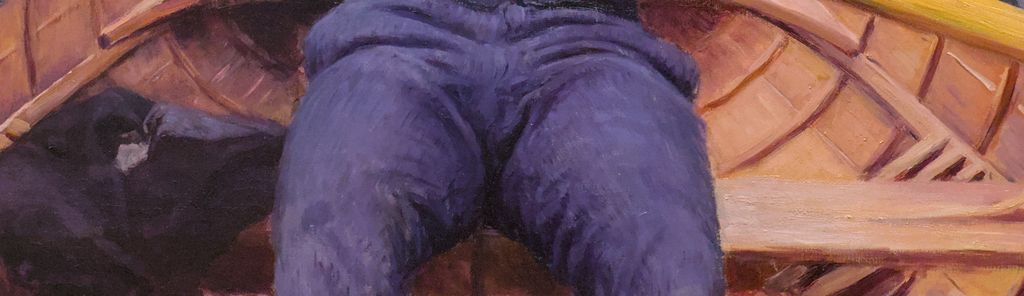
That enclosure has a convincing practical structure. Curved ribs repeat along the hull, a pale thwart crosses the foreground, and the boards change direction as they turn around the vessel. The warm pinks and ochres of the timber distinguish this near space from the cool water. Before we have worked out the bank or the distant boat, the construction tells us where our own body might fit. We seem to have crossed the picture's lower edge already.
The scale of the man strengthens the effect. His legs descend out of sight before we reach his feet, while his upper body rises against the river. His hands are widely separated, each wrapped around an oar handle, and the two oars open towards opposite edges. Their shafts offer strong, simple directions through the much busier pattern of the boat. We cannot follow them all the way to their blades: the action continues beyond what Caillebotte lets us see.
The rower's position is almost central, but the composition avoids a rigid symmetry. His face turns to our left; his hands sit at different heights; a second boat occupies the water on our right. The left bank recedes in a long sequence of trimmed trees, while the right bank gathers into a darker mass. Across this imbalance, the broad, nearly horizontal stretches of water hold the scene together. The result feels momentary without becoming disordered.
Even the apparent invitation has a limit. Although the rower faces us, he does not look at us. We have the privileged position of a companion without the confirming exchange of a glance. The Musée d’Orsay identifies the sitter as unknown. That absence of a name leaves the visible relationship especially important: a stranger is near enough for us to study his knuckles, yet remains occupied by a world beyond our position. [4]
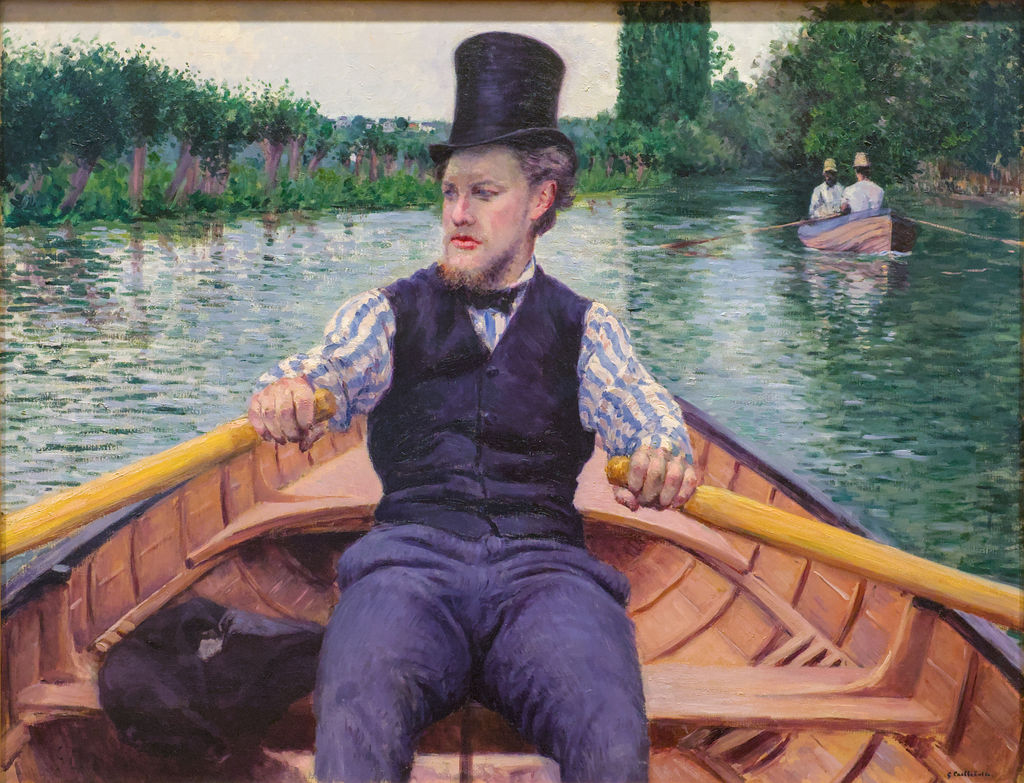
Rower in a Top Hat (Boating Party), about 1877–78; Musée d’Orsay. Own work. Image source. Public domain. Resized only; source appearance preserved.
Clothes under the pressure of movement
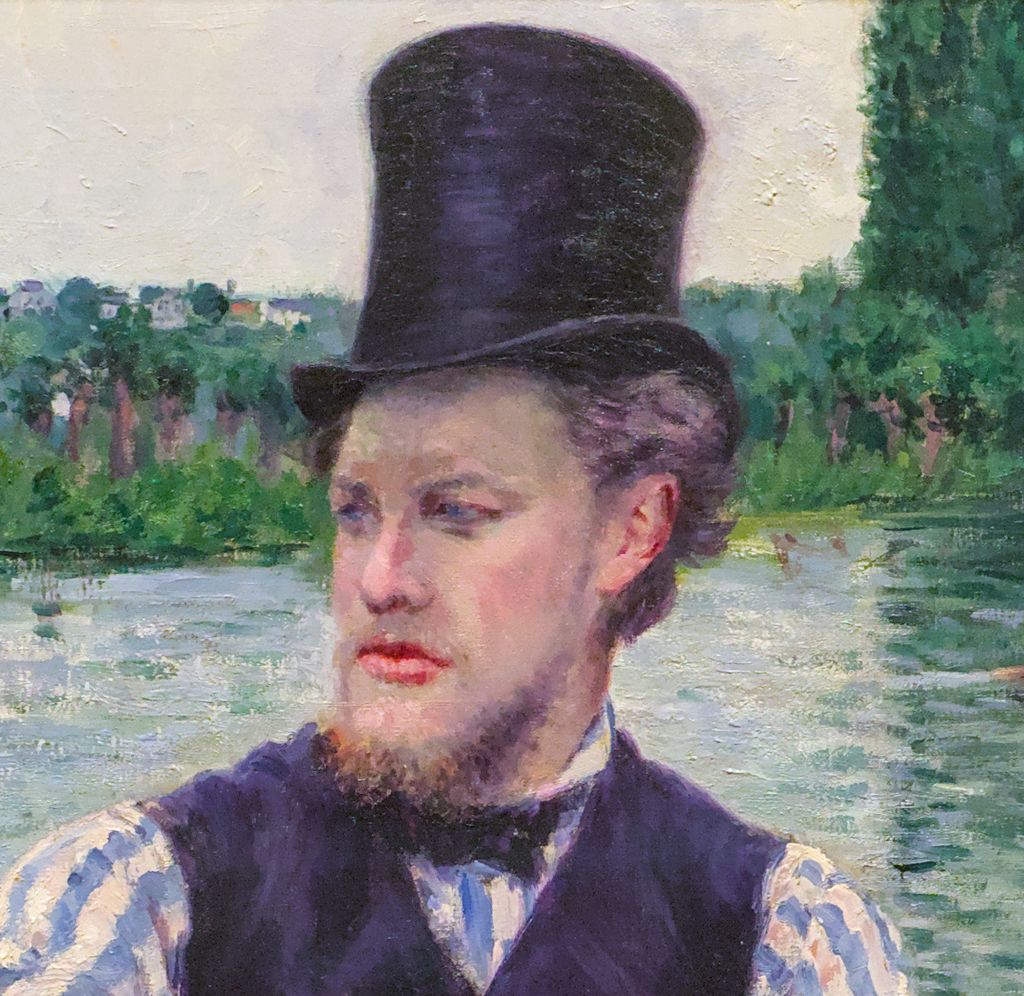
The hat makes the man instantly recognisable. Its tall crown, dark ribbon and projecting brim form an emphatic silhouette, more vertical and compact than anything around it. Below, his waistcoat gives the torso a similarly dark centre. Against these relatively continuous shapes, the blue and pale stripes of his shirt break into folds around the arms. His clothes organise the painting before they invite any social interpretation.
Their arrangement also makes the effort of rowing legible. The stripes change direction as the fabric bends over his shoulders and bunches around his elbows. Fingers curl tightly over the handles; his forearms angle into the stroke. His open stance and large, separated knees establish a braced seated body. The painting offers no spectacular exertion, but it makes an ordinary action substantial enough to occupy most of the canvas.
There is an arresting mixture of formality and adjustment. The top hat and waistcoat remain in place, while a dark garment lies on the seat beside him. The sleeves are exposed to the light, and the striped shirt becomes a conspicuous part of his appearance. We can follow the transition from dressed social figure to active body through these visible details without needing to invent an incident before the scene began.
The Orsay exhibition Peindre les hommes provides a useful context for this attention to dress. Its section on masculine costume explains how Caillebotte distinguished dark bourgeois clothing from workers' lighter or blue garments, while also showing patterned clothes worn in the country and for boating. This gives the striped shirt a historically specific setting. The river is a place where the appearance of the modern man could change with his activities. [5]
Clothing here also complicates any easy division between leisure and work. The man is enjoying an outing, yet his hands and posture demonstrate that recreation requires labour. His torso makes a stable dark block while the arms perform the action. Caillebotte gives comparable visual weight to the social surface of the figure and to the mechanics of moving a boat. Neither can be removed without changing the picture.
The wider curatorial argument of Painting Men, organised by Paul Perrin, Scott Allan and Gloria Groom, places sportsmen among the figures through whom Caillebotte reconsidered modern masculinity. The exhibition connects his male subjects with sociability, physical activity and the people immediately around him. In this painting, that approach draws attention to the combination of ordinary contemporary clothes, bodily engagement and shared leisure. It offers a context for looking, rather than a biography of this unidentified rower. [1]
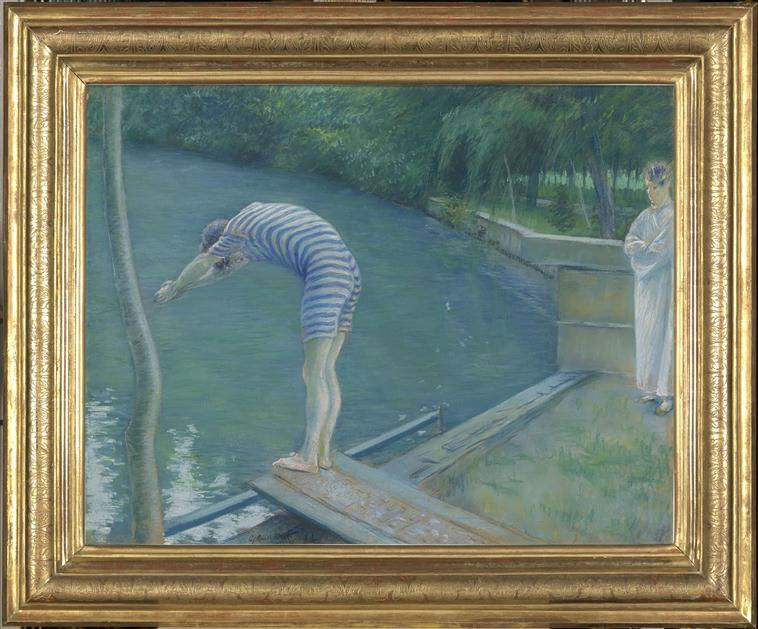
Le Nageur, 1877; separate pastel showing preparation for a dive, reproduced in its frame. Image source. Public domain. Whole suppliedimage retained; resizedonly.
Annotated Details from Rower in a Top Hat
The numbered points identify visible features discussed in this article. Return from each detail to the whole composition. Rower in a Top Hat (Boating Party), about 1877–78; Musée d’Orsay. Own work. Image source. Public domain. Resized only; source appearance preserved.
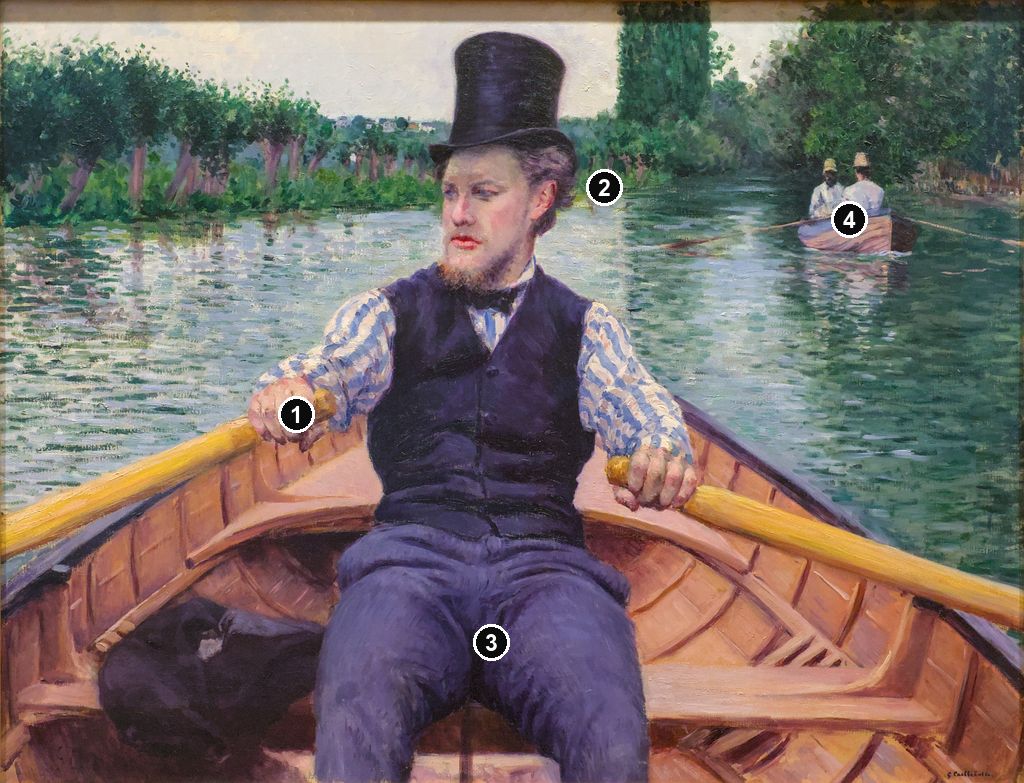
Details from ROWER IN A TOP HAT
Compare the cropped details with the complete images above. Notice how their colours, shapes and positions contribute to the larger compositions.
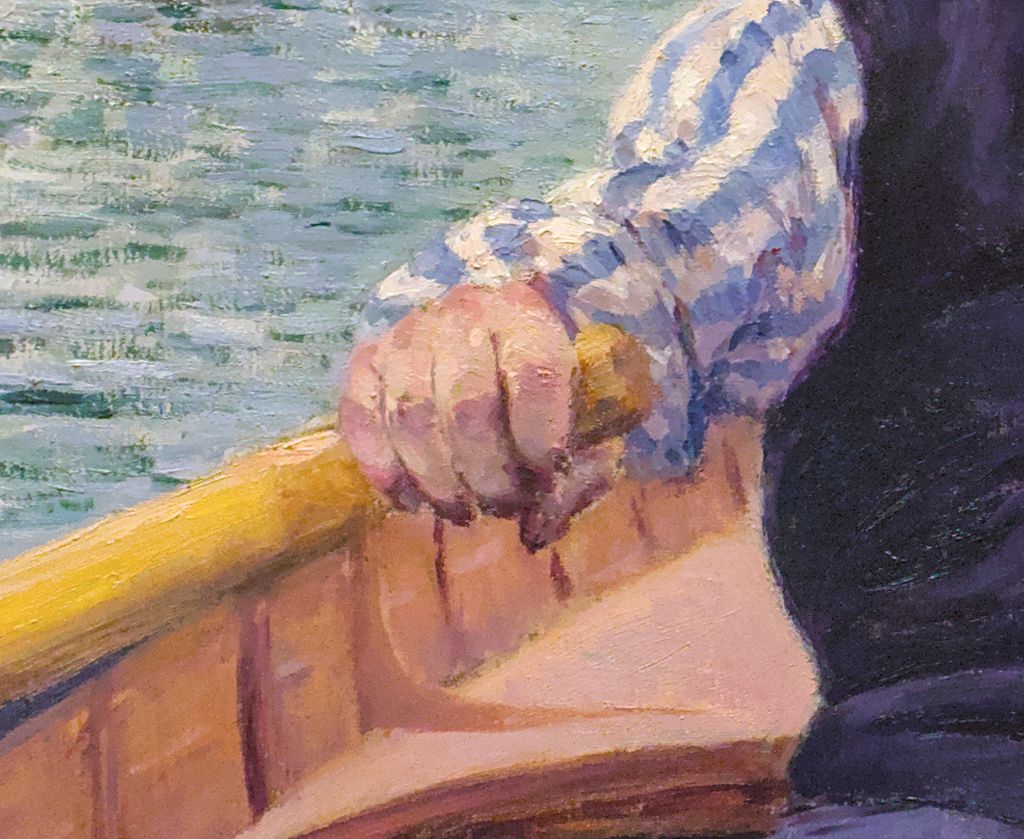
A hand around the oar
The rower’s hand closes around the oar handle. Pale knuckles and striped fabric make the grip conspicuous against the warmer wood of the boat.
Top hat and turned head
The tall hat, bow tie and dark waistcoat contrast with the striped shirt. The head turns away from a straightforward frontal portrait while the body faces the spectator.
The near boat encloses the viewer
The curved sides and boards of the boat surround the rower and continue beyond the lower edge. Their shape makes the spectator’s position feel close to the opposite seat.
Another boat on the river
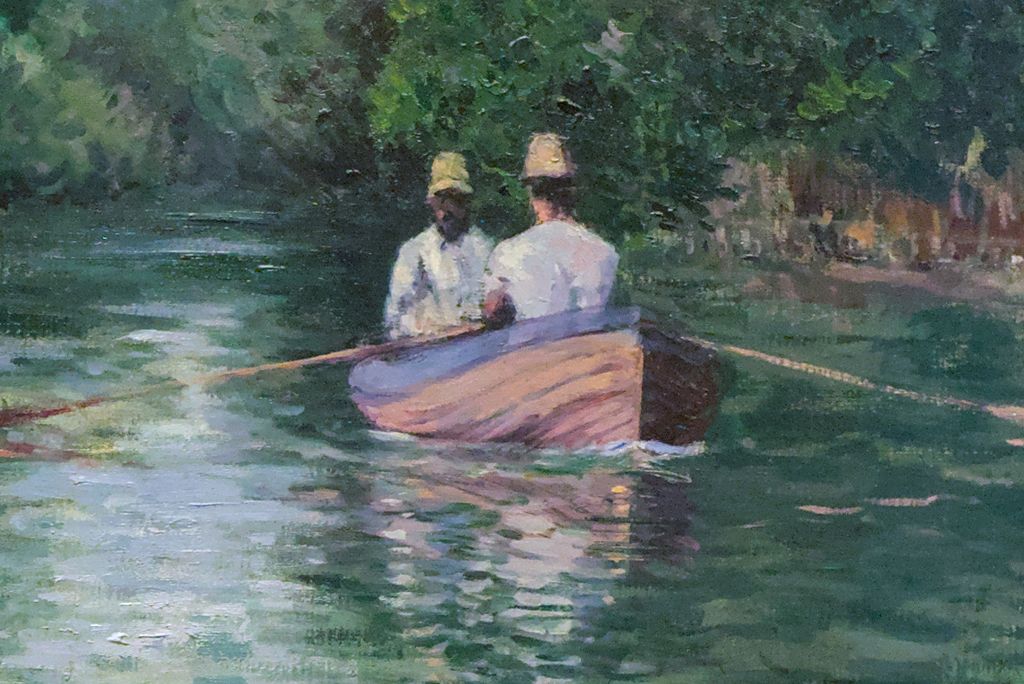
A smaller boat occupies the distance behind the principal figure. Its scale and the visible oars open a second interval of water beyond the crowded foreground.
The river behind his shoulders
A second, much smaller boat gives us a measure of distance. Two pale-shirted figures sit close together beneath light hats, and their vessel is shown from outside. Its pointed hull and surrounding reflections provide precisely the sort of complete object denied to us in the foreground. Within one picture, Caillebotte allows us to experience boating from two different positions: intimate participation nearby, detached observation farther away.
The little boat also changes how we look at the principal figure. His hat becomes enormous beside theirs; his hands seem especially close when compared with their barely differentiated arms. This is more than a contrast of large and small. The foreground man has an individual face, beard, mouth and gaze, while the distant pair are understood chiefly through their placement and activity. The painting moves between a meeting with one person and the broader life of the river.
Behind them, the channel has a gently unfolding structure. On the left, repeated trunks and rounded crowns lead into the distance. Their reflections descend into the river in broken pink and green passages. The right bank is darker and less regularly divided. A tall dark vertical behind the rower's head helps hold the background upright, answering the hat without repeating its precise shape.
The banks do not form an untouched wilderness. The orderly sequence of trees, the open channel and the presence of other boaters give the landscape a used, inhabited character. Berhaut's catalogue identifies the view as looking along the Yerres towards Crosne. The setting belongs to Caillebotte's familiar surroundings, yet its importance here comes from the relationship it makes possible between water, vessel and body. [2]
Notice, too, how little sky is needed. A narrow pale band opens above the low left bank, but the hat occupies much of that opening. The river supplies most of the picture's light. Its rippled surface provides a luminous field behind the dark waistcoat, allowing the man to stand out without an artificial spotlight. The same water that establishes the setting also gives the figure its clarity.
Watch: Gustave Caillebotte
Explore a museum overview and two discussions of Paris Street; Rainy Day. This shared selection offers wider context for the artist’s work.
"Who Is Gustave Caillebotte?" - HD version
An introduction to Caillebotte from the Kimbell Art Museum.
Watch on YouTubeA solid figure in broken paint
The painting's convincing space depends on very different kinds of mark. The oar shafts are broad yellow sweeps, with lighter streaks running along them. Around them, the boat's ribs are picked out with firmer, darker divisions. Across the water, short horizontal touches interrupt one another in blue, green, grey and pale cream. The separate pieces of colour resolve into ripples as the eye moves across them.
The shirt belongs to both systems. Its alternating stripes describe a piece of clothing, but the edges of those stripes fragment over the folds. At the shoulders they bunch into small patches; along the forearms they lengthen and twist. The figure is built through colour relationships as well as outlines. In particular, the sleeves connect the bright, changeable river with the dark, weighty centre of the body.
The waistcoat and trousers are far from featureless black. Bluish and violet passages distinguish folds, buttons and the swell of a thigh. Against the orange-pink timber, those cool darks become more emphatic. A similar exchange happens between the golden oars and the blue-green water. Warm and cool colours separate the materials and spaces while binding them together through repeated contrasts.
His face is more selectively described. The beard, lower lip, ear and line of the nose give it a particular character, but small touches of pink, blue and grey keep the skin within the same painted world as the surroundings. The dark brim above the forehead helps set off the face, while the turned head prevents it from becoming an immobile centre. Looking from the face to the hands makes the figure's divided attention visible: the head turns away as the hands remain committed to the oars.
These observations concern what the painted surface presents. They do not establish the sequence in which Caillebotte worked or how long he spent on a passage. What we can see is the contrast between substantial forms and briskly differentiated marks. The boat feels firm, the man has weight, and the water seems mobile because each receives a different visual rhythm.
Other ways to put the viewer on the water
Caillebotte had already explored a position inside a rowing boat in Canotiers ramant sur l'Yerres, dated 1877. There, two men lean forward over their oars, one behind the other. Their lowered heads and overlapping bodies give the action a more concentrated, repetitive character. Berhaut notes the relatively small place allotted to the river and the attention paid to the rowers' effort. Both paintings were included in the 1879 exhibition, as successive catalogue entries 7 and 8. [2]
The comparison makes the openness of Rower in a Top Hat more apparent. Its single principal figure allows the landscape to spread around his shoulders. His upright hat and sideways glance interrupt the forward bend and repetition that dominate Canotiers. Both pictures place us close to the activity, but they offer different experiences of companionship: the rhythm of two rowers working together in one, the presence of an individual across from us in the other.
Galina Olmsted connects the two compositions through their inclusion of the artist or viewer within the moving boat. Her discussion also follows the drawings and drypoint states associated with Canotiers. Those experiments show Caillebotte testing the boating subject across different media. Olmsted distinguishes her reconstruction of the order of production from Dorothee Hansen's earlier proposal, and records that Caillebotte exhibited no prints in 1879. The useful point for this picture is the sustained investigation of an internal viewpoint, carried into another medium and returned to painting. [6]
The Skiffs composition offers a different comparison. Its slender boats, long double-bladed paddles and straw-hatted occupants stretch out across a larger expanse of water. The closest vessel approaches the lower edge, but we can still see its pointed shape. Beside that mobile arrangement, the broad interior of Rower in a Top Hat feels unusually encompassing. Caillebotte's river pictures can shift the viewer from encountering a passing craft to inhabiting one.
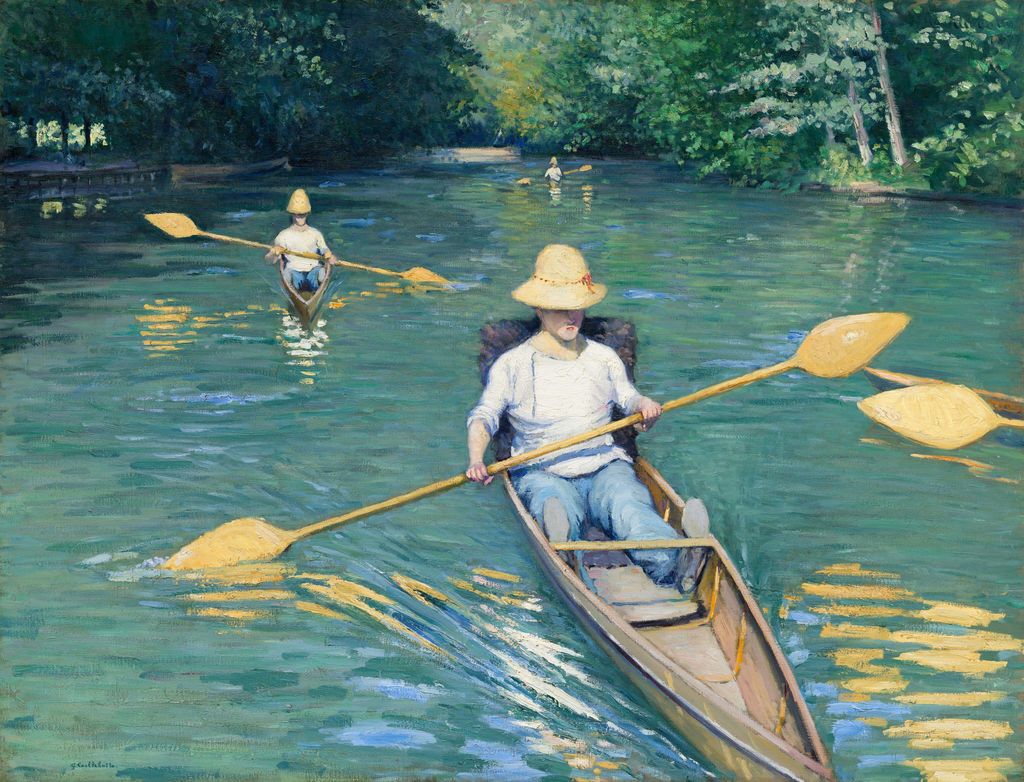
Skiffs, 1877; National Gallery of Art, Washington. Collection of Mr. and Mrs. Paul Mellon. Image source. Public domain. Resized only; source appearance preserved.
Why the picture unsettled viewers in 1879
The painting appeared at the fourth Impressionist exhibition under the title Partie de bateau. Berhaut records that it became Promenade en bateau in the artist's 1894 retrospective. The familiar descriptive title, Canotier au chapeau haut de forme, directs attention to the conspicuous figure, whereas the earlier title names the outing. Each is intelligible, but each gives a different first emphasis to the same canvas. [2]
Its reception demonstrates that the apparent simplicity of the subject did not make it uncontroversial. Berhaut links the picture to Armand Silvestre's description of Caillebotte's exhibited works as “fantaisies ultra-naturalistes”. More specifically, the catalogue records Draner's caricature in Le Charivari of 23 April 1879, captioned Partie de bateau… à vapeur: a boating party “under steam”. The joke seized on this particular rower, turning an immediately recognisable modern figure into material for satire. These responses reach us through Berhaut's documented account. [2]
Paul Perrin's Orsay commentary explains the difficulty as a meeting of an ordinary subject with an unfamiliar viewpoint. He cites Émile Zola's phrase “photographie de la réalité” in discussing the criticism. That description of excessive literalness makes a revealing contrast with the painting's broken colour and deliberate enclosure of the spectator. Its claim on reality is made through a highly organised painted encounter. [4]
The reception of Caillebotte's boating pictures as a group was more varied than a story of universal rejection would suggest. Olmsted notes favourable responses in Le Soir and La Presse, the latter praising the search for truth in his Canotiers. She also reconstructs a changing display, with works added during the exhibition, from critics' inconsistent counts and descriptions. Her argument concerns Caillebotte's broader exhibition strategy; those positive remarks should not all be reassigned to the top-hatted rower. They nevertheless show the lively and divided setting in which it appeared. [6]
The present picture helps explain that division. It gives meticulous attention to a familiar pastime while refusing the comfortable distance of a spectator on shore. The man's knees are close; his face is turned away; the oars disappear outside the frame. A viewer could recognise every object and still find the arrangement intrusive or strange. The modernity lies as much in that arrangement of a familiar world as in the choice to paint a recreational rower.
From the artist's family to the national collection
The canvas remained with Caillebotte until his death in 1894, then passed to his brother Martial and subsequently Martial's daughter Geneviève. Orsay's provenance places it in a private collection from 1986 until its acquisition in 2022. [4]
Its entry into the museum followed recognition as a French national treasure in 2020. The acquisition was supported exclusively by LVMH. The acquisition year is 2022; the public Orsay article announcing it is dated 30 January 2023. The museum's later Painting Men presentation made the newly acquired painting one of the principal works around which its exhibition was developed. [1] [4]
That history gives the picture a new public setting without resolving the encounter it offers. The sitter remains unnamed, the glance remains averted, and the boat still seems to hold a place for the spectator. Looking again after learning its exhibition history, one can appreciate how much depends on this carefully constructed nearness. Caillebotte turns a modest river outing into a sustained experience of sharing space with another person.
Catalogue and documented works
This directory brings together 578 entries in the revised 1994 catalogue, 11 further documented records and three groups of study descriptions. It is a directory of records, not a total of authenticated individual works. Albums, print states and surviving decorative panels are grouped. English labels retain the French titles as searchable aliases; dates are supplied only where checked. Numbered entries link to the relevant article or the historical catalogue. Pastels appear under the Drawing filter; original prints remain searchable under All media.
Frequently Asked Questions
His identity is unknown according to the current Musée d’Orsay account. [4]
Discussion
Look again at the images and ideas explored in Rower in a Top Hat. These editorial prompts invite your observations.
Reader Insights
The rower’s hands bring physical effort close to the viewer.
Formal clothing and the movement of rowing occupy the same compact space.
Does the picture make you feel like a passenger or an observer?
Join the Conversation
Share a detail, comparison or question about Rower in a Top Hat below.
References
- Musée d’Orsay; Paul Perrin, Scott Allan and Gloria Groom. Caillebotte: Painting Men, institutional presentation (2024), curatorial introduction and captions for Partie de bateau and Canotiers. View source. (in en/fr).
- Marie Berhaut, with Sophie Piétri. Gustave Caillebotte: Catalogue raisonné des peintures et pastels (1994), no. 122, p. 120; comparative no. 83, p. 103; public digitisation provided by the Wildenstein Plattner Institute. View source. (in French).
- Marie Berhaut with Sophie Pietri; Wildenstein Plattner Institute, Gustave Caillebotte Catalogue raisonné des peintures et pastels, 1994. View source. (in French).
- Musée d’Orsay; Paul Perrin. “Partie de bateau”, object record 265643 (30 January 2023, updated 2026), commentary, object data and provenance. View source. (in French).
- Musée d’Orsay. Gustave Caillebotte: Peindre les hommes (2024), “Focus: Caillebotte et le costume masculin 1/2”. View source. (in French).
- Galina Olmsted. Making and Exhibiting Modernism: Gustave Caillebotte in Paris, New York, and Brussels (PhD dissertation, University of Delaware, 2019), pp. 151–153 and 158–162, especially pp. 152–153 on Canotiers and A Boating Party, and p. 161 on reception. View source.
- Art Institute of Chicago, Caillebotte Paintings and Drawings at the Art Institute of Chicago, 2015. View source.
- Petit Palais / Paris Musées, Portrait de Paul Hugot, original print, PPG2319, current. View source. (in French).
- Paul Perrin, Musée d’Orsay, Transcription de l’entretien commissaire Caillebotte, 2024. View source. (in French).
- Cleveland Museum of Art, Caillebotte collection records: 2020.260, 2009.157 and 2020.105, current. View source.
- Splash image, Rower in a Top Hat, about 1877–78.


