



 by Tom Gurney
Tom Gurney BSc (Hons) is an art history expert with over 20 years experience
Published on June 19, 2020 / Updated on November 2, 2026
Email: tomgurney1@gmail.com / Phone: +44 7429 011000
Sailing Boats at Argenteuil: Introduction
Gustave Caillebotte’s Sailing Boats at Argenteuil gathers the pleasures of a riverside afternoon into a remarkably compact upright canvas. Pale sails rise above dark hulls, a bridge stretches across the distance, and reflections break into short strokes of cream, yellow and blue. The Musée d’Orsay dates the painting to about 1888. [1]
The most revealing detail may be the rough wooden rail crossing the foreground. It places us on the near bank, looking through the everyday equipment of a boating place. Beyond it, masts and sails offer clear shapes, while their reflections disperse across the river. This exchange between firm construction and flickering colour gives the scene its particular character. Caillebotte knew this shore intimately: Marie Berhaut’s catalogue identifies the foreground as the bank and landing stage at Petit Gennevilliers, close to his house. [2]
At a Glance
- ArtistGustave Caillebotte.
- French titleVoiliers à Argenteuil.
- DateAbout 1888, following the Musée d’Orsay’s current dating.
- Medium and sizeOil on canvas, 65.5 × 55 cm.
- CollectionMusée d’Orsay, Paris; accession RF 1954 31.
- AcquisitionPurchased in 1954 using income from the Dol-Lair bequest. [1]
- Catalogue identityBerhaut 214; placed within the 1882 sequence in the 1994 catalogue. [2]
This work across Gustave Caillebotte’s career
Contents
- Between the bank and the river
- A sailor’s familiar ground
- Geometry held inside light
- Reading the painted surface
- Returning to an Impressionist subject
- From private collections to the Musée d’Orsay
- Annotated details
Between the bank and the river
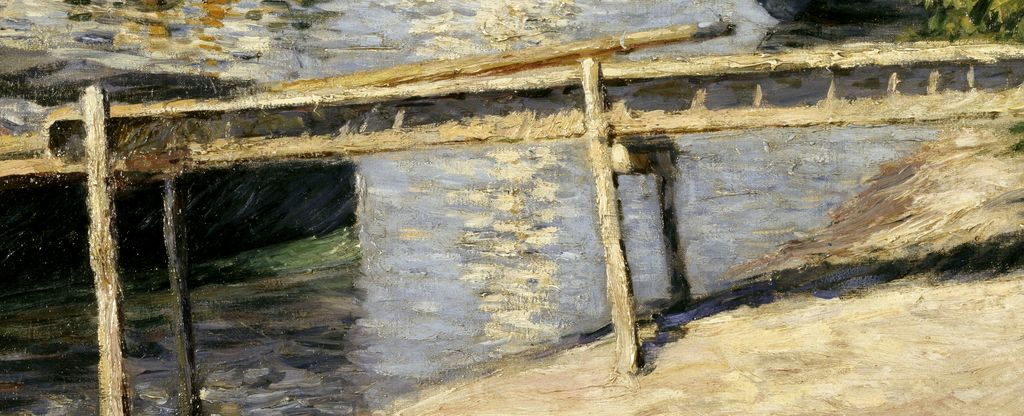
The painting opens with an obstacle. Two pale posts stand close to us, connected by an uneven horizontal rail that rises slightly towards the right. A dark boat intrudes from the lower left, partly hidden by this structure. At the lower right, the ochre bank slopes down towards the water. These forms establish a place to stand before the eye begins to travel through the flotilla.
The effect is more intimate than a view taken from a distant promenade. We are close enough to notice the roughness of the timber and the weight of the dark hull below it. Yet the foreground offers no broad, uninterrupted path into the scene. The rail crosses our sightline; a further length of timber runs diagonally behind it. Looking becomes an act of finding openings between things. Through the largest opening, a pale reflection carries the eye from the bottom of the picture towards the central sail.
The upright format gives unusual importance to that journey. A river landscape might spread across a broad horizontal canvas, with boats distributed along a bank. Here the space climbs from the nearest post to the tops of the masts. The left sail, the tallest mast and the smaller central sail all occupy different heights, setting up a series of vertical intervals. Much of the upper canvas belongs to the sky, but the sails reach into it and prevent it from becoming a separate, empty zone.
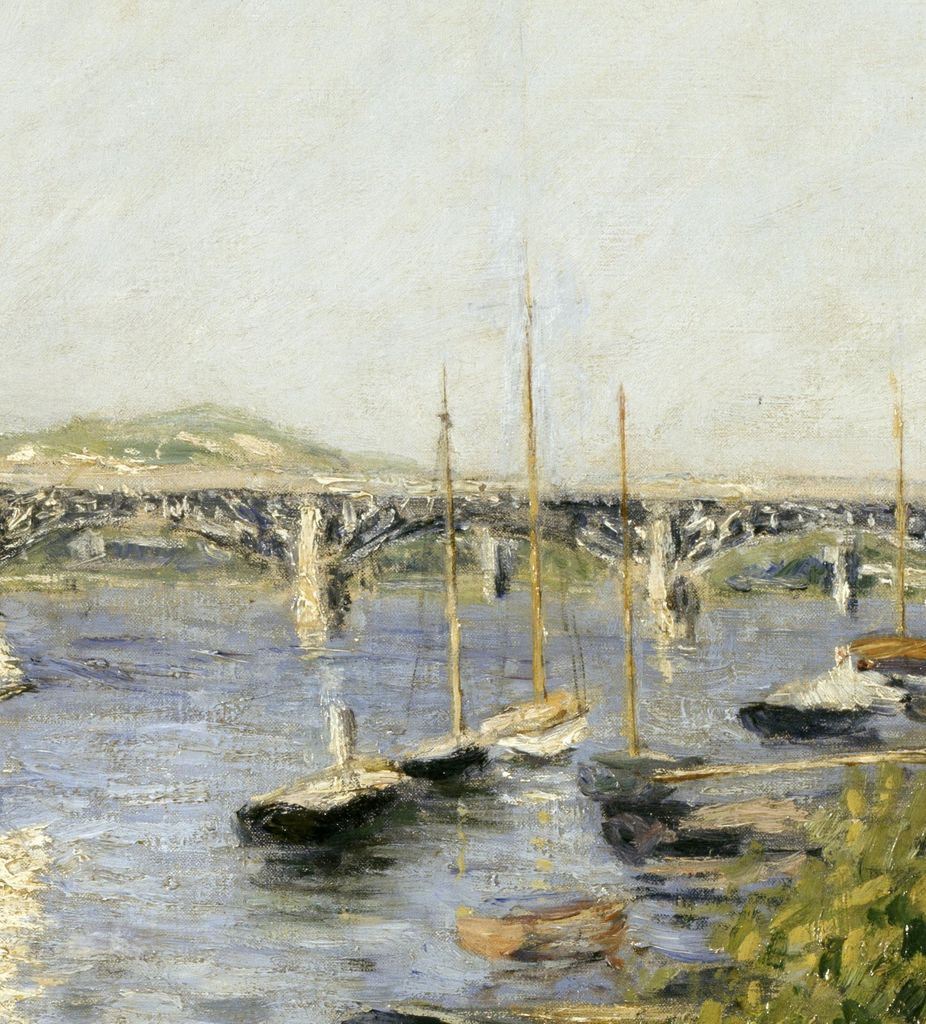
The largest raised sail extends beyond the left edge. Its missing portion makes the flotilla feel larger than the frame. Beneath it, a dark hull lies obliquely across the water. Closer to the centre, an open boat presents a broader, rounded end, with a bare mast rising almost vertically. Farther back, the central raised sail forms a smaller, more complete triangle. On the right, a sequence of low boats and slender masts recedes towards the bridge. The differences in scale make the river legible without a sharply drawn system of converging lines.
Berhaut identifies the distant structure as the old wooden bridge at Argenteuil, with the heights of Sannois and Orgemont behind it. The bridge’s repeated supports and diagonal braces create a dense strip across the horizon. [2] Above that strip, small pale buildings and low green hills remain subordinate to the sails. Below it, the open water gives the foreground boats room to separate. The architecture is an essential measure of distance, although it never takes over the scene.
The catalogue also connects this painting with another view, Voiliers sur la Seine, Argenteuil, number 213. Berhaut notes that the same three sailing boats appear at the centre of that composition. [2] This relationship places the Orsay canvas within Caillebotte’s repeated exploration of the basin. A familiar group of boats could yield more than one picture. Here the upright framing makes the different heights of the sails unusually prominent, while the close bank and rail anchor them to the spectator’s position.
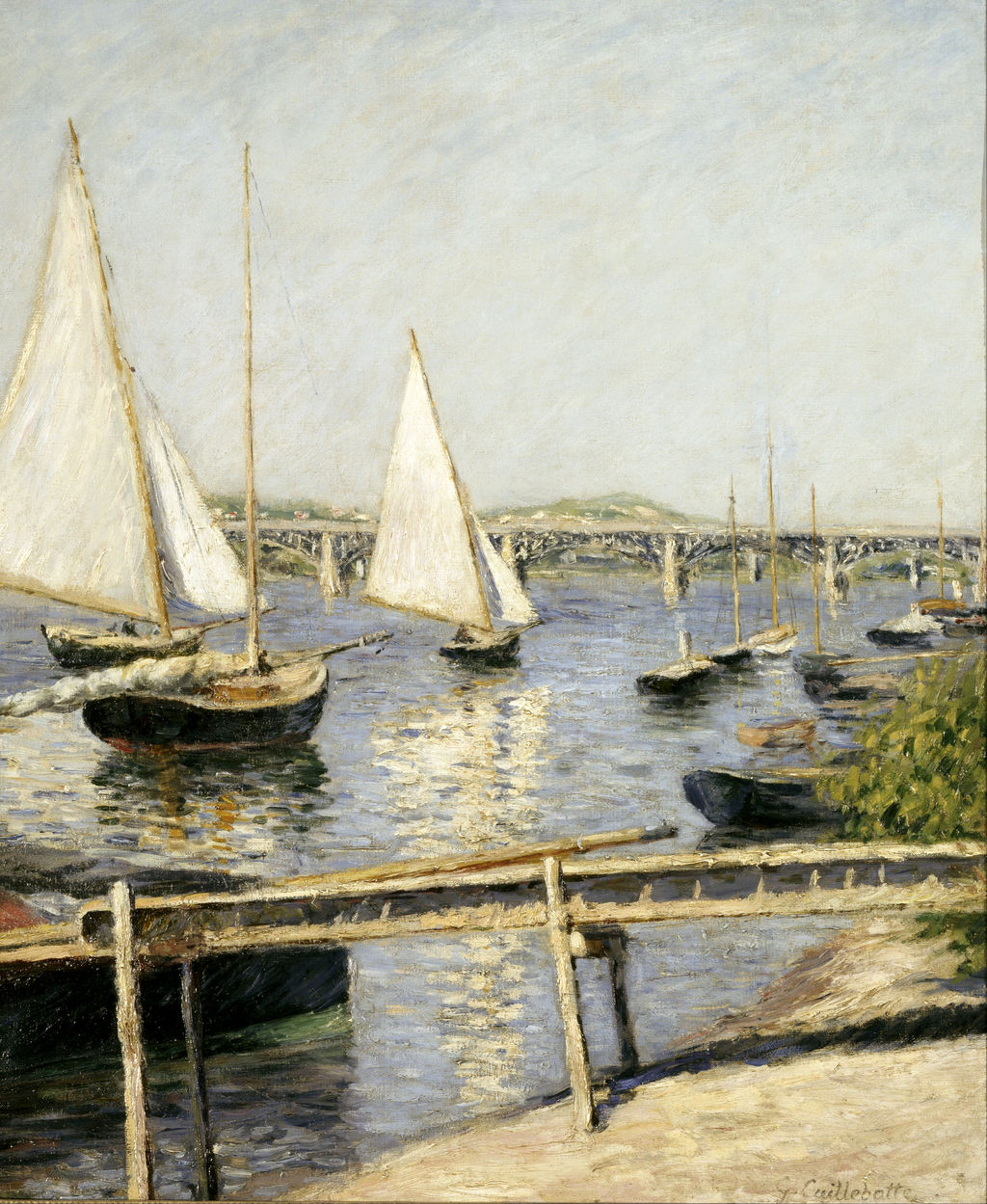
Sailing Boats at Argenteuil,about1888; catalogue214. Google Arts & Culture — 7wF0nCHN0GPPzw. Image source. Public domain. Resized only; source appearance preserved.
A sailor’s familiar ground
Caillebotte’s involvement with boating helps explain the sustained attention he gave this environment. The Musée des impressionnismes Giverny records that Gustave and his brother Martial bought their Petit Gennevilliers property in 1881, opposite Argenteuil and near the Cercle de la Voile de Paris. They had a house and a shed for their small boats built there; both were completed in 1882. The property therefore brought domestic life, painting and river sports into close proximity. [4]
By then, boating was already established in his work. His earlier pictures on the Yerres had explored paddling and rowing, often with figures close to the spectator. Giverny’s teaching dossier describes the long, narrow périssoires, propelled by a double paddle, which recur in those paintings. It distinguishes this earlier enthusiasm from his subsequent concentration on sailing. [4] The comparison with Skiffs brings out a change of emphasis: the hull and its relation to the water remain compelling subjects, while here sails and masts extend the composition high above the river.
Sailing was an exacting activity for Caillebotte. Berhaut records his involvement in regattas, his boat designs and his position as a vice-president of the Cercle de la Voile de Paris in 1880. [2] That practical knowledge makes the equipment in this painting worth attending to: booms stretch across the water, raised sails alternate with bare masts, and boats lie at different angles within a confined space. Their arrangement has the familiarity of a place used repeatedly. The scene does not need a conspicuous sporting contest to make that world interesting.
The variety within the group rewards a slower look. Some boats carry substantial areas of pale canvas; others register through the fine line of a mast or a short ochre stroke along a gunwale. The eye moves between the raised sails, the broad empty hull near the left and the smaller craft pulled against the right bank. A sailor’s environment becomes a painter’s store of contrasting shapes, sizes and surfaces.
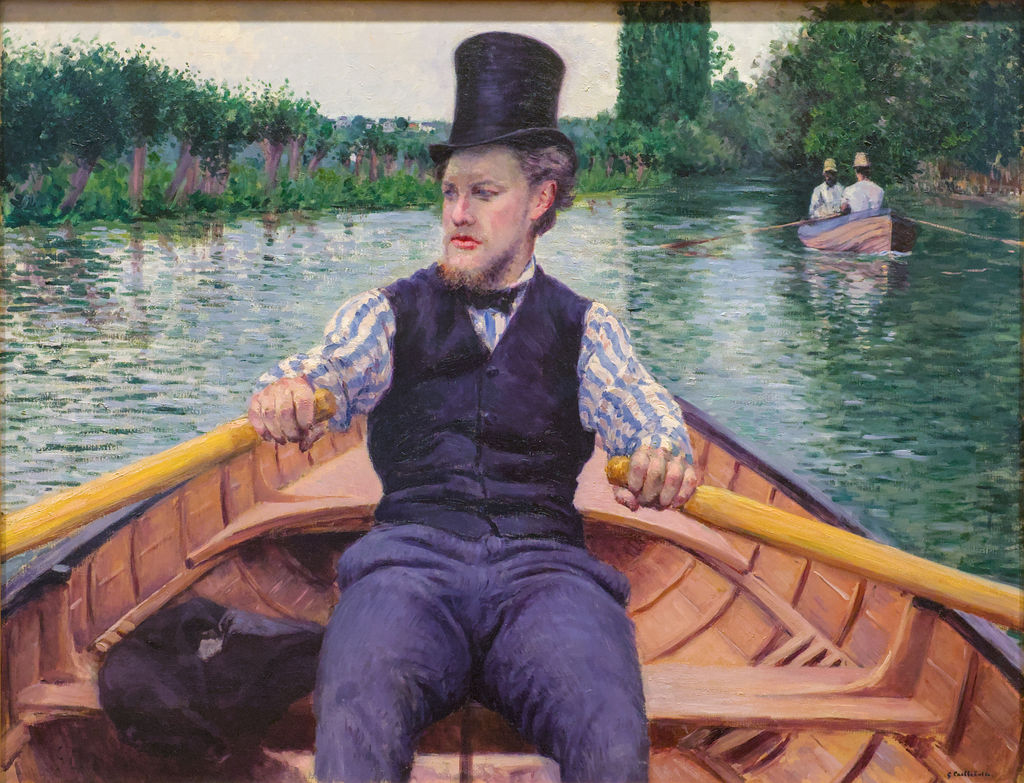
Rower in a Top Hat (Boating Party),about1877–78; Musée d’Orsay; separate rowing composition. Own work. Image source. Public domain. Resized only; source appearance preserved.
Geometry held inside light
Three kinds of line organise the scene. The bridge gives a strong horizontal measure; the masts establish verticals; sails, booms and the landing stage supply diagonals. Each system steadies the others. If the river alone were isolated, its restless marks might seem almost formless. If only the masts and bridge remained, the composition would become an arrangement of rods and braces. Caillebotte holds the two experiences together.
The foreground rail is especially important because it refuses perfect regularity. Its upper edge shifts, the posts lean slightly, and its pale strokes thicken or thin as they cross dark water. The more distant bridge is also broken into small marks, yet we recognise its continuous span. Construction is everywhere visible, but the painted lines retain the irregularity of observation. This gives the picture a convincing physical setting without making it resemble a diagram.
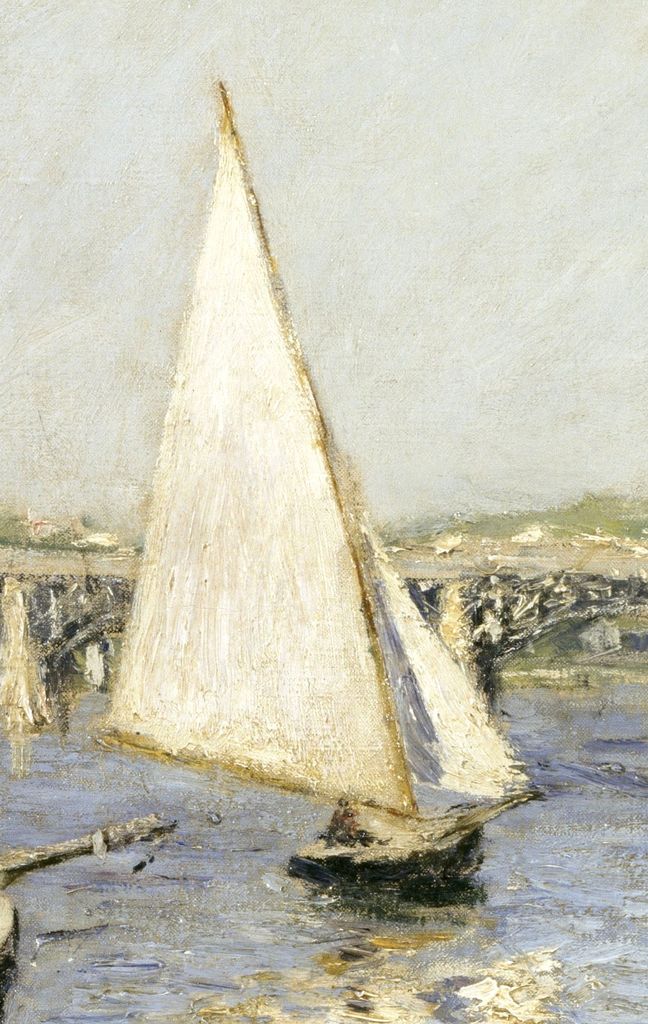
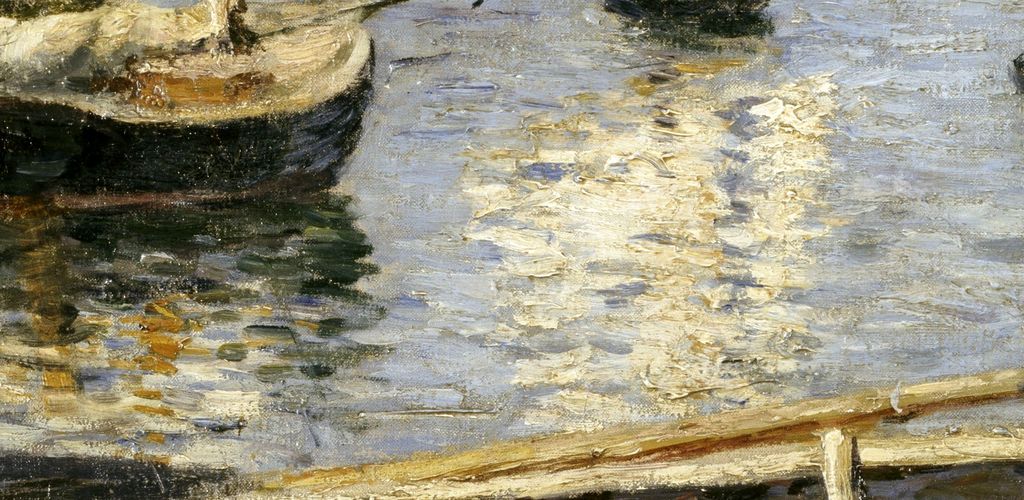
The central sail provides the brightest large shape. It is warm ivory rather than a featureless white, with thin darker passages near its edges. The smaller sail beside it picks up a cool blue shadow. Beneath the hull, the broad pale reflection becomes a loose column of separate strokes. It occupies more space than the boat itself and moves the visual centre of the painting down into the water. The eye can follow that column towards the foreground, cross the rail and then return upwards along a mast.
Elsewhere, reflections behave differently. Under the large open boat at the left, dark greens and nearly black strokes gather into a weighty patch. Yellow and warm brown touches interrupt them. At the right, the boats dissolve into shorter blue, cream and ochre fragments, close to the green bank. These differences prevent the water from becoming a repeated decorative pattern. Each reflection relates to a particular hull or sail, while the intervals between them keep the surface open.
The sky is quieter, although it is also worked with visible strokes. Grey-blue, pale yellow and muted green pass through one another without firm cloud outlines. Its relatively broad handling lets the sharper sail edges come forward. The sails gather that diffuse brightness into solid shapes, which break apart again in their reflections. Light connects the upper and lower halves of the canvas through these changes of form.
Watch: Gustave Caillebotte
Explore a museum overview and two discussions of Paris Street; Rainy Day. This shared selection offers wider context for the artist’s work.
"Who Is Gustave Caillebotte?" - HD version
An introduction to Caillebotte from the Kimbell Art Museum.
Watch on YouTubeReading the painted surface
The visible handling is freer than the carefully bounded forms associated with Caillebotte’s best-known Parisian scenes. In her National Gallery of Art brochure, Lynn Kellmanson Matheny contrasts the controlled edges of Le Pont de l’Europe with his later landscapes, where more emphatic brushwork and adventurous colour coexist with an underlying geometry. [5] That combination is particularly clear here. The principal objects are easy to locate, even where their surfaces have been built from conspicuous, separate touches.
Look at the near bank. Its sunlit slope is suggested by long, slanting ochre and cream strokes, interrupted by cooler shadows. The plants at the right are painted in shorter green and yellow marks. Across the water, many strokes spread sideways, while those inside the sails generally follow their rising forms. The direction of the brushwork helps distinguish earth, foliage, water and canvas. Detail is often carried by the movement of a mark rather than an enclosing contour.
Berhaut’s discussion of Caillebotte’s development gives particular attention to increasingly visible touches and textured paint in the Seine landscapes. She relates them to his growing interest in the light and colour of Monet’s Impressionism. [2] The comparison should not flatten the differences between painters. In this work the bridge, dark hulls and rough foreground barrier remain insistently substantial. The pale sails are embedded in a setting of timber, moorings and riverbank, whose varied weights are as important as the atmosphere.
A separate technical investigation offers a useful comparison with this apparent freedom. Caroline von Saint-George and Katja Lewerentz examined Caillebotte’s Sailing Boat on the Seine at Argenteuil of 1893 in Cologne. Their report describes an initial layout using charcoal followed by a few painted lines, beneath briskly applied colour. They also identify a mark at the canvas edge consistent with attachment to a field easel. These findings concern the Cologne picture, a different work from the Orsay painting. [6] They show how an energetic surface in one of Caillebotte’s sailing pictures can coexist with preliminary planning. The lively marks visible here likewise deserve to be considered as choices that construct a scene, without assuming that their appearance tells us the complete sequence of its making.
Annotated Details from Sailing Boats and a Separate River View
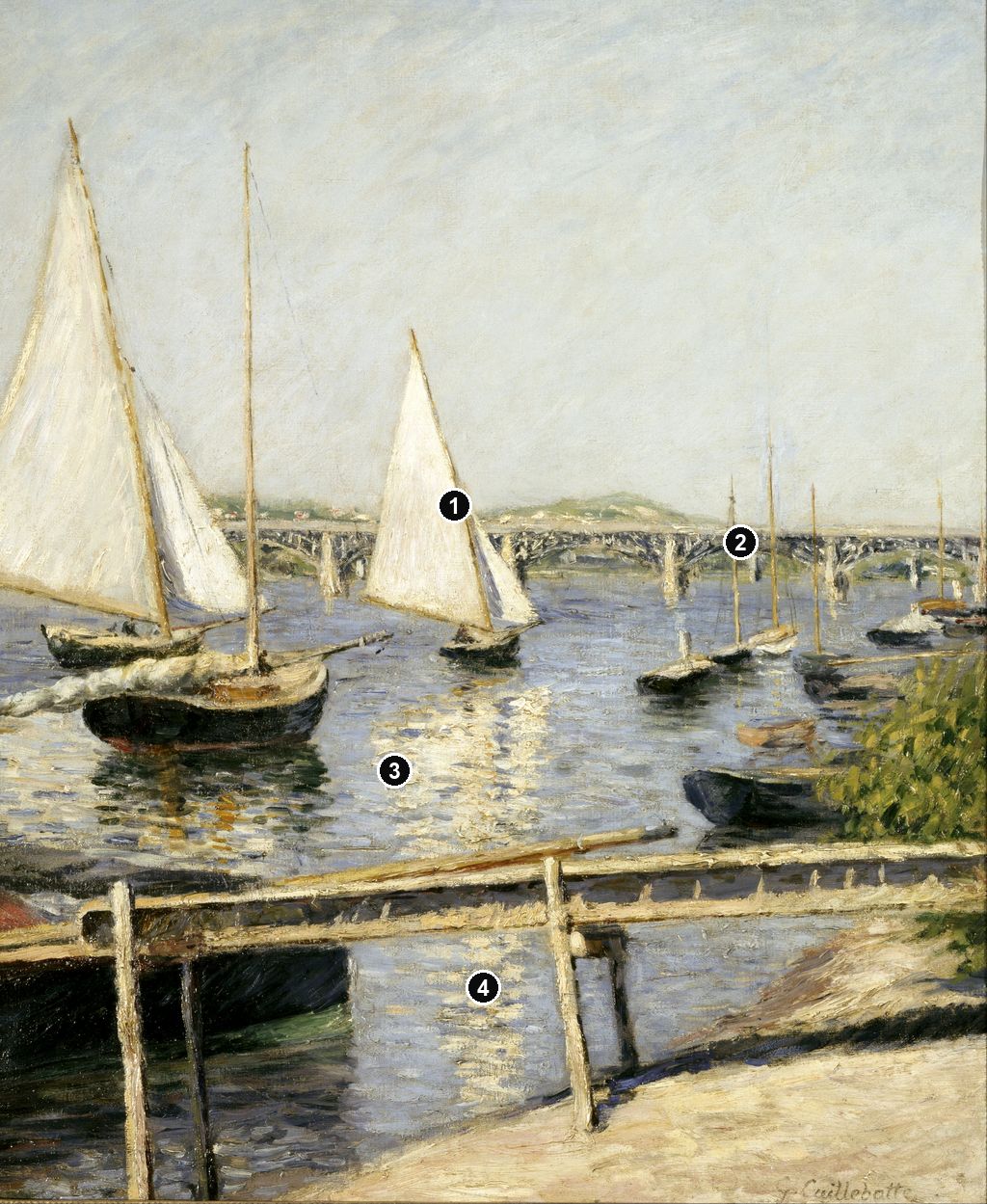
The numbered points identify visible features discussed in this article. Return from each detail to the whole composition. Each caption identifies the work shown.
Sailing Boats at Argenteuil
Sailing Boats at Argenteuil,about1888; catalogue214. Google Arts & Culture — 7wF0nCHN0GPPzw. Image source. Public domain. Resized only; source appearance preserved.
Comparative detail: The Seine and the Railroad Bridge at Argenteuil
The Seine and the Railroad Bridge at Argenteuil; a separate river painting. The retained source dates it 1885 or 1887. Google Arts & Culture — IQECrDdAV1ZqXg. Image source. Public domain. Resized only; source appearance preserved.
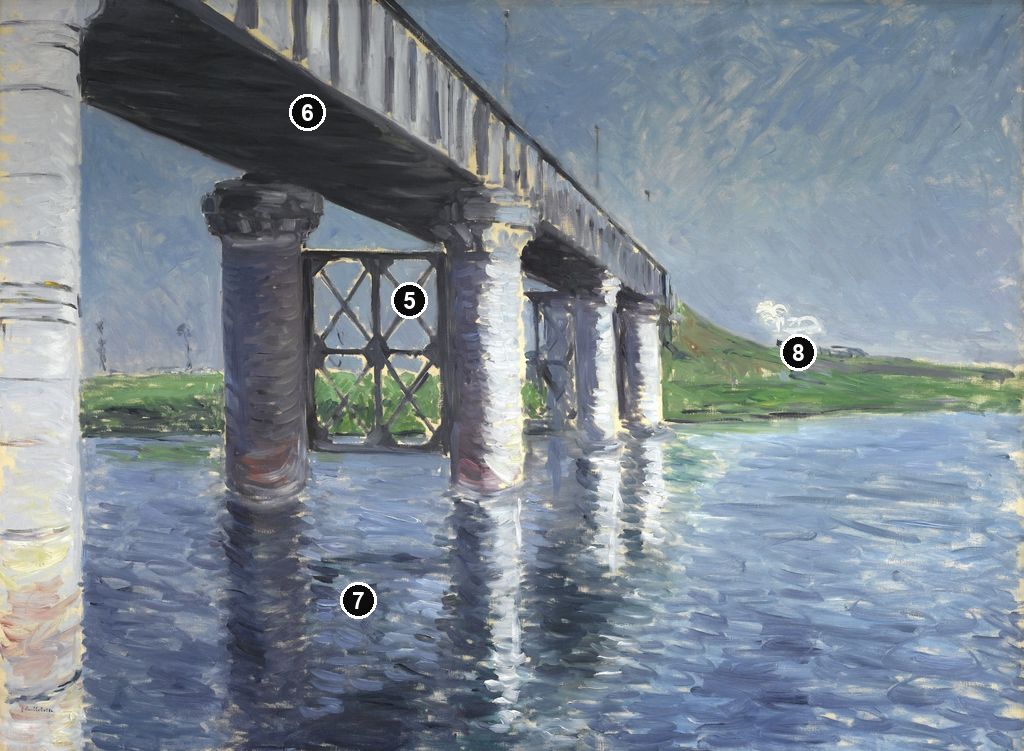
Details from SAILING BOATS AND A SEPARATE RIVER VIEW
The second overview and its details show the separate Seine and Railroad Bridge painting. Compare the handling of water and distant structures without treating them as one canvas.
Sailing Boats at Argenteuil
The central sail and hull
A pale triangular sail rises above a dark hull. Its strong shape interrupts the long bridge and the softer repeated marks on the water.
Moored boats and upright masts
Small hulls gather near the right bank, with thin masts rising above them. Their repeated uprights give the quieter boats a different rhythm from the broad open sails.
Light broken across the water
Short pale and yellow touches gather into broken reflections. Horizontal marks keep the river active between the dark hulls.
Timber across the foreground
Near posts and long wooden edges cross the lower part of the picture. They establish a close boundary before the more open water beyond.
Comparative detail: The Seine and the Railroad Bridge at Argenteuil
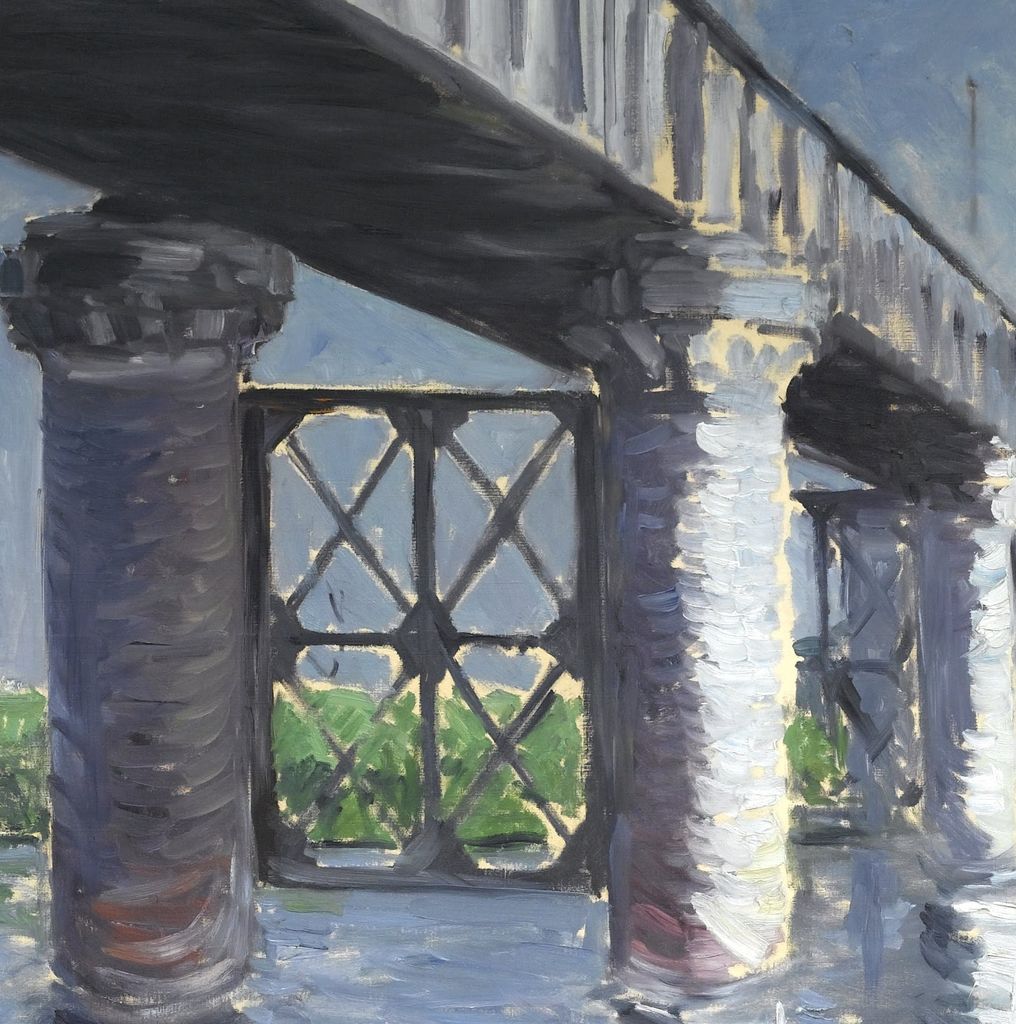
Bridge piers and open bracing
Pale cylindrical piers and dark diagonal braces support the bridge. The repeated structures become smaller as they approach the far bank.
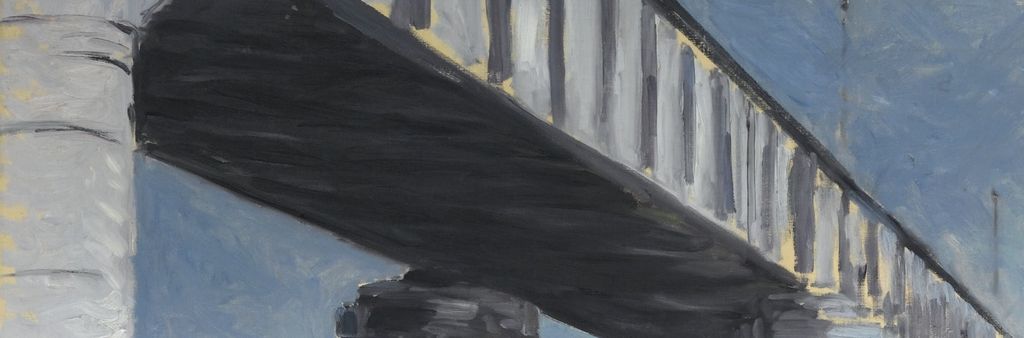
The bridge crossing the sky
The long dark underside cuts diagonally across the pale sky. Lighter upper divisions repeat along its edge towards the distance.
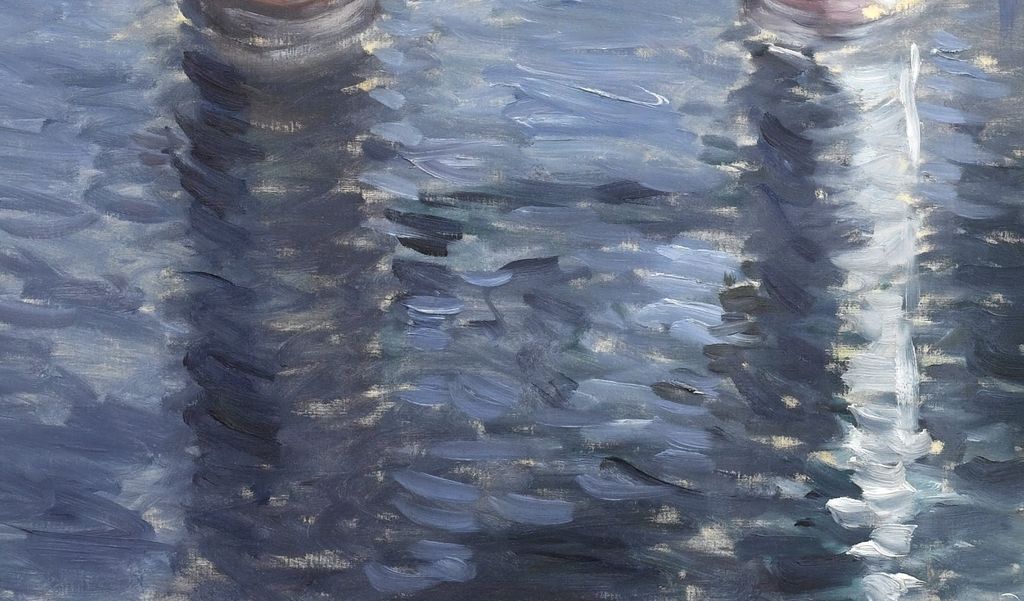
Reflections beneath the piers
Pale and dark touches make broken vertical reflections beneath the bridge. Horizontal strokes of water interrupt the repeated uprights.
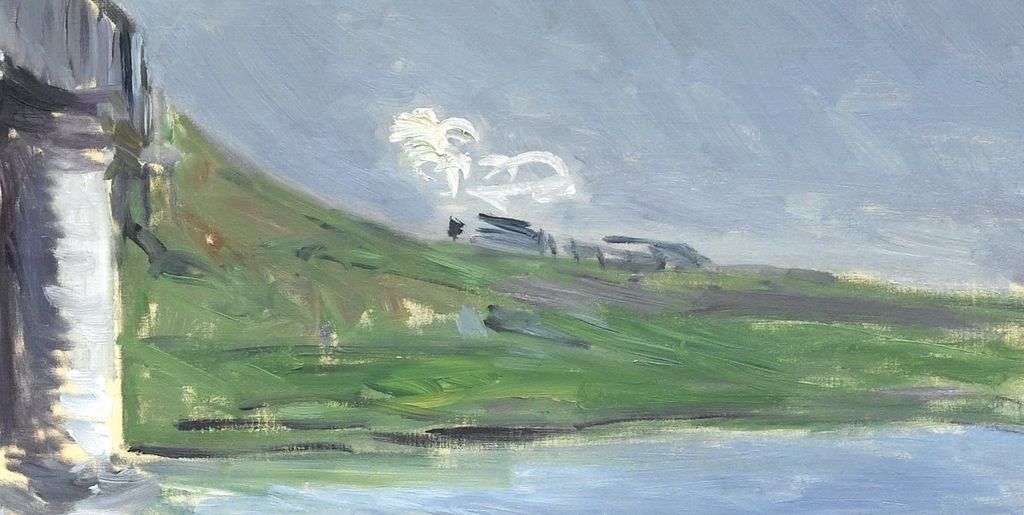
A white plume beyond the bridge
A small white plume appears above the far bank. Its bright shape briefly interrupts the lower horizon beyond the bridge supports.
Returning to an Impressionist subject
The choice of sailing boats at Argenteuil inevitably brought Caillebotte into dialogue with an earlier phase of Impressionism. Monet and his colleagues had already made the Seine and its leisure activities a major subject. Giverny’s exhibition dossier places Caillebotte’s pictures of sailboats and regattas within that established river imagery. [4] He was returning to a familiar artistic territory as well as painting his own surroundings.
This history complicates any simple equation between a modern painter and a newly discovered subject. Boats on the Seine could no longer surprise through novelty alone. Caillebotte’s particular contribution is visible in the pressure he gives to familiar elements: the high-reaching masts within a narrow format, the close foreground barrier, the dark boat cropped at the bottom, and the broad light reflection that leads through the centre. The picture offers a distinctive way of inhabiting a place already rich in painted associations.
The dating matters to that context. The current Orsay record gives about 1888, whereas the 1994 catalogue places this canvas among works of 1882. [1] [2] About 1888 situates it around the period when Caillebotte made Petit Gennevilliers his principal home. Giverny’s chronology records Martial’s marriage and Gustave’s purchase of his brother’s share of the property in 1887, followed by his establishment there in 1888. [4] The approximate date should be retained: the painting’s signature does not supply a year in the owner’s record. [1]
These later years were active ones. Although Caillebotte’s participation in the Impressionist group exhibitions ended in 1882, Berhaut records subsequent appearances abroad, including New York in 1886 and the Salon des XX in Brussels in 1888, as well as an exhibition at Durand-Ruel in 1888. [2] These are facts about his continuing public career, rather than proof that this particular canvas appeared in each exhibition. They help resist a misleading picture of the river paintings as the incidental pastime of someone who had simply stopped being an artist.
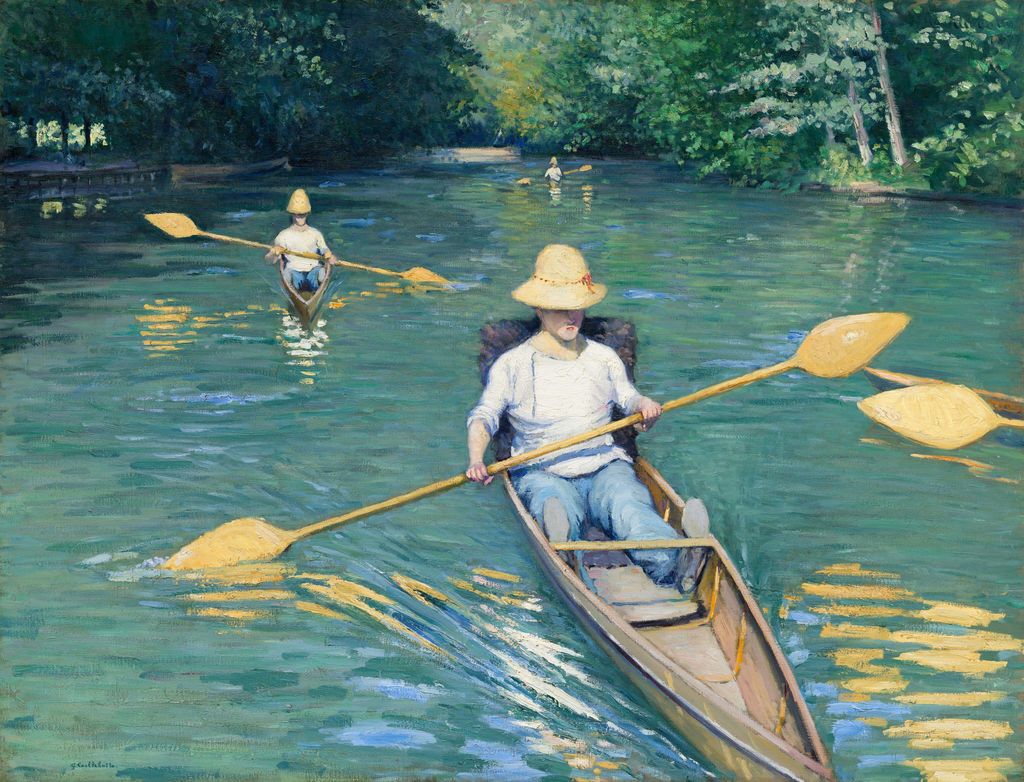
Skiffs,1877; National Gallery of Art,Washington; paddling on the Yerres. Collection of Mr. and Mrs. Paul Mellon. Image source. Public domain. Resized only; source appearance preserved.
From private collections to the Musée d’Orsay
The documented ownership history begins well after Caillebotte’s death. Berhaut records the painting in E. Laffon’s collection in Paris around 1933 and subsequently with Garcin in Cannes. It was acquired for the French national collections in 1954, shown at the Jeu de Paume and transferred to the Musée d’Orsay in 1986. [2] The current museum record specifies that the 1954 purchase used income from the Dol-Lair bequest. [1]
This route into a museum differs from the celebrated bequest of Impressionist paintings that Caillebotte himself assembled. Matheny explains how the importance of his collection helped overshadow his work as a painter, while the relative scarcity of his own canvases in public collections restricted their visibility. [5] Sailing Boats at Argenteuil entered the national collection through a later purchase. Its history therefore belongs both to his lifetime’s painting and to the later recovery of his reputation.
The catalogue lists the canvas in the 1984 Caillebotte exhibition at Pontoise, the 1985 Orsay avant Orsay exhibition at Antibes and the Paris–Chicago retrospective of 1994–95. [2] Such contexts brought a modestly sized river painting into broader accounts of his achievement. It can still change the balance of that achievement for a reader who knows mainly the Paris streets. Here his command of space works through low boats, towering sails and the smallest interruptions in reflected light. The ordered scene remains wonderfully responsive to the movement of the brush.
Catalogue and documented works
This directory brings together 578 entries in the revised 1994 catalogue, 11 further documented records and three groups of study descriptions. It is a directory of records, not a total of authenticated individual works. Albums, print states and surviving decorative panels are grouped. English labels retain the French titles as searchable aliases; dates are supplied only where checked. Numbered entries link to the relevant article or the historical catalogue. Pastels appear under the Drawing filter; original prints remain searchable under All media.
Frequently Asked Questions
The foreground is the bank and landing stage at Petit Gennevilliers, near Caillebotte’s house, looking towards the old wooden bridge at Argenteuil. Berhaut identifies the distant heights as Sannois and Orgemont. [2]
Yes. He competed in regattas, designed boats and held a vice-presidency of the Cercle de la Voile de Paris in 1880. [2]
The Musée d’Orsay in Paris owns it under accession number RF 1954 31. It measures 65.5 × 55 cm. [1]
Discussion
Look again at the images and ideas explored in Sailing Boats at Argenteuil. These editorial prompts invite your observations.
Reader Insights
Masts and reflections make the river’s movement visible through repeated verticals.
The bank gives a steady boundary to the shifting shapes on the water.
Which feels more prominent here: the boats as objects or the light around them?
Join the Conversation
Share a detail, comparison or question about Sailing Boats at Argenteuil below.
References
- Musée d’Orsay, Voiliers à Argenteuil, current collection record, RF 1954 31; identity, date, dimensions, inscription and acquisition. View source. (in French).
- Marie Berhaut, with Sophie Pietri, Gustave Caillebotte: Catalogue raisonné des peintures et pastels (1994), biography pp. 8–11; discussion of painting and handling p. 20; entry 214, p. 154. Public digital edition, Wildenstein Plattner Institute. View source. (in French).
- Marie Berhaut with Sophie Pietri; Wildenstein Plattner Institute, Gustave Caillebotte Catalogue raisonné des peintures et pastels, 1994. View source. (in French).
- Musée des impressionnismes Giverny, Caillebotte, peintre et jardinier: Dossier pédagogique (2016), PDF pp. 4–7, 11 and 14; river subjects, Petit Gennevilliers property and chronology. View source. (in French).
- Lynn Kellmanson Matheny, National Gallery of Art, Gustave Caillebotte: The Painter’s Eye, exhibition brochure (2015), PDF pp. 4–7; urban painting, landscape handling and the artist’s later visibility. View source.
- Caroline von Saint-George and Katja Lewerentz, Wallraf-Richartz-Museum & Fondation Corboud, Gustave Caillebotte—Sailing Boat on the Seine at Argenteuil: Brief Report on Technology and Condition (2008), pp. 1–5; the separate 1893 painting, WRM Dep. 622. View source.
- Art Institute of Chicago, Caillebotte Paintings and Drawings at the Art Institute of Chicago, 2015. View source.
- Petit Palais / Paris Musées, Portrait de Paul Hugot, original print, PPG2319, current. View source. (in French).
- Paul Perrin, Musée d’Orsay, Transcription de l’entretien commissaire Caillebotte, 2024. View source. (in French).
- Cleveland Museum of Art, Caillebotte collection records: 2020.260, 2009.157 and 2020.105, current. View source.
- Splash image, Sailing Boats at Argenteuil, about 1888.


