



 by Tom Gurney
Tom Gurney BSc (Hons) is an art history expert with over 20 years experience
Published on June 19, 2020 / Updated on November 2, 2026
Email: tomgurney1@gmail.com / Phone: +44 7429 011000
Sunflowers on the Banks of the Seine: Introduction
Gustave Caillebotte brings the sunflowers almost within reach. Their great leaves and heavy heads occupy the foreground, while the Seine opens behind them and a pale building stretches along the opposite bank. Painted about 1885–86, Sunflowers on the Banks of the Seine unites two environments central to his life at Petit-Gennevilliers: his cultivated garden and the river where he sailed. The painting entered the Fine Arts Museums of San Francisco through the bequest of Diana Dollar Knowles in 2013. [1]
The flowers offer a striking way into a landscape. They conceal much of the nearer bank, interrupt the water and rise into the distant view. Yet the river remains an expansive presence, carrying light across the picture in countless short strokes. Looking through the stems, the viewer repeatedly shifts between the scale of a single leaf and the much greater distance across the Seine.
At a Glance
- ArtistGustave Caillebotte.
- DateAbout 1885–86.
- MediumOil on canvas.
- Dimensions90.2 × 71.1 cm, as recorded in the museum's acquisition publication and owner-supplied collection record. [1] [2]
- CollectionFine Arts Museums of San Francisco, Legion of Honor; accession 2013.45.3, bequest of Diana Dollar Knowles.
- Alternative titleSunflowers along the Seine. [1]
- Catalogue identificationMarie Berhaut's 1994 catalogue, no. 336, Soleils au bord de la Seine. [3]
This work across Gustave Caillebotte’s career
Contents
- Looking from the garden towards Argenteuil
- A screen of flowers with openings in it
- The river's light and the building's reflection
- A garden taking shape beside the Seine
- Distinguishing Caillebotte's sunflower paintings
- From an 1888 exhibition to San Francisco
Looking from the garden towards Argenteuil
The picture's geography explains its unusual combination of subjects. In her catalogue entry, Marie Berhaut identifies the viewpoint as Caillebotte's property, with flower beds in front and the promenade at Argenteuil across the river. Below that promenade are the public washhouses whose forms appear again in the water. This is a view out from a garden towards a working riverbank, with cultivated plants occupying the space closest to the painter. [3]
That information changes the pale horizontal structure near the top of the picture. At first it can register simply as a brilliant strip dividing blue water from dark trees. Closer inspection reveals repeated dark openings and a long façade. Its position gives the distance a firm architectural measure. The flowers, by comparison, have irregular contours, overlapping leaves and heads facing in several directions. Caillebotte holds these different kinds of order together: the repeated intervals of the building and the less predictable growth of the plants.
The opposite bank sits high in the upright canvas. A narrow band of trees closes the upper edge, leaving almost no room for the sky. Most of the open space belongs to the river, which consequently seems broad even though the painting is taller than it is wide. Its surface extends beyond both sides of the frame. We see a selected passage of water through vegetation, and the cropping makes that passage feel part of a larger landscape continuing around us.
The garden itself is only partly disclosed. There is no clear path leading the eye down to a landing, and little exposed ground establishes where we stand. The flowers supply the near edge of the scene through their size and overlap. Berhaut's identification of the viewpoint anchors this intimacy in an actual property; Caillebotte's arrangement makes us experience it as a place from which we look outward. [3]
A screen of flowers with openings in it
The two most prominent flower heads sit towards the left and right sides of the lower half. Their dark centres are ringed by uneven rays of yellow. Smaller heads turn, droop or show their backs between them. High on the right, another bloom appears in profile, close to the level of the distant washhouses. That tall stem connects the near plants with the upper part of the landscape, preventing the composition from falling neatly into a floral bottom half and a river scene above.
The museum's acquisition commentary describes a “frieze of golden sunflowers” and stresses how their scale dominates the river view. The phrase usefully draws attention to their spread across the foreground, although the band is broken and asymmetrical. Water remains visible between the plants, especially in the central opening and beside the tall right-hand stem. The flowers establish a boundary that the eye can cross. [1]
Follow the large leaves on the right. Some present broad green surfaces, others turn sharply and narrow along their edges. They overlap the blue water, yet strokes of blue and violet also appear among the greens. On the left, the foliage gathers into a darker mass beneath the large sunflower. Across these passages, the leaves remain recognisable without every outline being continuously traced. Their different angles create an impression of thickness: there are plants behind plants, even where the foreground becomes difficult to disentangle.
The blooms also vary in their degree of clarity. The conspicuous left-hand head gives the eye a relatively stable circular centre; nearby blossoms break into smaller yellow touches. Towards the bottom, scattered flashes of yellow disappear into a dense tangle of green and blue. This uneven emphasis keeps the viewer moving. A botanical inventory would isolate each specimen, whereas Caillebotte makes the recognition of individual flowers depend on their position in the larger patch.
The result is a sense of abundance that comes from partial visibility. We cannot see every stem back to its root or separate every leaf from its neighbour. At the edges, the plants are cut off, implying further growth outside the picture. The painting therefore conveys both the particular character of sunflowers and the experience of standing close enough to a flower bed for its forms to fill the view.
The river's light and the building's reflection
Across the water, the handling changes direction. Short, predominantly horizontal marks describe the surface, accumulating into bands of blue, pale green, violet and white. The acquisition commentary specifically draws attention to the rhythmic brushwork of the Seine. Its repetition offers a visual counterweight to the twisting stems and larger leaf shapes in front. [1]
The strongest light lies close to the opposite shore. Beneath the pale washhouses, white strokes flicker across the blue and dark vertical intervals descend into the water. These reflections preserve enough of the structure to make its position readable, but the architectural regularity loosens as it meets the rippling surface. A straight edge on land becomes a succession of interrupted marks below it. Berhaut explicitly identifies the reflected buildings as the public washhouses. [3]
The water changes as it approaches the foreground. The brilliant upper band gives way to deeper blue, while the more open passages between the flowers allow us to follow the surface much further down the canvas. These narrow channels matter to the depth of the painting. Without them, the flowers might form a solid barrier; through them, the far river and the water immediately beyond the garden remain connected.
One small detail rewards attention near the opposite bank: a red, white and blue flag emerges against the trees, above the long pale building. Its colour reappears in a thin broken reflection below. The mark is tiny beside the sunflowers, yet it gives the distant shore a distinctive point of focus. It also demonstrates how Caillebotte can make a very small accent legible within an expanse of moving brushwork.
The yellows in the foreground gain force from the blue behind them, while the river's pale reflections echo the brightness of the petals. These relationships bind the two subjects together. The garden and water have different textures and scales, but they share the same field of colour. Looking at a blossom leads back to the river around it; looking across the river brings the eye against a leaf or stem.
Watch: Gustave Caillebotte
Explore a museum overview and two discussions of Paris Street; Rainy Day. This shared selection offers wider context for the artist’s work.
"Who Is Gustave Caillebotte?" - HD version
An introduction to Caillebotte from the Kimbell Art Museum.
Watch on YouTubeA garden taking shape beside the Seine
Caillebotte's connection to this bank preceded his permanent move there. The Musée des impressionnismes Giverny's account records that Gustave and his brother Martial bought their Petit-Gennevilliers property in 1881, close to the Cercle de la Voile de Paris and opposite Argenteuil. A house and boat shed were completed in 1882, and flower beds and a large kitchen garden soon occupied the surrounding ground. Gustave bought Martial's share in 1887 and established his principal residence there in 1888. The approximate 1885–86 date of Sunflowers places it within the earlier development of this garden. [5] [1]
The setting joined gardening to an existing enthusiasm for the water. The San Francisco acquisition note recalls Caillebotte's accomplishments as a sailor and boat designer, relating his home near the regatta waters of Argenteuil to the flowers cultivated on his property. These were activities rooted in the same place. In this painting, the viewer can understand their proximity without the presence of a sailing boat: the garden opens directly towards the broad river. [1]
Giverny's 2016 exhibition account treats the garden as an increasingly important subject in Caillebotte's work. Its discussion of Roses, Garden at Petit-Gennevilliers of 1886 describes aligned rose bushes, a broad path and maintained flower beds. That near-contemporary painting offers a useful contrast. The organisation of a garden can become a visible framework of rows and paths; in Sunflowers on the Banks of the Seine, foliage conceals most of that ground plan and establishes a screen at the water's edge. [5]
The difference is one of viewpoint and selection. We need not imagine that this flower bed grew without cultivation because its stems overlap freely in the picture. The documented setting is a garden Caillebotte helped to create. His painting brings us close to the growth itself, while the distant promenade keeps the larger surroundings in view. For more of this setting, Garden at Petit-Gennevilliers offers another route into the relationship between planted space and pictorial structure.
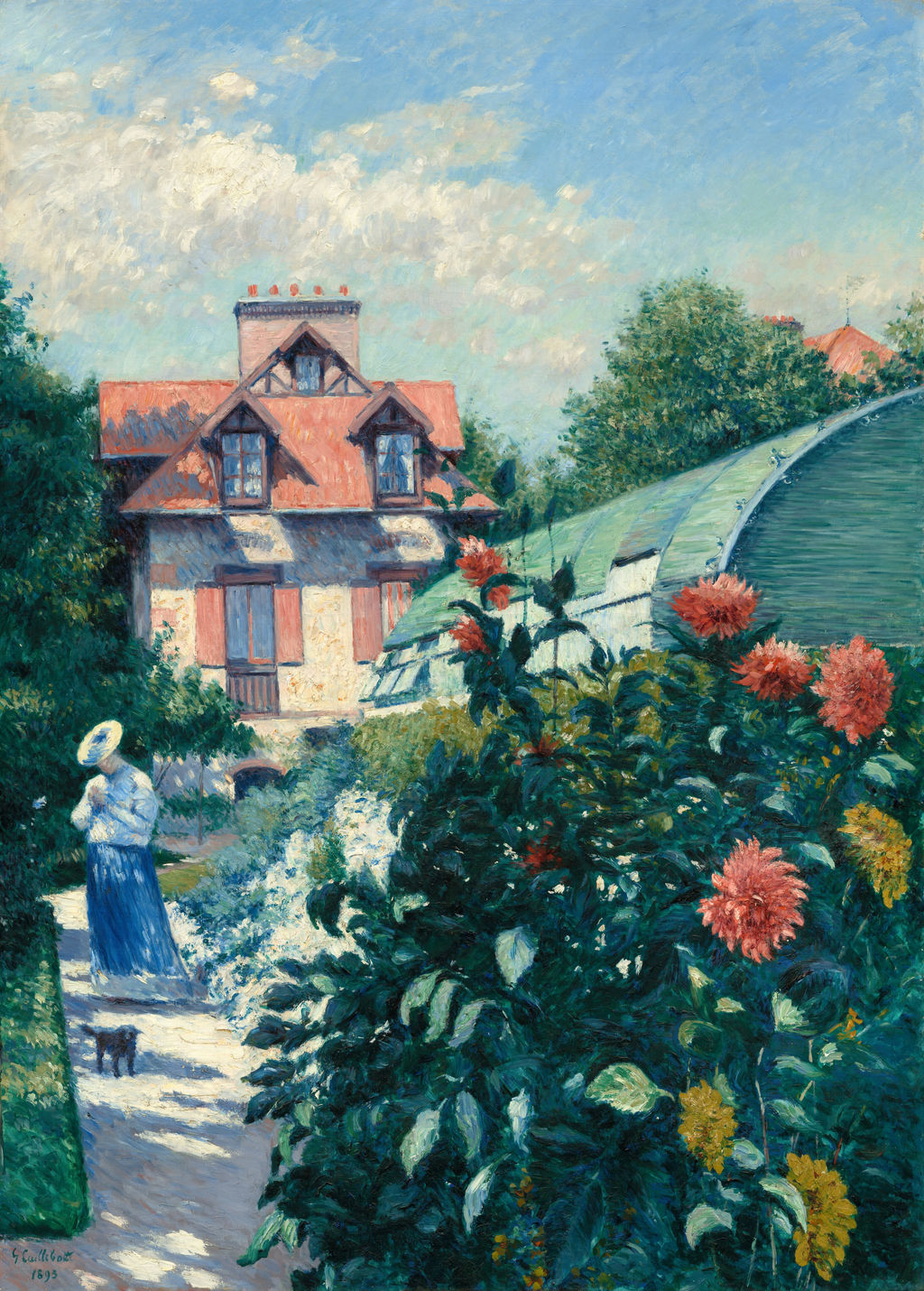
Dahlias at Petit Gennevilliers, 1893; a separate later painting of the cultivated garden. Gift of the Scharffenberger Family. Image source. Public domain. Resized only; source appearance preserved.
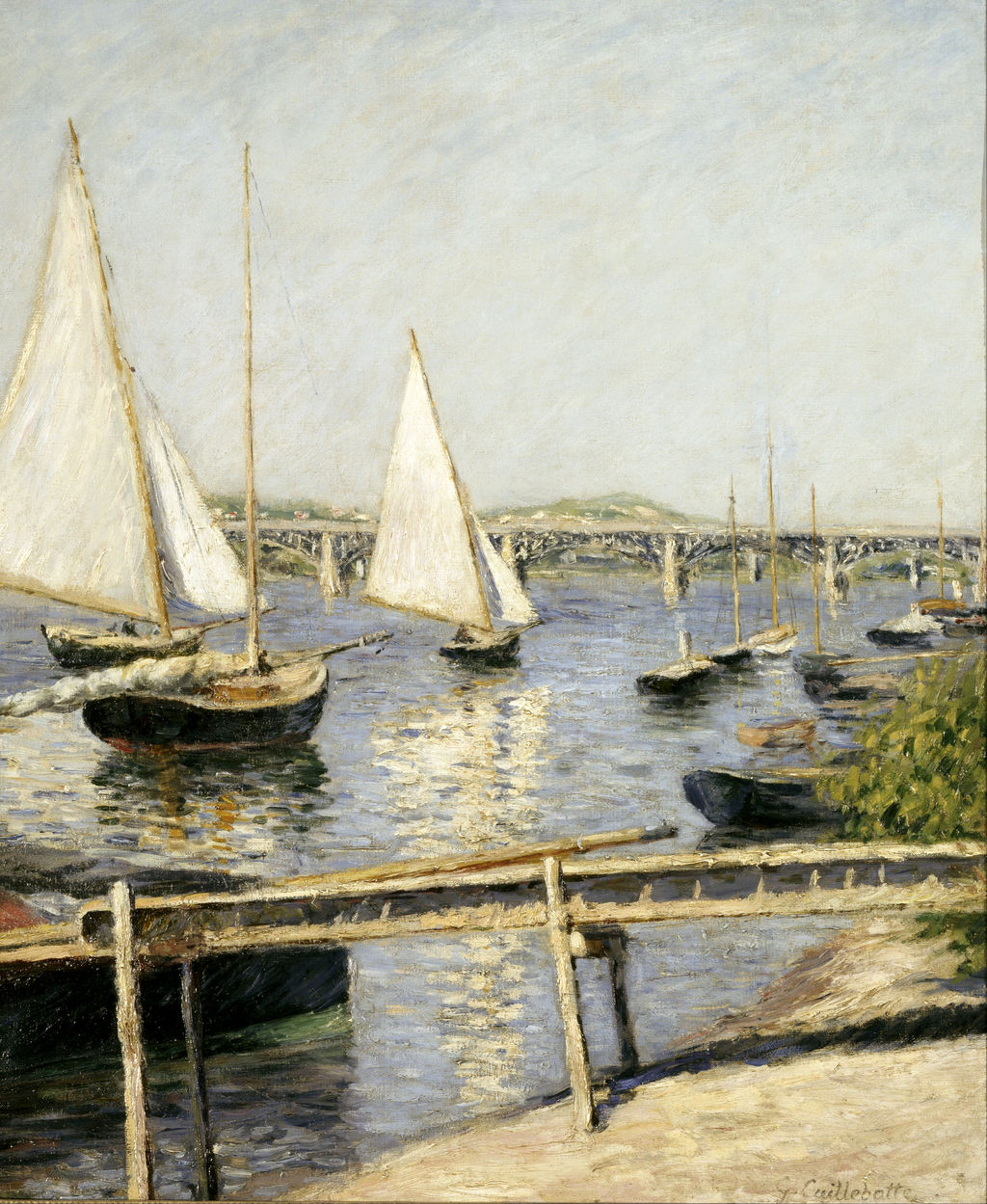
Sailing Boats at Argenteuil, about 1888; a separate view of the river beside Petit-Gennevilliers. Google Arts & Culture — 7wF0nCHN0GPPzw. Image source. Public domain. Resized only; source appearance preserved.
Distinguishing Caillebotte's sunflower paintings
The same flowers recur in neighbouring entries in Berhaut's catalogue. Number 335, Soleils, jardin du Petit Gennevilliers, is a smaller, horizontal canvas filled with flowers and foliage. Berhaut cautiously proposes that it may be a study for the riverbank painting. Her wording preserves the uncertainty: the relationship is a suggestion, rather than a documented sequence of preparation and execution. The comparison nevertheless helps identify what the riverbank composition adds to a close floral subject: a far shore, reflected architecture and a considerable expanse of open water. [3]
Number 337, Les Soleils, jardin du Petit Gennevilliers, is another upright composition, measuring 131 × 105 cm in the catalogue. Its illustration shows tall sunflowers in front of a house and garden buildings. The riverbank painting, no. 336, is immediately distinguishable by the water and long pale washhouses beyond. The similarity of their titles can obscure how differently the two pictures arrange the view. In one, flowers are set against the architecture of the garden; in the other, they become the near edge of a landscape across the Seine. [3]
These comparisons reveal the flexibility of the motif. Sunflowers can fill a small canvas, rise before a house or frame a river. Their large centres, radiating petals and broad leaves offer conspicuous shapes in each case, but the spaces around them change the encounter. Here, the openings among the plants make distance an active part of the experience.
From an 1888 exhibition to San Francisco
Berhaut records the riverbank painting at the exhibition of Les XX in Brussels in 1888, as no. 5. The entry also traces it through the Paris dealer Ambroise Vollard and lists auction appearances at the Galerie Charpentier in Paris in June 1960, Sotheby Parke-Bernet in New York in November 1978 and Sotheby's in New York in November 1992. These are documented stages in its history; the catalogue does not provide a continuous account of every intervening owner. [3]
The later museum acquisition gives a firm point of arrival. Published in The Burlington Magazine in April 2014, the Fine Arts Museums of San Francisco's acquisition notice identifies the work as the bequest of Diana Dollar Knowles, with accession number 2013.45.3. It dates the painting to about 1885–86 and records dimensions of 90.2 × 71.1 cm, also supplied in the Legion of Honor's Google Arts & Culture record. [1] [2]
Catalogue and documented works
This directory brings together 578 entries in the revised 1994 catalogue, 11 further documented records and three groups of study descriptions. It is a directory of records, not a total of authenticated individual works. Albums, print states and surviving decorative panels are grouped. English labels retain the French titles as searchable aliases; dates are supplied only where checked. Numbered entries link to the relevant article or the historical catalogue. Pastels appear under the Drawing filter; original prints remain searchable under All media.
Frequently Asked Questions
The Fine Arts Museums of San Francisco's acquisition publication dates it to about 1885–86. [1]
Berhaut identifies a view from Caillebotte's property at Petit-Gennevilliers, across the Seine towards the promenade and public washhouses at Argenteuil. The foreground flowers belong to his garden. [3]
Yes. Berhaut catalogues this riverbank view as no. 336, alongside a smaller floral composition, no. 335, and a larger upright garden view with a house, no. 337. [3]
Discussion
Look again at the images and ideas explored in Sunflowers on the Banks of the Seine. These editorial prompts invite your observations.
Reader Insights
The flowers form a screen through which the river remains partly visible.
Near stems and distant buildings bring two different kinds of vertical into the view.
Do the openings between the flowers feel more important than the flowers themselves?
Join the Conversation
Share a detail, comparison or question about Sunflowers on the Banks of the Seine below.
References
- Fine Arts Museums of San Francisco / The Burlington Magazine, “Recent acquisitions (2005–14) at the Fine Arts Museums”, 2014, p. 278, illustration IV, Sunflowers along the Seine, acquisition caption and commentary. View source.
- Fine Arts Museums of San Francisco, Legion of Honor, Sunflowers along the Seine, owner-supplied Google Arts & Culture collection record, object details and dimensions. View source.
- Marie Berhaut, with the assistance of Sophie Pietri, Gustave Caillebotte: Catalogue raisonné des peintures et pastels, 1994, pp. 198–199, nos. 335–337; illustrated catalogue consulted through the Wildenstein Plattner Institute. View source. (in French).
- Marie Berhaut with Sophie Pietri; Wildenstein Plattner Institute, Gustave Caillebotte Catalogue raisonné des peintures et pastels, 1994. View source. (in French).
- Musée des impressionnismes Giverny, Caillebotte, peintre et jardinier: Dossier pédagogique, 2016, pp. 3–5, 10–11 and 14, exhibition account, Les Roses, jardin du Petit Gennevilliers and chronology. View source. (in French).
- Art Institute of Chicago, Caillebotte Paintings and Drawings at the Art Institute of Chicago, 2015. View source.
- Petit Palais / Paris Musées, Portrait de Paul Hugot, original print, PPG2319, current. View source. (in French).
- Paul Perrin, Musée d’Orsay, Transcription de l’entretien commissaire Caillebotte, 2024. View source. (in French).
- Cleveland Museum of Art, Caillebotte collection records: 2020.260, 2009.157 and 2020.105, current. View source.
- Splash image, Sunflowers on the Banks of the Seine, about 1885–86.


