



 by Tom Gurney
Tom Gurney BSc (Hons) is an art history expert with over 20 years experience
Published on June 19, 2020 / Updated on November 2, 2026
Email: tomgurney1@gmail.com / Phone: +44 7429 011000
White and Yellow Chrysanthemums: Introduction
Flowers press towards the edges of Gustave Caillebotte’s White and Yellow Chrysanthemums. Two large white heads occupy the top of the picture; yellow, mauve and pale pink blooms carry the eye down through a tangle of dark leaves. There is no vase, tabletop or distant prospect to establish a comfortable viewing position. The garden fills the canvas, bringing its smallest differences of colour and growth within reach.
Painted about 1893, this is the composition associated with the Musée Marmottan Monet in Paris, catalogued by Marie Berhaut as number 488. Her 1994 catalogue records that Caillebotte gave it to Claude Monet, who kept it until his death. The painting thus joins two artists through an actual gift, as well as through their shared interest in gardens. [1]
Jane R. Becker’s Metropolitan Museum essay relates this painting and its New York counterpart to decorative panels. [2]
At a Glance
- ArtistGustave Caillebotte.
- DateAbout 1893. [2]
- MediumOil on canvas. [1]
- Dimensions73 × 60 cm, as recorded in Berhaut’s 1994 catalogue. [1]
- CollectionMusée Marmottan Monet, Paris, as recorded in Berhaut’s catalogue. [1]
- Full French catalogue titleChrysanthèmes blancs et jaunes, jardin du Petit Gennevilliers. [1]
This work across Gustave Caillebotte’s career
Contents
- Finding a Way Through the Flowers
- A Garden Without a Horizon
- The Gardener’s Subject
- When Flowers Become Decoration
- Three Chrysanthemum Paintings, Three Different Views
- A Painting Monet Kept
- Annotated details
Finding a Way Through the Flowers
The first impression is abundance, yet the flowers do not form a single undifferentiated mass. Their arrangement is uneven. The left side is particularly crowded: open heads, hanging petals, rounded buds and smaller flowers overlap in a descending cluster. On the right, individual blooms are more widely separated by foliage. A yellow flower just below the middle reaches out from the dark ground, while pale violet heads gather towards the lower edge. The eye moves between concentrations and intervals, finding small areas of breathing space inside the profusion.
Look at the two whites near the top. They give the composition conspicuous points of brightness, but neither behaves like a central flower in a formal bouquet. One is crowded towards the upper-left corner; the other opens close to the top edge, right of centre. Between and beneath them, thin stems cross an area of grey-violet ground. This exposed patch prevents the upper half from becoming a solid screen of petals. It also makes the stems unusually noticeable: the flowers belong to a network of growth, with separate supports that can be followed for a short distance before they disappear.
The yellow heads offer another kind of movement. Their long, narrow petals twist and droop, producing loose, irregular outlines. The prominent bloom on the left spreads across the darker leaves like a small burst of light. Lower down, the isolated yellow flower towards the right bends into a more pendant shape. Repeating the colour without repeating the silhouette gives the picture rhythm. Each recurrence invites comparison with the last.
The title names white and yellow, but the visible colour is much less restricted. Lavender, pink and rusty orange interrupt the greens. Some of the nominally white petals have violet shadows, and some pale heads are almost lilac throughout. Along the lower left, warmer browns and ochres appear among the smaller rounded forms. These shifts keep the garden from dividing neatly into bright flowers and a neutral background. Colour passes through both, binding them together while preserving differences.
A Garden Without a Horizon
The painting gives few clues about where the viewer stands. We can look into several open flower heads, yet other blooms present their sides or hanging petals. No horizon regulates these varying encounters. There is no path leading away and no building to measure distance. Instead, overlapping heads and leaves establish small pockets of depth, which are quickly interrupted by another flower or another stroke of foliage.
This makes looking unusually active. A dark opening near the middle seems to offer a passage into the plants; a bright head immediately pulls attention back towards the surface. Thin upright stems imply continuity from one part of the bed to another, while the crowded petals repeatedly conceal that continuity. The eye can recognise how the plants grow without being able to reconstruct the whole arrangement. Caillebotte gives enough structure to make the flowers convincing, and enough obstruction to make the view feel close.
Cropping strengthens that effect. Flowers enter at the left edge, and pale heads at the bottom continue beyond the rectangle. The visible bed feels larger than the portion we have been allowed to inspect. At the same time, the absence of a distant view makes this modest stretch of garden occupy the whole field of attention. Nothing outside it supplies a competing subject.
The paint marks contribute to the same experience. Narrow, pale strokes fan out around the flower centres. In the foliage, shorter dark and green marks cross one another and merge into broader patches. The difference allows the petals to detach themselves from the surrounding leaves without requiring every contour to be drawn continuously. Seen close, a head separates into many strokes; seen together, those strokes make a recognisable flower. The picture rewards both distances of attention.
This is also why its disorder feels controlled. A repeated pattern of identical blooms would soon become predictable. Here a dense cluster is answered by a gap, a pale circular head by a straggling yellow one, and an upright stem by a downward curve. The variations hold the composition together while keeping it open to further discoveries.
The Gardener’s Subject
The Giverny museum’s teaching dossier follows Caillebotte through Paris, Yerres, the Seine and Normandy, and Petit-Gennevilliers. Gustave and Martial bought their Petit-Gennevilliers property in 1881; it became Gustave’s principal residence in 1888. He developed its garden and built a greenhouse as plants gained prominence in his painting. [4]
That setting changes how we understand the apparent profusion. The flowers are rooted and growing, but the subject comes from a cultivated environment. A garden can be carefully made even when a close view conceals its paths, boundaries and maintenance. In this canvas, the structures that would explain the property have slipped outside the picture. Their disappearance concentrates attention on the plants themselves.
In Roses, Garden at Petit-Gennevilliers of 1886, the Giverny dossier identifies aligned rose stems, a broad path, ordered beds and a figure bending towards the flowers. [4]
That earlier view makes the change especially clear. In White and Yellow Chrysanthemums, the close crop removes those larger spatial explanations. The viewer encounters the result of cultivation from within its abundance. Flowers obscure the places where their stems begin; dark leaves interrupt our attempts to trace the bed’s organisation. The gardener’s labour is present in the profusion, even though its practical arrangements have moved outside the frame.
The garden at Petit-Gennevilliers therefore matters as more than a convenient source of attractive subjects. It gave Caillebotte a setting he could repeatedly examine at different scales. A path, a whole bed and a group of flower heads offer different problems of composition. Here the chosen scale makes the familiar act of looking at garden flowers unexpectedly absorbing: each bloom can be considered separately, but none can be fully detached from the surrounding growth.
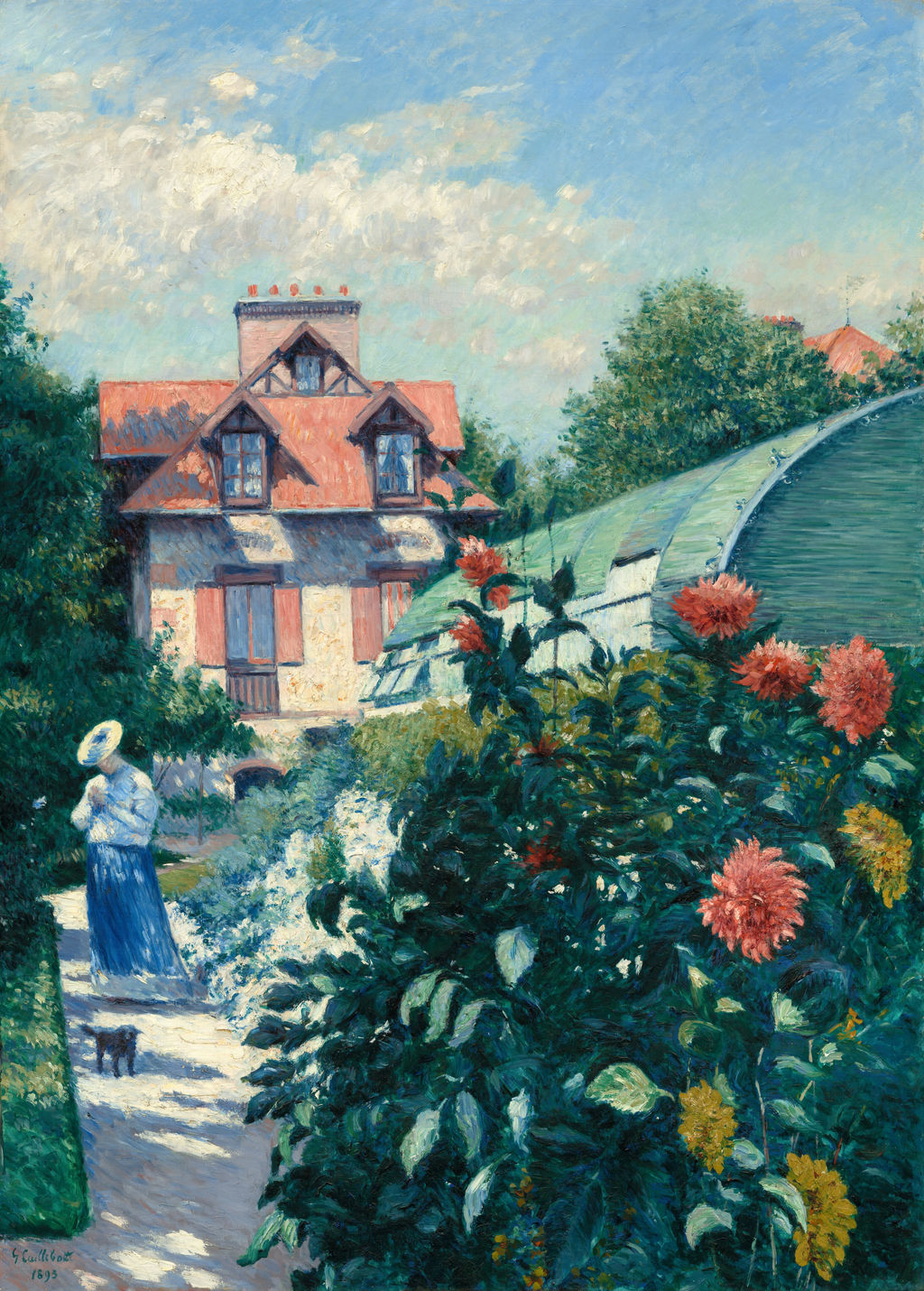
Dahlias at Petit Gennevilliers, 1893; another close view of cultivated garden flowers. Gift of the Scharffenberger Family. Image source. Public domain. Resized only; source appearance preserved.
Watch: Gustave Caillebotte
Explore a museum overview and two discussions of Paris Street; Rainy Day. This shared selection offers wider context for the artist’s work.
"Who Is Gustave Caillebotte?" - HD version
An introduction to Caillebotte from the Kimbell Art Museum.
Watch on YouTubeWhen Flowers Become Decoration
Following Kirk Varnedoe, Becker relates both paintings’ shallow space and dispersed motifs to decorative panels. Her further door or wall hypothesis concerns the Metropolitan canvas; it establishes no particular installation for the Marmottan painting. [2]
The distinction matters because “decorative” can describe something we see before it identifies an object’s intended destination. Here the flowers occupy the entire surface, with no single centre governing all the others. Their recurring heads and contrasting shapes could be enjoyed across a room as a pattern of colour. Closer attention then resolves that pattern into particular petals, stems and leaves. Decoration and observation work together: the surface remains lively at a distance because its repetitions are varied, and it remains interesting nearby because the variations are so specific.
Caillebotte’s documented dining-room project provides a concrete comparison. The Giverny teaching dossier describes painted doors involving orchids, nasturtium panels and a large daisy composition, left unfinished at his death. [4]
The museum’s press dossier explains that the four panels known as Parterre de marguerites preserve the more finished portions of a larger, partly damaged canvas, separated with the agreement of its owners and the Comité Caillebotte. They are surviving sections of an interrupted project, rather than an intact room installation preserved as Caillebotte left it. [5]
The project reveals an ambition to extend garden imagery across an interior, bringing an enveloping field of plants into domestic space. The chrysanthemum picture offers a related visual possibility on a smaller scale. Its edges cut into continuing growth; its scattered blooms animate the whole rectangle. Those qualities remain perceptible even though its intended setting is uncertain.
Three Chrysanthemum Paintings, Three Different Views
Similar titles can obscure the individuality of these canvases. Berhaut’s catalogue places this painting between two related works. Number 487, also called White and Yellow Chrysanthemums, is a narrower canvas recorded as 73 × 54 cm. Its more isolated upper flowers and greater stretches of exposed stems distinguish it from the dense Marmottan composition. Number 489 is the taller Massif de chrysanthèmes, jardin du Petit Gennevilliers, now associated with the Metropolitan Museum. [1]
The Metropolitan painting, titled Chrysanthemums in the Garden at Petit-Gennevilliers, is dated 1893. The museum records its dimensions as 99.4 × 61.6 cm and its acquisition as the gift of John C. Whitehead in 2014. Those measurements and that gift belong to the New York canvas. [6] Its flowers gather into a broad, light-coloured mass across the upper portion, above a long dark area of stems. The Marmottan picture distributes its distinct bright heads further down the surface, repeatedly renewing the eye’s interest instead of concentrating the strongest flowering near the top.
The difference is revealing. Caillebotte could make the same plant yield several spatial experiences: a comparatively open stand of stems, a closely woven bed, or a tall cascade of blossoms and foliage. The subject is consistent; the relationship between empty space, flowers and painted surface changes. Recognising the versions separately allows that experimentation to emerge.
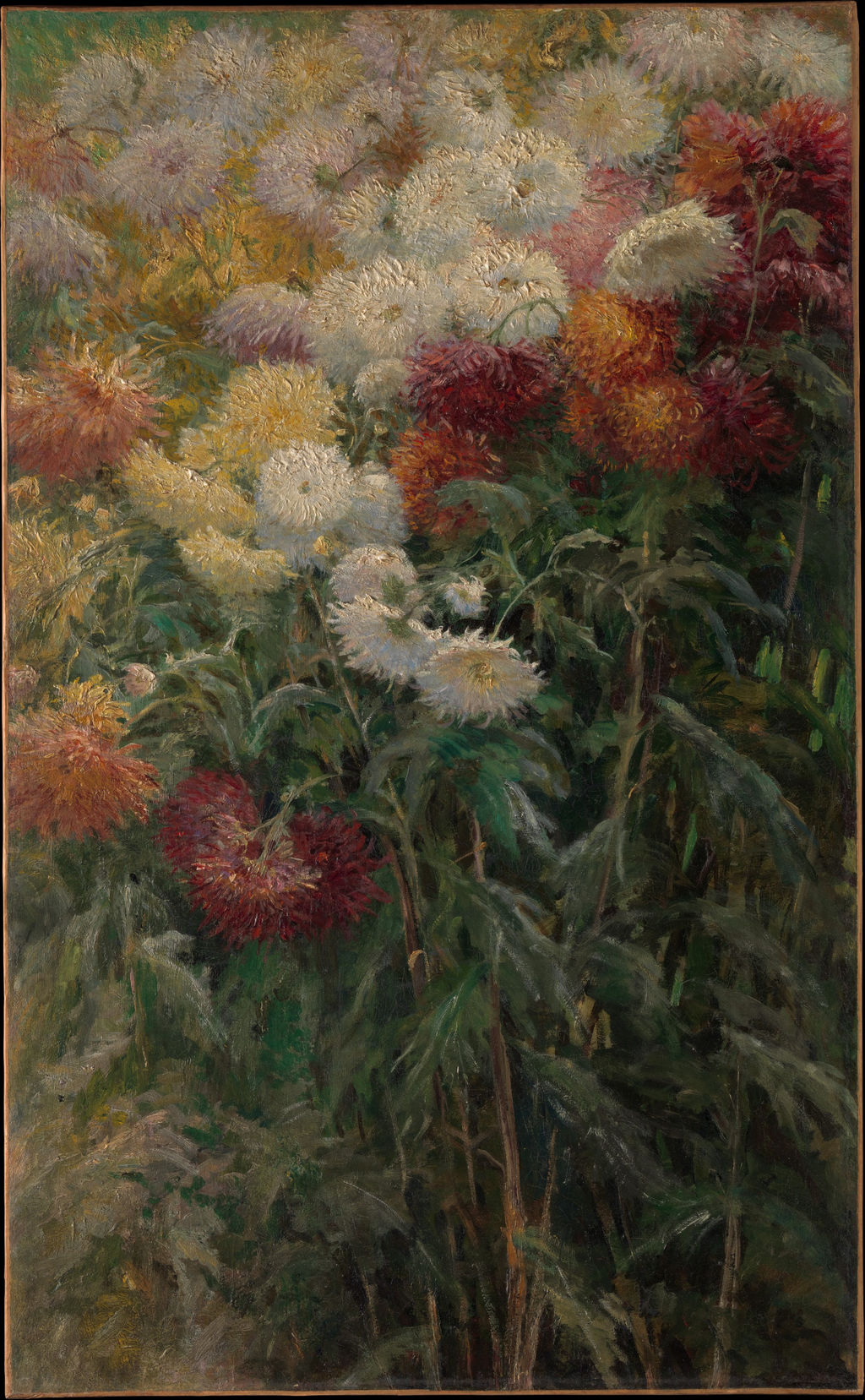
Chrysanthemums in the Garden at Petit-Gennevilliers, 1893; the separate Metropolitan Museum canvas, Berhaut 489. Gift of the Honorable John C. Whitehead, 2014. Image source. CC0 / Public domain. Resized only; source appearance preserved.
Annotated Details from the separate Met chrysanthemum painting
The numbered points identify visible features discussed in this article. Return from each detail to the whole composition. Chrysanthemums in the Garden at Petit-Gennevilliers, 1893; the separate Metropolitan Museum canvas, Berhaut 489. Gift of the Honorable John C. Whitehead, 2014. Image source. CC0 / Public domain. Resized only; source appearance preserved.
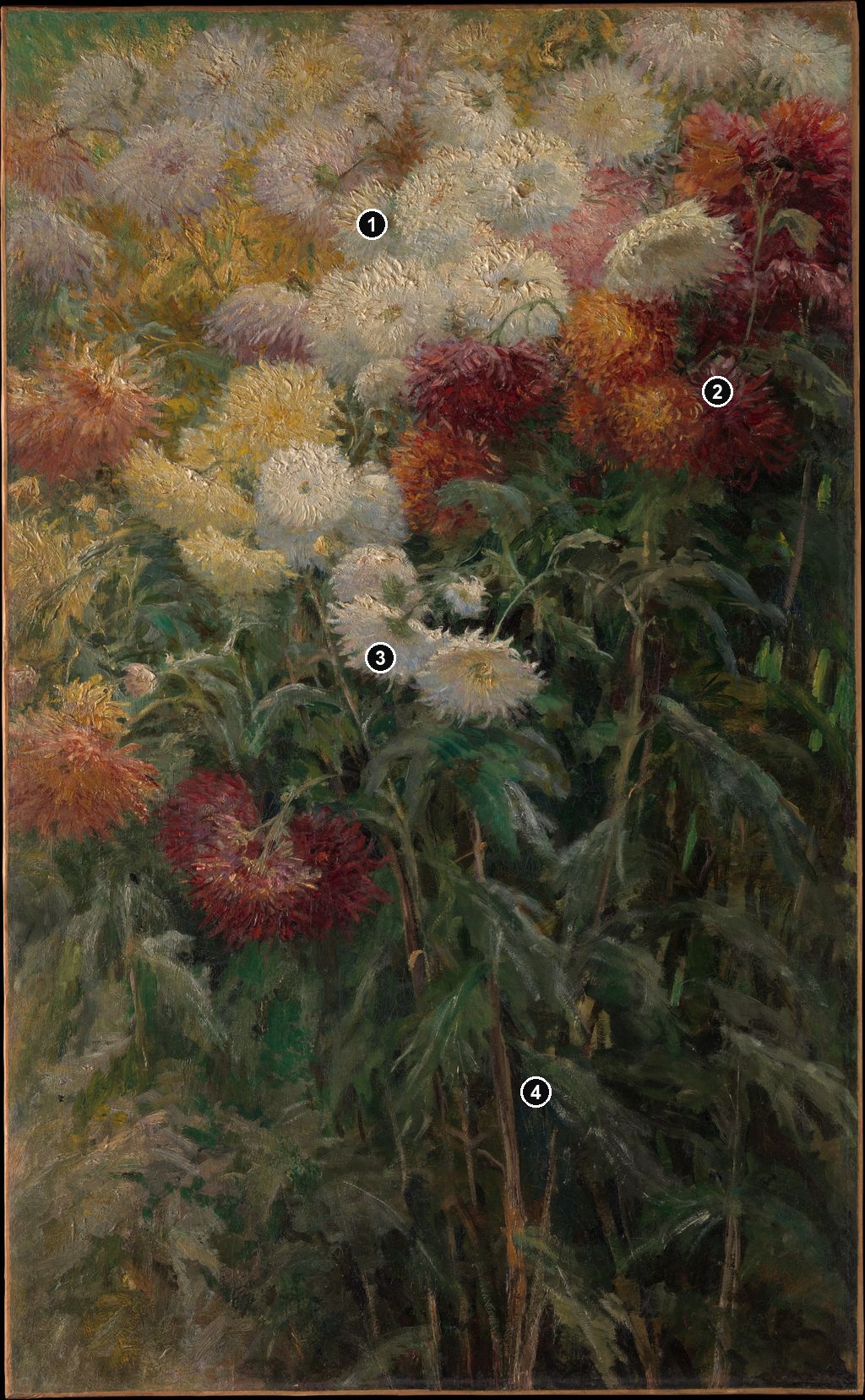
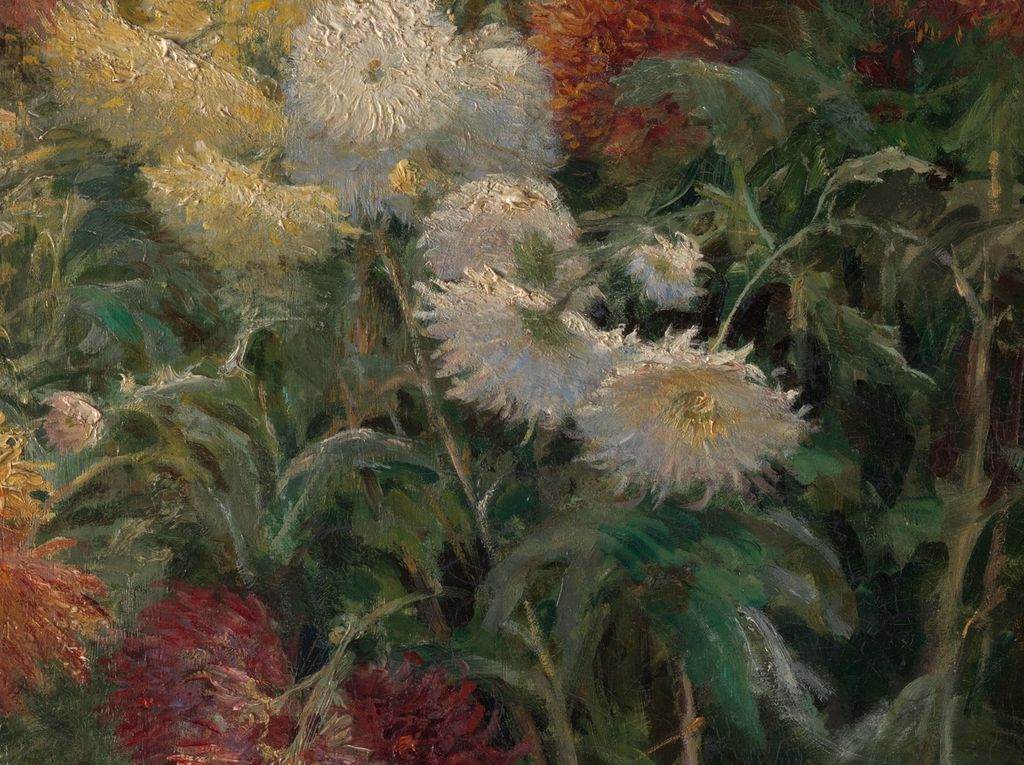
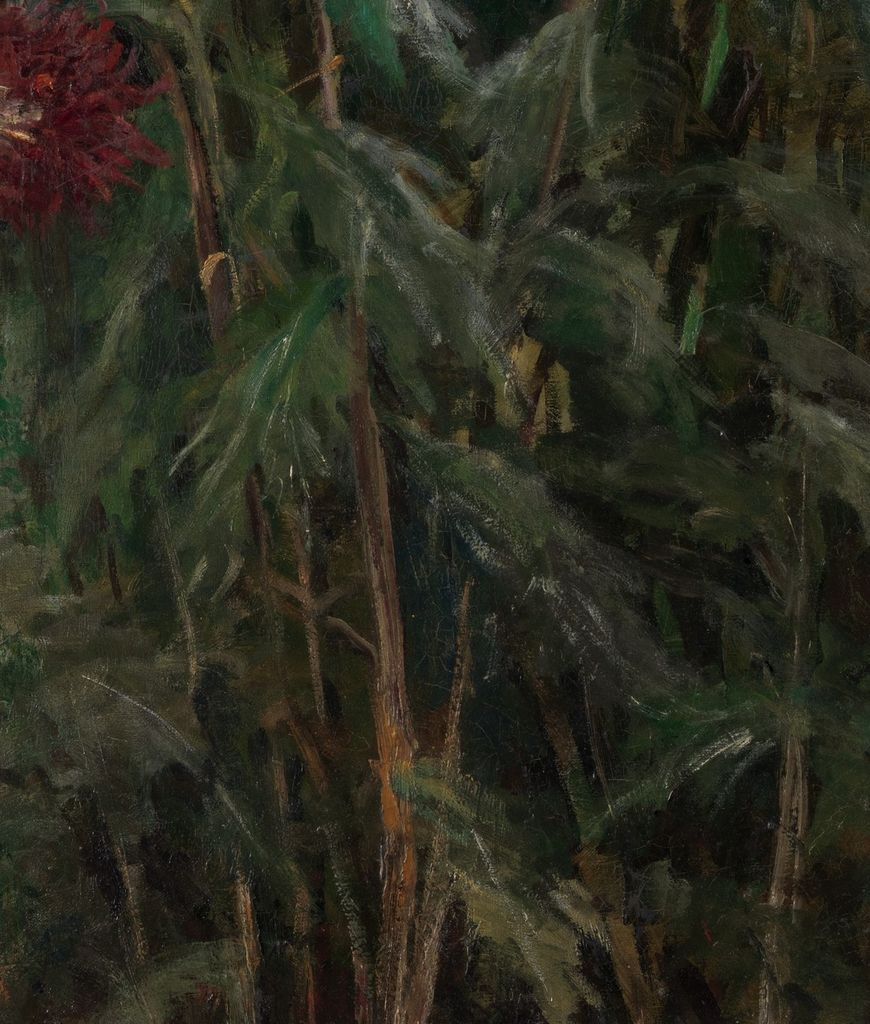
Details from THE SEPARATE MET CHRYSANTHEMUM PAINTING
The Met painting is Berhaut 489, distinct from the dense Marmottan composition, Berhaut 488. These crops show the Met work only.
Pale flower heads near the top
Large pale blooms overlap across the upper part of this tall canvas. Small coloured strokes distinguish their petals without isolating every flower from its neighbours.
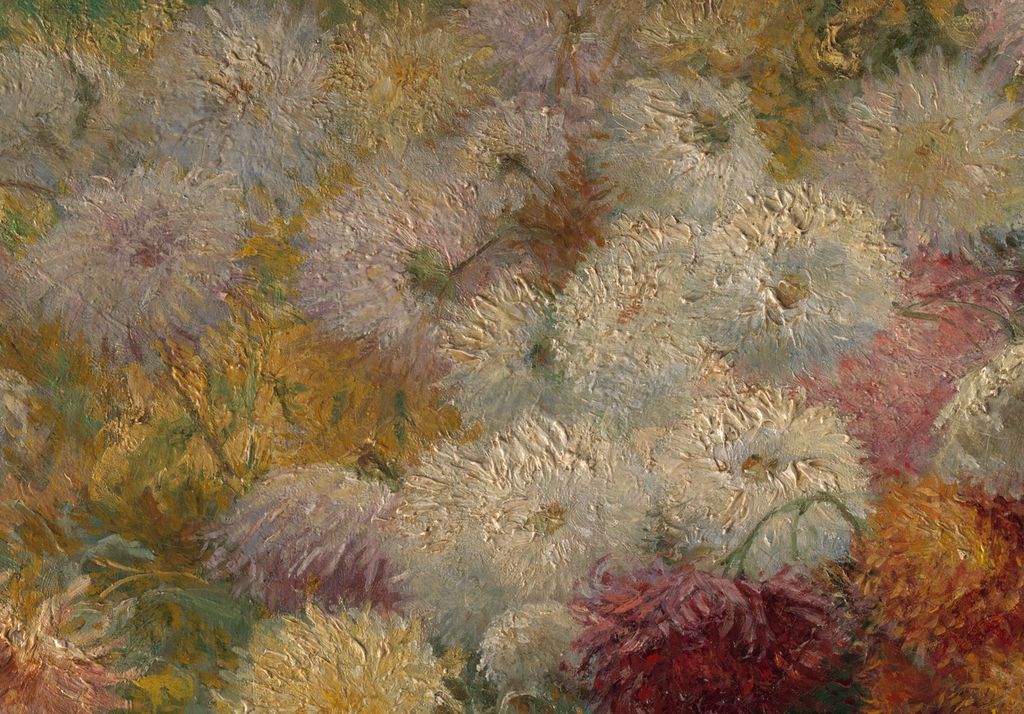
Dark red flowers among the pale heads
Dark red blooms interrupt the paler flowers. Their centres and twisting petals make irregular accents against the surrounding green.
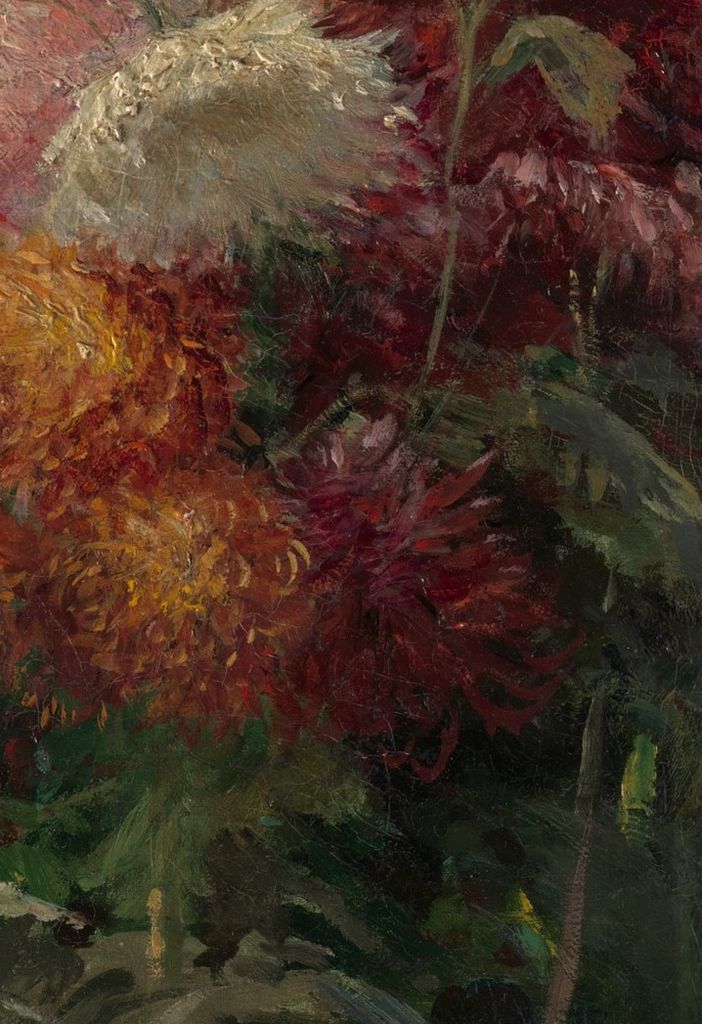
Flowers opening above the stems
Pale heads extend above a darker network of leaves and stalks. Their radiating petals contrast with the more upright forms beneath them.
Stems and leaves in the lower field
Long stems remain visible among the darker leaves. Their thin repeated lines carry the plants down towards the lower edge of the picture.
A Painting Monet Kept
The Marmottan canvas has a particularly suggestive history of ownership. Berhaut records Caillebotte’s gift to Claude Monet, followed by ownership by Monet’s son Michel. Michel’s 1966 bequest to the Académie des beaux-arts brought the painting into the Musée Marmottan. The catalogue also states that it was one of three Caillebotte works Monet retained until his death. [1]
This history gives the painting a personal connection to another painter-gardener, although it supplies no statement of Monet’s reasons for keeping it. His continuing possession makes it an enduring presence in the friendship’s material legacy. In a work so concerned with the immediate appearance of growing things, the passage between two artists who cultivated gardens is a compelling part of its life.
Berhaut’s entry also records its presence in exhibitions in Houston and New York in 1976–77, Paris in 1979, Ferrara in 1992 and Lausanne in 1993. [1] These later appearances placed a once personally held picture before wider audiences. Its interest survives that movement from domestic possession to public exhibition: a visitor can still begin with a single white flower, follow a stem into darkness and find another bloom pulling attention in a new direction. The garden remains close, crowded and resistant to being taken in at a glance.
Catalogue and documented works
This directory brings together 578 entries in the revised 1994 catalogue, 11 further documented records and three groups of study descriptions. It is a directory of records, not a total of authenticated individual works. Albums, print states and surviving decorative panels are grouped. English labels retain the French titles as searchable aliases; dates are supplied only where checked. Numbered entries link to the relevant article or the historical catalogue. Pastels appear under the Drawing filter; original prints remain searchable under All media.
Frequently Asked Questions
It is dated about 1893; Becker’s Metropolitan Museum essay gives 1893. [2]
Berhaut’s catalogue places it at the Musée Marmottan Monet in Paris, recording its arrival through Michel Monet’s 1966 bequest. [1]
No specific door installation is established. Becker’s door or wall hypothesis concerns the related Metropolitan canvas. [2]
Discussion
Look again at the images and ideas explored in White and Yellow Chrysanthemums. These editorial prompts invite your observations.
Reader Insights
The dense flowers leave the eye without a single obvious horizon.
The separate Met composition offers a different balance of flowers and surrounding space.
Where do you first find a path through this mass of white and yellow?
Join the Conversation
Share a detail, comparison or question about White and Yellow Chrysanthemums below.
References
- Marie Berhaut, with Sophie Pietri. Gustave Caillebotte: Catalogue raisonné des peintures et pastels (1994), p. 252, entries 487–489, especially entry 488 and its illustration; historical collection, provenance and exhibition information. Digitised by the Wildenstein Plattner Institute. View source. (in French).
- Jane R. Becker, Metropolitan Museum of Art. “Caillebotte’s Chrysanthemums; or, Unexpected Encounters with Impressionist Interior Design” (2015), Marmottan illustration, decorative-panel discussion and note 2, quoting Varnedoe. View source.
- Marie Berhaut with Sophie Pietri; Wildenstein Plattner Institute, Gustave Caillebotte Catalogue raisonné des peintures et pastels, 1994. View source. (in French).
- Musée des impressionnismes Giverny. Caillebotte, peintre et jardinier: Dossier pédagogique (2016), PDF pp. 3–5, 10–13: places, Petit-Gennevilliers, Les Roses and Parterre de marguerites. View source. (in French).
- Musée des impressionnismes Giverny. Caillebotte, peintre et jardinier: Dossier de presse (February 2016), PDF p. 15, printed p. 29, Parterre de marguerites acquisition proposal and explanation of the four surviving panels. View source. (in French).
- The Metropolitan Museum of Art. “Gustave Caillebotte: Chrysanthemums in the Garden at Petit-Gennevilliers,” collection record, artwork details: date, dimensions, credit and accession 2014.736. View source.
- Art Institute of Chicago, Caillebotte Paintings and Drawings at the Art Institute of Chicago, 2015. View source.
- Petit Palais / Paris Musées, Portrait de Paul Hugot, original print, PPG2319, current. View source. (in French).
- Paul Perrin, Musée d’Orsay, Transcription de l’entretien commissaire Caillebotte, 2024. View source. (in French).
- Cleveland Museum of Art, Caillebotte collection records: 2020.260, 2009.157 and 2020.105, current. View source.
- Splash image, White and Yellow Chrysanthemums, about 1893; Musée Marmottan Monet, Berhaut 488.


