


 by Tom Gurney
Tom Gurney BSc (Hons) is an art history expert with over 20 years experience
Published on June 19, 2020 / Updated on November 3, 2026
Email: tomgurney1@gmail.com / Phone: +44 7429 011000
At the Circus: Behind the Scenes: Introduction
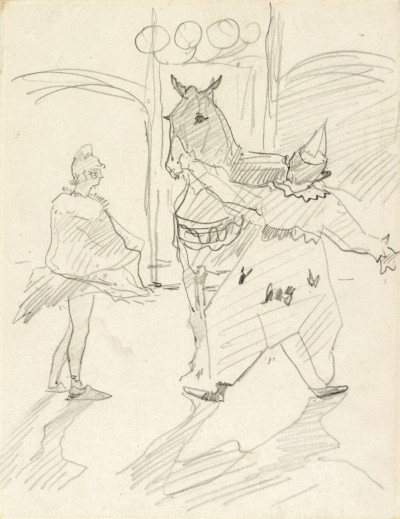
A horse faces us between two costumed performers. One figure reaches across its neck; the other stands to the left, holding out the edge of a short skirt. There is no crowd, no rider balancing on a moving animal, no trick reaching its climax. In At the Circus: Behind the Scenes, Henri de Toulouse-Lautrec makes the interval around a performance absorbing in itself. The small pencil drawing dates to 1888. Its French title is Au cirque: dans les coulisses. [1]
At a Glance
- ArtistHenri de Toulouse-Lautrec.
- Date and medium1888; pencil on paper.
- Dimensions22.5 × 17.4 cm, as recorded by Sotheby’s in 2018.
- Catalogue identityDortu D.3.056, cited in the 2018 auction record.
- SubjectA horse, a clown and a female circus performer beneath loosely indicated backstage architecture.
- Important distinctionThis sheet is separate from the related oil painting In the Wings at the Circus and from the circus drawings of 1899. [1]
This work across Henri de Toulouse-Lautrec’s career
Contents
- A horse at the centre of a human encounter
- How a few pencil marks build the space
- The related painting: a similar group, a different object
- The circus seen from the other side
- A small sheet preserved beyond the studio
A horse at the centre of a human encounter
The horse provides the drawing’s most stable upright. Its ears rise beneath a rectangular opening, its muzzle turns slightly to the left, and its forelegs descend into the open lower part of the sheet. Lautrec sets its head high enough to command attention without making the animal immense. Its body is largely hidden by the clown. We see enough of its neck, chest and harness to understand its position, but cannot inspect it as a complete specimen. The horse holds the centre because of the shapes that surround it as much as through its own outline.
Look at the space between the ears and the two human heads. The performer at the left is shown in profile, facing into the group. The clown, with a pointed hat above a broad ruff, turns towards the horse from the opposite side. These three heads establish a compact triangle. The bodies below spread much farther apart: the woman’s feet stand close together while the clown’s shoes point away from one another in a wide stance. A concentrated exchange at the top opens into a much broader arrangement near the floor. This movement from closeness to expansion gives the small vertical sheet surprising breadth.
The reaching arm makes the relationship tangible. It crosses in front of the horse, passing through the image’s busiest cluster of lines. Harness, hand, muzzle and sleeve meet in a small area, where several contours remain visible together. The action is easy to recognise in general terms, although the pencil does not resolve every overlap. Here the drawing gives us the connection between a person and an animal before supplying a fully explained anatomical arrangement. This is close-looking evidence, rather than proof of the exact action Lautrec witnessed. [1]
Costume distinguishes the people without needing a named identity. The woman’s fitted upper garment, short spreading skirt and exposed lower legs contrast with the clown’s loose outfit. Small dark motifs interrupt the clown’s broad pale back. His pointed cap and jagged collar remain readable even where the surrounding forms are lightly stated. Lautrec devotes relatively little work to faces, yet makes the two performers immediately different in silhouette. The costume carries information that a more elaborate portrait might have placed in facial expression.
The resulting encounter is informal, but its story remains open. The figures could be gathering around the horse before going into the ring, or pausing after an appearance. Nothing visible fixes that sequence. Nor do the woman’s profile and the clown’s turned back establish a definite mood. Their attention is directed into the little group; our own attention follows it. The absence of a resolved anecdote is part of the drawing’s interest. It lets a gesture, a stance and the animal’s steady presence sustain the scene.
How a few pencil marks build the space
Lautrec gives the horse a setting through a mixture of vertical supports, curved outlines and looping marks. Behind its head is something like a doorway or entrance. Broad curves extend from either side of that central opening, while four loosely circular shapes cross the upper part of the sheet. These marks suggest architectural or decorative features without offering a precise inventory. Calling the whole arrangement backstage is consistent with the title; identifying each loop as a particular piece of circus equipment would go beyond what the drawing makes clear. [1]
The contrast between the two sides is particularly effective. At the left, the curving structure surrounds a large area of untouched paper. At the right, repeated diagonal strokes fill the corresponding area behind the clown. One side stays open; the other acquires density. This uneven treatment helps prevent the central entrance from turning into a rigid symmetrical frame. It also means that the darkness behind the clown belongs to the composition, whatever physical surface it might describe.
The pencil changes function as it moves across the sheet. A firmer contour defines the horse’s muzzle; short strokes darken its eye. Closely spaced diagonals shade the side of the head and neck. Other diagonals pass across the clown’s clothing more expansively. Under the figures, the strokes become longer and freer. These are related marks used at different scales: the eye requires a compact dark accent, while a cast shadow can spread into a broad area. This flexibility gives the drawing its economy.
The shadows deserve particular attention. The woman’s legs give way to an irregular dark shape extending towards the lower left. Beneath the clown, another shadow stretches down and across the foreground, wider and more broken. Neither is enclosed and filled with uniform shading. Outlines and parallel strokes suggest their spread, leaving the paper visible between them. They anchor the feet while allowing the lower part of the image to stay loose. Without them, the people might seem suspended against an almost empty background.
Elsewhere, a contour doubles or wanders instead of settling into one clean edge. Around the woman’s skirt, for example, several lines compete to describe the hem and its outward sweep. The horse’s legs are considerably less emphatic than its head. These differences show where the image concentrates its descriptive force. They do not tell us exactly how many minutes Lautrec spent on the sheet, or establish that he intended to discard it. A freely handled drawing can still contain a clear and carefully sustained organisation.
At this scale, the unused paper is especially active. It separates the woman from the central horse, allows the shoes to stand out, and keeps the upper architecture from pressing evenly on every figure. The strongest marks never cover the whole surface. Our eye moves from the dark horse’s eye to the harness, then to the patterned costume and the shoes. Looking across those accents, one can read the composition through a sequence of contacts rather than through a fully modelled interior. This is one reason the drawing rewards being considered on its own, even alongside a more elaborately worked painting. [1]
Watch: Toulouse-Lautrec
Choose an artist introduction, a film about graphic design or a closer look at At the Moulin Rouge.
The related painting: a similar group, a different object
The closest comparison is In the Wings at the Circus, now documented by the Artizon Museum in Tokyo. The museum dates its oil on canvas to about 1887. A horse again stands between an equestrienne and a clown, and the setting has the same broad arrangement of curved openings. The resemblance makes the connection immediately visible. Sotheby’s describes the pencil sheet as a closely related study. [11] [1]
Placing the images together also reveals decisive differences. The painting includes a fourth participant: a man in a dark hat standing at the right edge. The museum identifies him as the ringmaster. In the drawing, the clown’s outward arm extends towards an edge that remains comparatively empty. There is no equivalent fully described observer beside him. The omission changes the scene’s balance. The pencil group has a more open right side, and the clown’s spreading body occupies a larger share of our attention. [11]
The animal changes too. In the painting, its head faces more directly forward, and its body emerges with greater weight behind the clown. The woman’s position is less isolated in the surrounding space. Broad bands of grey join figures, architecture and floor into a dim interior. By comparison, the drawing’s pale paper keeps its shapes distinct and gives the figures more breathing room. These are visible differences in the two images, rather than evidence that one was a mechanical copy of the other.
The Artizon Museum reads the painting’s greys as a way of suggesting the dim backstage setting, and its arrangement as communicating the tension before an appearance. That interpretation gives a helpful account of the oil’s subdued atmosphere. It should not turn the pencil sheet into an oil painting in miniature. A grey passage made with paint and a cluster of pencil strokes can have similar tonal values while remaining very different material decisions. The drawing lets the paper show through; the oil builds an environment with broader painted areas. [11]
The dates also call for care. The Art Institute of Chicago’s 2005 exhibition checklist listed the painting as about 1886–87, oil on canvas, measuring 67 × 60 cm. The pencil sheet’s 1888 date comes from its separate auction record. “Study” usefully describes their relationship, but these records do not establish a simple, precisely dated sequence in which the surviving sheet necessarily preceded the surviving canvas. Their shared composition and visible differences remain the firmest basis for comparison. [12] [1]
The circus seen from the other side
The Chicago painting usually called At the Circus Fernando: The Rider offers another instructive comparison. Dated 1887–88, it depicts the action inside the ring: a female rider on a horse, a ringmaster in the foreground, and spectators following the performance. The Art Institute describes the moment as preparation for the rider to stand and jump through a hoop. Here the circus is organised around a feat and the people who watch it. [13]
The two compositions give the horse entirely different kinds of space. In the Chicago canvas, the ring’s sweeping barrier carries the eye around the animal and rider. The ringmaster’s body blocks part of the foreground while directing attention towards the performance. In Behind the Scenes, the horse’s head occupies a narrow central interval between standing people. The architecture curves overhead, but it does not create an arena around which the animal can run. The focus moves from circulation to contact, from an action offered to an audience to a group gathered at close quarters. [13] [1]
This change of position helps explain what the backstage subject offers an artist. The ring distributes performers, animals, equipment and spectators according to the requirements of an act. At the side of that performance, bodies can overlap in less demonstrative ways. A clown’s back becomes a large shape; a horse’s neck becomes a meeting point; a skirt lifts just enough to alter a silhouette. Looking at the drawing this way brings attention to the physical arrangements that support spectacle, without requiring a hidden symbolic explanation for every gesture.
The 1888 sheet also needs to be distinguished from Lautrec’s much later circus drawings. The Getty Museum’s At the Circus: Entering the Ring dates to 1899 and belongs to the series made during his stay in a clinic. The Getty describes those works as drawing on memories of circus attendance. That setting belongs to the later series; it is not the documented origin of Behind the Scenes. [14]
A visual comparison still has value. In the Getty drawing, the horse and performer move away from us towards the arena and its spectators. In the 1888 sheet, the horse faces out and the people gather around it. Both give importance to a passage between performance spaces, but they use that passage differently. Remembering the eleven-year separation allows us to see a sustained subject in Lautrec’s drawings, while preserving the particular arrangement and character of each work. [14]
A small sheet preserved beyond the studio
The drawing’s documented history begins in Lautrec’s estate and continues through his father and Robert de Toulouse-Lautrec, followed by Dr Tomasini and Galerie Motte. The 2018 record states that the consigning owner acquired it in 1973. It also records its appearance in the 1963 Rennes exhibition Toulouse-Lautrec et son milieu familial. [1]
That history gives a lightly worked sheet a place beyond an imagined instant of sketching. It was retained, inherited, exhibited and catalogued. Its survival allows us to compare how a small drawing and a larger painting handle a related group without reducing either to an illustration of the other. The attraction remains close to what is visible: a horse’s alert head, the clown’s wide stance, the answering profile at the left, and the spare lines that hold their temporary gathering together.
Toulouse-Lautrec artworks directory
Browse 84 identified works and publications in this researched selection. Dates and titles follow the individual records; this is not a complete catalogue of the surviving oeuvre. Print impressions remain attached to their designs. Some listed works do not have a dedicated article. The Drawings guide also contains nine illustrated studies consolidated from former articles.
Frequently Asked Questions
The costumes indicate a clown and a female circus performer. The consulted object record does not establish personal names for the two figures in this pencil drawing. [1]
Sotheby’s cites Dortu, volume V, number 3.056, illustrated on page 497. This identifies the pencil sheet rather than the related painting. [1]
Discussion
Look again at the images and ideas explored in At the Circus: Behind the Scenes. These editorial prompts invite your observations.
Reader Insights
How does the absence of the painting’s observer at the right change your sense of the group?
Which does more to hold the drawing together: the central horse, the reaching arm, or the shadows beneath the figures?
Join the Conversation
Share a detail, comparison or question about At the Circus: Behind the Scenes below.
References
- Sotheby’s, Au cirque: dans les coulisses, Impressionist & Modern Art Day Sale, 2018, lot 341. Object description, image, provenance, exhibition, literature and catalogue note; includes the citation to Dortu, volume V, no. 3.056. View source.
- Autoportrait, 1880 (in French). View source.
- ALBERTINA: Der Schimmel Gazelle,GE123DL. View source. (in German).
- Franka Blok, Portrait of Vincent van Gogh, 2024. View source.
- Art Institute of Chicago: Moulin Rouge, La Goulue. View source.
- Art Institute of Chicago: At the Moulin Rouge. View source.
- Jane Avril, 1893. View source.
- Au Salon de la rue des Moulins (in French). View source.
- Colta Ives, Toulouse-Lautrec in The Metropolitan Museum of Art, 1996. View source.
- Maurice Joyant (in French). View source.
- Artizon Museum, In the Wings at the Circus, about 1887. Collection record, curatorial commentary and image of the separate oil painting. View source.
- Art Institute of Chicago, Toulouse-Lautrec and Montmartre, 2005 exhibition checklist, cat. 261; compare cats. 266 and 268–281. Exhibition checklist. View source.
- Art Institute of Chicago, Equestrienne (At the Cirque Fernando), 1887–88, accession 1925.523. Collection record and curatorial description; see also the museum’s public object data. View source 1. View source 2.
- The J. Paul Getty Museum, At the Circus: Entering the Ring, 1899, Google Arts & Culture collection entry. Getty-authored account, object details and image of the later drawing. View source.
 Henri de Toulouse-Lautrec.jpg)