


 by Tom Gurney
Tom Gurney BSc (Hons) is an art history expert with over 20 years experience
Published on June 19, 2020 / Updated on November 3, 2026
Email: tomgurney1@gmail.com / Phone: +44 7429 011000
Café-Concert à Montmartre by Henri de Toulouse-Lautrec: Introduction
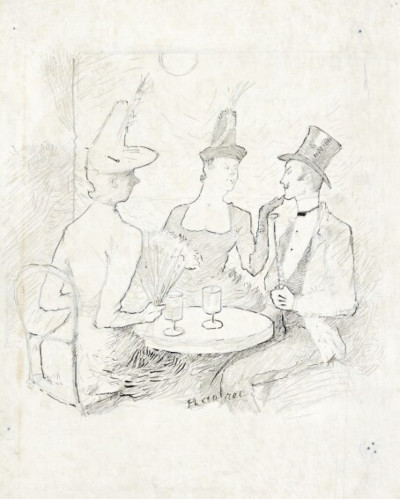
Three people gather around a small round table. Hats rise above their heads, glasses stand between them and a hand reaches towards the chin of the man at the right. Most of the surrounding paper remains pale. In Café-Concert à Montmartre, Henri de Toulouse-Lautrec makes a social encounter legible through a compact arrangement of bodies and a few conspicuous props, allowing the lines themselves to carry much of its energy.
Christie's catalogued the work in 2000 as ink, pencil and coloured crayons on Gilot paper, signed TLautrec near the lower centre and dated 1888. That material description matters: the appearance of a drawn line does not make this sheet a lithograph. The catalogue identifies a mixed drawing on a particular paper support, with its own relationship to Lautrec's other café compositions. [1]
At a Glance
- ArtistHenri de Toulouse-Lautrec.
- TitleCafé-Concert à Montmartre.
- Date1888, as catalogued by Christie's.
- Materialsink, pencil and coloured crayons on Gilot paper.
- SignatureTLautrec, lower centre.
- Related drawingstwo works called À Montmartre in Albi, cited in the auction record. [1]
This work across Henri de Toulouse-Lautrec’s career
Café-Concert à Montmartre (current article)
1888 (Christie’s catalogue) [1]At the Moulin Rouge
1892–1895 [6]Jane Avril
1893 [7]Contents
- Three hats establish a small society
- A hand brings the figures together
- The table's underside holds the drawing down
- Ink, pencil, crayon and Gilot paper
- Related compositions and uncertain names
- An encounter carried by a few objects
Three hats establish a small society
The hats provide the quickest route into the group. The woman's broad brim at the left reaches outward, while the central headwear rises more narrowly. At the right, the man's top hat introduces a recognisable upright shape. These differences separate the people even where the lighter lines of their clothing are harder to follow. We can grasp the gathering through three distinct silhouettes before identifying the gestures that connect them.
Their bodies occupy different orientations around the table. The left figure offers more of a back and shoulder; the central figure faces more nearly towards us; the man turns into the group from the right. The arrangement makes the viewer's position feel close to the table without supplying an empty seat in a fully described room. We look across some bodies and towards others, experiencing the same uneven access that the figures have to one another.
The central face is relatively small within the composition. Its visibility depends on the open ground around the head and the dark accents that define its features. The effect differs from an elaborately shaded portrait. A few marks must do enough work to hold the face in place while the broader clothes and table carry the surrounding scene. Lautrec's economy is selective: some passages receive considerable emphasis, while others remain scarcely more than indications.
A hand brings the figures together
The raised hand near the man's chin concentrates the social action. It crosses the gap that would otherwise separate the seated figures and makes the interaction more immediate. A gesture at that point of the body can suggest familiarity or teasing, but the image does not supply a conversation or establish what anyone intended. The visible contact is enough to turn a static grouping into an encounter.
Follow the movement from the man's face down towards his other hand and the narrow upright prop beside him. The repeated verticals of hat, body and cane-like line steady his position at the right. Across the table, slanting arms and the spreading fan introduce a different rhythm. The picture does not treat each person as a self-contained portrait. Their forms become legible through their relations to the objects and gestures between them.
The small table is crucial to those relations. Its curved rim supplies a shared centre without closing the people inside a rigid geometric arrangement. Glasses stand on its surface as delicate vertical accents, reinforcing the tabletop's horizontal plane. Because the setting is so lightly described, these few practical objects carry an unusual amount of information. They establish the kind of gathering more efficiently than a detailed background of furniture would do.
The table's underside holds the drawing down
The darkest hatching gathers below and beside the tabletop. Those diagonal marks give the lower group weight against the pale paper. Above them, the heads and upper bodies remain more lightly drawn. The difference makes the people seem to rise from a firmer base, even though their surroundings are not fully enclosed. A small area of concentrated darkness can organise a much larger field of open space.
At the left, the rounded chair and the figure's clothing produce overlapping curves. Near the centre, the fan breaks into smaller radiating marks. At the right, the man's clothing is described through longer changes of direction. Each part has its own rhythm, but all meet around the same table. The viewer can move between them without needing every boundary to be equally complete or every surface to be filled with tone.
The largely unworked upper area is therefore active rather than empty. It gives the hats room to register and keeps the three heads from merging into the setting. Light lines suggest something of an interior, yet they remain subordinate to the group. Lautrec makes an encounter feel situated while allowing the support to remain visible over much of the sheet. The balance depends on how little background is needed, not on an absence of compositional decisions.
Watch: Toulouse-Lautrec
Choose an artist introduction, a film about graphic design or a closer look at At the Moulin Rouge.
Ink, pencil, crayon and Gilot paper
The auction's list of materials prevents the work from being flattened into a generic black-and-white sketch. Ink, pencil and coloured crayon can contribute different kinds of mark, while the support is specifically named as Gilot paper. A reproduction at this scale may make slight colour differences difficult to distinguish. It is more reliable to retain the full catalogue description than to assign a material to every visible line from its darkness alone. [1]
There is nevertheless a clear contrast between the sharply accented features and the softer, more dispersed passages around them. Some contours close a shape decisively; others trail away or overlap. The variety helps the image hold both a particular encounter and the sense of an observation still open at its edges. The drawn surface does not require the even finish of a fully modelled interior painting in order to feel complete as a composition.
The distinction from lithography is worth preserving because Lautrec's printed work often retains the appearance of lively drawing. A line's spontaneity does not tell us whether we are seeing an original mark or a printed impression. Here, the consulted object record names drawn materials. It does not establish a print edition, identify a printer or supply a publication in which this exact sheet appeared. Those facts should not be imported from other works simply because the style looks graphic.
Related compositions and uncertain names
Christie's relates the work to two Albi drawings titled À Montmartre, citing a pencil drawing as D.2969 and a charcoal drawing as D.2970. These are reported catalogue references, not evidence that the present sheet passed through a securely established sequence from one to the next. They provide useful points of comparison for the three-person arrangement while leaving the precise order of production open. [1]
The same account suggests that the women might be Cha-U-Kao and La Goulue. It presents those identifications as possibilities. Neither should be converted into an unqualified sitter label. The drawing gives us distinctive hats, profiles and gestures, but those features do not independently prove a name. Its social interest remains clear even if the people cannot be securely identified: the essential subject is the arrangement of attention around the table. [1]
This is also why the work should not be absorbed into a general account of Montmartre nightlife. Its achievement is more concentrated. A broad history of venues would not explain the pressure of a hand against a chin, the contrast between three hats or the way the tabletop and fan hold the group together. Those details distinguish this particular sheet from other café scenes by the same artist.
An encounter carried by a few objects
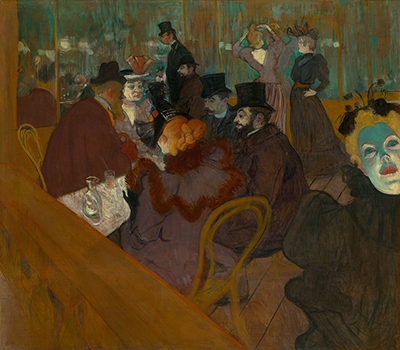
Compare the small round table here with the more expansive room in At the Moulin Rouge. The drawing gathers its attention into a compact group and leaves the surrounding space comparatively open. The painting asks us to negotiate a larger arrangement of people and obstructions. Each makes social space through a different distribution of visible information.
Look again at the fan and glasses. They are small beside the figures, yet they establish distance, posture and a shared centre. Remove them mentally and the three people become a looser cluster. With them, the scene becomes an intelligible gathering at a table. Lautrec's skill lies in making such modest objects do several things at once: describe a setting, organise the surface and bring a fleeting social gesture into focus.
Toulouse-Lautrec artworks directory
Browse 84 identified works and publications in this researched selection. Dates and titles follow the individual records; this is not a complete catalogue of the surviving oeuvre. Print impressions remain attached to their designs. Some listed works do not have a dedicated article. The Drawings guide also contains nine illustrated studies consolidated from former articles.
Discussion
Look again at the images and ideas explored in Café-Concert à Montmartre by Henri de Toulouse-Lautrec. These editorial prompts invite your observations.
Reader Insights
Which of the three hats first draws your attention?
How do the fan and glasses help establish the group’s shared space?
Where does the dark hatching make the lightly drawn figures feel more solid?
Join the Conversation
Share a detail, comparison or question about Café-Concert à Montmartre by Henri de Toulouse-Lautrec below.
References
- Christie's, Café-Concert à Montmartre, 2000, sale 6318, lot 527: description, signature, materials, 1888 dating and catalogue essay. Dimensions are omitted because its imperial and metric measurements disagree. The essay's inconsistent chronology and publication claims are not adopted. Its sitter identifications remain possibilities; the original Dortu entries were not directly consulted. View source.
- Autoportrait, 1880 (in French). View source.
- ALBERTINA: Der Schimmel Gazelle,GE123DL. View source.
- Franka Blok, Portrait of Vincent van Gogh, 2024. View source.
- Art Institute of Chicago: Moulin Rouge, La Goulue. View source.
- Art Institute of Chicago: At the Moulin Rouge. View source.
- Jane Avril, 1893. View source.
- Au Salon de la rue des Moulins (in French). View source.
- Colta Ives, Toulouse-Lautrec in The Metropolitan Museum of Art, 1996. View source.
- Maurice Joyant (in French). View source.
 Henri de Toulouse-Lautrec.jpg)