


 by Tom Gurney
Tom Gurney BSc (Hons) is an art history expert with over 20 years experience
Published on June 19, 2020 / Updated on November 3, 2026
Email: tomgurney1@gmail.com / Phone: +44 7429 011000
The Clowness Cha-U-Kao at the Moulin Rouge: Introduction
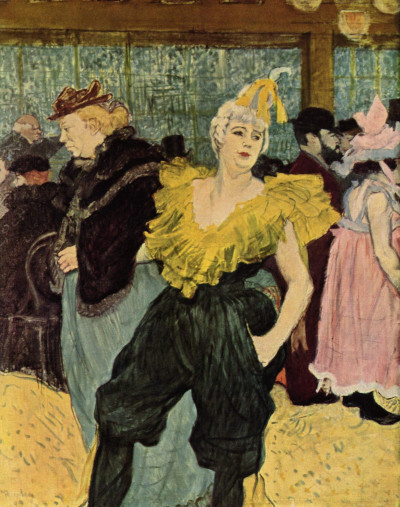
A yellow ruff opens around Cha-U-Kao like a fan. Beneath it, loose dark trousers spread into an uneven stance; above it, a white wig rises towards the lamps. She occupies the foreground of a crowded room, yet her pale face and open chest remain conspicuously clear. Around her, other people turn away, look sideways or disappear beyond the edges.
Henri de Toulouse-Lautrec painted this standing portrait in 1895. The oil on canvas belongs to the Oskar Reinhart Collection “Am Römerholz” in Winterthur. Its composition also appears in a separate colour lithograph of 1897, which changes the palette and the character of the surface. Comparing them reveals how much Lautrec could transform an image while retaining its central figure and surrounding company. [1] [2]
At a Glance
- ArtistHenri de Toulouse-Lautrec
- PaintingThe Clowness Cha-U-Kao at the Moulin Rouge, also catalogued as The Clown Cha-U-Kao
- Date and medium1895; oil on canvas
- Dimensions75 × 55 cm
- CollectionOskar Reinhart Collection “Am Römerholz”, Winterthur
- Inventory numberSOR1922.12
- AcquisitionAcquired by Oskar Reinhart in 1922
- Related printThe Clowness at the Moulin Rouge, 1897; colour lithograph, Wittrock 178, Delteil 205
The painting's details follow the Swiss Federal Office of Culture's collection record. The print is a separate work: MoMA's impression is object 156.1946. [1] [2] [3]
This work across Henri de Toulouse-Lautrec’s career
Contents
- A Performer Amid the Crowd
- Gabrielle, Jane Avril and the Edges of the Room
- Paint Makes the Room Restless
- The Composition Remade as a Lithograph
- Other Ways of Seeing Cha-U-Kao
- From Paris to the Reinhart Collection
A Performer Amid the Crowd
Cha-U-Kao belonged to both the Moulin Rouge and the Nouveau Cirque. Wolfgang Wittrock's catalogue identifies her as a clown and acrobat; the Musée d'Orsay also describes her work as a dancer. Her stage name has been connected with chahut, an acrobatic dance associated with the cancan, and chaos. Orsay explains its apparently Japanese sound through a phonetic transformation of those French words. The name belongs to a constructed public identity. [3] [13]
The Courtauld notes that her real name and life dates remain unknown. The repeated images preserve a distinctive performer more securely than they preserve a complete personal history. [14]
The costume gives that identity an exceptionally clear shape. The yellow ruff is far wider than the head, projecting over both shoulders and descending in irregular folds across the chest. A matching ribbon ties the high white hair or wig. Below the waist, the dark knickerbockers widen and gather above the close-fitting stockings. Light and dark alternate through the body: white hair, pale face, yellow ruff, black waistband, ample trousers and narrow lower legs.
The upper and lower halves pull in different directions. The ruff expands almost horizontally, while the legs divide into unequal diagonals. Her torso leans slightly, and the bare arm on the right of the image curves down towards a hand tucked against the trousers. This is a pose with room in it: the elbow, waist and separated legs make openings and changes of direction. The central figure does not depend on a spectacular leap to hold the room.
The Swiss collection describes the stance as relaxed and self-confident. That is a useful account of its visual effect: Cha-U-Kao appears at ease within the space her costume occupies. It remains an interpretation of a represented pose, however, rather than a statement from the performer about her feelings. The painting makes her conspicuous through bodily arrangement and colour, whether or not we can recover the circumstances of the sitting. [1]
Her gaze also resists a simple frontal encounter. The face is presented almost towards us, but the eyes glance sideways. The red mouth supplies a small, sharp accent beneath much finer marks around the nose and brows. Compared with the enormous yellow collar, these features occupy very little area. They nevertheless individualise a figure who could otherwise be read primarily as a costume.
Gabrielle, Jane Avril and the Edges of the Room
Cha-U-Kao's companion on the left of the painting faces in another direction. She wears a dark wrap over a pale blue-green skirt and a reddish hat above light hair. Their arms meet within the closely overlapped figures. The Swiss collection identifies this woman as the dancer Gabrielle and calls her Cha-U-Kao's friend; the Courtauld's exhibition interpretation describes Gabrielle as her partner. Those institutional identifications supply information beyond what proximity alone could tell us. [1] [14]
The two women establish different rhythms. Gabrielle's long skirt supplies a relatively continuous downward movement, partly hidden by Cha-U-Kao's projecting leg. Her wrap makes a dark block behind the yellow ruff. Cha-U-Kao turns out towards the spectator while Gabrielle looks left. Their association is made visible without arranging both faces into a conventional double portrait.
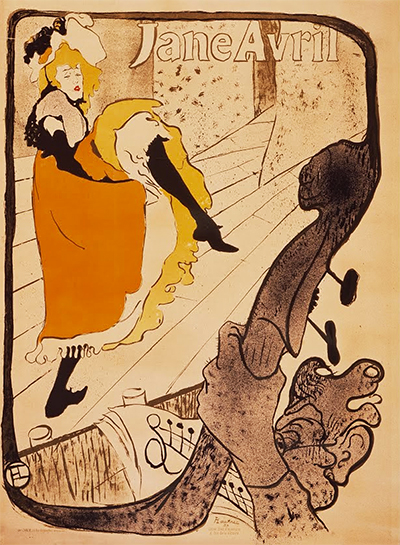
At the far left, a seated red-haired woman is partly concealed among hats and a curved chair back. The Courtauld identifies her as Jane Avril. She occupies only a fragment of the room, unlike the commanding presence Lautrec gives her in the advertisement for her performances. Here she helps populate the social setting around another entertainer. The museum's identification gives specificity to an otherwise obscured sitter; red hair alone would leave her name uncertain. [14]
On the opposite side, a bearded man in a dark hat appears behind Cha-U-Kao's shoulder. Farther right, a woman in a pale blouse and pink skirt turns away beneath an elaborate light-coloured hat. The picture cuts through her body at the outer edge. These incomplete figures make the room seem to continue beyond the canvas, while their turned profiles prevent the gathering from becoming a row of portraits offered equally to the viewer.
The background grid reinforces that effect. Narrow uprights and crossbars divide a blue-green field behind the heads; an ochre band runs across the top and descends near the right. Lamps are cut by the upper boundary. The architectural lines promise order, but bodies and hats repeatedly interrupt it. The eye moves between the stable grid and the irregular outlines in front of it.
Notice how little unobstructed floor remains. A pale yellow area opens towards the lower corners, marked with small strokes, while the central legs continue beyond the bottom. The crop brings us close enough to register costume and expression but withholds a complete view of the figure's footing. We encounter Cha-U-Kao within a flow of people, rather than on an isolated stage with a fully described arena around her.
Paint Makes the Room Restless
The painting's oil-on-canvas medium matters to its effect. The Swiss record identifies the materials; the reproduction shows a surface built from strokes that remain conspicuous within the clothes, wall and floor. Long greenish marks run through the dark trousers. Shorter yellow and ochre touches break across the ruff, while vertical blue-green strokes animate the background. The image holds together through outlines without reducing every enclosed area to an even patch of colour. [1]
Gabrielle's wrap demonstrates the distinction especially well. It reads at once as dark clothing, yet brown, red and lighter accents travel across its folds and border. Her skirt changes direction beneath it through long, pale strokes. In Cha-U-Kao's costume, the black waistband provides a narrow interval of concentration between the widely spread ruff and the mobile trouser folds. One dark passage binds together two much more active ones.
The pale face is quieter. Its limited internal marks become easier to see because the adjoining hair, cloth and wall are so busy. That distribution of activity gives the portrait a centre without clearing the surrounding room. Instead, the room's restless surface makes the calm openness of face and chest more striking.
Such handling can suggest speed, but the appearance of a stroke cannot establish the time taken to make the canvas. Nor does a visible dark line supply a solvent recipe or a pigment identification. The useful question here is what the marks achieve: they distinguish textures and bodies, sustain movement across the surface and leave the central likeness readable. Lautrec's broader style and technique emerge through these differences between individual passages.
Watch: Toulouse-Lautrec
Choose an artist introduction, a film about graphic design or a closer look at At the Moulin Rouge.
The Composition Remade as a Lithograph
In 1897 Lautrec returned to this standing group in The Clowness at the Moulin Rouge. Wittrock catalogues the published colour lithograph as number 178, with Delteil number 205. MoMA's current record names Éditions Pellet as publisher, Edward Ancourt as printer and an edition of twenty for its impression. These are printing and publishing particulars of the lithograph, separate from the history of the 1895 canvas. [2] [3]
Placing the identified images together makes the changes clear. In MoMA's sheet, Gabrielle's formerly dark wrap becomes a broad reddish-brown area crossed by dark lines and pale blue trimming. The woman at the right wears a blue skirt instead of the painting's pink. Cha-U-Kao's trousers become a stronger black mass, and the upper architectural band becomes an emphatic yellow field. The configuration survives while the distribution of colour is reconsidered.
Texture changes as well. The painting's wall contains long, overlapping strokes. The print spreads fine blue dots across its rectangular divisions. The pale foreground is also granular, with the paper showing through dispersed marks. Against these open areas, the trousers have much greater density. Their weight makes the large light chest and yellow ruff seem even more exposed.
The Art Institute's 2005 exhibition checklist describes its own impression, accession 1949.938, as printed from six stones in black, yellow, gold, blue, red and grey-brown on ivory wove paper. Its technical description helps explain why the printed image has to be considered as a coordinated set of coloured components. Those ink names and that paper belong to the Chicago sheet; they should not be assumed to describe the physical materials of every impression reproduced elsewhere. [15]
Phillip Dennis Cate describes Lautrec's general practice of preparing lithographic images and correcting or approving proofs before a printer produced the edition. This collaboration provides a practical setting for the apparent freedom of the finished marks. In the standing Clowness, the grainy background and concentrated black clothing are printed effects. Their resemblance to freely applied drawing does not turn the sheet into another oil painting. [16]
Small marks near the edges also help distinguish the printed object. MoMA's reproduction shows a circular monogram at the lower left and a separate signature inscription at the lower right. The Swiss collection's painting reproduction instead shows its signature and date together near the lower left. Such details deserve attention alongside the more obvious colour changes: recognising the pose alone does not establish which material version is before us. [2] [1]
The limited edition gave the print another form of circulation. Cate compares its twenty impressions with much larger editions of contemporary colour lithographs by Alexandre Lunois, using 1897 price listings to examine their relative markets. His evidence explains the small published issue without telling us exactly how many Clowness impressions were sold or what Cha-U-Kao thought of them. The portrait entered a publisher's business as well as retaining a performer's public likeness. [16]
Other Ways of Seeing Cha-U-Kao
Two other works clarify the particular encounter offered by the standing painting. Orsay's Clownesse Cha-U-Kao, also dated 1895, is oil on cardboard, 58 × 43 centimetres, inventory RF 2027. Here she turns her back while adjusting the yellow collar. The museum describes the setting as a dressing room or private room and leaves an important detail unresolved: the small male image above the table may be a portrait or a mirror reflection. [13]
The collar joins the two paintings, but its role changes. In the Orsay portrait, it surrounds a turned torso and becomes part of an act of dressing. In the standing canvas, it frames the open front of the body and projects into a crowded public setting. Yellow identifies the same stage costume while giving two very different arrangements their centre.
The Seated Clowness belongs to 1896 and is plate one of Elles. Chicago identifies it as a colour lithograph published by Gustave Pellet and probably printed by Auguste Clot. Its ruff again flares above dark clothing, but the body spreads across a red seat, with elbows supported on the legs. The upright social presence of the standing painting becomes a more compact seated arrangement. [17]
These differences give us several representations of a working performer, each with its own setting and pictorial problem. Dressing, sitting and standing are not sufficient evidence for a sequence of personal decline. Nor does inclusion in Elles establish an occupation or address shared with its other subjects. The works preserve the recurrence of a costume and a recognisable person while withholding much of her biography.
From Paris to the Reinhart Collection
The standing painting's ownership history also distinguishes it from the lithograph. The Swiss record lists Bernheim-Jeune in Paris, the former King Milan of Serbia in 1896, Madame Bernheim-Jeune and the dealership again before its acquisition in 1922. It records Oskar Reinhart's gift to the Swiss Confederation under the paired dates 1958/1965. The sequence documents movement between dealers and collectors; it does not supply a reason for every transfer. [1]
That history has brought the crowded Moulin Rouge scene into the collection at Winterthur. There, its identity is anchored by an individual canvas and inventory number. The related MoMA sheet has another collection history, credited to Abby Aldrich Rockefeller. Following both objects allows a close comparison of what Lautrec retained and altered: the painted room's flickering strokes, the print's dispersed dots, and the enduring prominence of a yellow ruff above dark trousers. [1] [2]
Toulouse-Lautrec artworks directory
Browse 84 identified works and publications in this researched selection. Dates and titles follow the individual records; this is not a complete catalogue of the surviving oeuvre. Print impressions remain attached to their designs. Some listed works do not have a dedicated article. The Drawings guide also contains nine illustrated studies consolidated from former articles.
Frequently Asked Questions
It belongs to the Oskar Reinhart Collection “Am Römerholz” in Winterthur, Switzerland, inventory SOR1922.12. Its recorded dimensions are 75 × 55 centimetres. [1]
Discussion
Look again at the images and ideas explored in The Clowness Cha-U-Kao at the Moulin Rouge. These editorial prompts invite your observations.
Reader Insights
How does changing Gabrielle's wrap from dark paint to reddish printed colour alter the prominence of Cha-U-Kao's yellow ruff?
What changes when you follow the background's long painted strokes in one version and its fine blue dots in the other?
Join the Conversation
Share a detail, comparison or question about The Clowness Cha-U-Kao at the Moulin Rouge below.
References
- Swiss Federal Office of Culture, Die Clownesse Cha-U-Kao, 1895, SOR1922.12, Oskar Reinhart Collection “Am Römerholz”, complete collection entry: oil on canvas, dimensions, Gabrielle identification, interpretation and provenance (in German). View source.
- Museum of Modern Art, The Clowness at the Moulin Rouge (La Clownesse au Moulin Rouge), 1897, 156.1946, current object record and reproduction: publisher, printer, edition, Rockefeller gift and visible printed marks. View source.
- Wolfgang Wittrock, “Catalogue of the Exhibition,” in Henri de Toulouse-Lautrec: Images of the 1890s, Museum of Modern Art, 1985, p. 186, cat. 170, facing reproduction p. 187: published lithograph, Wittrock 178, Delteil 205 and performer's venues; p. 172, cat. 143, separate seated print. View source.
- Autoportrait, 1880 (in French). View source.
- ALBERTINA: Der Schimmel Gazelle,GE123DL. View source. (in German).
- Franka Blok, Portrait of Vincent van Gogh, 2024. View source.
- Art Institute of Chicago: Moulin Rouge, La Goulue. View source.
- Art Institute of Chicago: At the Moulin Rouge. View source.
- Jane Avril, 1893. View source.
- Au Salon de la rue des Moulins (in French). View source.
- Colta Ives, Toulouse-Lautrec in The Metropolitan Museum of Art, 1996. View source.
- Maurice Joyant (in French). View source.
- Musée d'Orsay, Clownesse Cha-U-Kao, 1895, RF 2027, current collection entry and interpretation: oil on cardboard, 58 × 43 cm, stage name, costume adjustment and unresolved portrait-or-mirror detail (in French). View source.
- The Courtauld, The Clowness Cha-U-Kao, Oskar Reinhart exhibition interpretation: 1895 painting, acquisition in 1922, Gabrielle and Jane Avril identifications, limits of the performer's recorded biography. View source.
- Art Institute of Chicago, Toulouse-Lautrec and Montmartre, exhibition checklist, 2005, cat. 149, accession 1949.938: six-stone colour lithograph, inks and ivory wove paper; cat. 259c, separate seated Elles plate. View source.
- Phillip Dennis Cate, “The Popularization of Lautrec,” in Henri de Toulouse-Lautrec: Images of the 1890s, Museum of Modern Art, 1985, pp. 81–82, artist, proofs and printer; pp. 88–89, 1897 colour-lithograph prices and edition sizes; p. 92, note 21, letter concerning other deposited prints. View source.
- Art Institute of Chicago, Seated Female Clown (Mademoiselle Cha-U-Kao), plate one from Elles, 1896, 1927.970, retained complete institutional API record: colour lithograph, Pellet and probable Clot attribution; composition also examined in Wittrock, 1985, pp. 172–173. View source.
- Splash image, Henri de Toulouse-Lautrec, The Clowness Cha-U-Kao at the Moulin Rouge, 1895. Oil on canvas, 75 ×55cm. Sammlung Oskar Reinhart «Am Römerholz», Winterthur, SOR1922.12. Image source. Public domain. Resized only; native appearance preserved. (in German).
 Henri de Toulouse-Lautrec.jpg)