


 by Tom Gurney
Tom Gurney BSc (Hons) is an art history expert with over 20 years experience
Published on June 19, 2020 / Updated on November 3, 2026
Email: tomgurney1@gmail.com / Phone: +44 7429 011000
A Corner of the Moulin de la Galette by Henri de Toulouse-Lautrec: Introduction
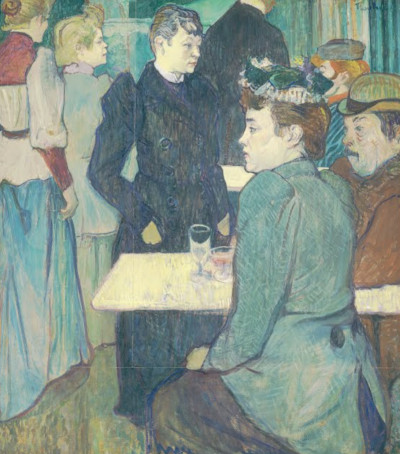
A woman in a blue-green jacket sits at a small yellow table, turning her profile towards the left. Behind her, dark coats, hats and partly concealed faces fill the room. The figures seem very close together, yet their directions of attention do not settle into a single conversation. In A Corner of the Moulin de la Galette, Henri de Toulouse-Lautrec makes a crowded interior through overlapping bodies and the narrow spaces that remain between them.
The National Gallery of Art, Washington, dates the painting to 1892 and records oil on cardboard, 100 × 89.2 centimetres. It entered the museum through Chester Dale's bequest in 1963. This is a different painting from Lautrec's broader 1889 view of the Moulin de la Galette: the corner, table and seated foreground woman identify the particular work considered here. [1]
At a Glance
- ArtistHenri de Toulouse-Lautrec.
- TitleA Corner of the Moulin de la Galette.
- Date1892.
- Mediumoil on cardboard.
- Dimensions100 × 89.2 cm.
- CollectionNational Gallery of Art, Chester Dale Collection, 1963.10.67. [1]
This work across Henri de Toulouse-Lautrec’s career
Contents
- The foreground woman sets our position
- A yellow table in a cool room
- Standing figures compress the middle distance
- Profile, back and diverted attention
- Colour and outline work together
- Exhibition and collecting history
The foreground woman sets our position
The seated woman at the right occupies a substantial part of the picture's height. Her head is turned left, while her body presents a broader view of the jacket and skirt. This combination gives us access to her profile without opening the whole figure towards us. She belongs to the room and the table rather than performing a direct encounter with the viewer.
Her jacket makes a long blue-green shape extending down towards the lower right. Darker strokes along its edges separate the clothing from nearby bodies and furniture. Below, the skirt introduces warmer colour and a different rhythm of folds. The figure holds together through those contrasts, but the brushwork remains visible throughout. We can recognise a clothed body without the surface becoming smoothly descriptive.
The proximity of the woman also creates an obstruction. Her shoulder and head conceal portions of the people behind her; the lower body interrupts the space beneath the table. We do not look freely into a room laid out for inspection. Our view is made through the presence of someone already occupying it. That restriction is central to the picture's sense of a particular corner, seen from a position close to its inhabitants.
A yellow table in a cool room
The tabletop provides one of the clearest areas of light. Its warm yellow shape projects leftward from the foreground woman and carries two small glasses. In a composition dominated by cooler clothing and dark coats, that compact horizontal surface becomes a point of orientation. It explains why the two nearest seated people belong to the same immediate area even though their bodies are only partly visible together.
Notice how little of the table's supporting structure is needed. The bright top establishes its plane, while darker passages below allow it to stand apart from the clothing. The glasses reinforce that reading through their narrow upright forms. Such small practical details keep the setting legible without requiring an elaborately painted still life. Their scale also makes the foreground woman's body seem especially substantial beside them.
The table's position contributes to the crowded effect. It occupies space into which the standing figures might otherwise move, so the people appear to negotiate around both bodies and furniture. Yet it does not form a strong barrier across the whole painting. Its short projection opens into a sequence of overlaps rather than dividing the image neatly into front and back. The room feels congested because its boundaries are partial and repeatedly interrupted.
Standing figures compress the middle distance
Near the centre, a woman in a long dark coat supplies a strong vertical form. Her head rises close to the top of the picture, and her body appears to stand beyond the nearer table. Dark clothing gives her a visual weight that competes with the brighter foreground woman. The resulting balance is uneven and lively: one figure sits close to us, another rises behind, and neither entirely dominates the room.
At the left, two more standing women are seen largely from behind or in partial profile. The nearer light jacket separates clearly from the darker central coat. Their arrangement gives the painting a route into depth, but it is a narrow, bodily route rather than an open corridor. One person stands behind another, and a turned head provides a brief glimpse across the surrounding backs.
Farther right and towards the rear, hats and portions of faces emerge between the larger bodies. The small red-haired head is particularly noticeable among the cooler passages. These fragments make the crowd convincing without requiring each figure to receive equal space. Lautrec varies the amount of a person that we can see, using concealment as an active part of the composition rather than as a problem to be eliminated.
Watch: Toulouse-Lautrec
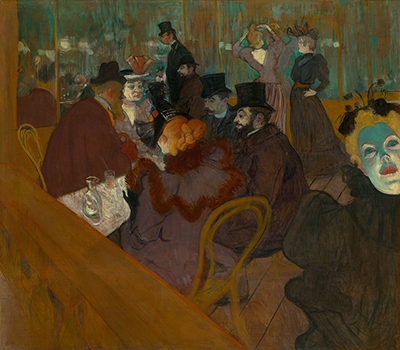
Choose an artist introduction, a film about graphic design or a closer look at At the Moulin Rouge.
Profile, back and diverted attention
A crowded painting need not describe a shared event. Here, the visible heads turn in several directions. The seated woman's profile leads us left, while the central standing figure looks across the image differently. Other people present backs or faces that are partly blocked. The scene does not resolve into a single action that everyone is watching.
This makes the painting interesting to look at slowly. At first, the close bodies suggest a gathering that might be understood as one group. As we trace the heads, that apparent unity becomes less secure. Some figures may be aware of one another, but the picture withholds the information needed to reconstruct all their relations. It gives us a social interior while preserving the incompleteness of a view from within it.
That incompleteness should not be converted into a diagnosis of either the sitters or the artist. A turned face does not prove loneliness; an obstructed body does not establish alienation as a personal condition. The formal arrangement is already specific and powerful. It places people close together while giving the viewer limited access to their interactions, allowing physical proximity and uncertain attention to coexist.
Colour and outline work together
The cooler colours carry across several parts of the painting: the foreground jacket, standing skirts and portions of the room. Their recurrence connects figures who remain separated by dark contours. Colour can therefore unify the surface without making the people indistinguishable. The eye recognises related tones across the scene while still following particular shoulders, profiles and changes of pose.
Outline supplies a complementary kind of definition. Around a face or hat, a dark edge can make a small change of direction immediately legible. Along clothing, lines become longer and less even. Some are reinforced, others fade into the neighbouring colour. The variation keeps the painting from looking like a row of filled-in silhouettes. Drawing remains visible within the painted surface, continually adjusting the boundaries between people and surroundings.
The cardboard support is part of the museum's material identification, but the image should not be treated as a casual study simply because it is painted on board. Its substantial size and carefully sustained arrangement reward attention in their own right. The selective finish makes the scene immediate without making it compositionally simple. A glance registers the table and nearest woman; longer looking reveals how many interruptions are required to construct the space around them.
Exhibition and collecting history
The museum records the work's appearance at the 1893 Salon des Indépendants. That documented exhibition provides an early public setting for the painting, close to its recorded date. It is evidence of the work's presentation, rather than a reason to assume that everyone who saw it understood the crowd in the same way. [1]
The NGA's ownership history traces the painting from François Depeaux through the 1906 sale and Otto Gerstenberg, then his daughter Margarethe Scharf. Carstairs Gallery sold it to Chester Dale in 1950; his bequest brought it to Washington. The museum explicitly corrects an older catalogue's omission of Gerstenberg. This is a useful example of why a current collection record can refine an artwork's history without altering the image we see. [1]
The title offers a final guide to looking. Unlike the more expansive Moulin de la Galette, this painting does not ask us to survey the dance hall as a whole. It asks what can be seen from one restricted part of it. Return to the small yellow table and follow the bodies that surround it. The room emerges through those partial relationships: a corner made vivid by the limits of our view.
Toulouse-Lautrec artworks directory
Browse 84 identified works and publications in this researched selection. Dates and titles follow the individual records; this is not a complete catalogue of the surviving oeuvre. Print impressions remain attached to their designs. Some listed works do not have a dedicated article. The Drawings guide also contains nine illustrated studies consolidated from former articles.
Discussion
Look again at the images and ideas explored in A Corner of the Moulin de la Galette by Henri de Toulouse-Lautrec. These editorial prompts invite your observations.
Reader Insights
How much of the people behind the foreground woman can you actually see?
What does the small yellow tabletop contribute to the crowded composition?
How do the figures’ different directions of attention change your reading of the gathering?
Join the Conversation
Share a detail, comparison or question about A Corner of the Moulin de la Galette by Henri de Toulouse-Lautrec below.
References
- National Gallery of Art, A Corner of the Moulin de la Galette, 1892, Chester Dale Collection, 1963.10.67: collection record, materials, dimensions, provenance notes and exhibition history. The museum's corrected Gerstenberg provenance is followed; older speculative psychological interpretations are not adopted. View source.
- Autoportrait, 1880 (in French). View source.
- ALBERTINA: Der Schimmel Gazelle,GE123DL. View source.
- Franka Blok, Portrait of Vincent van Gogh, 2024. View source.
- Art Institute of Chicago: Moulin Rouge, La Goulue. View source.
- Art Institute of Chicago: At the Moulin Rouge. View source.
- Jane Avril, 1893. View source.
- Au Salon de la rue des Moulins (in French). View source.
- Colta Ives, Toulouse-Lautrec in The Metropolitan Museum of Art, 1996. View source.
- Maurice Joyant (in French). View source.
 Henri de Toulouse-Lautrec.jpg)