


 by Tom Gurney
Tom Gurney BSc (Hons) is an art history expert with over 20 years experience
Published on June 19, 2020 / Updated on November 3, 2026
Email: tomgurney1@gmail.com / Phone: +44 7429 011000
Femme tirant son bas by Toulouse-Lautrec: Introduction
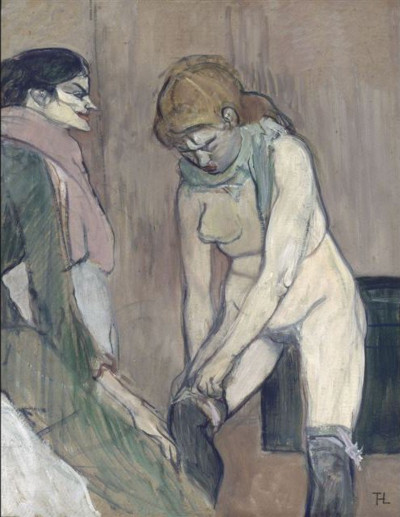
A woman bends her head and reaches down to a dark stocking. At the left, a second woman sits in green clothing, her pale profile turned towards the movement. The stocking gives Henri de Toulouse-Lautrec's painting its title, but the encounter between these two figures gives it much of its complexity. Femme tirant son bas, or Woman Pulling Her Stocking, belongs to the Musée d'Orsay, which dates it to about 1894. [1]
The action occupies a surprisingly small area. Hands, knee and stocking meet below the centre, while the bowed head, long arms and surrounding clothes guide us towards them. Looking carefully means following that movement without losing sight of the woman beside it. [2]
At a Glance
- ArtistHenri de Toulouse-Lautrec
- TitleFemme tirant son bas
- Alternative title in the museum recordFemme de maison
- DateAbout 1894
- MediumOil on cardboard
- Dimensions58 × 46 cm
- CollectionMusée d'Orsay, Paris
- InventoryRF 1943 66
- AcquisitionAndré Berthellemy donation, 1930, with lifetime enjoyment reserved to the donor
The details identify Orsay's two-figure painting. The French national Joconde database independently confirms its date, medium, dimensions and inventory. [1] [3]
This work across Henri de Toulouse-Lautrec’s career
Contents
- Following the hands
- A bowed head and a gathered garment
- The woman at the left
- A narrow room made from vertical strokes
- The separate stocking painting in Albi
- Dressing in paint and print
- From a private collection to Orsay
Following the hands
The red-haired woman occupies most of the right half. Her head bends forward, her shoulders slope at unequal angles, and both arms descend towards the raised knee. Bending the leg brings the stocking within reach of the inclined upper body. [2]
Her hands draw several directions together. One forearm descends steeply while the other follows a longer diagonal; the fingers close around the dark material at the knee. The stocking's opening makes a small, irregular band between pale skin and the darker lower leg. It is the point at which the movement becomes specific. Without it, the descending arms might suggest many actions; here they describe the adjustment of a garment.
The two legs have different jobs. At the right, a nearly upright thigh continues towards a stocking cut by the lower edge. Its vertical direction steadies the figure. The bent leg projects towards the left, creating an angled interval beneath the torso. One leg supplies the body's main descending line; the other brings the practical task into the space between the women.
Lautrec gives the hands enough definition to establish contact without describing every joint equally. The more emphatic contours identify wrist, fingers and stocking top, while adjacent marks remain loose. The detail is readable because its setting is organised. The pale arms lead towards it, and the dark stocking gives their destination a concentrated weight.
The title names an action rather than a completed state of dress. That choice matters to looking. We encounter fabric being handled, a knee lifted and a head lowered. The picture holds these things together without showing their beginning or completion. The adjustment organises the entire upright rectangle.
A bowed head and a gathered garment
The head is seen from above and slightly to the side. A sweep of ochre and reddish hair travels across the crown towards the ear and the gathered mass behind it. Darker lines distinguish the forehead and lowered features. The bend makes the top of the head almost as conspicuous as the face. Hair supplies a rounded shape above the longer, narrower movements of the arms. [2]
Around the neck, pale blue-green fabric remains gathered against the shoulders. Its folds create a compressed ring of colour between hair and exposed chest. The distinction is especially effective because the garment does not continue as a broad covering down the body. Clothing is present through an altered position: it has become a cluster around the upper torso while the stockings remain on the legs.
These separated areas of fabric give the figure several boundaries. The cool cloth surrounds the neck; dark material encloses the lower legs; pale skin stretches between. The upper garment has soft, overlapping folds, whereas the stockings have firmer edges and denser interiors. The contrast lets two forms of cloth describe quite different relationships to the body.
Within the torso, light and dark marks suggest the turn from chest through waist to hip. They do not produce a uniformly polished surface. The long outer edge of the right arm carries more visual authority than some of the short marks inside the body. A firm contour and a lightly varied interior can therefore coexist. The silhouette remains legible while the paint keeps its separate directions.
The lowered face does not explain the woman's private thoughts. What the pose establishes is bodily attention to a task. Head, hands and raised knee belong to the same practical arrangement. The specificity of that arrangement is sufficient to distinguish her from an abstract example of a nude.
The woman at the left
The second woman is essential to the composition. Her dark hair and pale profile emerge near the upper left corner, at almost the same height as the other woman's crown. Her face turns right. Below it, a broad pink collar or scarf separates the head from the green garment that fills much of the lower left. Her seated figure is closely cut by the side of the picture. [2]
Her posture has a different rhythm. The head is relatively upright, and the visible forearm descends beside the torso. Near the bottom of that arm, the hand lies close to the diagonal passage leading towards the raised leg. The picture brings their bodies into a tight arrangement, yet it does not clearly show the seated woman helping with the stocking. The central action remains in the other woman's hands.
Clothed and exposed surfaces acquire force through adjacency. The seated woman's green dress spreads into an angled mass; the standing woman's pale thigh narrows towards the stocking. Their boundaries approach one another around the knee. The green area supplies a broad counterpart to the narrow dark leg, preventing the stocking gesture from floating in an empty space.
Their heads also establish different kinds of visibility. The dark-haired woman's profile can be followed from forehead through nose and mouth. The other face is tilted down and partly sheltered by hair. We can register the direction of each head without turning their expressions into a definite conversation. Their proximity creates a relation within the picture, while leaving their personal relationship unstated.
The singular title can make the second figure easy to overlook. Once noticed, she changes the balance of attention. The stocking adjustment takes place beside another person, within a shared interior. Her substantial clothing, clear profile and compressed position make her more than background decoration. She gives the central movement a neighbouring presence against which its angle and exposure become more distinct.
Watch: Toulouse-Lautrec
Choose an artist introduction, a film about graphic design or a closer look at At the Moulin Rouge.
A narrow room made from vertical strokes
The setting provides little opportunity to look beyond the figures. Brown, pink and grey strokes rise behind the heads and shoulders. A darker upright division appears near the upper left; farther right, pale vertical marks continue above the red-haired woman's back. They suggest the surfaces of an interior without defining a complete wall, doorway or plan. [2]
A dark rectangular furnishing or panel occupies the lower right behind the legs. Its green-black colour repeats the stockings' darkness on a larger scale. The pale thigh passes in front of it, giving the outer contour a particularly clear setting. The rectangle establishes an overlap and a local sense of depth even though its exact function is difficult to identify.
At the lower left, a pale triangular area enters beside the seated woman's dress. Its diagonal direction answers the raised leg and the slant of the forearms. The room's most useful spatial cues thus remain close to the action: an overlapping dark rectangle, an angled light shape and the vertical surface behind the bodies. There is no expansive view to pull us away.
The framing reinforces that concentration. Neither figure is shown with a complete pair of feet. The seated woman's left side runs beyond the edge, and the dark shape behind the standing woman continues to the right. These interruptions make the encounter feel close. We receive a selected part of a room in which bodies and furnishings exceed the available rectangle.
The oil-on-cardboard medium recorded by Orsay belongs to this particular object. [1] Its handling varies across the surface: long strokes articulate the wall, broader green marks establish clothing, and pale touches build the body. The relation between drawn direction and painted surface connects it with Lautrec's wider style and technique. Here, the uneven density of those marks keeps the two figures more definite than the room that contains them.
The separate stocking painting in Albi
Lautrec treated a closely related gesture in Femme qui tire son bas, dated 1894, in the Musée Toulouse-Lautrec in Albi. It is another oil on cardboard, identified by the regional museum record as MTL 177. It shows one woman against a largely open brown ground. The two titles are similar, but the images and collection identities are distinct. [13] [14]
In the Albi image, bright reddish hair and blue-green cloth around the shoulders stand above a body described with comparatively few lines and pale strokes. The hands again meet a stocking below a raised knee. Without the seated companion and furnished setting, the bent body becomes a more isolated arrangement of curves and diagonals. The brown surrounding surface remains conspicuous inside as well as outside the figure. [13]
Danièle Devynck's regional collection commentary draws attention to the Albi work's violet and blue contours, white highlights and economical description of the hands and arms. Her account explains how a readily intelligible movement can emerge from apparently incomplete marks. Those observations concern MTL 177; they should not be transferred wholesale to the more populated Orsay composition. [14]
Looking between the paintings shows what the companion contributes at Orsay. The single figure in Albi allows the body to be followed against an open field. At Orsay, the same broad kind of action must share attention with a profile, a pink neck covering and a substantial green garment. The motif can sustain both arrangements. Resemblance alone does not establish which painting preceded the other or make either one a documented preparatory study for its counterpart.
Dressing in paint and print
A more distant comparison comes from the 1896 portfolio Elles. Its dressing scene Woman in Corset—Conquest of Passage is a colour lithograph, catalogued by Wolfgang Wittrock as W.164 and by Delteil as D.188. In the 1985 MoMA catalogue it appears as exhibition entry 157. These numbers identify the corset print, rather than either stocking painting. [15]
The print presents the woman from behind. Her elbows extend sideways as her hands return towards the small of her back; a seated man in a top hat appears beyond her. A large pale chair obstructs the lower foreground. Compared with the downward convergence of arms in Femme tirant son bas, the corset gesture spreads across the image before returning towards the waist. Clothing adjustment supplies a different structure for the body and the surrounding space. [15]
The comparison concerns how an action organises a picture, rather than a sequence of preparatory stages. The Orsay painting brings us close to two women and a small meeting of hands and stocking. The lithograph distributes attention among a back, outward elbows, a chair and a man farther away. Lautrec's repeated interest in dressing generated distinct compositions across different materials. It did not require every image to tell the same story.
From a private collection to Orsay
The museum's provenance records André Berthellemy's 1930 gift with a reservation of usufruct, allowing him to retain lifetime enjoyment. The work subsequently passed through the Louvre and its Jeu de Paume galleries before allocation to Orsay. The inventory number RF 1943 66 remains the clearest way to distinguish it from Albi's MTL 177. [1]
A small HTL monogram appears at the lower right. Both Orsay and Joconde qualify the inscription as doubtful. Its presence is therefore a recorded feature with a reservation, rather than a signature that can settle every question about the object. Joconde also cites the painting as Dortu P.552, adding a catalogue identity to its museum inventory. These details help keep this particular two-woman composition distinct as it travels through reproductions and similarly worded titles. [1] [3]
Toulouse-Lautrec artworks directory
Browse 84 identified works and publications in this researched selection. Dates and titles follow the individual records; this is not a complete catalogue of the surviving oeuvre. Print impressions remain attached to their designs. Some listed works do not have a dedicated article. The Drawings guide also contains nine illustrated studies consolidated from former articles.
Frequently Asked Questions
The two-woman painting belongs to the Musée d'Orsay, inventory RF 1943 66. It is oil on cardboard, 58 × 46 cm, dated about 1894. [3]
Discussion
Look again at the images and ideas explored in Femme tirant son bas by Toulouse-Lautrec. These editorial prompts invite your observations.
Reader Insights
How does the seated woman's green garment change the way the raised knee and dark stocking stand out?
Compare the Albi painting's open background with the Orsay room. How does the presence of another person change your attention to the gesture?
Join the Conversation
Share a detail, comparison or question about Femme tirant son bas by Toulouse-Lautrec below.
References
- Musée d'Orsay, Femme tirant son bas, about 1894, RF 1943 66, complete current collection record: title, medium, dimensions, inventory and provenance (in French). View source.
- Musée d'Orsay, institutional reproduction of Femme tirant son bas, photograph by Patrice Schmidt; exact two-figure composition used for the close-looking observations. The reproduction is linked from the museum record (French-language source). View source. (in French).
- Ministère de la Culture, Femme tirant son bas, Joconde 000PE004166, record updated 23 February 2026: RF 1943 66, medium, date, dimensions, qualified monogram and bibliography citing Dortu P.552 (in French). View source.
- Autoportrait, 1880 (in French). View source.
- ALBERTINA: Der Schimmel Gazelle,GE123DL. View source. (in German).
- Franka Blok, Portrait of Vincent van Gogh, 2024. View source.
- Art Institute of Chicago: Moulin Rouge, La Goulue. View source.
- Art Institute of Chicago: At the Moulin Rouge. View source.
- Jane Avril, 1893. View source.
- Au Salon de la rue des Moulins (in French). View source.
- Colta Ives, Toulouse-Lautrec in The Metropolitan Museum of Art, 1996. View source.
- Maurice Joyant (in French). View source.
- Musée Toulouse-Lautrec, Femme qui tire son bas, 1894, collection record and exact single-figure reproduction; separate Albi comparison (in French). View source.
- Danièle Devynck, Musée Toulouse-Lautrec, Femme qui tire son bas, MTL 177, Musées Occitanie, object metadata and full collection commentary on contour, white highlights and economy of handling (in French). View source.
- Wolfgang Wittrock, “Catalogue of the Exhibition,” in Henri de Toulouse-Lautrec: Images of the 1890s, Museum of Modern Art, 1985, pp. 172–179, especially entry 157, Woman in Corset—Conquest of Passage, W.164/D.188, p. 179; text and exact reproduction consulted. The numbered catalogue entry identifies a print distinct from both stocking paintings. View source.
- Splash image, Henri de Toulouse-Lautrec, Femme tirant son bas, about 1894. Oil on cardboard, 58 × 46 cm. Musée d’Orsay, RF 1943 66. Musée d’Orsay reproduction via Wikimedia Commons. Image source. Public domain. Resized only; native appearance preserved.
 Henri de Toulouse-Lautrec.jpg)