



 by Tom Gurney
Tom Gurney BSc (Hons) is an art history expert with over 20 years experience
Published on June 19, 2020 / Updated on November 3, 2026
Email: tomgurney1@gmail.com / Phone: +44 7429 011000
In Bed: The Kiss by Henri de Toulouse-Lautrec: Introduction
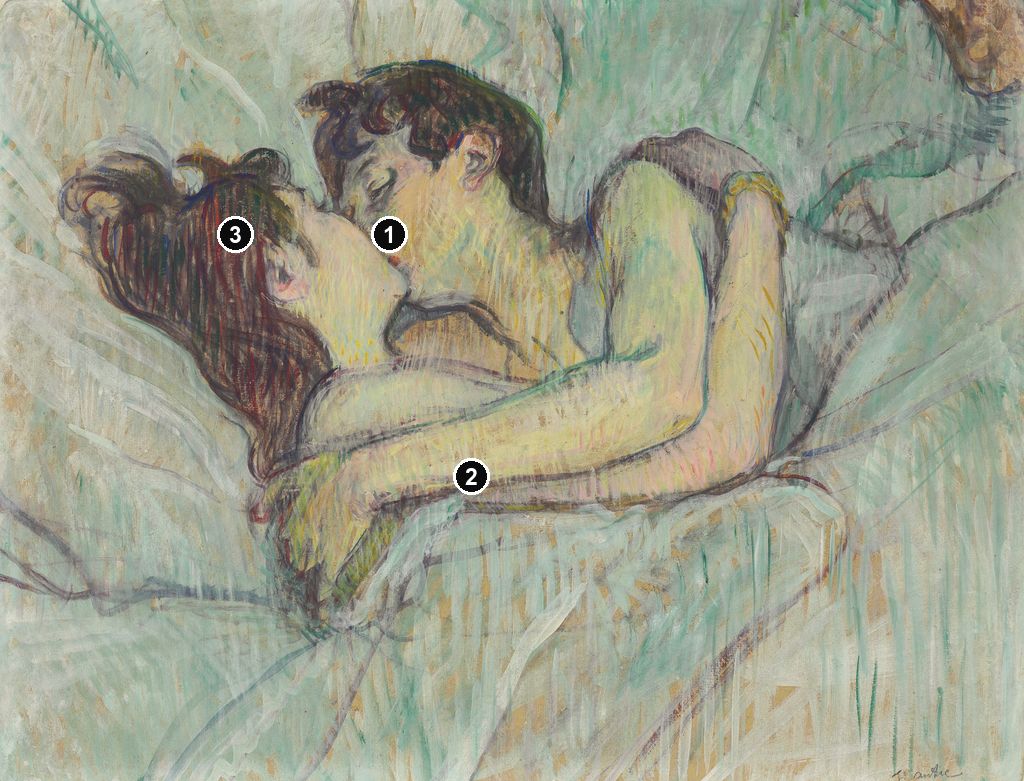
A long arm crosses the foreground and bends upwards, enclosing two faces that meet in a kiss. The dark heads are close enough to form a single compact shape, but the profiles remain distinct. Henri de Toulouse-Lautrec makes the embrace immediately legible while leaving much of the bodies, the room and the women's lives beyond our view.
This In Bed: The Kiss is the painting catalogued as Dortu P.438, recorded by Christie's as Au lit: Le baiser, 1892. [1] Its particular achievement lies in the coordination of touch and enclosure: arms hold the figures together, and the composition holds our attention around them.
At a Glance
- ArtistHenri de Toulouse-Lautrec
- French titleAu lit: Le baiser
- Date1892
- MediumPeinture à l'essence on board
- Dimensions45.5 × 58.5 cm
- Catalogue identityDortu P.438
- Ownership recordPrivate collection in the 2015 Christie's catalogue
These object details follow Christie's record. [1] A different kissing composition, P.436, has the same French title; it is discussed below. [2]
This work across Henri de Toulouse-Lautrec’s career
Contents
- Following the Embrace
- A Close View Without a Complete Room
- Paint That Retains the Energy of Drawing
- One Title, Different Kisses
- Intimacy and the Histories Attached to It
- Other Forms of Being Together
- A Private Painting in Public Exhibitions
- Annotated details
Following the Embrace
The kiss occupies a relatively small area, a little left of centre. Its importance comes from the larger structure that carries the eye towards it. Begin with the foreground shoulder at the lower left of the group. The exposed arm travels almost horizontally across the image, then turns at the elbow. Its rising section meets the other figure's shoulder at the right. The angular route gives the embrace breadth and weight before the eye arrives at the tiny contact between the mouths.
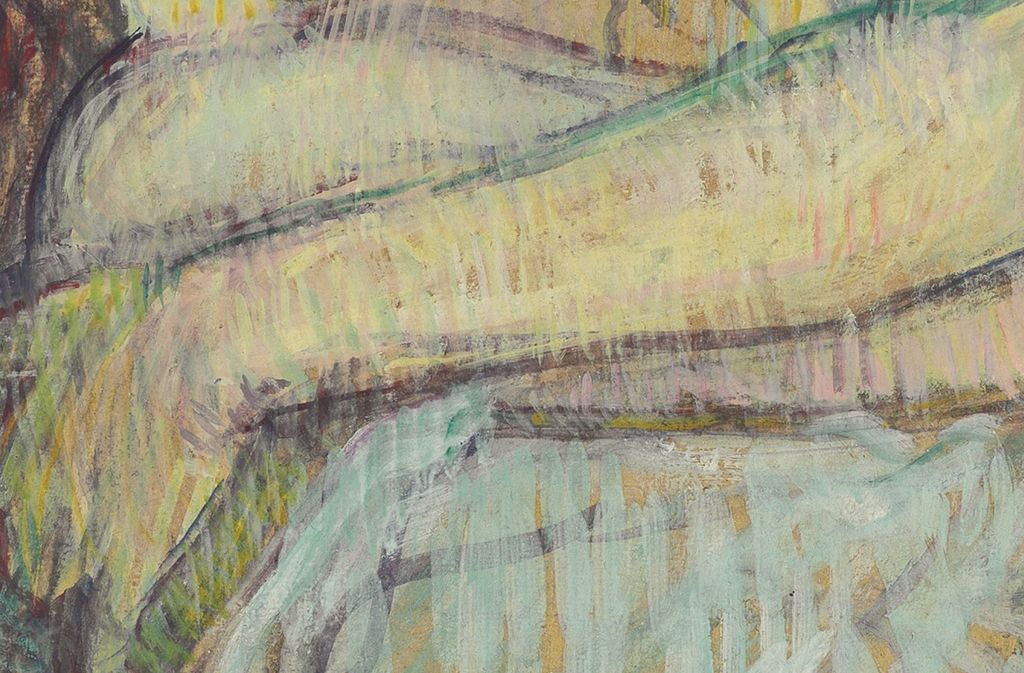
A second exposed arm lies beneath and behind this foreground one. The limbs overlap closely enough that following each body takes more time than recognising the gesture. That difference matters. At first we see an embrace as a whole; only afterwards do we work out its separate parts. Lautrec preserves enough outline to make touch intelligible without giving us a diagram of the anatomy. The density of the overlapping forms is part of the sensation of closeness.
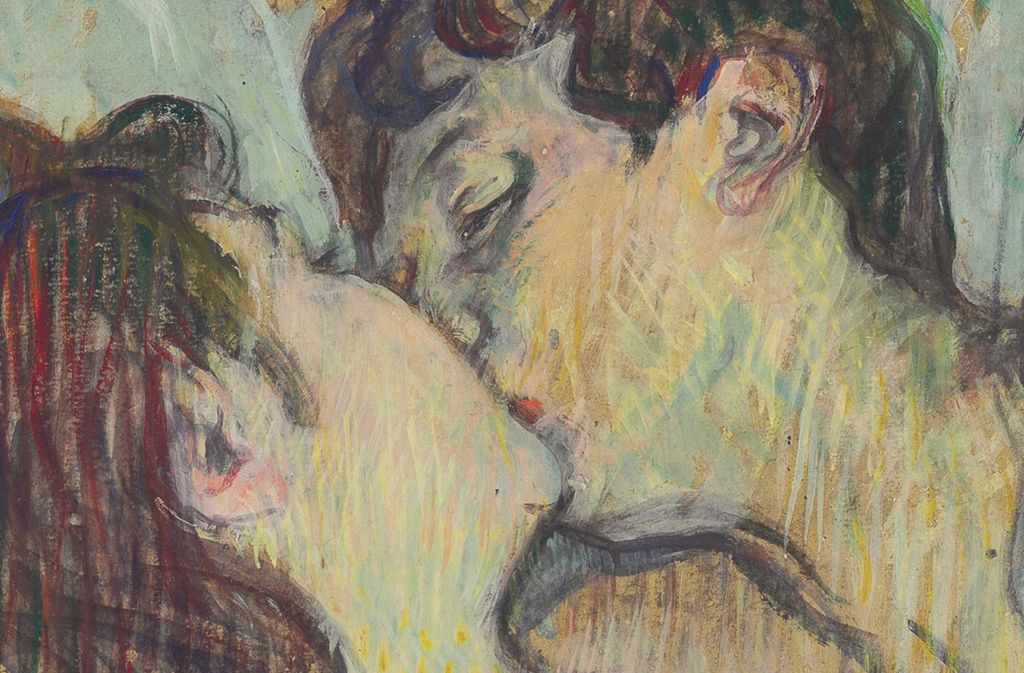
The woman nearer the left edge rests with her head tilted back. Her long, dark hair spreads against the pillow and falls towards her shoulder. The other woman bends down and towards her, showing a lowered eyelid, cheek, ear and a stretch of neck. Their directions are complementary rather than identical. One face lifts and the other inclines; their mouths join where those two movements meet. The kiss therefore registers as a relationship between two differently placed figures.
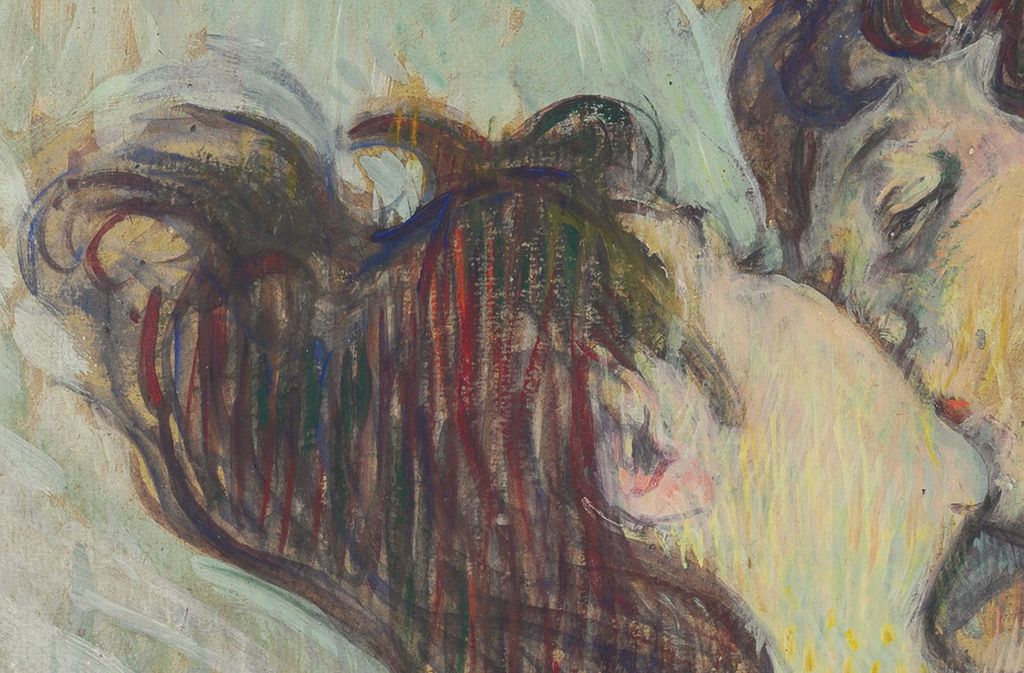
Hair helps distinguish them. The left-hand head has a loose, spreading mass, with reddish vertical strokes running through the dark colour. The upper head is more compact, its fringe picked out by curved lines. Both are dark enough to stand apart from the surrounding pale passages. Yet each has a different silhouette and internal rhythm. Even at the most compressed point in the picture, the women do not dissolve into an anonymous pair.
Their faces also resist the easy equation of intimacy with visual sameness. The left profile is largely a pale shape seen from the side; the upper face presents more of its surface, with coloured strokes crossing the cheek. The noses and mouths meet at slightly different angles. The result is a kiss that feels physically situated, with heads turning and bodies adjusting to one another. That reading follows the visible arrangement; it does not establish whether the women posed, moved or held this position for any particular length of time.
The hands are less emphatic than the heads, but they give the enclosure its purpose. At the right, fingers curve over a shoulder. Low on the left, another hand emerges beside the hanging hair. These small terminations prevent the arms from becoming merely decorative loops. The limbs end in points of contact, returning the eye to the bodily action that their long contours organise.
A Close View Without a Complete Room
Very little establishes where the bed stands. There is no broad view of floor or doorway and no clear route by which a spectator might have approached. Pale surfaces fill the margins, and an upholstered edge or cushion continues beyond the right side. A small warm, dark shape intrudes at the upper right. The picture supplies fragments of a setting rather than an inventory of furniture.
The fragmentary setting intensifies the embrace. The figures occupy a band across the upper and middle parts of the painting, while a larger pale area opens below them. Their exposed arms sit along the boundary between bodily closeness and the broad covering. The lower field gives the compact heads and shoulders room to register. Although the viewpoint brings us close, the image does not fill every part of the rectangle with exposed flesh.
The covering also interrupts our reconstruction of the bodies. We can follow shoulder, upper arm and forearm, but cannot confidently continue the figures beneath the fabric. The image establishes contact more completely than posture. That imbalance leaves the kiss clear and the wider physical situation partly concealed. The title names an action that we can see; it cannot finish the scene by telling us what happened before or afterwards.
Look at how the contours change direction around the right-hand elbow. The arm makes a firm bend, while the adjacent pale surfaces sweep away in softer diagonals. The transition keeps the group from becoming a rigid, closed geometric figure. Around the strongly outlined limbs, other marks loosen, break off or pass into neighbouring areas. The embrace is defined within a more fluid field.
The spectator occupies an unusual position in relation to this arrangement. Neither woman looks out towards us; both direct attention into the encounter. We can see closely without receiving an acknowledgement. That can make the image moving, but also calls attention to the act of looking. A private gesture has become a picture available to strangers. Its tenderness, as a visual response, exists alongside that exposure.
Annotated Details from In Bed: The Kiss
The numbered points identify visible features discussed in this article. Return from each detail to the whole composition. In Bed: The Kiss, 1892. Peinture à l’essence on board, 45.5 × 58.5 cm. Dortu P.438; private collection recorded in the 2015 Christie’s catalogue. The bent foreground arm encloses the pair. Image source. Public domain. Resized only; native appearance preserved.
Details from IN BED: THE KISS
Compare the cropped details with the complete images above. Notice how their colours, shapes and positions contribute to the larger compositions.
The meeting faces
The close profiles and dark outlines concentrate attention on the kiss.
The enclosing arms
The arms form an enclosing shape around the bodies.
Pale bedding and dark hair
The dark head is set against a broad pale area of bedding.
Paint That Retains the Energy of Drawing
The French term peinture à l'essence describes a way of working with thinned paint. In its account of Lautrec's Moulin de la Galette, the Art Institute of Chicago explains that he diluted paint with turpentine and applied it in loose washes. That is a useful explanation of the term, rather than a technical examination of the present painting. [12] Here the specified support is board, and the visible handling combines coloured strokes with insistent outlines. [1]
The large reproduction reveals how little the surface depends on smooth transitions. Green, yellow, rose and blue-grey strokes remain separate across the skin. On the foreground arm, cooler lines run beside the long contour while short warmer marks cross its length. The limb has a continuous form without a uniformly blended surface. Its volume emerges through changes of colour and the pressure of the outline.
The same independence of marks appears in the faces. Warm strokes run down the nearer cheek and neck; cooler passages settle around the closed eye and the meeting of the profiles. Colour does not stop obediently at every boundary. Some hues recur in skin and surrounding cloth, tying them together across the darker contour. The distinction between figure and setting depends on the arrangement of marks as well as on their colour.
At the left, the hair is built through close, downward strokes. Beside it, the pillow has longer, widely spaced marks that allow light passages to remain open. These different densities create a strong tactile contrast. Hair looks gathered and weighty; its support looks yielding. The comparison rewards attention because both areas are made from visible linear activity. The difference lies in its concentration and direction.
The lively handling does not establish that the entire picture was painted in one uninterrupted encounter. Individual strokes retain their distinctness, but their appearance does not tell us how many sittings, preparatory studies or revisions preceded them. Nor does the available object description supply a pigment analysis or a detailed account of the board's preparation. What we can assess is the finished relationship between a rapidly legible gesture and marks that remain active under close examination.
The scale adds to that relationship. This is an object small enough for the pair to be grasped together in a single field of vision. [1] Enlarged details make the coloured strokes prominent; the whole composition turns them back into the body of an embrace. Neither view cancels the other. The painting remains convincing as an image of touch while continually showing how that image was constructed.
Watch: Toulouse-Lautrec
Choose an artist introduction, a film about graphic design or a closer look at At the Moulin Rouge.
One Title, Different Kisses
The alternative Au lit: le baiser, Dortu P.436, changes the encounter substantially. Sotheby's records it as peinture à l'essence on board, measuring 39 × 58 cm. Its provenance begins with Charles Maurin and Maurice Joyant, who acquired it from the artist in 1893. Those particulars belong to that painting alone. [2]
In P.436, a woman leans down towards a partner whose face tilts sharply upwards. The bodies recede more strongly into depth, and the embrace sits above a conspicuous red covering. At the right, the dark structure of a bed or chair helps situate the group within a furnished interior. The room has more presence, even though the foreshortened figures remain closely interlocked.
P.438 presents a broader sweep of exposed arms. The pair lies more nearly across the image, and the pale surrounding field makes the outlines of their limbs especially consequential. The foreground arm stretches laterally before turning upwards, giving the gesture a long, enclosing reach. In P.436 the eye moves more insistently between an upper and a lower head. Each painting makes a kiss through different bodily directions and different proportions of figure to setting.
Their differing formats reinforce the contrast. P.436 is a shallower rectangle. [2] P.438 allows a more substantial area below the embrace. These are useful distinctions when identifying reproductions: the long exposed arm crossing pale bedding belongs to the image discussed here; the strongly foreshortened kiss above red belongs to P.436. A shared title is insufficient to identify an object or attach an ownership history to it.
There is a further difference between both kisses and the Musée d'Orsay's In Bed, or Le Lit. The French national collection database identifies that work as Dortu P.439, inventory RF 1937 38, circa 1892. [13] Its two heads face towards one another across a visible interval. With the arms and bodies largely concealed, the composition offers no equivalent enclosing gesture. The possibility of an exchange remains, but a kiss does not complete it.
P.438 makes that difference clear through action. The upper face moves down, the lower face rises, the mouths touch, and the arms fasten the two directions together. Comparing the paintings does not require us to arrange them as successive moments in a story. Their relationship is compositional: a shared motif permits several distinct distributions of contact, distance and concealment. There is no need to assume the same women appear in each.
Intimacy and the Histories Attached to It
Colta Ives places Lautrec's pictures of women away from clients alongside the routines represented in Elles. Her 1996 Metropolitan Museum catalogue pairs The Sofa with Waking Up, bringing companionship and an everyday bodily movement into the same discussion. [10] This offers a useful way to approach the kiss: it belongs to a range of activities through which women appear in relation to one another, rather than only in relation to a customer.
That context carries real historical weight, but also requires discrimination. Ives's account speaks broadly about the women and Lautrec's comfort in their surroundings. The picture supplies a narrower kind of evidence. It shows two women embracing; it does not give their names, their accounts of the encounter or their descriptions of their relationship. To read the gesture as female desire is a response to what is represented. To assign a complete sexual identity or occupation to either unnamed sitter would go beyond it.
The distinction also changes how tenderness can be discussed. The long arms, close faces and supporting hands give a viewer substantial grounds for recognising affection. We do not need an invented conversation or private biography to explain that response. At the same time, a painted kiss cannot certify that a relationship was secure, enduring or free of difficulty. Its emotional force comes from the visual particularity of a moment, not from the certainty of an unwritten love story.
Julia Frey's 1985 biographical essay describes Lautrec's access to brothel interiors and his interest in the activities that took place away from clients. She presents a world of meals, waiting, work and observation, and relates it to his broader habits as an artist. [14] That account helps explain why art historians connect these subjects. It does not identify the room in P.438, and the general history of access cannot establish how this particular painting was made.
Frey also illustrates a difficulty in writing about Lautrec: the compelling life story can come to seem like an explanation for every image. Her essay's opening challenges the familiar caricature of an artist whose habits overwhelmed his work, stressing the extent of his production. [14] For the kiss, the more useful emphasis is the work of composition itself. The differing directions of the faces and the careful overlap of the arms ask for attention as artistic decisions, even when the circumstances of their making remain elusive.
Neither apparent sympathy nor close access removes the spectator's position. The women have been brought into view through a male artist's choices of framing, pose and paint. A viewer can feel affection in their contact while recognising that the picture cannot speak for them. That tension is especially acute here because the embrace turns inwards. We see a relationship from which the composition gives us no reciprocal glance or spoken explanation.
Other Forms of Being Together
The later Au Salon de la rue des Moulins offers a concrete comparison. The Musée Toulouse-Lautrec dates the large oil on canvas to 1894. Its commentary identifies the closed composition and the seated women's lack of communication, while stressing the individualisation of their faces. [9]
Look at the foreground arm in each painting. In the Salon, an arm extends downwards from a seated figure, continuing the diagonal of her position and helping divide the room. In P.438, the long arm runs around another person and leads back towards a shoulder. A comparable length of exposed limb does different work: one organises a figure within a group, the other makes contact between two bodies the central event.
The backgrounds change that effect. The Salon places its figures among columns, mirrors and substantial red seating. Its room is both visible and enclosing. P.438 offers much less architectural information, so the embrace itself supplies the principal enclosure. The distinction is more revealing than treating both images as interchangeable illustrations of a single social setting. The women can occupy the same pictorial world without every composition giving them the same relationship to one another.
The Elles portfolio, published in 1896, extends the range of activities again. The Metropolitan Museum emphasises the series' representation of daily life, intimacy and friendship. [15] In Waking Up, reproduced by Ives, an arm rises above a reclining woman's head while the bed and pillow are articulated through sparse lines. [10] The lifted limb creates an open, stretching gesture. P.438's bent arms close around another person.
That comparison makes the kiss's physical structure easier to see. An arm is not simply an anatomical detail added to identify an activity. Its direction can open space, divide a setting or gather two people together. Lautrec makes these small differences consequential. The intimacy of P.438 depends as much on the long route through shoulder, elbow and hand as on the meeting of the lips.
A Private Painting in Public Exhibitions
Christie's lists Paul Gallimard, Paul Cassirer and Marie-Anne Goldschmidt-Rothschild before Maurice Rheims, who acquired the painting around 1965; a private collection follows. [1] The sequence supplies names, but not a dated transaction for every transfer. It should be read as an ownership outline, with gaps, rather than a continuous account of the object's whereabouts.
The same record lists Le Barc de Boutteville in November 1892, with catalogue number 167 or 168; Paris in 1959, no. 132; and Washington and Chicago in 2005, no. 251. It reports a police removal demand in 1892 without securely identifying the offending picture. [1] That qualification matters. Christie’s catalogue thus recounts controversy around the exhibited bed pictures, while leaving the identity of the removed work uncertain.
The 2005 institutional checklist independently includes In Bed: The Kiss, no. 251, as a privately lent 1892 painting. It calls the medium oil on cardboard and gives 42 × 56 cm. [16] The later Christie's measurements used above are larger. Neither record explains the difference. The dimensions therefore retain their source and date.
Exhibiting the painting alters the conditions of its encounter. What looks like a secluded exchange becomes something visitors look at together, within a larger account of an artist and a city. The 2005 checklist places it near other images of women resting, seated or attending to daily activities. [16] That grouping encourages comparison, while the particular arrangement of P.438 continues to demand close attention: two distinct profiles meet within a single, firmly drawn embrace.
Toulouse-Lautrec artworks directory
Browse 84 identified works and publications in this researched selection. Dates and titles follow the individual records; this is not a complete catalogue of the surviving oeuvre. Print impressions remain attached to their designs. Some listed works do not have a dedicated article. The Drawings guide also contains nine illustrated studies consolidated from former articles.
Frequently Asked Questions
Orsay's Le Lit is a separate work, RF 1937 38, catalogued as Dortu P.439. Its two faces remain apart rather than meeting in a kiss. [13]
It refers to working with thinned paint. The Art Institute explains Lautrec's use of the technique in Moulin de la Galette as paint diluted with turpentine and applied in loose washes. That explanation does not substitute for a technical analysis of P.438. [12]
Discussion
Look again at the images and ideas explored in In Bed: The Kiss by Henri de Toulouse-Lautrec. These editorial prompts invite your observations.
Reader Insights
How does the long horizontal foreground arm change your reading of the kiss compared with the upright bend at the right?
Comparing P.438 with Orsay's Le Lit, what changes when the figures' contact becomes the centre of the composition?
Join the Conversation
Share a detail, comparison or question about In Bed: The Kiss by Henri de Toulouse-Lautrec below.
References
- Christie's, Au lit: Le baiser, lot 5946122, 2015: Dortu P.438; object details, provenance, exhibition history and catalogue essay. The early exhibition number and censorship identification remain qualified. View source.
- Sotheby's, Au lit: le baiser, lot 18, 2015: the distinct P.436, its reproduction, dimensions and provenance. View source.
- Autoportrait, 1880 (in French). View source.
- ALBERTINA: Der Schimmel Gazelle,GE123DL. View source. (in German).
- Franka Blok, Portrait of Vincent van Gogh, 2024. View source.
- Art Institute of Chicago: Moulin Rouge, La Goulue. View source.
- Art Institute of Chicago: At the Moulin Rouge. View source.
- Jane Avril, 1893. View source.
- Musée Toulouse-Lautrec, Au Salon de la rue des Moulins, 1894: collection record and commentary on composition and individual faces (in French). View source.
- Colta Ives, Toulouse-Lautrec in The Metropolitan Museum of Art, Metropolitan Museum of Art, 1996, p. 52, figures 58–59 and accompanying discussion of The Sofa, Waking Up and daily life. View source.
- Maurice Joyant (in French). View source.
- Art Institute of Chicago, Moulin de la Galette, 1889, 1933.458, collection commentary explaining peinture à l'essence in that painting. View source.
- Ministère de la Culture, Joconde database, Le Lit, notice 000PE004167, inventory RF 1937 38, Dortu P.439 (in French). View source.
- Julia Frey, “Biography of the Artist,” in Henri de Toulouse-Lautrec: Images of the 1890s, Museum of Modern Art, 1985, pp. 19–20, 30–32: professional activity and accounts of brothel interiors. Biographical interpretation is distinguished here from evidence about this particular painting. View source.
- Metropolitan Museum of Art, Elles (portfolio cover), 1896, 1984.1203.166(2), curatorial discussion of the suite's daily-life subjects and publication by Gustave Pellet. View source.
- Art Institute of Chicago, Toulouse-Lautrec and Montmartre: exhibition checklist, 2005, cat. 251 and neighbouring entries: title, date, lender, materials and measurements. Its dimensions differ from the later Christie's record. View source.
- Splash image, In Bed: The Kiss, 1892. Peinture à l’essence on board, 45.5 × 58.5 cm. Dortu P.438; private collection recorded in the 2015 Christie’s catalogue. The bent foreground arm encloses the pair. Image source. Public domain. Resized only; native appearance preserved.


 Henri de Toulouse-Lautrec.jpg)