



 by Tom Gurney
Tom Gurney BSc (Hons) is an art history expert with over 20 years experience
Published on June 19, 2020 / Updated on November 3, 2026
Email: tomgurney1@gmail.com / Phone: +44 7429 011000
Jane Avril Dancing by Henri de Toulouse-Lautrec: Introduction
Jane Avril's raised leg cuts across the pale folds of her skirt, while her other foot points down towards a floor alive with green and yellow strokes. Her body seems to press forward through the tall, narrow picture. Far behind her, two small figures occupy a quieter corner of the room. The force of the painting comes from this unequal distribution of attention: the dancer receives almost everything, yet the surrounding space remains essential to how we see her.
Jane Avril Dancing, or Jane Avril dansant, is Toulouse-Lautrec's oil painting of about 1892 in the Musée d'Orsay. Its pale costume and loosely described interior distinguish it from his better-known advertisements for the same performer. [1]
At a Glance
- ArtistHenri de Toulouse-Lautrec
- French titleJane Avril dansant
- DateAbout 1892
- MediumOil on cardboard
- Dimensions85.5 × 45 cm
- CollectionMusée d'Orsay, Paris
- InventoryRF 1937 37; also RF 28827
Object information follows the Musée d'Orsay record. [1]
This work across Henri de Toulouse-Lautrec’s career
Contents
- A dance held inside a narrow picture
- The floor moves with her
- Two figures at the back
- Paint that keeps the drawing visible
- A face within the performance
- The paintings and prints are separate works
- From a private collection to Orsay
- Annotated details
A dance held inside a narrow picture
Start with the outline of Avril's whole figure. Her dark hat sits close to the left edge; the puffed sleeve projects towards the right; the lifted shoe reaches further right still. Below, the second leg descends towards a small, dark foot. These are markedly different directions within one figure. The body resists a simple vertical arrangement, even though the narrow format encourages us to read it from top to bottom.
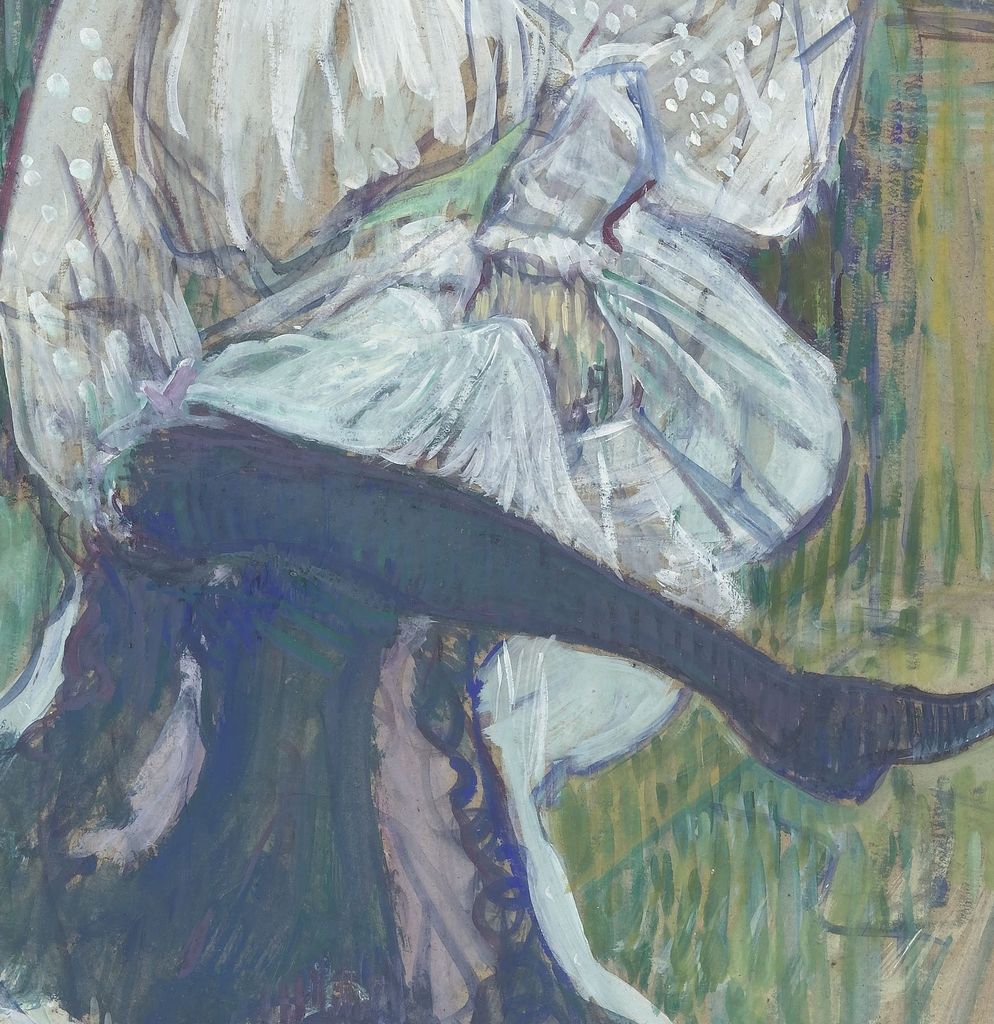
The long, dark shape of the raised leg interrupts that downward reading. It passes almost horizontally across the dress, dividing the pale upper costume from the darker fabric below. Its pointed shoe carries the eye outwards, then the contours of the skirt bring us back. The movement is legible before we have worked out every fold or anatomical connection. Lautrec gives the action an immediately graspable shape while preserving the complication of a body turning and balancing.
The hands matter as much as the feet. One gathers fabric near the waist, while the other holds the skirt lower down. The costume becomes part of the performance's construction: lifting it changes the dancer's silhouette and reveals the contrasting directions of the legs. The immense sleeve and the bunched skirt also enlarge the upper body, so that the slender supporting leg looks especially exposed beneath them. That contrast supplies a sense of precariousness without requiring us to reconstruct the precise step.
There is no need to give the pose an exact choreographic name to appreciate its precision as an image. The painting lets us see how much depends on coordinated oppositions: a projecting foot and a descending foot, a bent elbow and a lowered arm, a large mass of cloth and a narrow point of contact with the floor. Our impression of motion grows from those relationships; the visible arrangement does not record a complete dance sequence.
The floor moves with her
The lower part of the picture is unusually active for an area containing so few objects. Green, yellow and pale strokes run at an angle beneath Avril. Some suggest the floor's recession; others register more insistently as streaks of paint. They make it possible to understand the room spatially while remaining conspicuous marks on a flat surface.
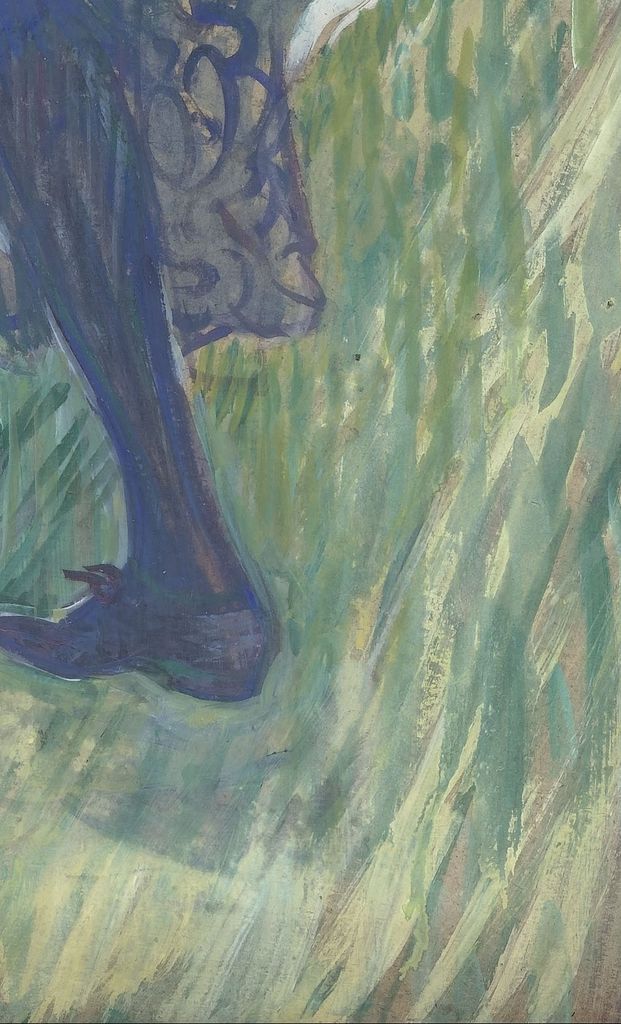
Follow the foot at the bottom of the figure. Its small patch of shadow and surrounding colour give it a place to land, but the floor does not become a fully measured grid. We see enough to feel the dancer's contact with it, then the brushwork carries our attention along the surface. The still image gains energy from the difference between the sharply readable shoe and the restless marks around it.
At the left, the room presses close to Avril's face and upper body through vertical green passages and pale openings. At the right, a broad brown strip remains comparatively sparse. The dancer is therefore framed by two different kinds of space: one densely marked, the other comparatively quiet. Her lifted foot crosses towards the quieter side, making its dark shape easy to register. Empty space has an active role here, providing the interval against which a gesture becomes distinct.
The viewpoint also makes the figure feel close. The floor appears to rise behind her, and we can see a substantial stretch of it below the background pair. A few oblique lines, vertical accents and abrupt changes of colour establish the room around her. Looking at these cues, we seem to occupy the same compressed interior as the dancer, even though Lautrec never supplies a complete plan of it.
Annotated Details from Jane Avril Dancing
The numbered points identify visible features discussed in this article. Return from each detail to the whole composition. Jane Avril Dancing, circa 1892, Musée d’Orsay, RF 1937 37 / RF 28827. Musée d’Orsay; Google Art Project reproduction via Wikimedia Commons. Image source. Public domain. Resized only; native appearance preserved.
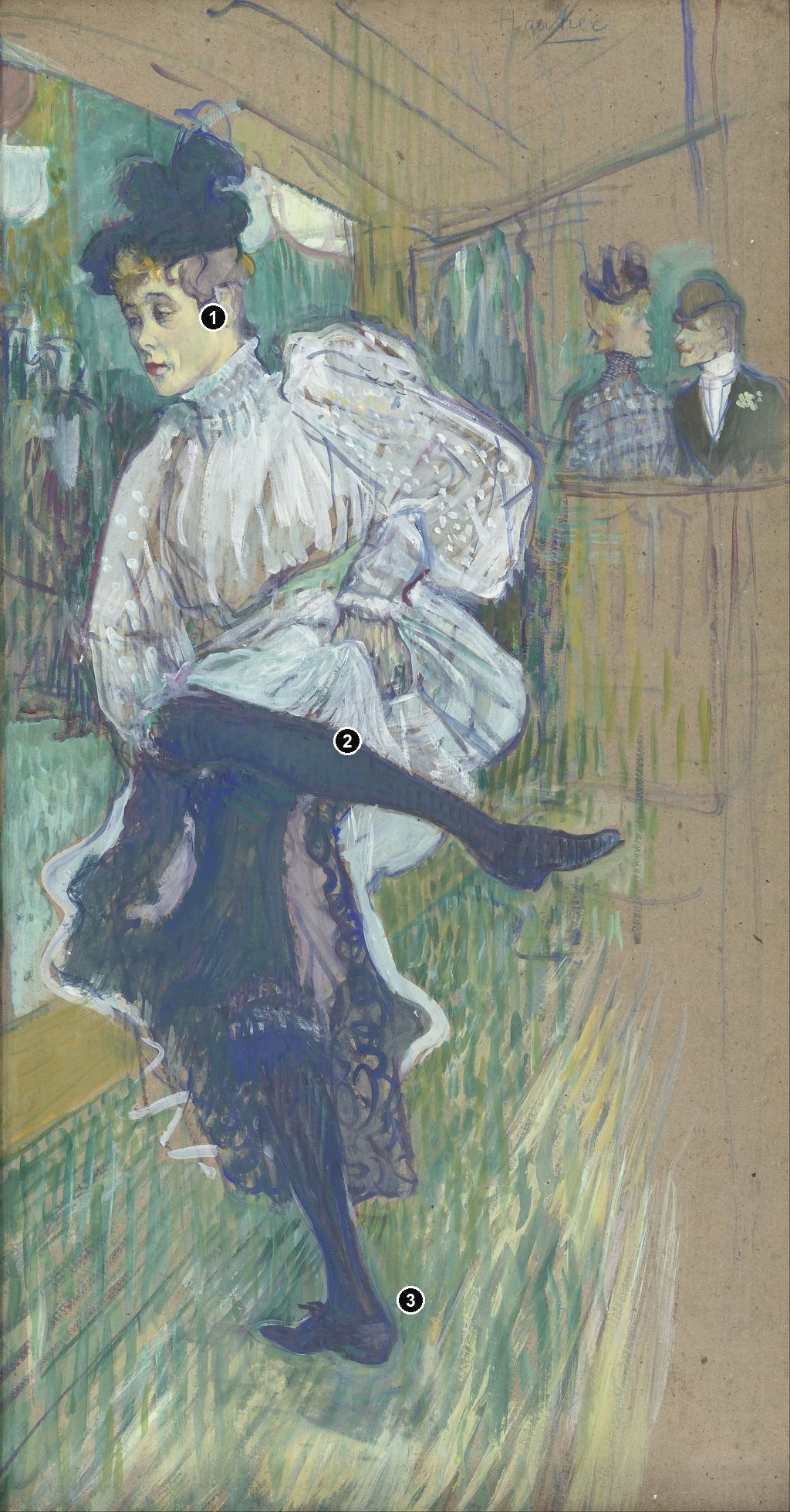
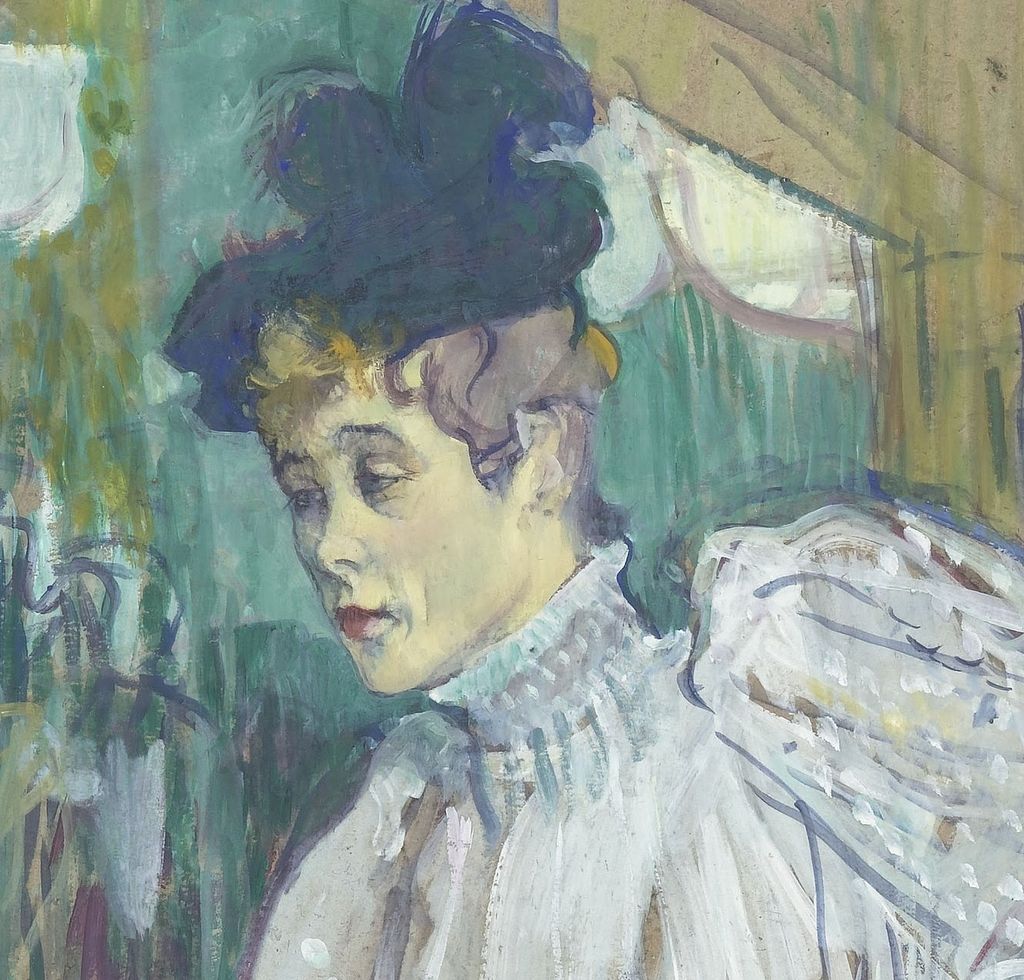
Details from JANE AVRIL DANCING
Compare the cropped details with the complete images above. Notice how their colours, shapes and positions contribute to the larger compositions.
The lifted petticoat
The pale petticoat breaks the dark dress into an angular moving shape.
The diagonal floorboards
The floorboards provide a directional setting beneath the dancing figure.
Two figures at the back
The couple near the upper right changes the scale of everything around them. Their heads are much smaller than Avril's, and their lower bodies disappear behind a horizontal division. The dark jacket and white shirt of one figure, beside the other's patterned clothing and hat, supply enough information to establish a second human presence without competing with the dancer's elaborately articulated costume.
Notice that the pair does not form a conventional audience row. Their heads turn towards one another across the narrow interval between them. Avril's face turns in a different direction. The picture's human figures thus have separate orientations, and the space contains more than one possible focus of attention. We can read this as a glimpse of social activity continuing around the solo performance, although the painting does not tell us what either background figure is saying or thinking.
Orsay's commentary leaves the hatted woman unidentified. [1] Her anonymity does not diminish her pictorial function. The two small figures keep the room from becoming an abstract backdrop, while their sketchier treatment makes the difference in distance palpable. They are present enough to imply a shared place, but Avril's scale and the density of marks around her prevent us from losing sight of the main action.
Their placement also balances the composition without making it symmetrical. Avril occupies much of the left and centre; the pair sits high on the right. Between them lies an uneven expanse of brown and green. That separation allows us to move between close bodily action and distant social detail. The eye discovers the people at the back after encountering the dance, and their presence alters a second reading of the room.
Paint that keeps the drawing visible
The Musée d'Orsay explains the work's fluid handling through oil paint diluted with turpentine, and notes the near-bare cardboard behind the background figures. [1] This makes the brown support an important part of the image's appearance. It is especially conspicuous above the figures and along the right side, where the room is indicated with relatively little paint.
Across Avril's costume, the painting becomes much more intricate. Pale strokes follow the swollen sleeve; thin blue and violet lines divide folds; darker passages gather beneath the skirt. Yet the cloth does not resolve into a uniformly polished surface. Contours, patches and short touches retain their individual identities. We can follow the drawing through the colour, rather than experiencing colour as an opaque covering that conceals how the figure was built.
This varied density is crucial. The face, hands, clothing and setting do not receive an equal degree of description. In the dress, a sequence of looping lines can establish a fold without closing it completely. In the background, a few strokes do the work of a much larger architectural account. Looking closely, we see selection at every scale: information is concentrated where it helps a gesture or an expression become readable.
Colta Ives, discussing a different image of Avril, emphasises the structural as well as decorative importance of Lautrec's fluid line. Her example is the 1893 lithograph from Le Café Concert, whose sweeping contours organise the dancer and her billowing dress. [9] That observation offers a useful comparison with the Orsay painting. Here, too, a curve is more than ornament: the sleeve's arc, the skirt's changing edges and the line of the lifted leg direct our attention through the action. The two works achieve this with different materials and different poses.
A face within the performance
Avril's head is relatively small beside the emphatic costume. Its pale surface is sharply interrupted by the eye, brow, nose and mouth, while darker touches define the hair beneath the hat. The chin angles down and the face turns towards the left. Unlike the raised shoe, which pushes across the painting, the features occupy a contained area of closely gathered marks.
The contrast can make her face seem restrained beside the body's expansive action. That restraint belongs to the picture's arrangement: small facial accents hold their place while sleeve and skirt spread out around them. Lautrec gives the features sufficient definition to interrupt our reading of the dance without isolating them as a separate portrait.
Keeping those distinctions in mind makes the portrait more interesting. The body communicates through large opposing shapes; the face works through small, precise accents. Neither cancels the other. We encounter both a recognisable person and a performed action, with the scale of the costume continually pulling us away from the features and the features drawing us back. The painting's individuality depends on that exchange, rather than on a generic image of a dancer smiling towards an audience.
The paintings and prints are separate works
The comparison most likely to cause confusion is the 1893 Jane Avril poster. Its orange skirt, high kick and enormous double-bass neck belong to another composition, made to advertise Avril's engagement at the Jardin de Paris. The Met records that Avril commissioned the print. [7] In that design, lettering names the performer and the instrument becomes part of an enclosing frame. The Orsay painting instead gives the pale-clothed figure an interior shared with two people in the distance.
There is also a separate oil painting connected with the 1893 poster. Wolfgang Wittrock's MoMA catalogue lists it as Jane Avril Dancing, dated 1893, oil on cardboard, 99 × 72 cm, Dortu P482, then in a private collection. Its reproduced orange-costumed dancer unmistakably differs from Orsay's narrower composition. [11] Sharing a title and a sitter does not establish that the Orsay painting was the poster's preparatory study. The Phillips Collection's account of an oil sketch in the poster's development concerns that distinct advertising design. [12]
The 1893 Le Café Concert lithograph provides a third, especially revealing comparison. In the Met's impression, black brush lines and spatter describe a widely flaring skirt against a finely speckled ground. It is a smaller printed image, its billowing silhouette surrounded by a stippled rectangle. [13] Beside the Orsay painting, it shows how differently a gathered skirt and an airborne contour can organise a dancer's movement.
Finally, the 1899 Jane Avril lithograph is the snake-dress design: a long dark gown carries a winding serpent motif, while the arms rise around the head. MoMA records Avril as its publisher and Henri Stern as printer. [14] These distinctions reveal the range of Lautrec's responses to one performer. He could make her occupy a loosely brushed room, condense her into a black printed contour or turn her costume into an advertising emblem. None of those solutions exhausts the others.
From a private collection to Orsay
The painting's recorded provenance passes through E. Blot and Antonin Personnaz. Personnaz's bequest entered the French national collections in 1937 for the Louvre; the work was allocated to Orsay in 1986. The museum also records its appearance at London's Goupil Gallery in 1898. [1]
That history gives the picture a life beyond the moment of dance it represents. A performance vanishes as it happens, while this particular arrangement of paint and cardboard could be collected, exhibited and transferred between museums. Its durable form preserves something less complete than a choreographic record and more visually specific: a raised foot against pale fabric, an emphatic sleeve, two distant heads and a floor that seems to carry movement through the whole image.
Toulouse-Lautrec artworks directory
Browse 84 identified works and publications in this researched selection. Dates and titles follow the individual records; this is not a complete catalogue of the surviving oeuvre. Print impressions remain attached to their designs. Some listed works do not have a dedicated article. The Drawings guide also contains nine illustrated studies consolidated from former articles.
Frequently Asked Questions
The oil painting belongs to the Musée d'Orsay in Paris, inventory RF 1937 37. [1]
The orange-skirted Jane Avril is a separate lithographic poster of 1893 advertising the Jardin de Paris. The painting discussed here is the pale-costumed figure in a narrow interior. [7]
A different oil on cardboard, dated 1893 and catalogued as Dortu P482, is associated with the poster design. It should not be confused with the Orsay work. [11]
The Musée d'Orsay's commentary does not identify her. Her small scale and placement help establish the distance behind Avril. [1]
Discussion
Look again at the images and ideas explored in Jane Avril Dancing by Henri de Toulouse-Lautrec. These editorial prompts invite your observations.
Reader Insights
Which carries the strongest sense of movement: the raised leg, the gathered skirt or the streaks of colour on the floor?
Compare the Orsay painting with the 1893 poster. How does the presence of two background figures change your sense of Avril's place in the room? [7]
Join the Conversation
Share a detail, comparison or question about Jane Avril Dancing by Henri de Toulouse-Lautrec below.
References
- Musée d'Orsay, Jane Avril dansant, about 1892, RF 1937 37 / RF 28827. Exact painting, institutional image, materials commentary, provenance and exhibitions; English commentary with French object data. View source.
- Autoportrait, 1880 (in French). View source.
- ALBERTINA: Der Schimmel Gazelle,GE123DL. View source. (in German).
- Franka Blok, Portrait of Vincent van Gogh, 2024. View source.
- Art Institute of Chicago: Moulin Rouge, La Goulue. View source.
- Art Institute of Chicago: At the Moulin Rouge. View source.
- Metropolitan Museum of Art, Jane Avril, 1893, accession 32.88.15. Jardin de Paris commission and separate poster composition. View source.
- Au Salon de la rue des Moulins (in French). View source.
- Colta Ives, Toulouse-Lautrec in The Metropolitan Museum of Art, 1996, p. 40 and figure 40; Jane Avril from Le Café Concert, fluid line and composition. View source.
- Maurice Joyant (in French). View source.
- Wolfgang Wittrock, “Catalogue of the Exhibition,” in Henri de Toulouse-Lautrec: Images of the 1890s, Museum of Modern Art, 1985, p. 94, selected classification of works devised for lithographs; p. 226, entry 252; and p. 228, reproduction. Distinct 1893 painting, Dortu P482. View source.
- Phillips Collection, “Performers of the Belle Époque: Jane Avril,” 29 March 2017. The 1893 poster's development, oil sketch and trial proofs. View source.
- Metropolitan Museum of Art, Jane Avril (from Le Café Concert), 1893, accession 23.30.3.1. Brush and spatter lithograph printed in black on wove paper; image and exact impression record. View source.
- Museum of Modern Art, Jane Avril, 1899, object 167.1946. Publisher and printer; composition also viewed in Wittrock's 1985 catalogue, p. 253, entry 298. View source.
- Splash image, Jane Avril Dancing, circa 1892, Musée d’Orsay, RF 1937 37 / RF 28827. Musée d’Orsay; Google Art Project reproduction via Wikimedia Commons. Image source. Public domain. Resized only; native appearance preserved.


 Henri de Toulouse-Lautrec.jpg)