



 by Tom Gurney
Tom Gurney BSc (Hons) is an art history expert with over 20 years experience
Published on June 19, 2020 / Updated on November 3, 2026
Email: tomgurney1@gmail.com / Phone: +44 7429 011000
La Troupe de Mademoiselle Églantine: Four Dancers in Motion: Introduction
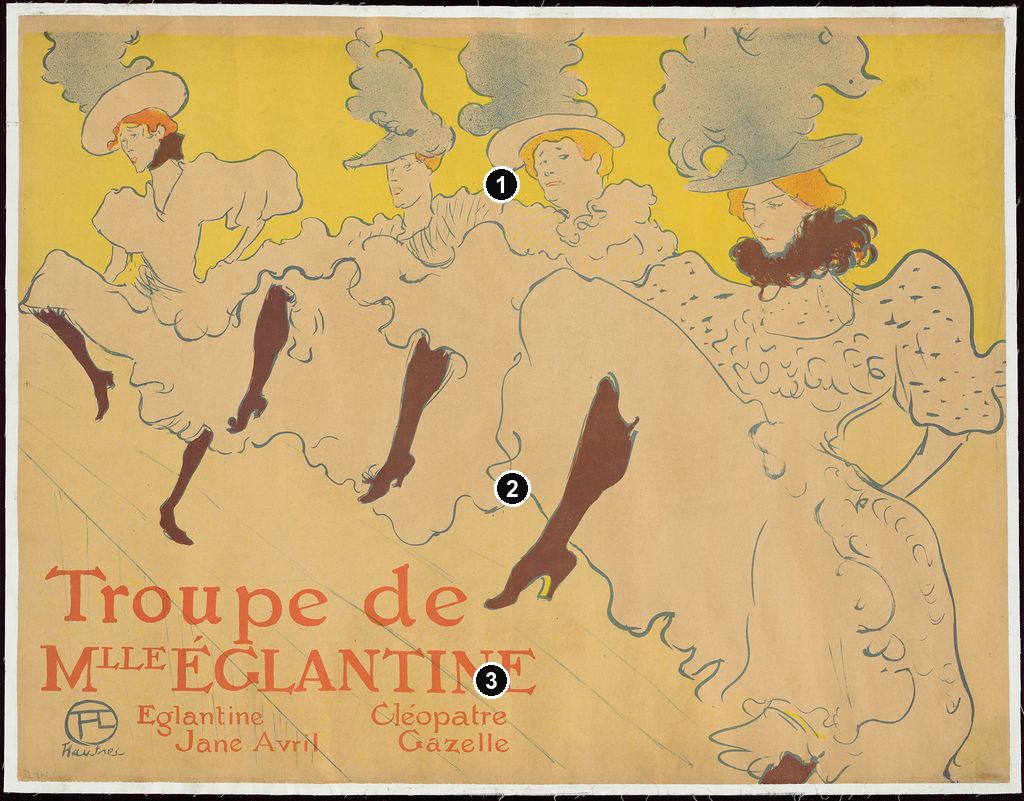
Four feathered hats stretch across a yellow field. Below them, pale skirts swell into one another, while dark stockings punctuate the fabric with sharply different angles. In La Troupe de Mademoiselle Églantine, Toulouse-Lautrec makes a group dance recognisable through repetition, then keeps it lively through small departures from the pattern. The colour lithograph dates from 1896 and advertised a troupe whose members included Jane Avril, the dancer at the far left. Princeton University Art Museum identifies her as the commissioner and connects the advertisement with the Palace Theatre of Varieties in London. [1] [2]
At a Glance
- ArtistHenri de Toulouse-Lautrec.
- Title and dateLa Troupe de Mademoiselle Églantine, 1896. [1]
- MediumColour lithograph on tan wove paper. [1]
- Featured impressionArt Institute of Chicago, accession 1936.220, Mr. and Mrs. Carter H. Harrison Collection. Image: 61.4 × 79.5 cm; sheet: 62 × 79.9 cm. [1]
- Dancers, from left to rightJane Avril, Cléopâtre, Églantine and Gazelle. [3] [4]
- Advertising purposeA London engagement, with the theatre's name omitted so the design could be used elsewhere. [2] [3]
This work across Henri de Toulouse-Lautrec’s career
Contents
- A request from the dancers
- Recognising four individuals
- From a posed photograph to a printed dance
- Legs, skirts and the rhythm of the line
- Three printing colours, many kinds of mark
- The names at the dancers' feet
- Annotated details
A request from the dancers
The commission began with practical instructions. In her study of Lautrec's dance posters, Svenja Ludwig discusses a letter sent from London by Jane Avril and Églantine on 19 January 1896. It requested an advertisement and supplied the performers' names in a specified order. Ludwig cites the letter through its published transcription and translation; her account gives unusually concrete evidence of the dancers participating in the preparation of their publicity. They were choosing how their professional identities should appear in print. [3]
The same request explains a conspicuous absence. Although the Palace Theatre was the immediate context, the correspondents reconsidered including its name, anticipating appearances elsewhere. The completed poster names the troupe and its four members without binding them to one venue. That decision makes the sheet a portable advertisement for the act. The yellow space behind the dancers contains no identifiable London architecture, and the few floor lines establish a stage without describing a particular theatre. [3]
The distinction between an announcement and a performance record matters here. Princeton associates the poster with a Palace appearance in 1896, while the Baltimore Museum of Art's teaching account describes the troupe planning its London tour. The image itself supplies neither an opening date nor a schedule. Its secure historical purpose is to promote the dancers' engagement; its poses cannot establish the sequence of movements performed on a particular evening. [2] [4]
Avril's involvement also belongs to the material history of the print. The Museum of Modern Art names her as publisher of its impression. That credit enlarges her role beyond the familiar description of an artist's model or friend: she helped bring the advertisement into circulation. MoMA identifies the printer as unknown, leaving the workshop responsible for producing the sheets unconfirmed. [14]
Recognising four individuals
The order of the figures differs from the order in which the names are read down the two small columns at the foot. Jane Avril appears at the far left, followed by Cléopâtre, Églantine and Gazelle. The Baltimore Museum's account identifies Avril stepping apart from the others; Ludwig likewise emphasises the special treatment of this leftmost figure. The largest name in the inscription, Églantine, therefore does not identify the woman nearest the left edge. [3] [4]
The Musée Carnavalet identifies the troupe's Églantine as Églantine Demay and records Gazelle as the stage name of Victorine Madeleine Weber. These names give substance to a group easily reduced to anonymous dancers. They also distinguish Églantine from Avril, whose own stage name was Jane Avril and whose birth name the same museum records as Jeanne Louise Beaudon. [15]
Their costumes make the differences visible before we consult a name. Avril's reddish hair, narrow face and tilted head occupy a relatively open space at the left. Cléopâtre, next to her, has a slimmer, more pointed hat silhouette and a face emerging between neighbouring ruffles. Églantine's broad brim frames a more frontal head in the middle. Gazelle dominates the right side with an enormous plume, a dark gathered collar and a blouse covered in small scattered marks. The shared act has not required identical appearances.
That individuality operates at several scales. From a distance, the hats and stockings establish the troupe as a unit. Closer inspection separates the collars, sleeves, faces and little turns of the head. Small differences keep four people legible within an almost continuous mass of costume; the restrained faces give the moving fabric a quieter counterpoint.
Annotated Details from La Troupe de Mademoiselle Églantine: Four Dancers in Motion
The numbered points identify visible features discussed in this article. Return from each detail to the whole composition. Henri de Toulouse-Lautrec, Mademoiselle Eglantine’s Troupe,1896. Colour lithograph on tan wove paper,laid down on fabric. Art Institute of Chicago,1936.220; sheet62 × 79.9 cm. Image source. Public domain. Resized only; native appearance preserved.
Details from LA TROUPE DE MADEMOISELLE ÉGLANTINE: FOUR DANCERS IN MOTION
Compare the cropped details with the complete images above. Notice how their colours, shapes and positions contribute to the larger compositions.
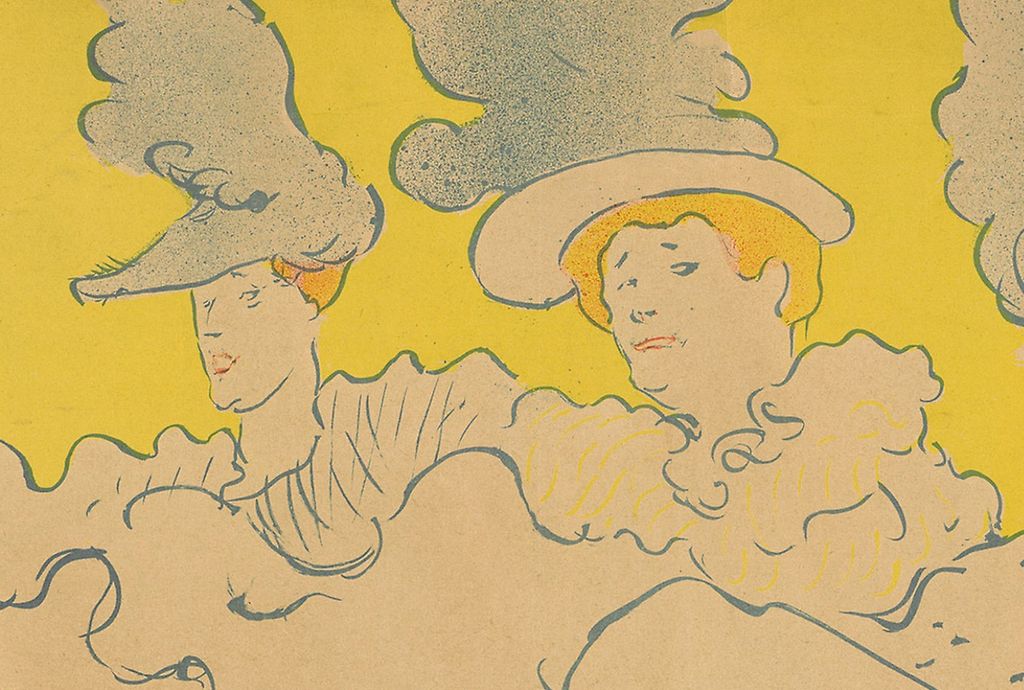
A line of feathered hats
Repeated hats form a moving rhythm above the dancers.
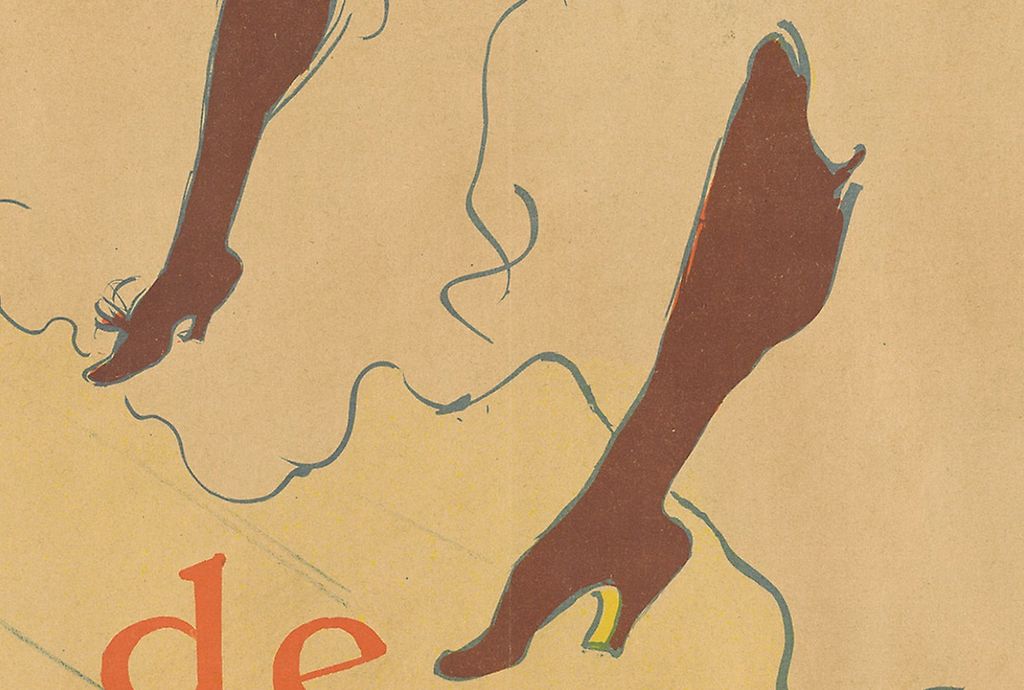
The raised legs
Dark stockings and pale ruffles turn separate poses into a shared pattern.
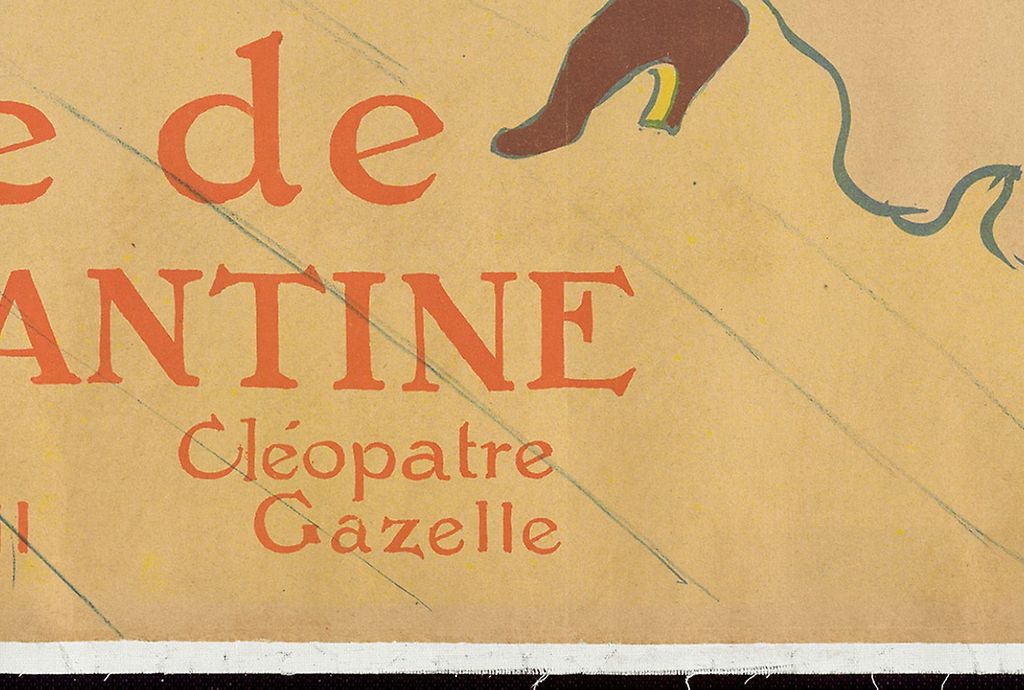
Names across the sheet
The red lettering identifies the troupe within the design.
From a posed photograph to a printed dance
A photograph reproduced by Ludwig provides a particularly revealing comparison. An unidentified photographer arranged the four dancers in a studio, holding their skirts and lifting their legs. The background and floor remain visible, and the cloth falls in heavy, layered folds. The photograph records a held studio pose, with differences in the height and angle of the lifted legs. Ludwig treats the photographic arrangement as a source that Lautrec transformed rather than simply copied. [3]
Compare the skirts. In the photograph, their lower edges hang down between the bodies. In the poster, the hems curl upwards and outwards, carrying the eye from one figure to the next. The separate garments become a larger scalloped shape. The lithograph makes the suggestion of movement stronger by loosening the description of fabric: folds no longer have to account for the full weight and fall of each skirt. Ludwig identifies this change as central to the passage from photographic pose to graphic rhythm. [3]
A preparatory work introduces another stage. Wolfgang Wittrock's 1985 exhibition catalogue reproduces a charcoal-and-gouache composition on cardboard alongside its records of the lithographic poster. The study already gathers the four dancers into a diagonal arrangement, but its broken marks and light touches describe the clothes differently from the continuous contours of the print. Drawing, photograph and printed sheet offer related forms of evidence. Together they show that the apparent immediacy of the finished dance rests on selection and reformulation. [16]
The transformation remains easy to see. The poster retains the group arrangement while changing the relationship between bodies, fabric and surrounding space. It gives us a convincing image of dancing without needing to preserve every detail of a specific studio pose. That achievement concerns the construction of movement within a still picture, rather than a claim that the artist caught the four women at one unrepeatable instant.
Watch: Toulouse-Lautrec
Choose an artist introduction, a film about graphic design or a closer look at At the Moulin Rouge.
Legs, skirts and the rhythm of the line
Start with the dark legs beneath the three rightmost dancers. Their long diagonal shapes give the eye a repeated direction. The gaps between them are unequal, and the pale skirts interrupt their upper ends, but each supplies another strong beat. The line of bodies simultaneously recedes towards the left and spreads across the surface. We can read a row of performers in space and a sequence of coloured shapes on paper.
Avril unsettles that sequence. Both her legs are visible, and her raised knee moves towards the left edge. Her torso also turns away from the more frontal presentation of her companions. The figure seems to open the row rather than close it into a regular formation. Ludwig makes repetition and variation the central terms of her reading: the dance's recurring movements become recurring shapes, while Avril's altered posture prevents their arrangement from becoming mechanically uniform. [3]
The pale areas are just as active as the stockings. Follow a skirt edge and it swells, narrows, doubles back and opens into another ruffle. A sharp indentation can suggest the passage of a leg; a broad curve can carry the fabric beyond the body's apparent width. Because adjacent skirts overlap, the eye does not always stop at the boundary of one dancer. It travels through a longer, shared contour. The group acquires a continuous movement without losing its separate heads and feet.
The upper half repeats this effect more loosely. Plumes curl in one direction and then another; sleeve edges rise into lobes; collars break into short waves. The hats are tall enough to approach the upper border, so their irregular silhouettes occupy space that might otherwise have remained empty. They provide a second register of movement above the kicks. No single plume is an exact duplicate of another, but their repeated expansion makes the row feel coordinated.
Floorboards introduce a quieter rhythm. Fine diagonals cross the lower field and pass behind the inscription, extending the stage towards us. They are much less emphatic than the stockings, yet they help the figures sit on a sloping plane. Ludwig notes how little architectural description the composition needs: the floor provides enough information to suggest performance space while the yellow background remains largely undifferentiated. The eye can keep returning to the dancers without having to negotiate scenery or a crowd. [3]
Three printing colours, many kinds of mark
The Art Institute's 2005 exhibition checklist describes this Chicago impression more precisely than its shorter collection label: yellow, turquoise and red on tan wove paper, laid down on fabric. Those are the documented printing colours of this sheet. They should be distinguished from the many colour names a viewer might use for the effect of inks, paper and their combinations in a reproduction. [17]
In the featured impression, yellow fills much of the upper background while the costumes remain close to the warm tone of the paper. The contours have a muted blue-green appearance, and the stockings look reddish brown. The red lettering is clearer and more concentrated than the softer areas around it. This distribution lets colour perform different tasks: a broad field unifies the setting, thin lines describe the clothes, and denser shapes anchor the lower part of the dance.
Texture gives the hats another distinction. Their plumes contain fine speckling, while the adjacent faces and broad skirt interiors remain comparatively open. The tiny marks supply density without requiring every feather to be drawn. At the right, Gazelle's collar makes a much heavier cluster, setting her pale face between two contrasting masses: the airy plume above and the dark neckpiece below. A restricted palette still accommodates substantial differences in weight and surface.
Different accounts of the print's edition preserve a degree of uncertainty. Colta Ives's Met checklist describes a three-colour lithograph and estimates an edition of approximately one thousand, while MoMA's current record gives its edition as unknown. The estimate is useful as an attributed catalogue account, not a verified count of every sheet distributed. The Met, MoMA and Chicago preserve individual impressions whose measurements and collection histories remain their own. [12] [14] [1]
The names at the dancers' feet
The inscription occupies the relatively open lower left. Troupe de spreads across a broad line, followed by the larger group name and then the four smaller names. Its horizontal emphasis steadies the restless fabric above it. At the same time, the reddish letters connect visually with the warm dark shapes of the legs. Advertising information becomes part of the balance of the sheet.
Ludwig notes, citing Adriani, that the troupe's lettering was not designed by Lautrec himself. The finished advertisement therefore combines his image with lettering supplied separately. His circular monogram and longer signature appear together at the lower left, beside the performers' bill. [3]
Reading down the left name column gives Églantine and Jane Avril; the right contains Cléopâtre and Gazelle. The figures instead place Avril first at the left. The discrepancy helps explain why an inscription is not automatically a positional key. It presents the members of an act, with its own order of billing, rather than placing a caption directly beneath each body. Ludwig connects that ordering to the commission letter while observing that the pictured arrangement follows the photographic group. [3]
Compare the sheet with the 1893 Jane Avril poster. There, a conspicuous double bass and framing curve organise the encounter with one dancer. Here, the group supplies its own sequence of interruptions and repetitions, and the surrounding environment has been reduced. Ludwig places that reduction within a broader change in Lautrec's dance advertisements. [3] The comparison brings the distinctive problem of the troupe poster into focus: four performers must register as one advertised act while retaining enough difference to reward a closer look.
Toulouse-Lautrec artworks directory
Browse 84 identified works and publications in this researched selection. Dates and titles follow the individual records; this is not a complete catalogue of the surviving oeuvre. Print impressions remain attached to their designs. Some listed works do not have a dedicated article. The Drawings guide also contains nine illustrated studies consolidated from former articles.
Frequently Asked Questions
Ludwig reproduces and discusses a posed studio photograph of the troupe. The poster transforms its arrangement, especially in Avril's posture and the moving contours of the skirts. [3]
Discussion
Look again at the images and ideas explored in La Troupe de Mademoiselle Églantine: Four Dancers in Motion. These editorial prompts invite your observations.
Reader Insights
How does Avril's changed posture affect the rhythm established by the other three dancers? Compare the directions of her two legs with the repeated diagonals to her right. [3]
What changes when you read the names after studying the figures? Consider how the billing order and the visual order give prominence in different ways. [3]
Join the Conversation
Share a detail, comparison or question about La Troupe de Mademoiselle Églantine: Four Dancers in Motion below.
References
- Art Institute of Chicago, Mademoiselle Eglantine's Troupe, 1896, accession 1936.220, and its institutional API record: medium, separate image and sheet dimensions, collection credit and featured image. View source 1. View source 2.
- Princeton University Art Museum, La Troupe de Mademoiselle Églantine, 1896, x1970-145, collection commentary on Jane Avril's commission, her position at the left and the Palace Theatre of Varieties announcement. View source.
- Svenja Ludwig, Tanzbilder und Bildbewegungen: Toulouse-Lautrecs Plakate, fotografische Porträts und die Darstellung von Bewegung im Bild, transcript Verlag, 2021, pp. 119–129, commission, photographic source, repetition and variation; pp. 152–156, reduced setting, venue omission and lettering attribution; pp. 169–171, synthesis; figs. 1, 3 and 4, pp. 202, 204–205 (in German). The 19 January 1896 letter is consulted through Ludwig's discussion and citations, not as an independently examined original. View source.
- Baltimore Museum of Art, “Dancing on a Poster: Henri de Toulouse-Lautrec, Troupe of Mlle. Églantine”, teaching sheet, April 2014, opening passage: performers' sequence, Avril at the left and the planned London tour. View source.
- Autoportrait, 1880 (in French). View source.
- ALBERTINA: Der Schimmel Gazelle,GE123DL. View source. (in German).
- Franka Blok, Portrait of Vincent van Gogh, 2024. View source.
- Art Institute of Chicago: Moulin Rouge, La Goulue. View source.
- Art Institute of Chicago: At the Moulin Rouge. View source.
- Jane Avril, 1893. View source.
- Au Salon de la rue des Moulins (in French). View source.
- Colta Ives, Toulouse-Lautrec in The Metropolitan Museum of Art, 1996, p. 67, checklist entry for La Troupe de Mademoiselle Eglantine, dated 1895/96: three-colour lithograph and approximate edition estimate. View source.
- Maurice Joyant (in French). View source.
- Museum of Modern Art, Mademoiselle Eglantine's Troupe, 1896, object 591.1940, current object fields: Jane Avril as publisher, unidentified printer, unknown edition and Rockefeller gift. View source.
- Musée Carnavalet–Histoire de Paris, Troupe de Mlle Églantine, 1896, AFF1983, object and iconographic record, including Églantine Demay, Jane Avril and Gazelle's recorded names (in French). View source.
- Wolfgang Wittrock, “Catalogue of the Exhibition,” in Henri de Toulouse-Lautrec: Images of the 1890s, Museum of Modern Art, 1985, pp. 246–247, entries 285–288: preparatory charcoal and gouache on cardboard and separate poster impressions. View source.
- Art Institute of Chicago and National Gallery of Art, Toulouse-Lautrec and Montmartre, exhibition checklist, 2005, catalogue 176, p. 20: Chicago accession 1936.220, yellow, turquoise and red, tan wove paper and fabric mounting. View source.
- Splash image, Henri de Toulouse-Lautrec, Mademoiselle Eglantine’s Troupe,1896. Colour lithograph on tan wove paper,laid down on fabric. Art Institute of Chicago,1936.220; sheet62 × 79.9 cm. Image source. Public domain. Resized only; native appearance preserved.


 Henri de Toulouse-Lautrec.jpg)