


 by Tom Gurney
Tom Gurney BSc (Hons) is an art history expert with over 20 years experience
Published on June 19, 2020 / Updated on November 3, 2026
Email: tomgurney1@gmail.com / Phone: +44 7429 011000
The Little Pony of Calmese by Henri de Toulouse-Lautrec: Introduction
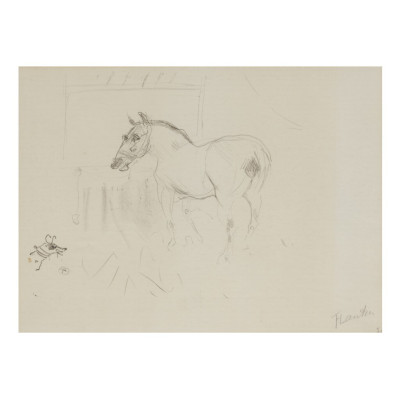
A pony stands inside a lightly indicated enclosure, its head turned towards the left and its body extending across the middle of the sheet. A much smaller dog appears near the lower left corner. Henri de Toulouse-Lautrec leaves large areas pale, making the animals' unequal sizes and the different densities of their marks central to The Little Pony of Calmese.
The work is a lithograph, despite the ease with which its fine lines can be mistaken for an original pencil drawing in reproduction. Sotheby's dates its catalogued impression to 1898; the National Gallery of Art dates its own impression to 1899. The design is therefore discussed here as circa 1898–99, with the catalogue disagreement retained rather than turned into an invented sequence of revisions. [1] [2]
At a Glance
- ArtistHenri de Toulouse-Lautrec.
- French titleLe Petit Poney de Calmèse.
- Mediumlithograph.
- Date1898 in Sotheby's record; 1899 in the NGA record.
- Catalogue referencesDelteil 287, Adriani 282 and Wittrock 304, as reported by Sotheby's.
- Auction impressionprinted in brown-black, numbered 7/15; formerly owned by Alfred Stieglitz and Georgia O'Keeffe. [1]
This work across Henri de Toulouse-Lautrec’s career
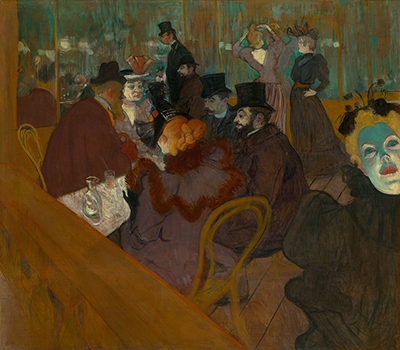
At the Moulin Rouge
1892–1895 [7]Jane Avril
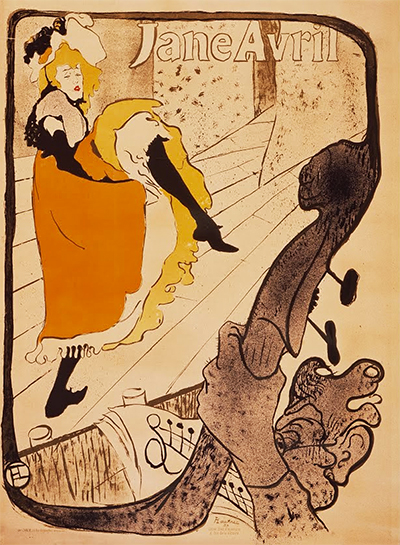
1893 [8]The Little Pony of Calmese (current article)
1898 (Sotheby’s) / 1899 (NGA) [1] [2]Contents
- The pony's body occupies the centre
- The turned head provides a direction
- A small dog changes the scale
- An enclosure drawn with restraint
- Lithographic line and a numbered impression
- Stieglitz, O'Keeffe and a museum loan
The pony's body occupies the centre
The animal is shown at a slight angle rather than in a completely flat side view. Its head turns left, while the broad body reaches towards the right and ends in a more concentrated area around the hindquarters. This change of orientation makes the pony feel substantial even though much of its coat is scarcely filled with tone.
The contour varies in emphasis. Small accents define ears, muzzle and mane; longer lines carry the back and belly. The body can therefore remain lightly described while its outline gives us enough information to understand the animal's size and stance. Lautrec does not need to shade every part equally to make the pony recognisable.
The legs introduce a more complicated set of intervals beneath the body. Their slender lines separate patches of pale paper, and some passages are more emphatic than others. We understand the animal partly through the openings between them. The empty areas are not merely what the artist has left unused: they help define the arrangement of a standing body.
The turned head provides a direction
The head projects into the comparatively open space at the left. Its small changes of contour become important because there is little surrounding detail to compete with them. Ears, forehead and muzzle form a sequence of accents that gives the pony a particular presence without requiring a fully modelled portrait of its face.
That direction also connects the larger animal with the smaller one below. The dog occupies a different level and a much smaller area of the page. The two figures do not have to meet physically for their arrangement to matter. The contrast encourages us to compare scale, posture and the different amounts of line used to make each animal legible.
It would be easy to turn the scene into an invented exchange between the animals. The print does not establish such a story. What it offers more securely is a distribution of attention: the pony dominates the centre, while the dog supplies a compact secondary presence near an edge. Their relationship is visible before any narrative is attached to it.
A small dog changes the scale
The dog is tiny beside the pony, but its darker, busier marks make it noticeable. Its compact shape interrupts a broad pale area in the lower left. Without that interruption, the pony would occupy the sheet more nearly alone. The smaller animal gives the open ground another point of interest and makes the pony's larger body seem more expansive.
The difference is not simply one of measurement. Each animal has a distinct rhythm. The pony's long back, neck and legs require extended lines and broad intervals. The dog is assembled from much shorter changes of direction. Looking between them, we can see how the same printed surface accommodates bodies that demand different scales of description.
The dog's position also keeps the lower edge active. It draws the eye away from the pony's head and towards the space under the larger body. From there, the legs lead us back into the centre. The composition's openness therefore does not produce a single fixed focus. Attention can circulate among the animals and the pale spaces that separate them.
Watch: Toulouse-Lautrec
Choose an artist introduction, a film about graphic design or a closer look at At the Moulin Rouge.
An enclosure drawn with restraint
Behind the pony, a small number of upright and horizontal marks suggest the interior. The setting is sufficient to place the animal within an enclosure without competing with it. We see a relation between body, wall and ground rather than an elaborate inventory of stable equipment.
The background lines are particularly useful for distinguishing the pony's curved forms from straighter surroundings. An upright behind the head or a horizontal edge behind the body gives the animal something to stand against. Yet those marks remain comparatively slight. The setting supports the animal's presence without becoming a separate architectural subject.
This selective description makes the print feel different from a tightly enclosed animal portrait. The pony has space around it, and the enclosure remains partly open to interpretation. The viewer can recognise a practical environment while remaining aware of the paper across which the marks have been distributed. Its lightness is a feature of the composition, not proof that the work lacks a completed printed form.
Lithographic line and a numbered impression
Sotheby's describes its sheet as a lithograph printed in brown-black on wove paper, signed and numbered 7/15. Those details identify an individual impression of the design. They should not be replaced by the generic phrase “pencil sketch,” nor should every physical feature of that sheet automatically be assigned to the NGA's separately catalogued impression. [1]
The distinction becomes especially important at small scale on a screen. Fine lithographic marks can preserve the appearance of freely drawn lines. Their visual immediacy does not tell us that we are seeing the unique drawing from which a printed design might have been developed. Materials and catalogue identity restore information that the reproduction alone cannot provide.
The two dates require similar care. Sotheby's 1898 and the NGA's 1899 are different catalogue datings of the work. They do not independently document a year-long process of making, revising or publishing it. Retaining both makes the uncertainty visible while allowing the image itself to be discussed precisely. [1] [2]
Stieglitz, O'Keeffe and a museum loan
The auction provenance records Alfred Stieglitz's ownership, followed by Georgia O'Keeffe in 1946 and subsequent descent. It also lists a loan to the Museum of Modern Art in 1947. These are facts about the history of the catalogued impression. A museum loan should not be confused with the museum acquiring the sheet. [1]
That collecting history adds another way to encounter the print, but it does not reveal why Stieglitz chose it. The record establishes ownership and later movement, rather than a documented statement of his response to the pony or Lautrec's technique. Keeping that limit clear prevents a plausible account of a collector's taste from becoming an invented personal motive.
For a useful visual comparison, look at Philibert the Pony. Its concentrated head study offers a different arrangement of attention from the complete animal, small dog and lightly indicated enclosure here. The two subjects belong to Lautrec's sustained interest in horses, but each composition needs its own printed identity and physical history.
The openness of The Little Pony of Calmese is its particular strength. The animal occupies a large part of the sheet without filling it, and the small dog makes the surrounding intervals more noticeable. A few lines establish a body, another scale of animal life and a working enclosure. The print asks us to notice how much those limited marks can hold together.
Toulouse-Lautrec artworks directory
Browse 84 identified works and publications in this researched selection. Dates and titles follow the individual records; this is not a complete catalogue of the surviving oeuvre. Print impressions remain attached to their designs. Some listed works do not have a dedicated article. The Drawings guide also contains nine illustrated studies consolidated from former articles.
Discussion
Look again at the images and ideas explored in The Little Pony of Calmese by Henri de Toulouse-Lautrec. These editorial prompts invite your observations.
Reader Insights
How does the small dog change your sense of the pony’s scale?
Which few lines are enough to establish the enclosure?
What can an image’s appearance tell you about whether it is drawn or printed?
Join the Conversation
Share a detail, comparison or question about The Little Pony of Calmese by Henri de Toulouse-Lautrec below.
References
- Sotheby's, Le Petit Poney de Calmèse, 5 March 2020, lot 40: 1898 dating, brown-black lithograph, numbered impression, catalogue references, Stieglitz–O'Keeffe provenance and 1947 MoMA loan. View source.
- National Gallery of Art, The Small Pony of Calmese (Le Petit Poney de Calmese), 1952.8.452: the museum's separately catalogued lithographic impression, dated 1899. View source.
- Autoportrait, 1880 (in French). View source.
- ALBERTINA: Der Schimmel Gazelle,GE123DL. View source.
- Franka Blok, Portrait of Vincent van Gogh, 2024. View source.
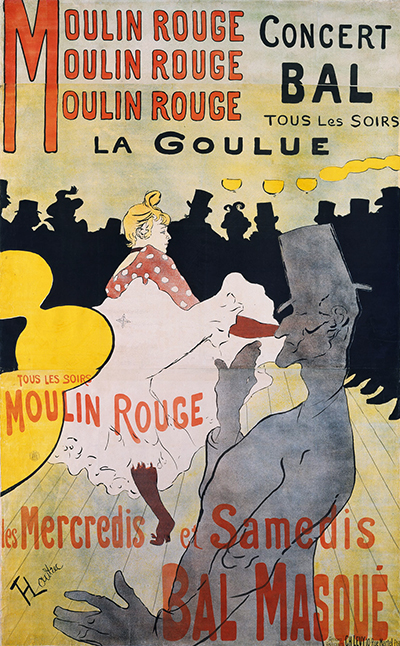
- Art Institute of Chicago: Moulin Rouge, La Goulue. View source.
- Art Institute of Chicago: At the Moulin Rouge. View source.
- Jane Avril, 1893. View source.
- Au Salon de la rue des Moulins (in French). View source.
- Colta Ives, Toulouse-Lautrec in The Metropolitan Museum of Art, 1996. View source.
- Maurice Joyant (in French). View source.
 Henri de Toulouse-Lautrec.jpg)