



 by Tom Gurney
Tom Gurney BSc (Hons) is an art history expert with over 20 years experience
Published on June 19, 2020 / Updated on November 3, 2026
Email: tomgurney1@gmail.com / Phone: +44 7429 011000
At the Moulin Rouge, La Goulue and Her Sister: Introduction
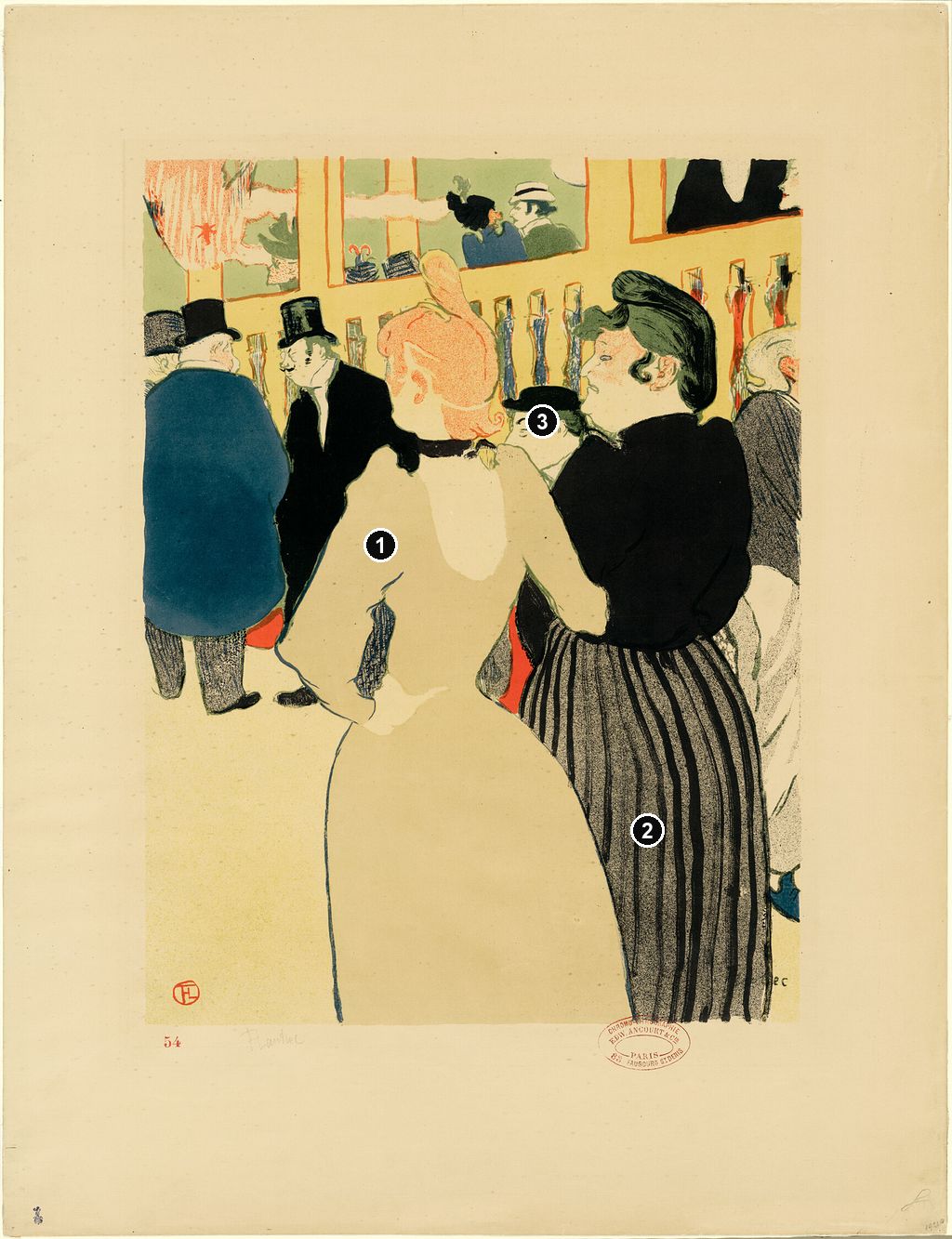
Two women stand so close that their shoulders overlap. Beyond them, top hats, half-hidden faces and small figures in rectangular wall panels fill the room. Yet a broad patch of floor remains almost empty. Toulouse-Lautrec makes the Moulin Rouge feel crowded through the placement of bodies rather than by filling every inch of the sheet.
Made in 1892, At the Moulin Rouge, La Goulue and Her Sister is a colour lithograph whose apparent ease conceals careful choices of outline, pattern and scale. The Art Institute of Chicago holds the impression discussed here, accession 1946.449. [1] Looking closely reveals how an encounter among people becomes an encounter among colours.
At a Glance
- ArtistHenri de Toulouse-Lautrec
- TitleAt the Moulin Rouge, La Goulue and Her Sister. [1]
- Date1892. [1]
- MediumColour lithograph on tan wove paper; the Chicago exhibition checklist specifies brush and spatter lithography. [1] [2]
- Chicago impressionImage 45.7 × 34.7 cm; sheet 65 × 49.8 cm. [1]
- CollectionArt Institute of Chicago, The Charles F. Glore Collection, 1946.449. [1]
- Catalogue identificationWittrock 1, second state of two; Delteil 11, as recorded by Chicago. [1]
- Printing coloursOlive-green, blue, light green, red, yellow and salmon-beige. [2] [3]
This work across Henri de Toulouse-Lautrec’s career
Contents
- Standing just behind the women
- A dancer recognised without a dance
- How six inks build the image
- Empty ground, striped cloth and a crowded wall
- The Japanese comparison: expression through selection
- Three images, three positions for the viewer
- The Chicago sheet and the history it preserves
- Annotated details
Standing just behind the women
The foreground gives us two very different silhouettes. La Goulue, at the left of the pair, has reddish hair piled high, a ribbon at her neck and a pale dress with a deep opening down the back. Her companion's dark upper garment expands into a broad rounded shoulder; below it, a striped skirt runs to the bottom edge. The light dress and dark blouse meet at an irregular boundary formed by the women's arms and bodies. Their closeness is the first fact we register, before we begin to make sense of the room. MoMA's interpretation of the design identifies the high hairstyle and ribbon as features of La Goulue's recognisable appearance. [13]
The women face into the interior, placing us immediately behind them. We see enough of La Goulue's cheek to understand the direction of her head, but we cannot meet her eyes. The other woman's profile is more exposed, its nose and mouth outlined against the pale ground. One figure is recognised largely through costume and the back of her head; the other through the firm sideways contour of her face. The unequal access makes the pair more interesting than two equivalent portraits set alongside one another.
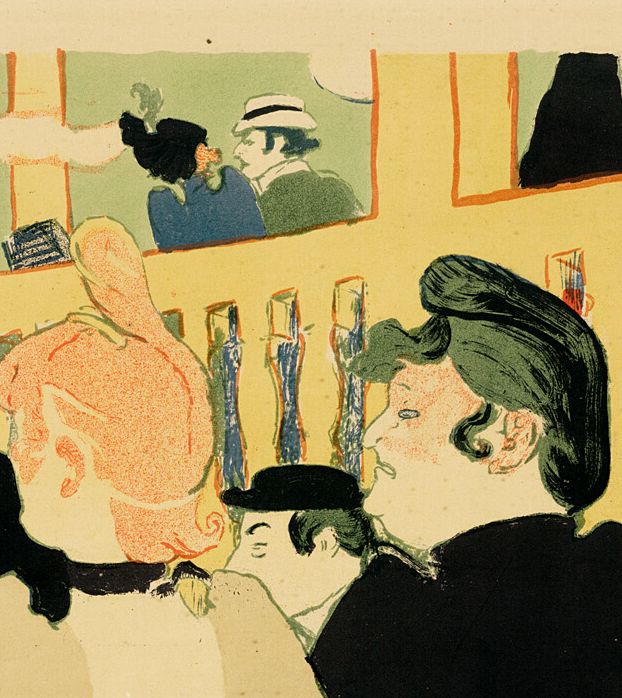
A man in a rounded hat appears in the small interval above their shoulders. His head is sharply legible, but much of his body has disappeared behind them. Farther left, a man in a top hat faces us at an angle, while the bulky blue back of another man blocks part of the view. These overlaps give a clear succession of near and far figures without opening a long, continuous vista. To look into this room is to look around other people.
The broad blue coat is especially important. It balances the dark blouse on the opposite side, keeping the pale central figure between two areas of strong colour. But the two dark masses are not symmetrical: the coat is smaller and higher, while the woman's blouse connects to a striped skirt extending below the frame. That imbalance gives the scene a sideways pull. We seem to have arrived beside a group already arranged for its own purposes, rather than before people posing for our benefit.
A dancer recognised without a dance
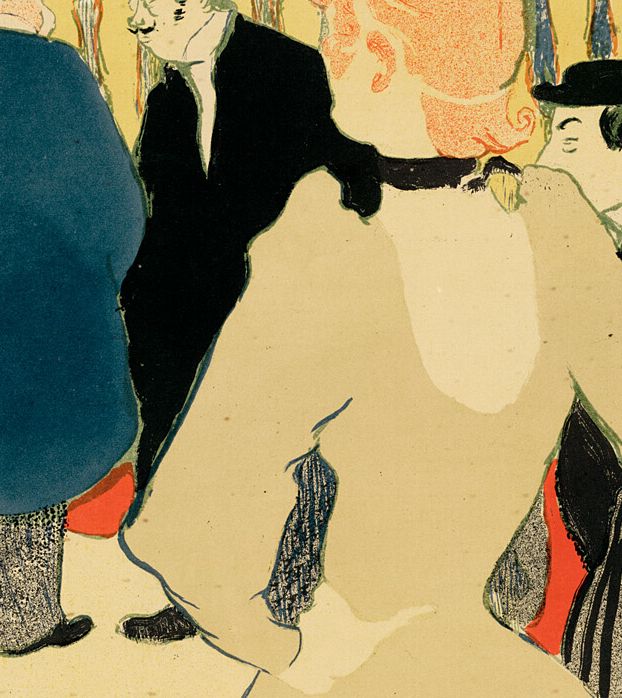
La Goulue was Louise Weber, the Moulin Rouge performer whose public appearance became a recurring subject for Lautrec. The museum label accompanying MoMA's impression stresses that her hairstyle, low neckline and black ribbon could identify her even when her face was turned away. [13] Here the ribbon makes a dark horizontal interruption between the head and the long pale shape of the dress. The upward loop of hair supplies another sign. Both are small enough to be overlooked, yet they make the central woman more than an anonymous figure in evening clothes.
Nothing in the foreground describes a spectacular kick. The interest has moved from a performer's action to her presence among other people. She occupies the same social space as the hat-wearing men around her, and her companion gives an equally substantial shape to the composition. The print allows celebrity to persist during an apparently ordinary interval. Recognition does not depend on showing the activity for which someone is famous.
The words “and Her Sister” belong to the established title used by Chicago and other collections, but the Chicago record supplies no personal name or biography for the second woman. [1] The visible relationship is easier to describe securely. The two stand close, look into the same room and occupy a shared foreground. Their overlapping outlines convey accompaniment without telling us the conversation, occasion or exact nature of their bond.
Nor does a set mouth disclose a particular thought. We can follow the companion's raised chin and emphatic profile while leaving her mood unresolved. The men are similarly reduced to a few distinctive features. Lautrec's selection of hair, hats, collars and noses makes the gathering readable at a glance; it gives us appearances and interactions rather than a complete account of anyone's inner life.
Annotated Details from At the Moulin Rouge, La Goulue and Her Sister
The numbered points identify visible features discussed in this article. Return from each detail to the whole composition. At the Moulin Rouge, La Goulue and Her Sister, 1892, Art Institute of Chicago, 1946.449. Art Institute of Chicago, The Charles F. Glore Collection. Image source. Public domain. Resized only; native appearance preserved.
Details from AT THE MOULIN ROUGE, LA GOULUE AND HER SISTER
Compare the cropped details with the complete images above. Notice how their colours, shapes and positions contribute to the larger compositions.
La Goulue’s pale back
The pale back and red hair separate La Goulue from surrounding darker clothing.
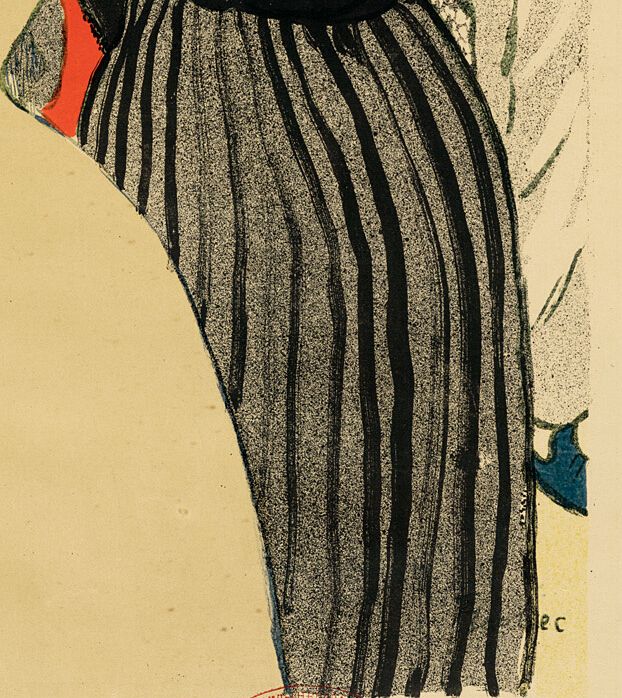
The companion’s striped skirt
The striped skirt gives the broad companion a contrasting rhythm.
The smaller watching faces
Small heads and dark hats crowd the space above the foreground figures.
How six inks build the image
The most revealing technical evidence concerns this particular design. In his study of Lautrec's printmaking, Phillip Dennis Cate explains that colour proofs at the Bibliothèque Nationale preserve the final order of its six stones: olive-green, blue, light green, red, yellow and salmon-beige. The Chicago exhibition checklist independently names the same six inks for accession 1946.449. [3] [2] The colour scheme was therefore a sequence of separately prepared printing operations, rather than a wash of colour added to a finished monochrome image.
Cate makes a more precise observation about the first stone. The initial drawing, or key stone, had helped establish the subsequent colour separations, but much of it was erased before the final printing. Olive-green consequently ceased to act as an outline governing the whole image and became a colour in its own right, defining parts of the companion's clothing. [3] A preparatory guide was transformed into one participant in the finished arrangement.
This helps explain why the print should not be imagined as a colouring-book outline filled with subordinate tints. A large coloured area can do the work of drawing. The edge of a blouse establishes the shoulder and upper arm; a pale shape describes the exposed back; a continuous blue field brings a coat forward. Lines still matter, but the design does not require every object to receive an identical enclosing border.
The six inks also need to be understood as selected colours. Cate distinguishes this approach from the four-colour system he describes in Lautrec's 1891 Moulin Rouge poster, where overlapping printing colours could create another hue. For the 1892 prints he emphasises the juxtaposition of solid colours and the use of premixed inks. [3] Here olive-green and salmon-beige are part of the planned palette. Their presence is not evidence that every secondary colour was generated by superimposing red, yellow and blue.
The distinction matters when we look at the companion's upper garment. It reads as a very dark mass, but “dark” is a visual effect, not a reliable identification of black printing ink. Chicago's list names olive-green among the six colours and includes no separate black stone. [2] The print can produce a powerful opposition of light and dark while using a more particular and less obvious set of inks.
Cate also separates the artist's preparation and correction of images from the printer's production of an edition: proofs were pulled for Lautrec to correct or approve before the edition was printed. [3] For its separate impression, MoMA names Edward Ancourt as printer and Boussod, Valadon et Cie as publisher, and records an edition of 100. [13] The apparently spontaneous encounter was made through a process that allowed repeated inspection and adjustment.
Watch: Toulouse-Lautrec
Choose an artist introduction, a film about graphic design or a closer look at At the Moulin Rouge.
Empty ground, striped cloth and a crowded wall
The lower left is surprisingly open. After the small feet of the men, a broad pale area reaches towards the bottom edge with little to interrupt it. La Goulue's skirt is almost as lightly articulated. A long contour at its left and the adjoining striped skirt at its right do much of the work of separating her body from the room. The economy makes the figure seem immediate: we recognise a dress without needing a full inventory of folds.
On the right, the stripes offer the opposite experience. Their repeated dark curves make a dense field, carrying the companion's body downwards and suggesting the fullness of cloth around it. They also reinforce the skirt as a flat pattern. The eye can follow the shape of a garment or enjoy the repeated marks across the paper. The print holds both readings together.
Above the heads, the room becomes busier. A row of narrow hanging forms establishes a repeated vertical rhythm, while the upper rectangular panels contain further heads and shoulders. The small figures are squeezed into horizontal spaces close to the top edge. These separate compartments keep the eye moving without resolving into one deep architectural view. The wall is both part of the setting and an organised field of signs.
There are smaller interruptions within this regularity. A light hat contrasts with the dark head beside it in an upper panel. At the far right, another pale head and a fragment of clothing are cut by the edge. Such fragments imply that the gathering continues outside the rectangle. They also prevent the two foreground women from being isolated as a self-contained pair. Their encounter belongs to a room containing many other encounters.
Chicago's checklist specifies brush and spatter, a useful reminder that broad colour does not mean a mechanically uniform surface. [2] The printed fields can contain fine texture while retaining clear boundaries. Seen in reproduction, that texture gives the pale dress and surrounding ground a different character from the emphatic stripes. Surface variation and simplified shape work together, rather than cancelling each other out.
The Japanese comparison: expression through selection
Colta Ives places this lithograph beside Sharaku's actor portrait Ōtani Oniji III as Edohei in her Metropolitan Museum catalogue. Her discussion connects Lautrec's performer images with the forceful simplification of faces in Japanese actor prints. [11] The comparison gives us a concrete way to look at the companion's profile: the lifted hair, compact eye, projecting nose and sharply turned mouth are a small number of decisions with a large expressive effect.
Sharaku's portrait, reproduced beside Ives's discussion, also combines a pale face, emphatic dark hair and patterned clothing. A hairstyle can become a prominent shape, and the boundary of a face can carry as much information as detailed modelling within it. In Lautrec's image, the companion's curved hair and the vertical stripes beneath her blouse give different rhythms to the same upright figure. [11]
This does not establish that Lautrec copied a particular pose from Sharaku. Ives offers an interpretation of how Japanese prints helped him think about portraying performers. It is more productive to follow the visual problem than to turn the comparison into a one-to-one source hunt. How much can be removed while a person remains recognisable? How much expression can be carried by an outline? Those questions connect this small social scene to Japonisme while remaining visible within the print itself.
Three images, three positions for the viewer
The related La Goulue Entering the Moulin Rouge reverses our position. In that oil painting, dated 1891–92 by MoMA, La Goulue faces us between two companions. Her light dress pushes forward between darker clothes, and the high hairstyle and neck ribbon remain conspicuous. The painting is oil on board, accession 161.1957; it is a separate object from this lithograph. [14]
The difference extends beyond the direction of her face. In the painting, the light dress contains a restless network of pale strokes, and the surrounding bodies almost close the room behind her. In the print, the dress becomes a much broader field, and the group is placed against a more regularly divided background. Changing the viewpoint also changes the distribution of attention. The painted face invites sustained examination; the printed back allows the neighbouring figures and wall patterns to compete with it.
The 1891 Moulin Rouge: La Goulue poster sets up another relationship. Chicago's 2005 checklist identifies that work separately as a poster in black, yellow, red and blue. [2] Its enormous lettering announces the venue and performer; the spread of the dancing skirt makes action central. Here, the tall advertisement's spectacle gives way to the closeness of people standing in the room. There is no comparable block of promotional lettering to tell us what to attend.
These differences help explain why repeated appearances of La Goulue do not become interchangeable likenesses. The poster places us before an attraction, the painting confronts us with an approaching group, and the lithograph brings us just behind the women. Recognisable features survive each transformation, but the spectator's relationship to the performer changes. In this print, the star is also someone through whom we enter a shared social space.
The Chicago sheet and the history it preserves
The Art Institute records its impression as the second of two states, Wittrock 1 II/II, with an image measuring 45.7 × 34.7 cm on a sheet of 65 × 49.8 cm. Its paper is described as tan wove. [1] The distinction between image and sheet is important: the printed scene occupies only part of the physical object. Its margins and paper belong to the history of an individual impression, even when a reproduction concentrates our attention on the composition.
The 2005 Toulouse-Lautrec and Montmartre checklist lists this same accession as catalogue 57 and marks it “Chicago only.” It therefore documents the appearance of this particular sheet in the Chicago exhibition, rather than merely the inclusion of the design somewhere in a touring show. [2] The detailed ink description in that entry lets museum documentation and technical scholarship reinforce one another.
Other collections preserve other impressions, with their own measurements, credits and histories. MoMA's copy, for example, is accession 139.1946, a gift of Abby Aldrich Rockefeller. [13] Their common composition allows comparison, but their physical descriptions should remain attached to the separate sheets. That distinction is part of looking carefully at Lautrec's prints: a printed image can be repeated while every surviving impression remains an object with its own evidence.
Toulouse-Lautrec artworks directory
Browse 84 identified works and publications in this researched selection. Dates and titles follow the individual records; this is not a complete catalogue of the surviving oeuvre. Print impressions remain attached to their designs. Some listed works do not have a dedicated article. The Drawings guide also contains nine illustrated studies consolidated from former articles.
Frequently Asked Questions
“Her Sister” is part of the historical title retained by the Art Institute. Its collection record does not give the companion a personal name or establish a fuller family biography. [1]
Discussion
Look again at the images and ideas explored in At the Moulin Rouge, La Goulue and Her Sister. These editorial prompts invite your observations.
Reader Insights
How does the open floor at the lower left affect the sense of crowding around the women's shoulders?
What happens to your recognition of La Goulue when you compare this rear view with the frontal painting and the dancing figure in the poster?
Join the Conversation
Share a detail, comparison or question about At the Moulin Rouge, La Goulue and Her Sister below.
References
- Art Institute of Chicago, At the Moulin Rouge, La Goulue and Her Sister, 1892, accession 1946.449. Current public collection API record: title, medium, paper, image and sheet measurements, credit and catalogue identifications. View source.
- Art Institute of Chicago, Toulouse-Lautrec and Montmartre: Exhibition Checklist—Chicago Only, 2005, PDF pp. 1 and 3, cats. 10/51 and 57. Exact Chicago poster and six-colour lithograph entries; checklist rather than the full exhibition catalogue. View source.
- Phillip Dennis Cate, “The Popularization of Lautrec,” in Henri de Toulouse-Lautrec: Images of the 1890s, Museum of Modern Art, 1985, printed pp. 81–82; also Wolfgang Wittrock's catalogue introduction, printed p. 94, and entries 2–3, printed p. 97. Consulted passages distinguish colour systems, the six-stone sequence, key-stone revision and artist/printer roles; catalogue reproduction used for close looking. View source.
- Autoportrait, 1880 (in French). View source.
- ALBERTINA: Der Schimmel Gazelle,GE123DL. View source. (in German).
- Franka Blok, Portrait of Vincent van Gogh, 2024. View source.
- Art Institute of Chicago: Moulin Rouge, La Goulue. View source.
- Art Institute of Chicago: At the Moulin Rouge. View source.
- Jane Avril, 1893. View source.
- Au Salon de la rue des Moulins (in French). View source.
- Colta Ives, Toulouse-Lautrec in The Metropolitan Museum of Art, 1996, printed pp. 34–35, figs. 34–35. Sharaku comparison and reproductions of the actor portrait and the Met's separate impression, 41.12.18. View source.
- Maurice Joyant (in French). View source.
- Museum of Modern Art, At the Moulin Rouge, La Goulue and Her Sister, 1892, accession 139.1946. Object record and 2014–15 gallery label: printer, publisher, edition and recognition through costume and hairstyle. View source.
- Museum of Modern Art, La Goulue at the Moulin Rouge, 1891–92, accession 161.1957. Current object record, medium and date; painting reproduction consulted for comparison. View source.
- Splash image, At the Moulin Rouge, La Goulue and Her Sister, 1892, Art Institute of Chicago, 1946.449. Art Institute of Chicago, The Charles F. Glore Collection. Image source. Public domain. Resized only; native appearance preserved.


 Henri de Toulouse-Lautrec.jpg)