


 by Tom Gurney
Tom Gurney BSc (Hons) is an art history expert with over 20 years experience
Published on June 19, 2020 / Updated on November 3, 2026
Email: tomgurney1@gmail.com / Phone: +44 7429 011000
Woman before a Mirror by Henri de Toulouse-Lautrec: Introduction
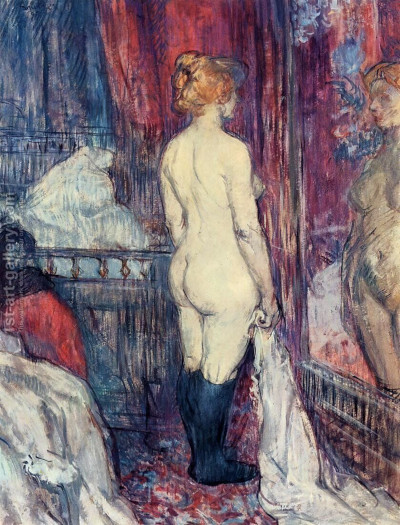
A pale back rises against a red interior. Beside it, a second body appears in the mirror, darker and much less distinct. In Woman before a Mirror, Toulouse-Lautrec lets us see the same woman from two directions while giving those views strikingly different degrees of clarity. The Metropolitan Museum of Art dates the painting to 1897. [1]
The mirror promises to reveal what the turned body conceals. Look closely, however, and the reflected face remains elusive. The room becomes more legible while the woman's expression stays uncertain.
At a Glance
- ArtistHenri de Toulouse-Lautrec
- Museum titleWoman before a Mirror
- Also known asNude Standing before a Mirror
- Date1897
- Current medium descriptionOil on cardboard
- Dimensions62.2 × 47 cm
- CollectionMetropolitan Museum of Art, New York
- Accession2003.20.15
- CreditThe Walter H. and Leonore Annenberg Collection, Bequest of Walter H. Annenberg, 2002
The object facts follow the current Met record. Its support description differs from the wood recorded in Colta Ives's 1996 catalogue. [1] [2]
This work across Henri de Toulouse-Lautrec’s career
Contents
- A back held within a crowded room
- The reflection gives another view, withholds another face
- Furniture sets the viewing distance
- Paint, support and the difference between clear and loose
- A seated back and a hand mirror
- How much can the scene tell us about the woman?
A back held within a crowded room
The standing woman occupies the centre of an upright rectangle, but her body does not face us squarely. Her head turns towards the right, and one shoulder falls away into the arm beside her. The central line of the back curves towards the waist before the hips widen. One leg seems more firmly aligned beneath the torso; the other changes direction. These small inequalities keep the figure from becoming a symmetrical emblem of standing still.
Her hair forms a compact orange-brown shape above the pale neck. Its gathered loops are much denser than the surrounding skin, while a dark passage across the crown pushes the head into the red behind it. From there, the eye travels down through shoulder blades, waist and hips. The body is exceptionally readable at a distance because a largely continuous light area holds together against the darker room.
Closer looking changes that simplicity. Yellow, pink, blue-grey and greenish touches interrupt the flesh. A curving line beside the shoulder blade is more emphatic than the softer marks crossing the upper back. Darker contours collect around the waist and the underside of the buttocks. Some marks describe an anatomical boundary; others move through the interior of the body without becoming a distinct anatomical feature. The rounded form remains legible through this uneven description.
The stockings make a different kind of shape. Their concentrated blackness joins the lower legs into a heavy base beneath the much lighter thighs. Their upper edges are irregular rather than a single horizontal division. At the bottom, the dark forms meet the patterned floor with remarkably little descriptive separation. The figure appears grounded, but we are given no meticulous account of each foot.
The right hand is more intricately articulated. Small hooked contours mark the fingers where they hold a pale cloth. The hand joins two contrasting movements: the arm descends close to the body, while the cloth opens outward and trails towards the lower right. The body has a compact vertical presence; the fabric extends that presence into the room. This modest action becomes a crucial link between the person and the surrounding things.
The reflection gives another view, withholds another face
The tall mirror stands at the right, its near upright edge running just beyond the woman's arm. Within it, the reflected torso turns towards us more fully. The breast, abdomen and upper leg supply information absent from the view of her back. Yet the reflection never achieves the same pale solidity. Dark diagonal marks cross it, and reddish surrounding colour seems to press into its contours.
The difference is especially strong at the head. In the direct view, the gathered hair has a clear outline against the background. In the mirror, a few pale and dark strokes suggest forehead, nose and cheek, but the features fail to resolve into an equally definite expression. The face lies close to the painting's right edge, so that the reflected figure feels restricted by the outer rectangle as well as by the mirror itself.
We can relate the two bodies by following the level of the shoulders and the turn towards the glass, but they have different pictorial weights. The near back asserts its shape; the reflection seems to gather from the room's darker marks. The mirror extends our knowledge of bodily orientation without giving us a second, fully descriptive portrait.
The lower edge helps establish the glass as a furnishing. It slopes down towards the right, and a patterned band beneath it repeats small vertical divisions. The reflected figure ends against that diagonal rather than continuing to the bottom of the painting. Below it, the frame and floor take over. What first appears to be an opening into another space is therefore also a substantial object occupying this room.
Nor does the mirror turn the picture into a complete diagram of the interior. Its red field and decorative fragments enlarge the surrounding colour, but the angle leaves much outside the reflected view. We see no reflected artist or spectator. That absence gives no reliable way to reconstruct who was present when the painting was made. The visible arrangement is enough to establish that our view differs from the woman's: we stand behind her, while her head turns towards a glass at her side.
Looking repeatedly between the pale back and the reflected face makes this disparity more noticeable. The large, clearly bounded mirror attracts the eye, yet its contents stay elusive. Its firm construction and loose image pull attention in different directions.
Furniture sets the viewing distance
At the left, a curved upholstered furnishing enters the foreground beneath a spread of pale fabric. Its dark rounded crest and red section form a firm interruption beside the much lighter cloth. Because it continues beyond the bottom and left edges, we cannot survey it as a complete piece of furniture. We see it from close enough for its full extent to exceed the picture.
Farther back, a rail crosses behind the standing woman's hips. Small turned or spindle-like forms repeat underneath it, and another dark vertical section extends towards the floor. Pale piled material rises beyond the rail. These details suggest a furnished sleeping or dressing interior, although the precise construction of every overlapping object is harder to settle. The repetition of the little supports is clearer than the complete furniture to which they belong.
That horizontal rail has an important compositional task. It approaches the woman's silhouette from the left and disappears behind her. The overlap locates her in front of it, while the rail's level makes the body appear taller. The mirror's upright border provides another measure beside her. Furniture establishes the figure's place through crossings and interruptions rather than through a large open floor.
The red background is full of vertical movement. Long dark streaks rise behind the head and shoulders; warmer orange passages alternate with brown and blue-grey. Those directions echo the standing body and the mirror frame, making the room feel narrow even where no hard architectural boundary can be followed. The figure occupies a setting made from repeated uprights.
At floor level, the arrangement changes. Red and blue-green marks gather into a carpet-like pattern, while the trailing cloth spreads into broad pale folds. The viewer looks down far enough to see these forms around the feet. The foreground furnishing and the floor together establish proximity, but the woman's head remains high in the rectangle. We experience a close view of a standing person, rather than the pronounced overhead inspection of a seated figure.
The large pale cloth at the lower left balances the cloth in the woman's hand without duplicating it. One enters from outside the composition; the other can be followed directly to a grip. Their curved edges guide the eye towards the darker legs between them. The room's fabrics therefore do more than identify a domestic setting. They shape a path through the image, keeping the central body connected to both foreground corners.
Watch: Toulouse-Lautrec
Choose an artist introduction, a film about graphic design or a closer look at At the Moulin Rouge.
Paint, support and the difference between clear and loose
The current museum description identifies oil on cardboard. Ives's 1996 Met catalogue describes the same composition as oil on wood, both beneath its full-page reproduction and in the checklist. The checklist also records the signature and date at the upper left and assigns the painting Dortu P.637. These older particulars securely identify the object, even though the support description differs from today's record. [1] [2]
The discrepancy should not be solved by looking for supposed wood grain in a reproduction. Long lines belong to many passages of this painted room, and their presence cannot identify the material beneath the paint. The useful distinction is between the documented support and the handling visible on its surface. The latter can be examined without supplying an unverified explanation for the former.
In the red background, long strokes partly overlap while preserving their individual directions. Across the pale cloth, broader lights run beside dark hooked lines. In the flesh, the touches are often shorter and less continuous, allowing changes of colour to suggest a rounded plane. The same painting alternates between drawing with a brush, spreading colour and building an area through smaller marks.
The mirror makes that variation unusually consequential. Its reflected body contains many conspicuous diagonal strokes, some crossing rather than following the figure. The near back is also visibly worked, but its light area holds together more strongly. Clarity depends on the relation between contour, colour and surrounding darkness, rather than on concealing every trace of the brush. The near figure can look solid while remaining full of separate touches.
That contrast gives a practical way of looking at the surface. Follow one shoulder until its boundary grows uncertain, then notice which neighbouring dark stroke restores it. Follow a fold until it ceases to describe cloth and becomes a streak of colour. Such changes are central to the painting's appearance. They do not establish how many sittings it required, the precise mixture of its paint or the treatment history of its support. Lautrec's wider style and technique offers other examples of this interplay, while each work retains its own material history.
A seated back and a hand mirror
The comparison with Rousse (La toilette) begins with a familiar combination: gathered red hair, a back turned towards the viewer, pale cloth and dark stockings. Orsay dates that oil on cardboard to 1889. [11] Its figure is seated, and the view comes more steeply from above. Wicker chairs, an open vessel and the rising floor organise the space around her.
In the 1897 painting, standing changes the relationship between body and room. The back extends into a much longer sequence from head to hips to dark lower legs. Furniture crosses behind it instead of surrounding a seated torso on both sides. Above all, the large mirror returns part of the hidden front to view. The comparison makes the mirror's particular contribution clear: the earlier picture turns attention towards a back, while the later one sets that back beside a less definite alternative view.
The hand mirror in the 1896 Elles portfolio offers a different arrangement again. Wittrock catalogues the colour lithograph as Woman with Mirror—The Hand Mirror, and reproduces the woman holding the small oval glass away from her face. [12] Her hand, forearm and turned head make the direction of attention conspicuous. The object is portable and visibly positioned through a gesture.
The tall glass in the Met painting belongs more forcefully to the room. The woman's hand is occupied by cloth, and the reflection extends through a much larger area. The small mirror in Elles makes looking legible as an action; the standing mirror makes two views coexist within one interior. These are related pictorial questions with different answers. Similar hair, undress or a recurring grooming motif does not establish that the same person appears in all three works.
How much can the scene tell us about the woman?
Museum interpretation has often centred on the woman's self-scrutiny. The Met's collection commentary reads her encounter with the mirror as a severe appraisal, while acknowledging that her expression is not disclosed. Cora Michael's 2010 essay develops the idea of bodily assessment and places the painting within Lautrec's depictions of sex workers. These are curatorial readings of the represented scene, rather than the sitter's testimony or a personal identification. [1] [13]
The composition supports a narrower but still absorbing observation: the woman directs her head towards the mirror while we see her largely from behind. The painting divides attention between someone looking and someone being looked at. It gives those acts a physical arrangement without telling us what the woman thinks of her appearance. The loose reflected face leaves room for different responses, but cannot verify dissatisfaction, vanity, melancholy or acceptance.
That distinction also affects how we describe the pose. The lowered arm and upright back can be followed precisely; a complete personal story cannot. The cloth might belong to a moment of dressing or undressing, but the image does not show the whole sequence. No depicted client, sign or identifying inscription supplies a name or a securely documented occupation for this individual. Historical context can frame a subject without turning visible nudity into biographical proof.
The things the picture does reveal are specific. The fingers catch the cloth; the stockings anchor the light body; the rail disappears behind the hips; the reflected face fades towards the edge. These details give the woman a particular bodily presence while leaving her history largely unrecorded. Keeping both conditions in view allows close attention to what Lautrec painted without claiming to recover everything about the person who stood before him.
Toulouse-Lautrec artworks directory
Browse 84 identified works and publications in this researched selection. Dates and titles follow the individual records; this is not a complete catalogue of the surviving oeuvre. Print impressions remain attached to their designs. Some listed works do not have a dedicated article. The Drawings guide also contains nine illustrated studies consolidated from former articles.
Frequently Asked Questions
Yes. The standing figure, tall mirror and black stockings identify the 1897 composition catalogued by the Met as Woman before a Mirror, accession 2003.20.15. [1]
It presents another aspect of the standing figure, with the front of the body more visible. Its looser handling makes the reflected face much less definite than the near back. [1]
Discussion
Look again at the images and ideas explored in Woman before a Mirror by Henri de Toulouse-Lautrec. These editorial prompts invite your observations.
Reader Insights
How does the change from the pale back to the darker reflection alter the amount you feel able to see?
Follow the cloth from the woman's fingers to the floor. How does its spreading shape change the narrow vertical arrangement of body and mirror?
Join the Conversation
Share a detail, comparison or question about Woman before a Mirror by Henri de Toulouse-Lautrec below.
References
- Metropolitan Museum of Art, Woman before a Mirror, 1897, accession 2003.20.15, current collection commentary, materials, dimensions and credit line; official Open Access object record. The museum's object image is the basis for the close looking throughout this article. View source 1. View source 2. View source 3.
- Colta Ives, Toulouse-Lautrec in The Metropolitan Museum of Art, 1996, p. 53, fig. 60, and p. 61 checklist: historical wood-support description, signature, date and Dortu P.637; pp. 68–69 for the distinct Elles portfolio and its mirror lithograph. View source.
- Autoportrait, 1880 (in French). View source.
- ALBERTINA: Der Schimmel Gazelle,GE123DL. View source. (in German).
- Franka Blok, Portrait of Vincent van Gogh, 2024. View source.
- Art Institute of Chicago: Moulin Rouge, La Goulue. View source.
- Art Institute of Chicago: At the Moulin Rouge. View source.
- Jane Avril, 1893. View source.
- Au Salon de la rue des Moulins (in French). View source.
- Maurice Joyant (in French). View source.
- Musée d'Orsay, Rousse (La toilette), 1889, RF 2242, current object record and discussion of the high viewpoint (in French). View source.
- Wolfgang Wittrock, “Catalogue of the Exhibition,” in Henri de Toulouse-Lautrec: Images of the 1890s, Museum of Modern Art, 1985, p. 177, entry and reproduction 154, Woman with Mirror—The Hand Mirror, 1896, Wittrock 161, Delteil 185. View source.
- Cora Michael, “Henri de Toulouse-Lautrec (1864–1901)”, Metropolitan Museum of Art, May 2010, final two paragraphs: curatorial interpretation of Woman before a Mirror. View source.
- Splash image, Henri de Toulouse-Lautrec, Woman before a Mirror, 1897. Oil on cardboard, 62.2 × 47 cm. Metropolitan Museum of Art, 2003.20.15. Narrow frame retained in the official reproduction. The Metropolitan Museum of Art, The Walter H. and Leonore Annenberg Collection. Image source. Public domain. Resized only; native appearance preserved.
 Henri de Toulouse-Lautrec.jpg)