



 by Tom Gurney
Tom Gurney BSc (Hons) is an art history expert with over 20 years experience
Published on June 19, 2020 / Updated on November 3, 2026
Email: tomgurney1@gmail.com / Phone: +44 7429 011000
The Photographer Sescau by Henri de Toulouse-Lautrec: Introduction
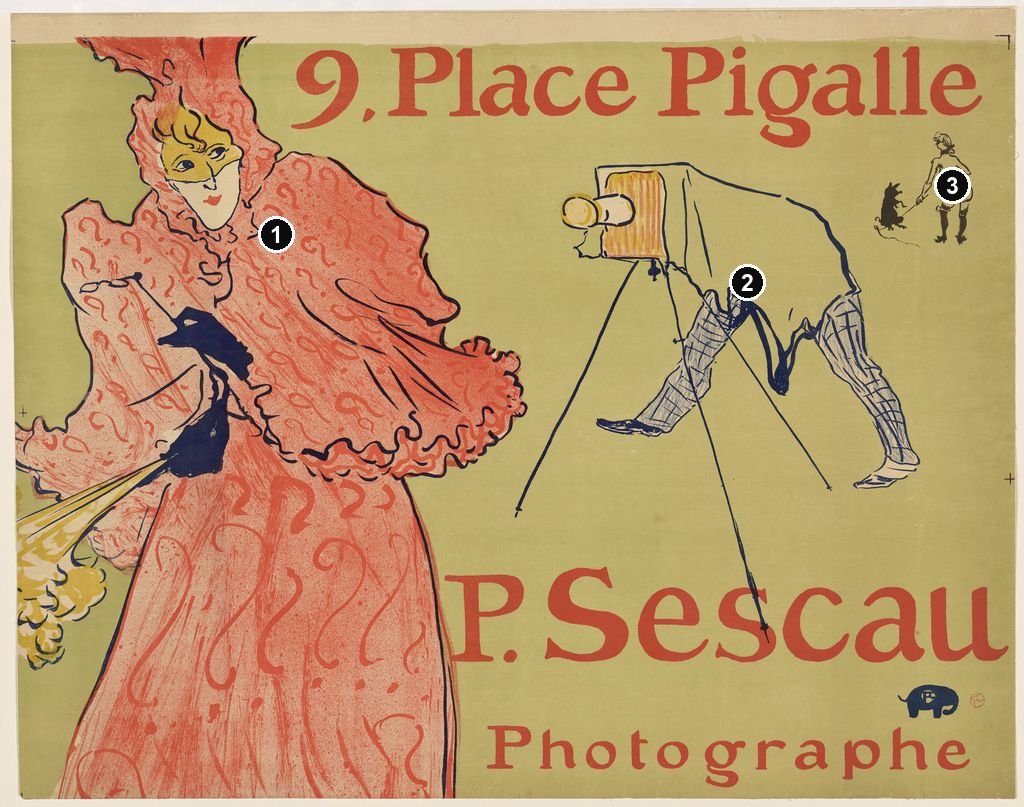
The photographer has disappeared beneath his own equipment. Two trousered legs project from the cloth behind a camera, while a woman in an enormous red dress fills the other side of the sheet. Above them, an address announces where to find the business; below, a name identifies its owner. Toulouse-Lautrec's The Photographer Sescau makes a photographic studio memorable through the peculiar appearance of a person at work. The Art Institute of Chicago dates its colour lithograph to 1896. [1]
The joke depends on unequal visibility. The woman offers a face, gloves and a wealth of patterned clothing. The photographer, whose name is so conspicuous, offers no face at all. Between them, the camera turns looking into an activity with equipment, a working posture and a prospective customer.
At a Glance
- ArtistHenri de Toulouse-Lautrec.
- TitleThe Photographer Sescau, or Le Photographe Sescau.
- Date1896 in Chicago's record and Wittrock's 1985 catalogue; 1894 in the current Met and MoMA records. The difference is discussed below. [1] [2] [3] [4]
- PurposeAdvertisement commissioned by photographer Paul Sescau for his studio at 9 place Pigalle, Paris. [5]
- Medium of the Chicago impressionColour lithograph on ivory laid paper, mounted on linen.
- Chicago image dimensions60.7 × 79.2 cm; sheet 61.1 × 79.2 cm.
- Chicago collectionClarence Buckingham Collection, accession 1959.549. [1]
This work across Henri de Toulouse-Lautrec’s career
At the Moulin Rouge
1892–1895 [10]Jane Avril
1893 [11]The Photographer Sescau by Henri de Toulouse-Lautrec (current article)
1894 / 1896 (records differ)Contents
- A photographer becomes an advertising subject
- The body beneath the cloth
- A dress that pushes against the frame
- Name, address and picture share the sheet
- The date and the individual printed sheet
- Concealment without losing recognition
- Annotated details
A photographer becomes an advertising subject
Paul Sescau was a friend of Lautrec as well as the owner of the studio advertised here. The Phillips Collection identifies him as the commissioner and places the poster among the projects Lautrec undertook beyond the entertainment industry in 1895–96. A studio needed customers, and an advertisement for its services presented a different problem from a poster announcing a dancer's engagement. The image had to make a business recognisable without a celebrated stage act. [5]
Photography already belonged to Lautrec's working and social surroundings. Julia Frey's biographical essay describes Sescau as a neighbourhood photographer and records the use of photographs of posed models in the artist's practice. Frey also mentions other friends taking photographs, so the association does not identify Sescau as the photographer behind every related image. The studio poster gives this broader activity a particularly direct public form. Here photography itself becomes the advertised service, and its practitioner enters the image through the act of using his camera. [15]
MoMA's collection record credits Paul Sescau as publisher of its impression and leaves the printer unidentified. These are separate responsibilities. A photographer could commission and issue his own publicity while a lithographic workshop produced the sheets. The named business on the poster should therefore not be mistaken for the printing firm. The visible camera likewise belongs to the subject represented; the poster itself is a lithograph. [2]
The body beneath the cloth
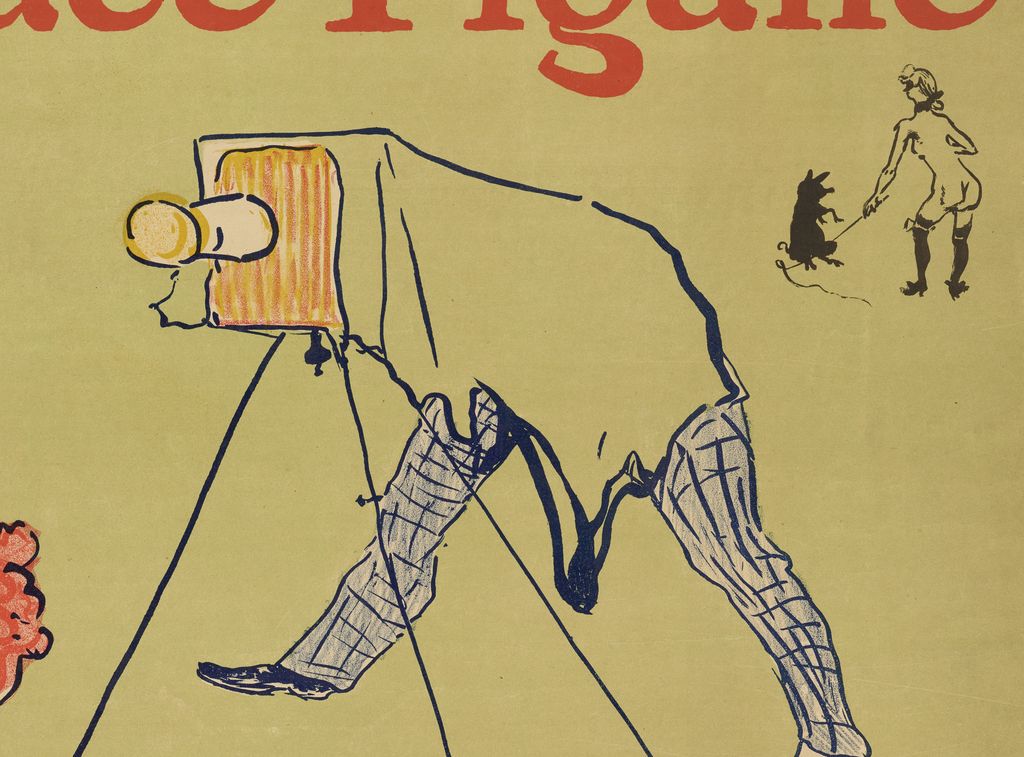
At the right, the camera's lens points towards the woman. Its cylindrical projection and rectangular front are among the few objects described with something approaching solid volume. Behind that front, the pale covering expands and then drops into an irregular outline. The photographer's head and upper body are concealed. There is no portrait likeness to match against the name below.
Instead, posture makes the person intelligible. One trousered leg extends forward, the other back, and both bend at the knee. Their checked pattern gives them more internal detail than the covering above. The shoes turn in different directions, making the stance look awkwardly expansive. The cloth could initially be mistaken for the outline of a strange creature, but the recognisable trousers return that shape to an ordinary human activity. The comedy lies in how far the working body can be simplified while remaining readable.
The tripod adds a second set of legs. Its narrow black lines descend at angles beneath the camera, crossing the open background and extending towards the lettering. Human and mechanical supports occupy the same small area, yet their different thicknesses keep them distinct. The photographer's knees supply bent, clothed forms; the tripod supplies long straight strokes. Following those strokes is a useful way to separate the apparatus from the person hidden behind it.
Lautrec provides almost none of the surrounding furniture that might establish a studio interior. The pale green field does not describe a detailed floor meeting a wall, and no backdrop encloses the prospective sitter. This removal leaves the working arrangement unusually exposed. We can read the relationship between woman, lens and operator without being asked to reconstruct a whole room. The camera identifies the service; the curious stance gives it a memorable human presence.
Annotated Details from The Photographer Sescau
The numbered points identify visible features discussed in this article. Return from each detail to the whole composition. Henri de Toulouse-Lautrec, The Photographer Sescau, dated 1896 by BnF and Chicago; other museums give 1894. Impression with remarque and yellow mask. Bibliothèque nationale de France, RESERVE DC-365-FT 5; reproduction via Wikimedia Commons. Henri de Toulouse-Lautrec; Bibliothèque nationale de France, département Estampes et photographie, RESERVE DC-365-FT 5; reproduction via Wikimedia Commons. Image source. Public domain. Resized only; native appearance preserved.
Details from THE PHOTOGRAPHER SESCAU
Compare the cropped details with the complete images above. Notice how their colours, shapes and positions contribute to the larger compositions.
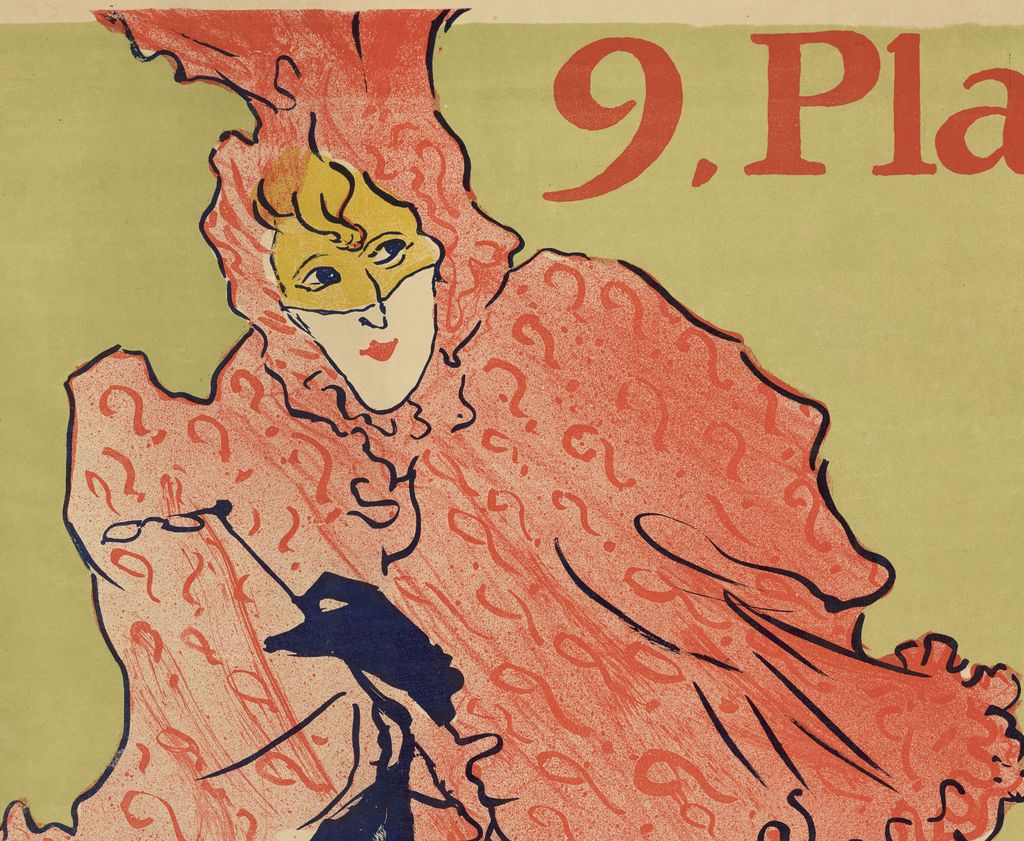
The masked figure
Patterned costume and black gloves make the posing figure visually conspicuous.
The photographer and camera
The camera and covering cloth turn the photographer’s work into a recognisable silhouette.
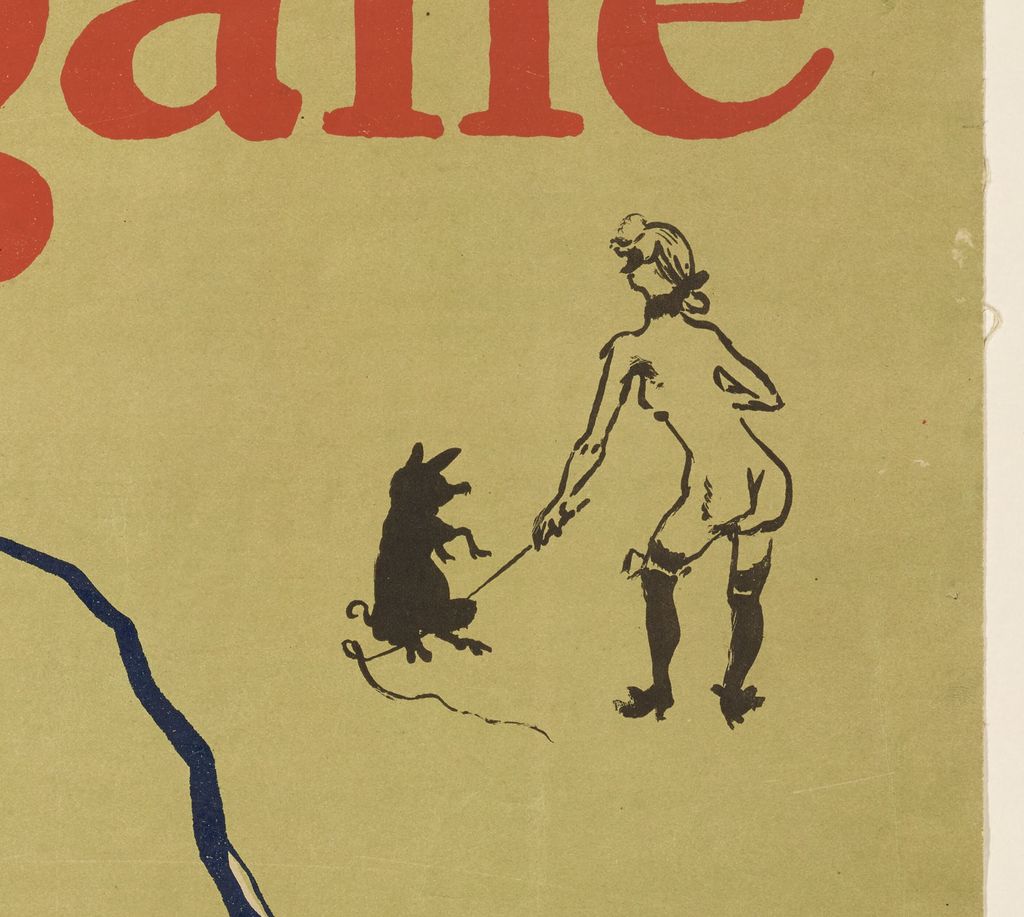
The upper-right remarque
The small additional figure distinguishes this illustrated sheet from impressions without the remarque.
A dress that pushes against the frame
The woman commands attention differently. Her clothing spreads across much of the left half, and the sheet cuts through it at the side and bottom. Red fabric above her head also meets the upper edge. She seems too large for the space available to her, whereas the photographer occupies a comparatively compact island of detail. Their unequal sizes prevent the encounter from settling into an evenly balanced illustration.
The dress contains several different kinds of movement. Long red curves travel down the skirt; smaller curls and loops cover the upper fabric. At the shoulder and sleeve, a dark scalloped outline gathers that pattern into a ruffled boundary. Some lines describe folds, while others belong to the decorative surface. The eye passes between the two without needing every mark assigned to a seam or an ornament. A broad red shape remains readable at a distance, then breaks into many separate paths as we look more closely.
The black gloves provide a stronger interruption than the dress's pattern. One sits higher against the body; the other grips the yellow object extending towards the left edge. Their dense colour connects the hands across a busy area of costume. The small pale face, framed by yellow hair and red fabric, provides another concentrated point of attention. Clothing takes up much more space than features, but the few facial lines keep the woman from becoming merely a patterned mass.
The Phillips Collection interprets her as hurrying away and connects the encounter to Sescau's supposed reputation as a philanderer. That is an attributed reading of the joke, rather than an identity for the woman or a documented account of an actual sitting. Her turned body and streaming clothing permit a lively narrative, but they cannot establish who posed, what relationship the figures had, or why she is moving. The visual comedy remains effective without supplying those missing particulars. [5]
Her proximity also changes our position. We encounter her costume before reaching the smaller photographer across the open ground. The lens directs attention towards her, while her face remains available to us outside the camera's view. The arrangement makes the act of being photographed something we watch from the side. We see more of the exchange than either a conventional studio portrait or a frontal image of the photographer would provide.
Watch: Toulouse-Lautrec
Choose an artist introduction, a film about graphic design or a closer look at At the Moulin Rouge.
Name, address and picture share the sheet
The lettering does practical work immediately. “9, Place Pigalle” stretches across the top, “P. Sescau” occupies a broad lower band, and “Photographe” specifies the profession beneath it. These are the essentials of a service advertisement: where to go, whose business to seek and what that business does. The image supplies an encounter; the words turn that encounter into directions. [1] [3]
The words also participate in the composition. Their red connects with the dress, carrying colour across a background otherwise dominated by pale green. The address stretches horizontally above the camera, while the name fills an interval below the figure. A long tripod line runs down into the area of the name. Lettering and apparatus occupy one designed surface, even though one gives information and the other represents an object.
This double function is especially clear in the lower half. The woman's dress forms a tall red field at the left; the name answers it across the right. “Photographe” makes a smaller, more widely spaced line below. The hierarchy lets the business owner's name register before the occupational label, but both remain legible. The photographer's head can disappear from the picture because the text carries the identification so emphatically.
Albi's 2025 exhibition account places such designs within the growth of commercial advertising. It describes the need for posters to remain understandable while standing out among competing images on urban walls, and also recognises Lautrec's taste for mysterious compositions. Sescau makes that tension visible: the business information is plain, while the cloth-covered figure takes a moment to decipher. Clear wording and an odd visual puzzle give the viewer different reasons to pause. [16]
The date and the individual printed sheet
Museum records disagree about the date. Chicago gives 1896, the year used by Wolfgang Wittrock in the 1985 MoMA exhibition catalogue. Wittrock lists two colour-poster examples as P22/B and P22/C, with Delteil 353 identifying the design. Colta Ives's 1996 Met checklist instead places Le Photographe Sescau under 1894. The current Met record and MoMA's record for object 594.1997 also use 1894. Here, 1896 follows Chicago and Wittrock, with the alternative retained rather than presented as a different composition. [1] [3] [13] [4] [2]
The physical records need to remain equally specific. Chicago describes ivory laid paper mounted on linen. The Met describes its own impression as a four-colour lithograph on machine wove paper, measuring 62.1 × 79.1 centimetres as a sheet. Those descriptions concern separate surviving objects. Paper type, mounting and dimensions cannot be transferred from one museum's example to every reproduction of the image. The familiar design is shared; the material history of each sheet is individual. [1] [4]
Nor should the apparent spontaneity of the outlines obscure the production work. Phillip Dennis Cate distinguishes Lautrec's preparation and correction of lithographic images from the printer's mechanical production of an edition. The sweeping dress and spare tripod could be repeated through printing even though they preserve the character of drawn marks. That combination suits the advertisement: a distinctive encounter becomes a reproducible image tied to one address and one name. The wider account of his prints and posters follows the workshops, publishers and different printed formats behind such sheets. [17]
Concealment without losing recognition
Compare the photographer with the cropped singer in Divan Japonais. In that poster, a performer survives as part of a pale dress and long dark gloves at the upper edge. In Sescau, the operator survives through trousers, shoes and equipment. The comparison reveals two different uses of withheld information: the singer is cut by the frame, whereas the photographer is hidden by a tool of his profession. Both arrangements give a fragment more responsibility than its size might suggest. [3]
The difference also helps explain what is particular to this advertisement. Sescau's concealment arises from the activity being promoted. The image asks us to recognise photography through the person who momentarily vanishes while performing it. The vivid woman catches attention, the machine establishes the service, and the red lettering supplies the business identity. Each contributes something the others leave unstated.
Toulouse-Lautrec artworks directory
Browse 84 identified works and publications in this researched selection. Dates and titles follow the individual records; this is not a complete catalogue of the surviving oeuvre. Print impressions remain attached to their designs. Some listed works do not have a dedicated article. The Drawings guide also contains nine illustrated studies consolidated from former articles.
Frequently Asked Questions
Paul Sescau was a photographer and friend of Toulouse-Lautrec. The Phillips Collection identifies him as the commissioner of this advertisement for his studio at 9 place Pigalle. [5]
No. A cloth conceals his head and upper body behind the camera. His patterned trousers and shoes remain visible beneath it. [3]
It is a lithograph advertising a photographer. Chicago's impression is a colour lithograph on laid paper mounted on linen; the camera appears within the printed design. [1]
Discussion
Look again at the images and ideas explored in The Photographer Sescau by Henri de Toulouse-Lautrec. These editorial prompts invite your observations.
Reader Insights
How much of the photographer could disappear before the activity became difficult to recognise? Compare the cloth's outline with the trousered legs and tripod. [15]
Does your eye reach the woman's face, the camera lens or the red business name first? Consider how the dense pattern of the dress differs from the open space around the equipment. [13]
Join the Conversation
Share a detail, comparison or question about The Photographer Sescau by Henri de Toulouse-Lautrec below.
References
- Art Institute of Chicago, The Photographer Sescau, 1896, accession 1959.549, Clarence Buckingham Collection; complete institutional API record, medium, image and sheet dimensions, date and catalogue identifiers. View source 1. View source 2.
- Museum of Modern Art, The Photographer Sescau (Le Photographe Sescau), dated 1894, object 594.1997, Grace M. Mayer Bequest; publisher Sescau and unidentified printer. View source.
- Wolfgang Wittrock, “Catalogue of the Exhibition,” in Henri de Toulouse-Lautrec: Images of the 1890s, Museum of Modern Art, 1985, p. 248, cats. 289–290, Sescau, P22/B and P22/C, dated 1896, and reproduced composition; p. 232, cats. 259–261, Divan Japonais comparison. View source.
- Metropolitan Museum of Art, The Photographer Sescau (Le Photographe Sescau), dated 1894, accession 32.88.4, Harris Brisbane Dick Fund, 1932; four-colour lithograph, machine wove paper, sheet dimensions and institutional image. View source.
- The Phillips Collection, “The Photographer Sescau”, 9 February 2017, commission, studio address and attributed interpretation of the encounter. View source.
- Autoportrait, 1880 (in French). View source.
- ALBERTINA: Der Schimmel Gazelle,GE123DL. View source. (in German).
- Franka Blok, Portrait of Vincent van Gogh, 2024. View source.
- Art Institute of Chicago: Moulin Rouge, La Goulue. View source.
- Art Institute of Chicago: At the Moulin Rouge. View source.
- Jane Avril, 1893. View source.
- Au Salon de la rue des Moulins (in French). View source.
- Colta Ives, Toulouse-Lautrec in The Metropolitan Museum of Art, 1996, checklist p. 65, Le Photographe Sescau, dated 1894, Met 32.88.4. View source.
- Maurice Joyant (in French). View source.
- Julia Frey, “Henri de Toulouse-Lautrec: A Biography of the Artist,” in Henri de Toulouse-Lautrec: Images of the 1890s, Museum of Modern Art, 1985, p. 32, Sescau, photography and posed models. View source.
- Fanny Girard and Musée Toulouse-Lautrec, Toulouse-Lautrec et l'art de l'affiche, press dossier, 2025, pp. 5–6, advertising purposes, commercial visibility and collecting (in French). View source.
- Phillip Dennis Cate, “The Popularization of Lautrec,” in Henri de Toulouse-Lautrec: Images of the 1890s, Museum of Modern Art, 1985, pp. 81–82, preparation, proofing and printing. View source.
- Splash image, Henri de Toulouse-Lautrec, The Photographer Sescau, dated 1896 by BnF and Chicago; other museums give 1894. Impression with remarque and yellow mask. Bibliothèque nationale de France, RESERVE DC-365-FT 5; reproduction via Wikimedia Commons. Henri de Toulouse-Lautrec; Bibliothèque nationale de France, département Estampes et photographie, RESERVE DC-365-FT 5; reproduction via Wikimedia Commons. Image source. Public domain. Resized only; native appearance preserved.


 Henri de Toulouse-Lautrec.jpg)