



 by Tom Gurney
Tom Gurney BSc (Hons) is an art history expert with over 20 years experience
Published on June 19, 2020 / Updated on November 3, 2026
Email: tomgurney1@gmail.com / Phone: +44 7429 011000
Portrait of Suzanne Valadon: Introduction
Suzanne Valadon faces us beneath an elaborate dark hat, her upright figure surrounded by a restless pattern of trees. The face holds our attention, but almost every part of the painting remains active: blue-violet marks cross the warm earth colours, branches divide the background, and folds gather the blouse towards her waist. Henri de Toulouse-Lautrec painted this portrait in 1885. Its title in the Museo Nacional de Bellas Artes, Buenos Aires, identifies Valadon as an artiste peintre: a painter. That identification is essential to seeing the woman before us, whose artistic work deserves attention alongside the pictures for which she posed. [1]
At a Glance
- ArtistHenri de Toulouse-Lautrec
- SubjectSuzanne Valadon, artist and model
- Date1885
- MediumOil on canvas
- Dimensions55 × 46 cm
- CollectionMuseo Nacional de Bellas Artes, Buenos Aires
- Inventory number2710
- Museum titlePortrait de Suzanne Valadon (Madame Suzanne Valadon, artiste peintre)
The museum’s collection entry and institutional Google Arts & Culture record establish the painting’s identity, date, support and dimensions. [1] [2]
This work across Henri de Toulouse-Lautrec’s career
Contents
- An encounter organised around a face
- Hat, collar and the rhythm of clothing
- Trees, colour and the compressed setting
- An early Paris portrait of another artist
- Valadon beyond Lautrec’s easel
- Three paintings, three different encounters
- Annotated details
An encounter organised around a face
The portrait places Valadon close to the front of the picture, with her torso occupying most of its lower half. There is little intervening space. Her arms reach towards the bottom edge, and her hands fall outside the crop. This removes the small gestures that often explain what a sitter is doing. We cannot follow a hand towards a book, a chair or an object associated with her work. Instead, attention moves upwards through the gathered blouse, the narrow white collar and the face to the striking structure of the hat.
Her head is almost frontal, though its small irregularities prevent it from becoming a symmetrical emblem. The eyes do not make identical shapes; the mouth sits within a subtly uneven arrangement of light and shadow. Dark eyebrows and the shadow beneath the hat give the upper part of the face particular emphasis. The pale collar makes a second, much narrower boundary beneath the chin. Between these dark and light edges, Lautrec gives the features enough definition to remain distinct within a very busy surface.
The museum’s education booklet draws attention to this difference in handling: Valadon is centrally placed in the foreground, with more precise treatment of her face than of the landscape. It also invites viewers to notice the small, visible touches of oil paint. These are useful starting points because the portrait depends on degrees of definition. The eyes and mouth resolve into recognisable features, while the forms beyond her shoulders repeatedly break into separate strokes. [12]
At the same time, the face is far from smoothly polished. Greenish and cool blue touches appear within the warmer flesh colours. Around the cheek, temple and jaw, short marks retain their individual direction rather than disappearing into an even skin tone. Seen from farther away, they help the head emerge as a solid form. Seen closely, they remain a woven surface of colours. The transition between those two experiences is one of the portrait’s pleasures: recognition never quite cancels our awareness of paint.
Valadon’s closed mouth and gaze towards us give the encounter its directness. The absence of an explanatory gesture also leaves it open. A viewer might experience the figure as reserved, attentive or difficult to read. These are responses to the likeness, rather than settled facts about Valadon’s state of mind. The portrait makes a person visually present while preserving something of her distance from us.
Hat, collar and the rhythm of clothing
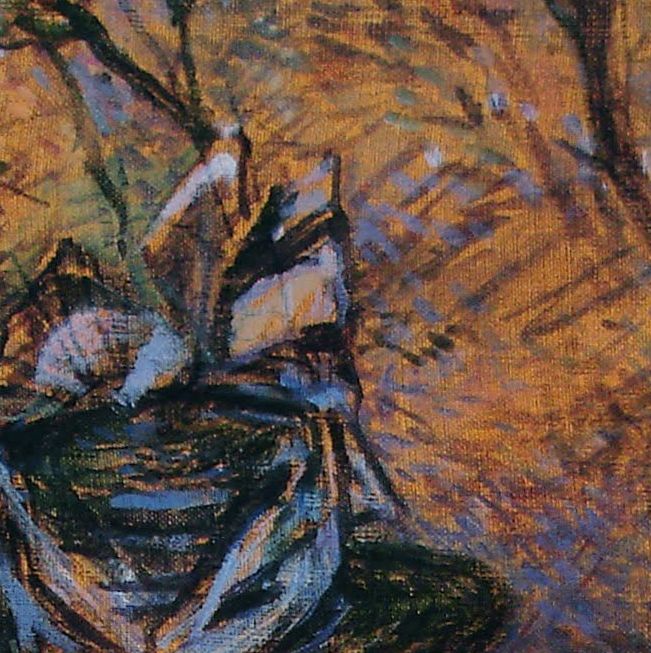
The hat is a substantial presence in its own right. Its broad dark brim spans the head, while folded, ribbon-like forms rise in an irregular cluster above it. Pale blue and violet passages catch along the edges of the folds. Some shapes appear almost flat; others turn sharply into shadow. Their broken, angular construction provides a lively counterweight to the compact oval of the face below.
The hat also changes the proportions of the figure. Valadon’s face occupies a relatively small area within the combined silhouette of headgear and body. Yet its comparatively clear features draw the eye more decisively than the larger, more strongly contrasted forms above it. Lautrec has given the accessory enough visual weight to compete for attention, then organised the surrounding contrasts so that it frames rather than obscures the sitter.
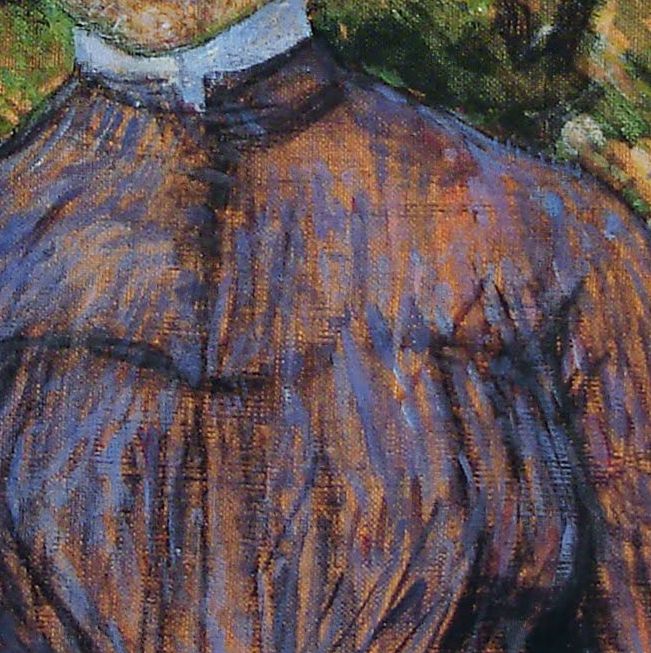
Below the collar, the blouse changes the direction of the painting. Long blue-violet strokes follow the sleeves and descend through the front of the garment. Near the centre, folds converge towards the dark belt. The shoulders spread more broadly, establishing a stable base beneath the narrower head and hat. Warm brown-orange passages show between the cool marks, so that the clothing never becomes one continuous purple area. Colour is broken across the form, even where the garment has a strong, readable outline.
Looking between the blouse and the background reveals an unexpected continuity. Similar warm and cool colours appear in both. The trees contain blue-violet touches; the clothes contain the ochres and browns that dominate the ground behind. Valadon stands out through the arrangement and direction of marks as much as through differences of colour. The strokes in her blouse gather around a body, while those in the setting branch outwards or scatter across the surface.
This makes clothing an active part of the composition rather than a detachable record of fashion. The white collar is particularly economical. Its light strip separates the lower face from the dark neckline, with a small interruption at the centre. It creates a point of clarity amid competing marks and gives the eye a place to pause before descending into the folds. Placement and contrast give this small detail an influence out of proportion to its size.
Annotated Details from Portrait of Suzanne Valadon
The numbered points identify visible features discussed in this article. Return from each detail to the whole composition. Portrait of Suzanne Valadon, 1885, Museo Nacional de Bellas Artes, Buenos Aires, 2710. Image source. Public domain. Resized only; native appearance preserved.
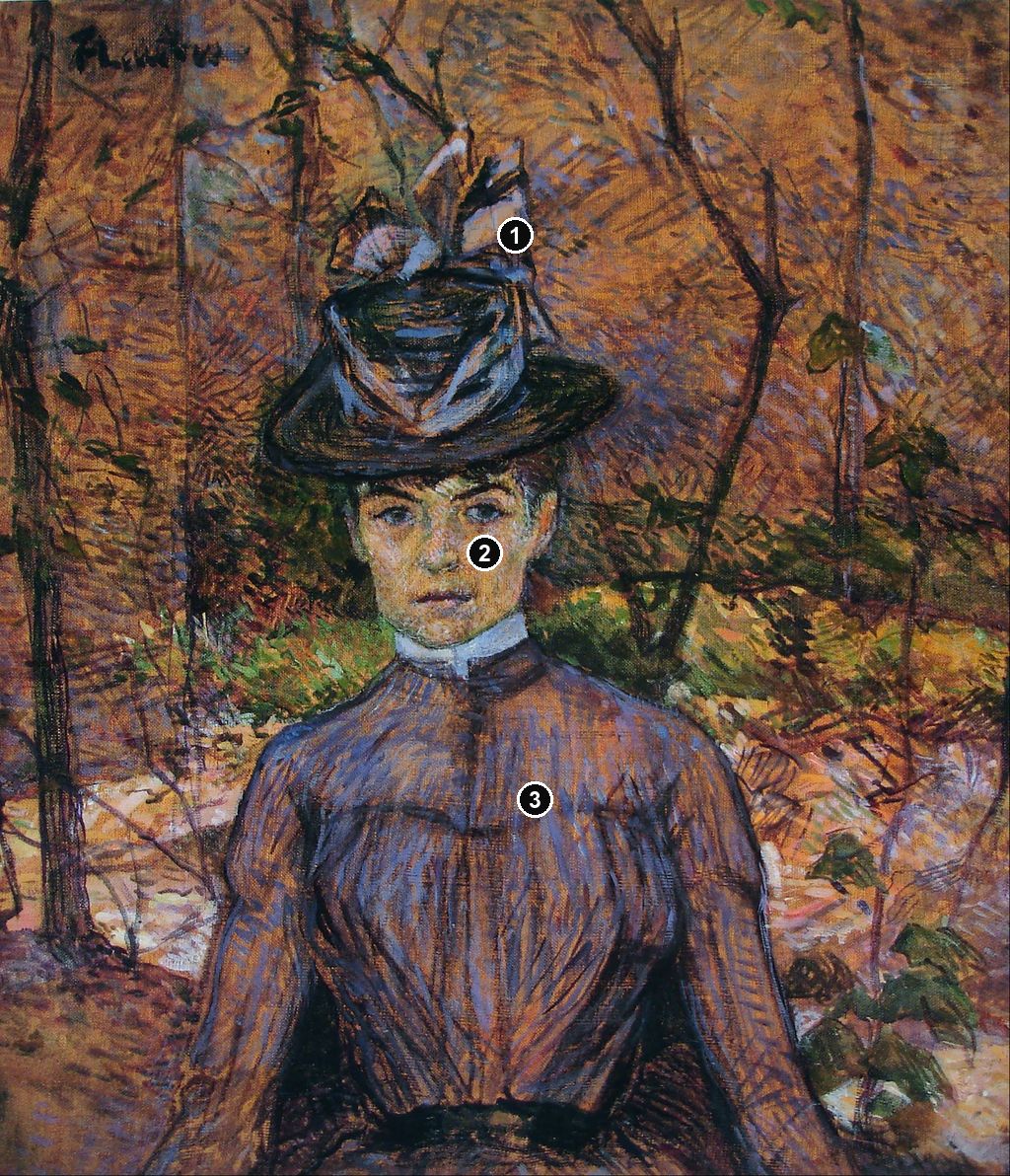
Details from PORTRAIT OF SUZANNE VALADON
Compare the cropped details with the complete images above. Notice how their colours, shapes and positions contribute to the larger compositions.
The folded hat
The tall folded hat gives the portrait a distinctive upper silhouette.
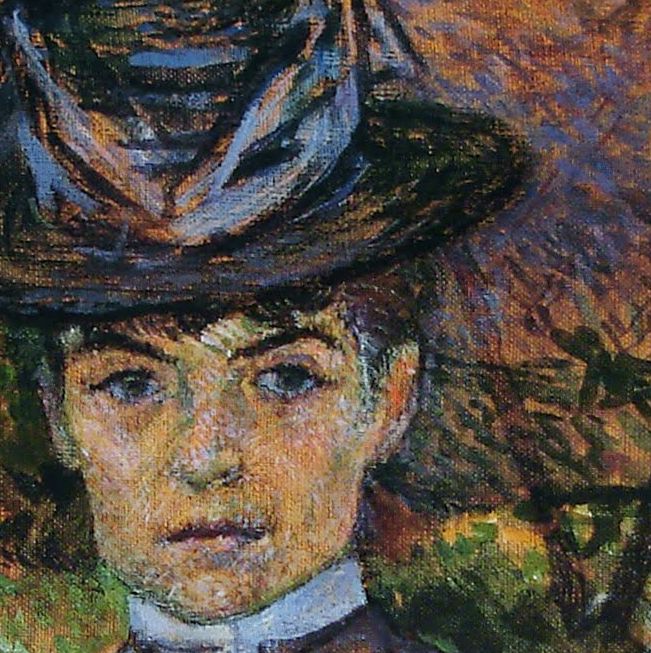
The purple garment
Purple strokes set the sitter against the warmer outdoor colours.
Trees, colour and the compressed setting
The background is recognisably wooded, but it gives little sense of an open vista. Tree trunks rise towards the upper edge and disappear beyond it. Their branches cut across an accumulation of ochre, russet, green and violet marks. Pale patches behind the figure suggest openings through the vegetation, yet no single clear route leads the eye into a distant landscape. Most of the visual activity stays close to the picture’s surface.
The colours suggest an autumnal setting, though they do not establish a date or a precise location for a sitting. More useful than naming a season is observing how the setting works. The thin, dark trunks repeat the long vertical axis of Valadon’s figure, while the spreading branches contrast with her contained outline. A green area behind the lower part of her head helps distinguish the face and collar. On either side of the shoulders, paler marks interrupt the darker vegetation and keep the torso legible.
The density is uneven. At the upper left, the signature occupies a patch within the network of marks. On the right, a dark trunk and branching forms make a firmer framework. Lower down, pale ground and scattered leaves create a different rhythm around the sleeves. The composition consequently feels more responsive than a simple figure placed against a uniformly decorative backdrop. Each neighbouring area alters how sharply or softly an edge is read.
Franka Blok’s 2024 Van Gogh Museum catalogue places the Buenos Aires portrait among the works stylistically related to Lautrec’s 1887 pastel of Vincent van Gogh. Her discussion of that period stresses the growing colour and directness of his portraiture and its dense patterns of short strokes. The comparison helps locate the Valadon painting within an evolving practice of portrait-making, rather than treating its open handling as an incidental lack of finish. [5]
The distinction between materials still matters. The Valadon portrait is oil on canvas; the Van Gogh portrait is pastel on prepared paper over cardboard. Blok’s account of unblended pastel lines concerns that particular work. Here, what we can directly see is the expressive independence of oil-painted marks. Their visibility gives the surroundings a persistent energy, while changes in their direction describe the figure. The two portraits offer a productive comparison without requiring one material to behave exactly like the other. [2] [5]
Watch: Toulouse-Lautrec
Choose an artist introduction, a film about graphic design or a closer look at At the Moulin Rouge.
An early Paris portrait of another artist
The date places this painting within Lautrec’s years of study and experimentation in Paris. The Musée Toulouse-Lautrec’s current chronology records his attendance at Léon Bonnat’s studio in 1882, followed by work with Fernand Cormon; it places his departure from Cormon’s studio in 1887. The portrait therefore belongs to a developing Paris practice already several years under way. It precedes the 1891 Moulin Rouge poster that made his advertising imagery so conspicuous. [13]
Valadon’s position within this artistic world was complex. She earned money as a model while pursuing drawing herself. The Centre Pompidou’s exhibition chronology places these activities alongside one another and records Lautrec’s encouragement of her work. Their relationship brought together two people engaged with the making of images. His encouragement belongs within the history of her developing practice, alongside her own sustained work. [14]
The Buenos Aires title makes this especially clear. Madame Suzanne Valadon, artiste peintre names an artistic identity, although the portrait does not illustrate it with a palette or brush. Barbara Musetti’s museum entry reads the title as an acknowledgment of Valadon’s role as a painter. That is a valuable distinction: the recognition is carried by the naming of the sitter, while the image itself concentrates on her appearance. The title asks us to bring knowledge of her work to an encounter that remains visually open. [1]
The picture’s present institutional home also shapes how it is encountered. In Buenos Aires it belongs to a collection far from the Montmartre studios associated with its making. The museum’s education programme uses it to encourage close observation of a portrait: face, setting, brushwork and the relationship between painter and sitter. This is a particularly apt approach to a painting whose immediate visual impact depends on details that a short biographical anecdote would pass over. [2] [12]
Valadon beyond Lautrec’s easel
Valadon’s own work changes the terms on which this portrait can be understood. The Museu Nacional d’Art de Catalunya’s 2024 retrospective treated her self-portraits as a reclamation of an image previously shaped by male artists. That interpretation does not erase the value of Lautrec’s likeness. It places it beside another kind of evidence: the images in which Valadon decided for herself how a face, a body or a room would be represented. [15]
Her practice extended across drawing, printmaking and painting. The same retrospective describes Degas’s support for her drawing, his teaching of printmaking and his collecting of her work. It also emphasises the importance of the nude in her mature production, where the former model became the artist organising other bodies on the canvas. The reversal concerns authorship and the control of representation, as well as a change in professional standing. [15]
Specific career landmarks make that standing tangible. The Centre Pompidou records her participation in the Salon of the Société nationale des Beaux-Arts in 1894, a solo exhibition at Clovis Sagot’s gallery in 1911, and sustained support from the dealer Berthe Weill. It also records the state’s acquisition in 1924 of La Chambre bleue, painted the previous year. Valadon’s career thus developed through exhibitions, dealers, collectors and public recognition during her lifetime. [14]
Remembering this career enlarges the encounter with Lautrec’s portrait. The woman represented here also looked at others, made decisions about their appearance and produced images that invite equally careful attention. Readers can follow that larger story through Suzanne Valadon’s own art.
Three paintings, three different encounters
Lautrec made more than one portrait associated with Valadon, and the distinctions are useful. The Buenos Aires canvas is the frontal, upright figure among trees. A separate portrait belongs to the Ny Carlsberg Glyptotek in Copenhagen. Its reproduction in the Barcelona exhibition dossier shows a different arrangement of face, hat and clothing, with the head turned more obliquely. Similar titles should not conceal those differences in viewpoint and composition. [15]
Dating also requires care. The Barcelona dossier labels the Copenhagen picture 1885, while Blok’s Van Gogh Museum catalogue gives it as 1886–87. Both sources distinguish it from the Buenos Aires work. The disagreement need not affect the identification of the painting discussed here, whose museum date is 1885, but it cautions against building an exact sequence from titles alone. [1] [5] [15]
The Hangover (Suzanne Valadon), in the Harvard Art Museums, is more different still. Harvard dates it 1887–89. Its horizontal composition shows Valadon in profile, leaning at a café table beside a bottle and glass. The turn away from the viewer and the table’s broad ellipse organise the encounter very differently from the frontal figure and vertical trees in Buenos Aires. Helen Burnham’s account identifies Valadon as posing in the role of a solitary drinker; that represented role should not be converted into an uncomplicated statement about her life. [16] [17]
These comparisons show why the Buenos Aires painting deserves to be seen on its own terms. Its intimacy comes from proximity, direct address and the concentration of detail around the face. Its movement belongs largely to the marks surrounding and describing the figure. Valadon remains upright within that movement, while the painter continually adjusts how strongly she emerges from it.
Toulouse-Lautrec artworks directory
Browse 84 identified works and publications in this researched selection. Dates and titles follow the individual records; this is not a complete catalogue of the surviving oeuvre. Print impressions remain attached to their designs. Some listed works do not have a dedicated article. The Drawings guide also contains nine illustrated studies consolidated from former articles.
Frequently Asked Questions
The 1885 oil on canvas is in the Museo Nacional de Bellas Artes, Buenos Aires, inventory 2710. It measures 55 × 46 cm. [1]
Discussion
Look again at the images and ideas explored in Portrait of Suzanne Valadon. These editorial prompts invite your observations.
Reader Insights
Which most clearly separates Valadon from the background: colour, outline or the direction of the brushwork?
How does knowing that Valadon made portraits herself change your encounter with this likeness?
Join the Conversation
Share a detail, comparison or question about Portrait of Suzanne Valadon below.
References
- Barbara Musetti, Portrait de Suzanne Valadon (Madame Suzanne Valadon, artiste peintre), inventory 2710, Museo Nacional de Bellas Artes, collection entry and commentary (in Spanish). View source.
- Museo Nacional de Bellas Artes, Portrait de Suzanne Valadon (Madame Suzanne Valadon, artiste peintre), institutional Google Arts & Culture record and reproduction. View source.
- Autoportrait, 1880 (in French). View source.
- ALBERTINA: Der Schimmel Gazelle,GE123DL. View source. (in German).
- Franka Blok, Portrait of Vincent van Gogh, Works Collected by Theo and Vincent van Gogh, Van Gogh Museum, 2024, “Pastel crayon,” “Place in Toulouse-Lautrec’s oeuvre,” notes 27–34. View source.
- Art Institute of Chicago: Moulin Rouge, La Goulue. View source.
- Art Institute of Chicago: At the Moulin Rouge. View source.
- Jane Avril, 1893. View source.
- Au Salon de la rue des Moulins (in French). View source.
- Colta Ives, Toulouse-Lautrec in The Metropolitan Museum of Art, 1996. View source.
- Maurice Joyant (in French). View source.
- Museo Nacional de Bellas Artes, Un retrato a cada rato, education booklet, 2021, Valadon portrait commentary (in Spanish). View source.
- Musée Toulouse-Lautrec, Toulouse-Lautrec et l’art de l’affiche, press dossier, 2025, chronology, p. 13 (in French). View source.
- Centre Pompidou, Suzanne Valadon, exhibition chronology, 2025, entries “1880–1887,” “1883–1886,” “1894–1897,” “1911,” “1915–1928” and “1922–1924” (in French). View source.
- Museu Nacional d’Art de Catalunya, Suzanne Valadon: una epopeya moderna, exhibition dossier, 2024, pp. 8–12 and 22 (in Spanish). View source.
- Harvard Art Museums, The Hangover (Suzanne Valadon), institutional Google Arts & Culture record and reproduction. View source.
- Helen Burnham, “Spectacular and Subtle: The Art of Toulouse-Lautrec,” in Toulouse-Lautrec and the Stars of Paris, MFA Publications, 2019, p. 13, publicly available book preview. View source.
- Splash image, Portrait of Suzanne Valadon, 1885, Museo Nacional de Bellas Artes, Buenos Aires, 2710. Image source. Public domain. Resized only; native appearance preserved.


 Henri de Toulouse-Lautrec.jpg)