



 by Tom Gurney
Tom Gurney BSc (Hons) is an art history expert with over 20 years experience
Published on June 19, 2020 / Updated on November 3, 2026
Email: tomgurney1@gmail.com / Phone: +44 7429 011000
The Streetwalker by Henri de Toulouse-Lautrec: Introduction
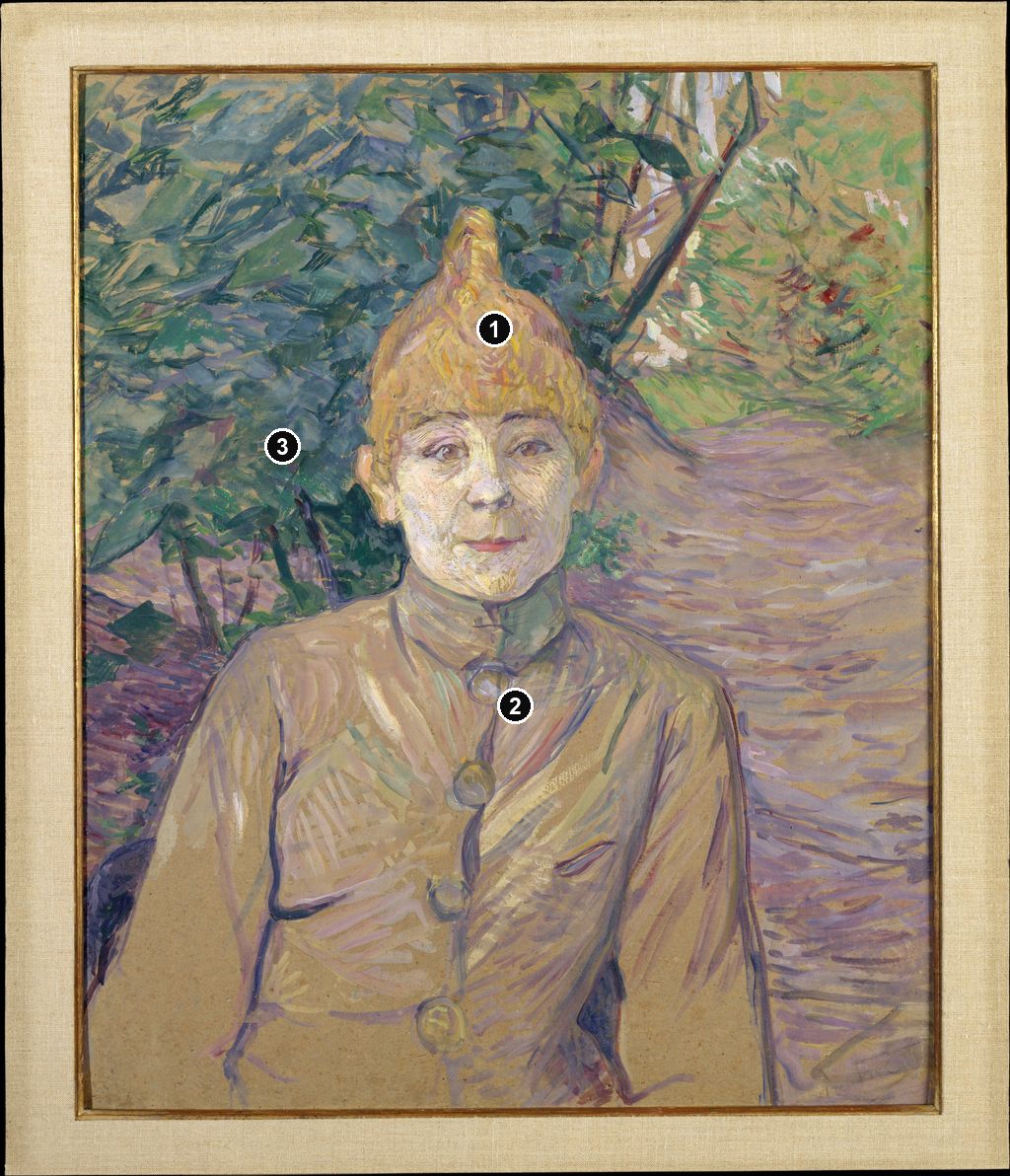
A woman faces us beneath an extraordinary crest of golden hair. Her buttoned coat occupies the foreground; leaves gather behind her head, while a path opens at her shoulder. Henri de Toulouse-Lautrec makes this small encounter in a garden feel remarkably direct. The face holds our attention even as the surrounding paint breaks into restless strokes. The sitter's appearance, the turn of each brushstroke and the opening of the path make the garden an active part of this portrait. [1]
At a Glance
- ArtistHenri de Toulouse-Lautrec.
- TitleThe Streetwalker.
- DateCirca 1890–91.
- MediumOil on cardboard.
- Dimensions64.8 × 53.3 cm.
- CollectionThe Metropolitan Museum of Art, New York.
- Accession number2003.20.13. [1]
This work across Henri de Toulouse-Lautrec’s career
Contents
- A nickname without a recovered name
- Monsieur Forest's garden
- How the pose holds the picture together
- Cardboard, colour and the direction of the brush
- Another sitter in the same garden
- From a garden sitting to a museum collection
- Annotated details
A nickname without a recovered name
The Met states that the woman was identified as a streetwalker by 1901. Her personal name has been lost; the surviving nickname, La Casque d'Or, means Golden Helmet and, according to the museum, refers to her wig. This is the institution's historical identification of the sitter. Her clothing and facial expression do not independently establish an occupation or supply a biography. [1]
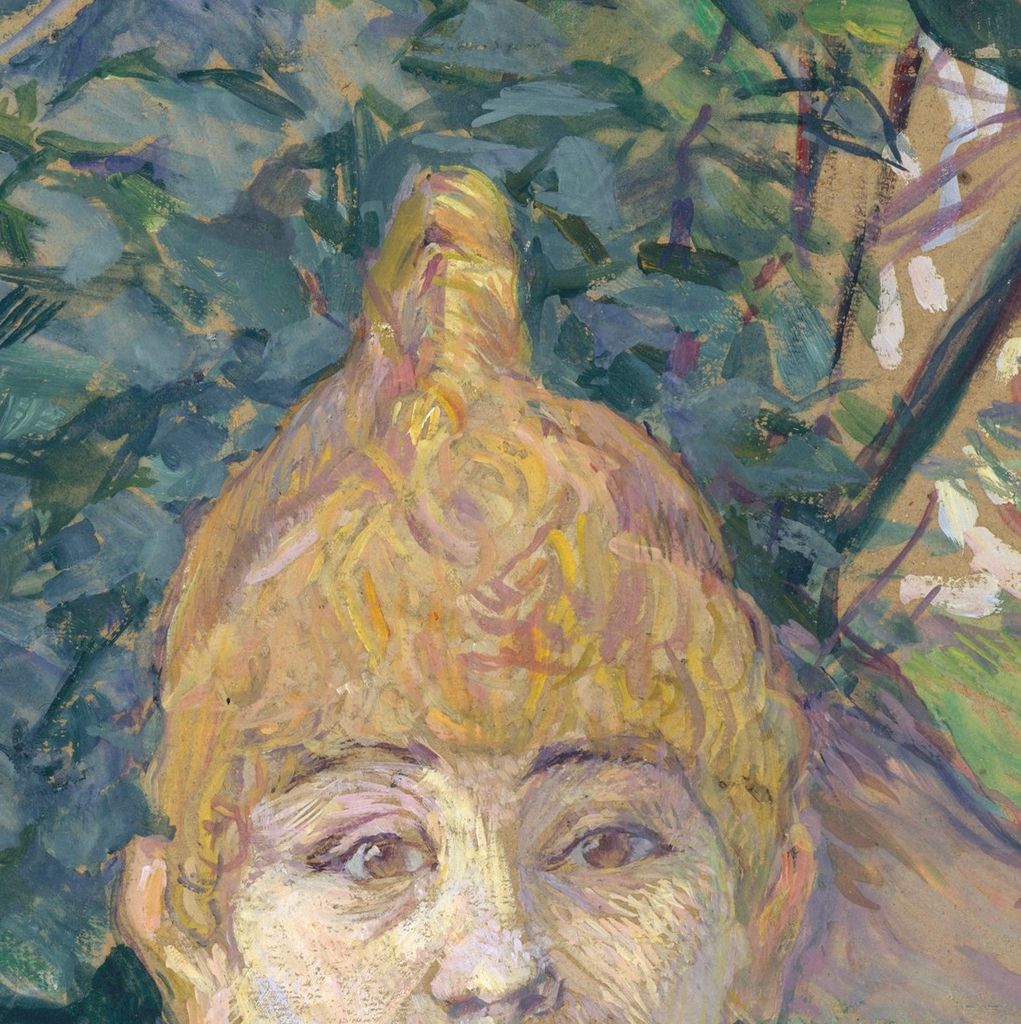
The nickname directs the eye towards a feature that would be striking even without it. The hair rises from a rounded mass above the forehead to a narrow, almost flame-shaped summit. Yellow strokes curl through pink, violet and ochre. Against the cooler foliage, the head seems to acquire an additional height and weight. Yet the golden colour also connects with the coat and the warm spaces between the painted leaves. The hair stands out through its shape and placement as much as through an isolated patch of bright colour. The coiffure concentrates several of the picture's strongest contrasts in one distinctive form. [1]
The portrait makes the sitter's appearance intensely particular, even while her identity remains incomplete. The set of the lips, the unequal curves of the eyelids and the slightly different heights of the shoulders invite close attention, but they do not tell us what she was thinking. A viewer may find the expression reserved, questioning or faintly amused. Each response describes an encounter with the painting; none recovers a private statement from the sitter. Her directness is a formal achievement whose effect survives the gaps in the record. [1]
Monsieur Forest's garden
The garden belonged to Lautrec's Montmartre neighbour, Monsieur Forest. In her 1996 catalogue, Colta Ives identifies Forest as a retired photographer and places Lautrec's repeated outdoor sittings there between 1889 and 1891. She relates this activity to his engagement with Impressionism and the late painting of Édouard Manet. The garden was a recurring place of work. [1] [9]
The Met's account of another painting from the group, Woman in the Garden of Monsieur Forest, describes these sessions as self-imposed exercises in technique, for which friends and models sat. The museum records Lautrec's term for them as “impositions.” That account gives a useful practical context: a familiar outdoor space could become a place to test how a figure appears among foliage and changing light. [11]
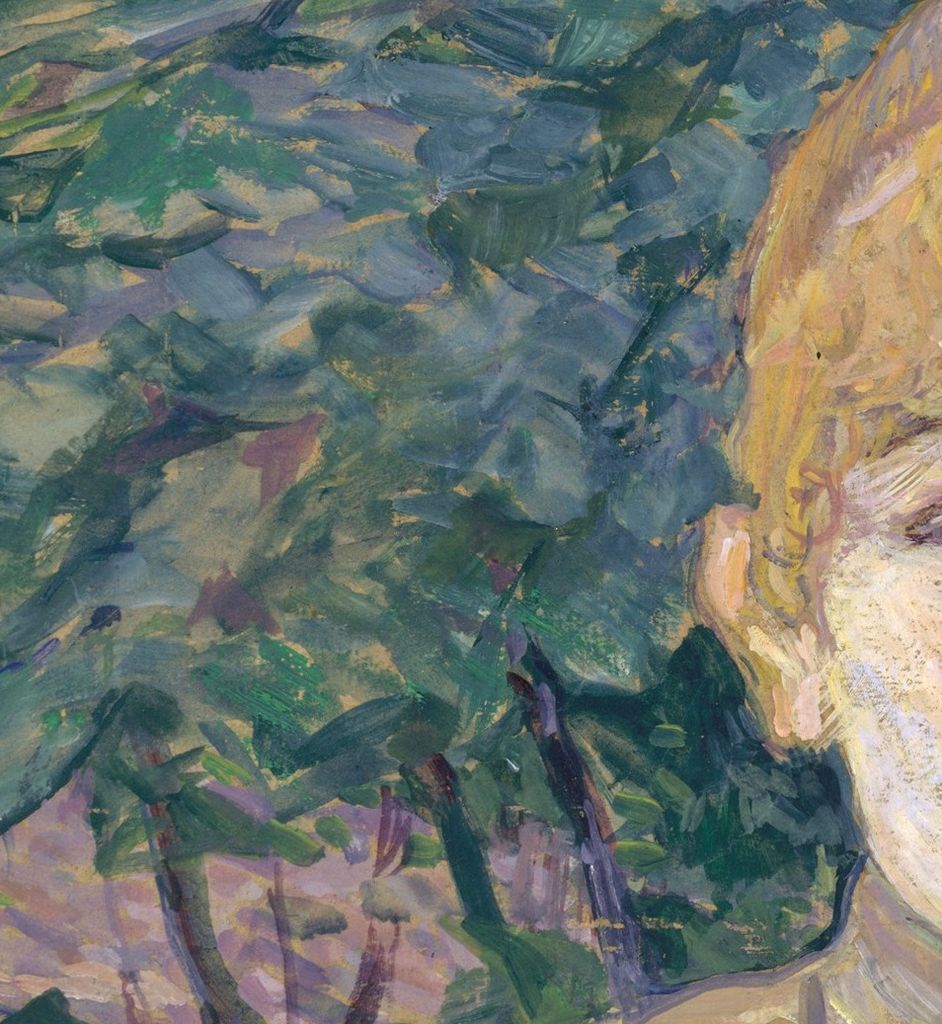
Here the setting divides into two markedly different zones. Dense blue-green foliage fills much of the upper left, pressing closely around the golden hair. To the right, a broad band of violet and brown opens into a path. Its narrowing shape leads towards lighter vegetation and pale upright forms near the top. One side of the head is enclosed by leaves; the other is set against a space that recedes. The woman's position joins these two ways of organising the background. [1]
Look at the dark branch that angles behind her. It moves from near the head towards the upper right, countering the more upright thrust of the coiffure. Small branches and leaf strokes multiply its diagonals. At the far upper right, pale vertical marks suggest a boundary glimpsed through vegetation, but the garden is not described with the precision of a plan. We can recognise enclosure, planting and a route through the space without reconstructing every fence rail or tree. That selective description keeps the setting lively while allowing the face to remain the most sustained passage of observation. [1]
The path also matters because it leaves an area of relative openness beside the sitter. Without it, foliage would surround the head on every side and turn the background into an almost continuous screen. Instead, the broad strokes along the right edge give the eye somewhere to travel before returning to the face. A modest garden supplies a complex arrangement of density and interval. A neighbour's garden belongs to the everyday geography of Lautrec's Montmartre, a familiar place made visually absorbing through the arrangement of a sitting. [1]
Annotated Details from The Streetwalker
The numbered points identify visible features discussed in this article. Return from each detail to the whole composition. The Streetwalker, circa 1890–91, The Metropolitan Museum of Art, 2003.20.13. Broad mount removed; complete painting retained. The Metropolitan Museum of Art, The Walter H. and Leonore Annenberg Collection, Bequest of Walter H. Annenberg, 2002. Image source. CC0 / Public domain. Resized only; native appearance preserved.
Details from THE STREETWALKER
Compare the cropped details with the complete images above. Notice how their colours, shapes and positions contribute to the larger compositions.
The pointed golden hair
The golden hair forms a pointed outline above the pale face.
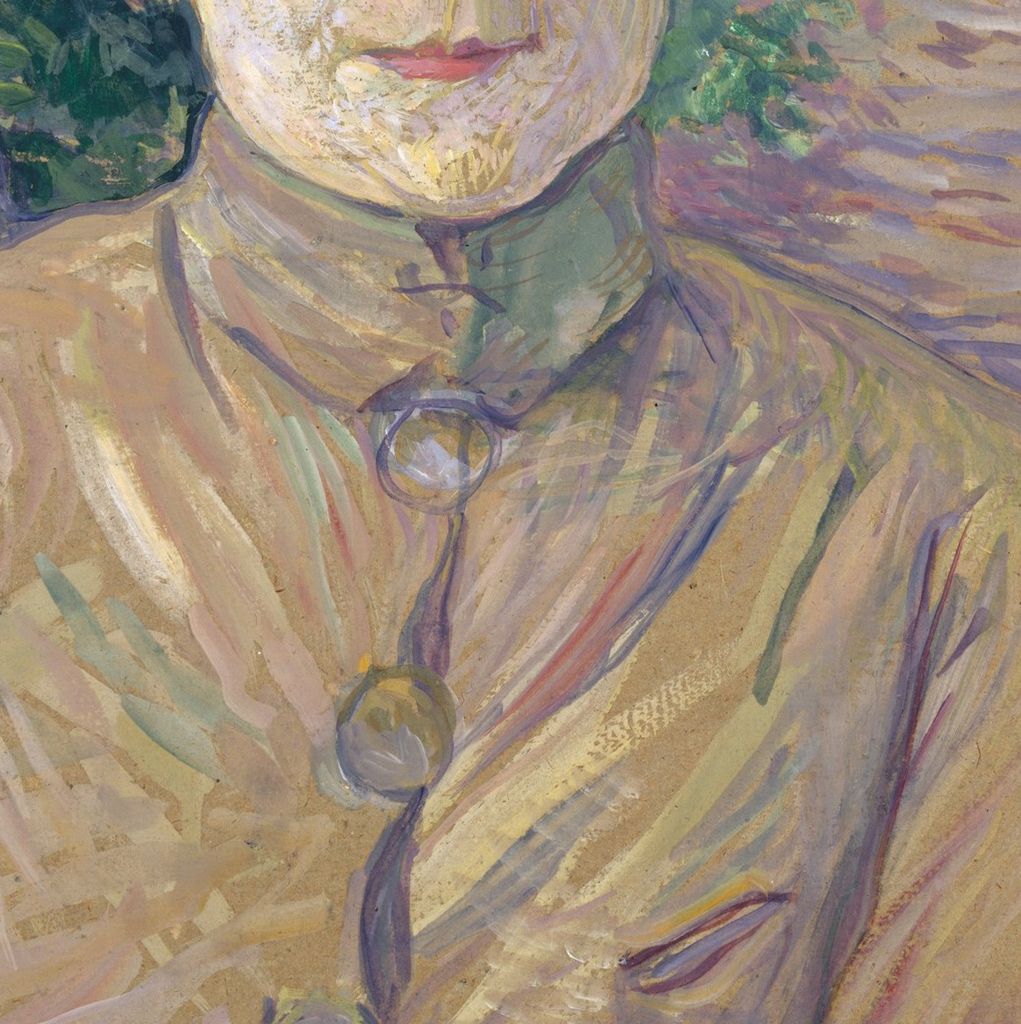
The coat and buttons
A broad brown coat and a line of buttons give weight to the frontal figure.
Foliage beside the face
Blue-green foliage contrasts with the warmer hair and face.
How the pose holds the picture together
The sitter's head is close to frontal, while the shoulders slope and the torso leans slightly across the picture. Her hands and the lower part of her body fall outside the frame. This cropping brings the coat forward as a substantial shape and concentrates attention on the upper body. What matters most is the relationship between the facing head and the less symmetrical body beneath it. The face steadies the composition while the shoulders introduce a gentle imbalance. [1]
The row of large, round fastenings provides a second route through the figure. Beginning below the high collar, it descends through the chest towards the lower edge. The dark line beside the buttons bends rather than forming a rigid central axis. Around it, short strokes follow the fabric in changing directions. Some run down from the shoulders; others gather into chevrons across the chest or sweep along the sleeves. The coat is held together by a few decisive contours, while its interior remains open and varied. [1]
This variation creates a useful contrast with the head. Around the eyes, nose and mouth, the marks are smaller and more tightly grouped. Fine strokes turn around the cheeks and chin, building the face from adjacent touches instead of concealing the work beneath a uniformly smooth surface. The mouth is a small pink-red interval within the much larger field of pale skin. Dark accents around the eyes carry considerable force because the surrounding marks are lighter and more dispersed. We notice the expression through these differences in emphasis. [1]
The portrait therefore asks for two distances of looking. From farther away, hair, head and coat read as clear connected masses. At closer range, their apparent solidity loosens into separate strokes and exposed warm intervals. The large shapes make the person immediately legible; the changing marks keep the image from becoming a fixed silhouette. Lautrec's attention is unevenly distributed in a purposeful visual hierarchy, with the face emerging most insistently from a broadly handled setting. [1]
Even the near-frontal gaze is less symmetrical than it first appears. One eye is more strongly outlined, and the shadow beside the nose changes the balance of the two sides of the face. The hair's pointed summit is offset from the line of the buttons. These small deviations stop the upright figure from appearing diagrammatic. They also help explain why a reproduction can seem immediately recognisable while rewarding a much slower second look. [1]
Watch: Toulouse-Lautrec
Choose an artist introduction, a film about graphic design or a closer look at At the Moulin Rouge.
Cardboard, colour and the direction of the brush
The cardboard support is an essential part of the recorded object. Cora Michael's 2010 Met essay discusses the portrait in connection with Lautrec's use of peinture à l'essence: oil paint thinned with turpentine on cardboard. Michael supplies a historical account of the practice; establishing this painting's exact layer sequence and pigments would require separate technical analysis. [1] [12]
What the image does make available is the contrast between lightly covered passages and denser clusters of strokes. Warm brown remains conspicuous in the lower sleeves and between marks on the coat. Across the chest, violet, greenish and pale yellow touches interrupt that warmth. The garment can appear brown at a glance, but its painted surface is far more varied. Close looking turns a general colour name into an account of several interacting colours. [1]
The same happens in the garden. Its leaves are not simply green. Blue-grey strokes gather in the upper left; deeper green and dark purple marks articulate stems and gaps; the right side contains lighter, more widely spaced touches. The path is built with lavender and ochre strokes that seem to ripple across its surface. Those colours connect it to the garment, even while their more horizontal direction distinguishes the ground from the body. Colour binds the picture together, while the direction and scale of marks separate one kind of form from another. [1]
It is particularly revealing to follow a colour across the boundary between figure and setting. Violet outlines the coat, shadows the face, threads through the hair and crosses the path. Pale yellow catches the hair and appears in the clothing. The sitter is clearly outlined in places, but she does not occupy a wholly separate colour world from the garden. The picture gains unity through these repeated notes, which remain visible across objects that would ordinarily be named and understood separately. This is one reason the setting contributes so much without competing with the face. [1]
The brushwork also complicates any simple opposition between a still sitter and a moving landscape. Leaves are animated by broad, directional touches, but the coat is almost equally active. Small turns of paint continue across the face itself. The seated body supplies compositional stability; the act of painting gives its surface movement. For a fuller account of such material choices across Lautrec's work, see Style and Technique. [1]
Another sitter in the same garden
A particularly useful comparison is the Met's Woman in the Garden of Monsieur Forest, dated 1889–91, an oil painting on canvas, accession 1976.201.15. It is a separate work, with a dark-haired sitter in pink. Ives reproduces it immediately before The Streetwalker, allowing the garden paintings to be considered together without merging their identities. [9] [11]
The second sitter turns her face towards the left, with her eyes directed away from a frontal encounter. Her dark hair forms a broad, rounded mass, and the pink garment expands across the foreground. Behind her, leaves and branches again occupy one side of the picture while a lighter, more open passage appears beside the shoulder. The shared arrangement makes the differences especially clear. In The Streetwalker, the upright golden coiffure and forward-facing head arrest the eye; in the other portrait, the turn of the head encourages a more lateral movement. The comparison makes the effect of each pose easier to recognise. [1] [11]
Their different supports also deserve attention. One is cardboard and the other canvas, as the collection records specify, yet both preserve a strong sense of drawing within painting. Contours and separated strokes remain active instead of disappearing beneath a fully blended finish. The comparison shows that Lautrec's interest in an openly worked surface was not confined to a single support. It also makes the repeated garden setting useful: with some elements held broadly similar, the changes in the sitter's angle, clothing, hair and placement become easier to see. [1] [11]
From a garden sitting to a museum collection
Ives's 1996 checklist listed The Streetwalker as an anticipated bequest from Walter H. Annenberg. The Met now credits it to the Walter H. and Leonore Annenberg Collection, bequest of Walter H. Annenberg, 2002. The two records document a change in the painting's collection status. They do not resolve the missing personal name behind the nickname. [9] [1]
Toulouse-Lautrec artworks directory
Browse 84 identified works and publications in this researched selection. Dates and titles follow the individual records; this is not a complete catalogue of the surviving oeuvre. Print impressions remain attached to their designs. Some listed works do not have a dedicated article. The Drawings guide also contains nine illustrated studies consolidated from former articles.
Frequently Asked Questions
Her personal name is lost. The Met records the nickname La Casque d'Or, meaning Golden Helmet. [1]
The Met identifies the golden coiffure as a wig. [1]
Discussion
Look again at the images and ideas explored in The Streetwalker by Henri de Toulouse-Lautrec. These editorial prompts invite your observations.
Reader Insights
Follow the violet strokes through the face, coat and path. How do they connect forms that initially seem separate?
Join the Conversation
Share a detail, comparison or question about The Streetwalker by Henri de Toulouse-Lautrec below.
References
- The Metropolitan Museum of Art, The Streetwalker, circa 1890–91, accession 2003.20.13, current collection record and commentary; original collection photograph, consulted for visual analysis. View source 1. View source 2.
- Autoportrait, 1880 (in French). View source.
- ALBERTINA: Der Schimmel Gazelle,GE123DL. View source. (in German).
- Franka Blok, Portrait of Vincent van Gogh, 2024. View source.
- Art Institute of Chicago: Moulin Rouge, La Goulue. View source.
- Art Institute of Chicago: At the Moulin Rouge. View source.
- Jane Avril, 1893. View source.
- Au Salon de la rue des Moulins (in French). View source.
- Colta Ives, Toulouse-Lautrec in The Metropolitan Museum of Art, 1996, printed pp. 28–29, figures 28–29, and p. 61, painting checklist entries for Woman in the Garden of Monsieur Forest and The Streetwalker. View source.
- Maurice Joyant (in French). View source.
- The Metropolitan Museum of Art, Woman in the Garden of Monsieur Forest, 1889–91, accession 1976.201.15, current collection record and commentary; original collection photograph, consulted for comparison. View source 1. View source 2.
- Cora Michael, “Henri de Toulouse-Lautrec (1864–1901)”, Heilbrunn Timeline of Art History, The Metropolitan Museum of Art, May 2010, paragraphs on Forest's garden and peinture à l'essence. View source.
- Splash image, The Streetwalker, circa 1890–91, The Metropolitan Museum of Art, 2003.20.13. Broad mount removed; complete painting retained. The Metropolitan Museum of Art, The Walter H. and Leonore Annenberg Collection, Bequest of Walter H. Annenberg, 2002. Image source. CC0 / Public domain. Resized only; native appearance preserved.


 Henri de Toulouse-Lautrec.jpg)