


 by
Tom Gurney
Tom Gurney BSc (Hons) is an art history expert with over 20 years experience
Email:
tomgurney1@gmail.com
/ Phone:
+44 7429 011000
Henri Matisse, The Artist and His Model, c. 1921: Introduction
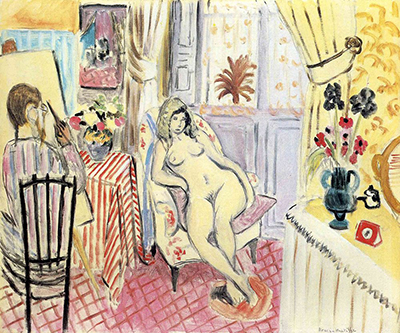
Henri Matisse's The Artist and His Model places the act of painting inside the painting. Matisse sits at the left, seen mainly from behind, while a nude model reclines in a patterned chair near the center. The room presses close around them: a red-striped textile, red checks underfoot, a window with a palm beyond it, and flowers to the right. The artist and model are immediately recognizable, yet the rest of the canvas is too active to be mere background. Stripes, curves and patches of light make the working room part of the subject. [1]
The French title in the documented sale record is L'artiste et le modèle nu . Christie’s catalogues the signed picture as oil on canvas, 60 × 73 centimetres , painted in Nice and usually dated 1921 . The date has a complication that deserves to remain visible: older catalogues called it 1919 , and one exhibition entry in the same Christie’s record gives 1920 , even though the essay cites archival evidence for completion in April 1921. This page uses c. 1921 while keeping that unresolved conflict in view. The long-established /artist-and-his-model/ URL remains the route for this particular canvas. [1] [2]
At a Glance
- Artist Henri Matisse
- Work The Artist and His Model
- Date c. 1921
- Explore Painting
This work across Henri Matisse’s career
Dance (1910)
1910The Red Studio
1911The Piano Lesson
1916The Snail
1953Contents
- What is happening between painter and model?
- How does the room hold together?
- Is this a real room or a constructed scene?
- Why do sources disagree on the date?
- How does it differ from Matisse's other painter-and-model scenes?
- Where did the painting go?
What is happening between painter and model?
Matisse does not show himself addressing us from the front. His head and upper body turn toward the model and the canvas at the left edge. The back of his chair makes a dark, firm shape in the foreground. Thin vertical stripes on his clothing lead the eye up toward his head; the stripes then reappear, with more color and force, in the cloth beside him. His position gives us an apparent seat just behind the painter, looking across his workspace rather than straight at a posed portrait. [1]
The model occupies the middle of the room and the brightest figure-shaped area of the picture. Her body bends across a flowered chair: one arm curves upward, her torso shifts against the upholstery, and her legs descend toward the patterned floor. The pose is not isolated against a neutral studio wall. Floral marks, pink fabric and yellow light meet the outline of her body at several points. Matisse has to keep the figure legible while letting the surroundings remain visually lively.
At the left, the easel's pale surface turns partly away from us. We see the painter making or looking at a picture, but we do not receive a clear copy of the work on his canvas. That withholding matters. The scene does not simply present the finished result of the session twice, once as a painting within the painting and once as the large work before us. It invites us to watch the relation among the artist, his subject and the room, while leaving the small easel picture uncertain.
The model is not merely an object the artist observes. She is a strong organizing shape, set against competing decorative forms. The artist too is a shape among them, his striped clothing and chair tied to the textiles around him. The picture acknowledges the unequal roles of a painter working and a nude model posing, but it also shows how both figures are brought into an arrangement made by paint. That is one reason the English title is useful: it names a relationship rather than reducing the work to either a self-portrait or a nude.
Christie’s identifies the model as Antoinette , using the surname Arnoud in its essay. The National Galleries of Scotland identifies the woman in its distinct 1919 Painting Lesson as Antoinette Arnoux . The two spellings in institutional sources are not a reason to invent a confident correction here. What matters for this picture is that the model belongs to Matisse's early Nice work, before the later cycle associated with Henriette Darricarrère. The painting itself does not write her name into the room. [1] [3]
How does the room hold together?
The composition is full of contrasts that repeat across different objects. The painter's mostly vertical stripes meet the red-and-white striped cloth just beyond him. The floor's small red checks spread diagonally into the foreground. A pale window and door frame stand behind the model, while yellow curtains and patterned wall areas draw the eye toward the right. These repetitions make the room feel continuous even when individual surfaces are simplified or abruptly colored.
The window provides a pause. Its pale panes open onto a small crown of palm foliage, enough to locate an outside beyond the compressed interior. It also sets a rectangle of light behind the model and chair. Yet the outside is not a landscape explored for its own sake. The view is brief and nearly swallowed by the room's curtains, wall and flowers. The painting is about how Matisse arranges an interior around a working encounter, not about a panoramic view of Nice.
On the right, a vase of dark flowers and bright red touches stands against a yellow patterned area. The vase's dark mass balances the painter's head and chair at the opposite side. Between them, the model's pale body carries the eye through the center. This does not mean every object has a fixed coded meaning. The old page suggested that each thing has one definite place and meaning, but the more verifiable point is visual: Matisse makes ordinary furnishings participate in a deliberate balance of dark and light, straight and curved.
The red textile beside the painter is a particularly forceful element. Its narrow stripes project forward against the less regular marks of the chair and wall. The floor checks below it continue the red rhythm at a different angle. Seen together, they make a patterned route through the picture: from the painter's clothing, across the fabric, down to the carpet, and back toward the model's chair. The room's decoration does not merely fill space after the figures have been painted. It helps direct how we find them.
The nude's curves resist that grid of stripes and checks. Her outline loops and slopes where the adjacent furnishings stand upright or recede in small squares. Christie’s describes this contrast between rigid lines and the figure's arabesque as central to the painting. Its reading is persuasive because the shapes can be followed in the image itself: the broad bend of the model's torso has a different tempo from the striped cloth, even as both are held within one shallow room. [1]
Watch: Matisse’s art and working methods
Choose a museum film or a close reading to continue exploring Matisse’s work.
Matisse: “For Me It’s Always New”
The Museum of Fine Arts, Boston considers Matisse’s creative practice.
Watch on YouTubeIs this a real room or a constructed scene?
Christie’s locates the painting in Matisse's room at the Hôtel de la Méditerranée et de la Côte d'Azur in Nice. The artist used this waterfront hotel before taking a more permanent apartment later in 1921. The painting includes furnishings recognizable from his hotel interiors: the high window, curtains, red rug, flowered chair and decorative objects. These are not invented merely to give a nude a luxurious setting. They came from a working environment Matisse repeatedly painted. [1]
Yet the canvas should not be treated as an exact floor plan. In the Christie’s essay, the writer Charles Vildrac recalls visiting the actual room and finding it smaller and more cluttered than Matisse's painted versions had led him to expect. His recollection shows the gap between observed place and pictorial arrangement. Matisse could select, shift and intensify a window, textile or chair until the room seemed to have a new order on canvas. The painting is based in lived space, but its persuasive space is made by the artist. [1]
This distinction also applies to the apparent studio session. We can see Matisse depicting himself with a model, but we cannot infer from the canvas alone that all of its parts were painted in one sitting from one fixed spot. It is a considered composition about work. The model's pose, the artist's turned back and the objects around them serve the image Matisse wanted to make. Calling it a scene of painting does not require treating it as a photograph of a single afternoon.
Why do sources disagree on the date?
The work circulated for decades with 1919 in some publications. Christie’s 2014 essay reports that the Matisse Archives were inclined toward April 1921 . It cites biographer Hilary Spurling's account of Matisse sending a sketch to his family the day after finishing a painting of Antoinette, on 24 April 1921 . Christie’s and a later Bernard Jacobson Gallery listing both use 1921 for the 60 × 73-centimetre canvas. This source trail makes c. 1921 the best working date for the page. [1] [2]
There is still a documentary inconsistency. Christie’s exhibition list includes an October–November 1920 Bernheim-Jeune show for the same lot. If that listing refers to this exact finished painting, it cannot both have been exhibited then and completed in April 1921. The accessible record does not establish whether the exhibition entry, the archival identification or the dating of a related composition needs correction. Rather than quietly choosing a definite day, this page notes the conflict and uses an approximate year. No visual resemblance to other Nice interiors can solve it by itself. [1]
How does it differ from Matisse's other painter-and-model scenes?
The National Galleries of Scotland owns La Leçon de peinture , also called La Séance de peinture , dated 1919 . In that separate Nice canvas, a sketchily indicated artist sits to the left while the young model reads. The museum emphasizes the picture's careful calculation despite thin, quick-looking paint. Compared with it, The Artist and His Model gives the painter a more substantial role and fills the room with stronger stripes, checks and flowers. The comparison shows Matisse returning to the subject while changing the relation between figure, decorative pattern and work in progress. [3]
An earlier and more severe comparison is Le Peintre dans son atelier at Centre Pompidou, made in Paris around late 1916–early 1917 . There Matisse appears from behind with the model Laurette and an easel in a taller studio composition. Pompidou's analysis emphasizes a geometric arrangement of painter, model, picture and window. The Paris work is not this Nice painting or the separate Phillips Collection Studio, Quai Saint-Michel : these works have different compositions and records. What links them is Matisse's repeated question of how an artist can represent himself looking and working inside his own image. In Nice, the question unfolds through a warmer, more densely furnished room. [4]
The paintings directory offers other interiors from Matisse's long career. This picture is valuable among them because he places himself plainly within the decorated space he has arranged. The viewer can look at the model, then at the painter looking at her, then back at the surrounding fabric and window. The sequence makes us aware that the room, too, is being transformed into a painting.
Where did the painting go?
Christie’s provenance begins with Galerie Bernheim-Jeune in Paris. It records the American collector John Quinn acquiring the work from the gallery on 21 September 1921 . After his death it passed to Ruth and Harry Bakwin , remaining with their family for many years; Ruth Morris Bakwin sold it at Sotheby's in 1985 . Christie’s described it as property from a private American collection in its 2014 sale. These dated records show the painting's route from Matisse's early Nice period into important American collections. They do not verify where it is displayed or who owns it today. [1]
To return to the image, start with Matisse's striped back at left, follow his attention toward the model, then let the red patterns carry the eye across the floor to the flowers at right. The small pale window opens the room briefly before the curtains and yellow wall draw it closed again. That circuit explains why this is more than a portrait of two people. It is a painting of the conditions under which one person turns another, and the place around them, into a work of art.
Explore 113 Matisse artworks
This directory covers the 113 individual works explored in these articles, rather than a complete catalogue of Matisse’s output. Cut-paper designs and prints appear under Drawing in the medium filter; each row names its form. Dates retain the qualifications explained in the linked articles.
Discussion
Look again at the images and ideas explored in Henri Matisse, The Artist and His Model, c. 1921. These editorial prompts invite your observations.
Reader Insights
What is happening between painter and model?
Which comparison discussed in the article helps you see the work differently?
How do the materials and historical setting affect your reading?
Join the Conversation
Share a detail, comparison or question about Henri Matisse, The Artist and His Model, c. 1921 below.
References
- Christie’s , Henri Matisse, L'artiste et le modèle nu , lot record and essay, 2014, object facts, dating discussion, Nice room, exhibition list and provenance. View source .
- Bernard Jacobson Gallery , Henri Matisse, L'artiste et le modèle nu , 1921 attribution, medium, dimensions and signature. View source .
- National Galleries of Scotland , Matisse, La Leçon de peinture / La Séance de peinture , distinct 1919 Nice painting and model identification. View source .
- Centre Pompidou , Matisse, Le Peintre dans son atelier , distinct Paris studio painting, late 1916–early 1917, object record and Isabelle Monod-Fontaine's analysis. View source .






 Henri Matisse.jpg)
