


 by
Tom Gurney
Tom Gurney BSc (Hons) is an art history expert with over 20 years experience
Email:
tomgurney1@gmail.com
/ Phone:
+44 7429 011000
Henri Matisse, Still Life with Oranges (Basket with Oranges), early 1912: Introduction
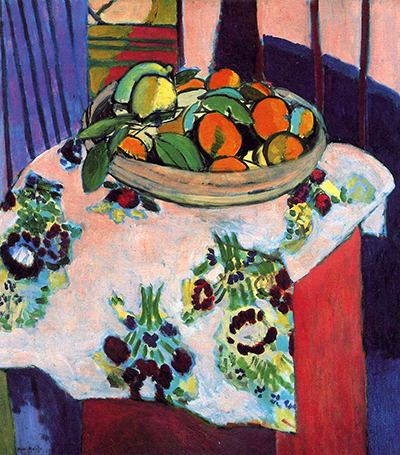
An oval basket of fruit sits near the top of Henri Matisse's Still Life with Oranges . Below it, a pale cloth strewn with large, dark floral shapes spreads toward us and almost reaches the bottom of the canvas. Blue-violet and wine-colored vertical areas enclose the table from either side. The arrangement is ordinary enough to recognize at a glance, but its color and tilted spaces keep the eye moving. The oranges occupy the center; the cloth seems to compete with them for attention. [1]
The painting has long appeared on this site as Basket with Oranges , and that name remains in its page address. The owning Musée national Picasso-Paris catalogues it in French as Nature morte aux oranges , meaning Still Life with Oranges . Its record dates the oil painting to early 1912 , identifies Tangier, Morocco as its place of creation, and gives its size as 95 × 84.8 centimetres . That owner record is a firmer basis for the date than commercial listings that describe the work as 1913. The painting's inventory number is MP2017-21 . [1]
At a Glance
- Artist Henri Matisse
- Work Still Life with Oranges (Basket with Oranges), early 1912
- Date 1912
- Explore Painting
This work across Henri Matisse’s career
Dance (1910)
1910The Red Studio
1911The Piano Lesson
1916The Snail
1953Contents
- How are the fruit and basket arranged?
- Why does the tablecloth command so much space?
- How does the room hold the still life together?
- What does the related Tangier drawing tell us?
- How does it compare with another Tangier painting?
- Why is the painting in the Picasso museum?
How are the fruit and basket arranged?
The basket is broad and shallow. Its pale rim cuts a long oval across the upper middle of the picture, compressing the fruit into a dense group. Several bright orange circles and ovals are easy to pick out. Green forms and darker leaves interrupt them, so the fruit does not become a simple row of identical spheres. A leaf reaches leftward over the basket's edge, and another dark shape points into the tablecloth. The basket has a physical rim, but Matisse lets some of its contents break that tidy boundary.
The fruit has weight because of its crowded placement and stronger dark outlines, yet it is also a set of color notes. Orange touches reappear in the upper background, while green and blue-green strokes turn up in the patterned cloth below. The eye can therefore leave the subject and find its colors elsewhere in the painting. The arrangement is more active than a conventional still life that asks us to admire a bowl placed on a neutral table.
Matisse does not separate the basket from its setting with a large empty field. The rear wall, cloth and perhaps another textile come close to it. At the upper left, bands of red and green sit behind the fruit; at the upper right, a deep dark form cuts into pink and purple. These areas make the still life feel enclosed by other colored surfaces. The oranges shine most clearly because their curved forms and saturated warmth press against those cooler and darker surroundings.
The exact identity of every green round form is not settled by what can be seen in the painting or by the museum's short object notice. Calling them all oranges would go beyond what can be seen. What matters visually is their alternation with the orange fruit. Green wedges and curves separate one bright orb from another, preventing the basket from reading as a flat orange patch.
Why does the tablecloth command so much space?
The cloth fills most of the lower half of the painting. It is pale pink and off-white, marked with loose clusters of green, blue, burgundy and nearly black. Some clusters read as flowers with leaves; others dissolve into strokes and spots. The pattern does not follow a strict, evenly repeated grid. As it crosses the tilted table, it grows and shifts, giving the cloth a lively surface of its own.
At the left, the cloth projects forward, then turns around the table edge. On the right, it seems to hang against a red vertical support. These changes of direction tell us where the horizontal tabletop ends, although the contours are not consistently drawn like a measured diagram. The picture offers enough cues to understand an object covered by fabric, then lets the painted pattern challenge that understanding. We know the basket rests on a table, but our gaze is pulled repeatedly back to the cloth's scattered forms.
The flowers are important for another reason: they make the still life about surfaces as well as objects. The fruit is a collection of things that could be lifted from the basket. The painted or woven floral design belongs to the fabric, yet in the image its marks are as energetic as the leaves and fruit above. Matisse has made decoration into a partner of the main subject. The cloth does not merely dress a table after the basket has been set down; it shapes how the basket is seen.
This relationship can be followed without assigning the fabric a precise origin. The owner record locates the painting in Tangier, but it does not identify this cloth as a particular Moroccan textile or tell us where Matisse obtained it. A geographic label cannot supply details the object record does not provide. Here the safest reading begins with the visible folds, edges and color patterns rather than an imagined history for the material. [1]
Watch: Matisse’s art and working methods
Choose a museum film or a close reading to continue exploring Matisse’s work.
MoMA Conservators discover Matisse's process for "The Red Studio" | CONSERVATION STORIES
Conservators examine the making of The Red Studio.
Watch on YouTubeHow does the room hold the still life together?
The blue-violet curtain or hanging fabric at left makes a strong vertical strip. Opposite it, a deeper purple area and a red lower section close the right side. Between them, the pale tablecloth opens like a bright wedge. This is one of the painting's clearest contrasts: dark, upright edges around a broad, light, sloping foreground. The basket settles across the transition between those zones.
Behind the fruit, the background is divided into rectangles and irregular bands rather than described as a detailed interior. The upper left offers glimpses of green, ochre and red. The central upper area rises in pink and dark violet. Matisse does not need to explain exactly what each block represents to give the composition depth. Their overlapping edges place the basket in front of a wall or furnishing, while their colors keep the background fully involved in the picture.
The viewpoint is slightly raised: we look into the basket and across the cloth. At the same time, the table seems to tilt toward us. This gentle instability lets the cloth's design occupy more of the canvas than it would from a low viewpoint. It also brings the fruits close enough for their outlines and colors to matter individually. The room is legible, but it is arranged primarily for the relationship among basket, textile and painted background.
What does the related Tangier drawing tell us?
The Musée national Picasso-Paris also holds an Esquisse pour “Nature morte aux oranges” , a sketch for this still life. It is dated 1912 and catalogued as ink and graphite on paper , measuring 26 × 17.1 centimetres . The museum records the inscription “Tanger, H. Matisse” on the drawing. This is unusually direct evidence linking a preparatory work to Tangier and to the painting's subject. The sketch and oil have separate inventory numbers and separate acquisition histories; they are related works, not two reproductions of a single object. [2]
The drawing's existence is useful even when we do not treat it as a complete explanation of the painting. A study suggests Matisse worked through the arrangement before or alongside the canvas, but the museum record alone does not fix an exact sequence of decisions. Nor does it prove that every floral mark or color zone was planned in pencil. The oil's most distinctive effect depends on paint: the push and pull of orange, green, violet and pale cloth. The sketch establishes a process connection; the canvas must still be read on its own terms.
Matisse made this work during his Moroccan period. The National Gallery of Art's exhibition history describes two visits to Morocco, one in early 1912 and another during the winter of 1912–13 . The Musée Picasso-Paris specifically assigns this painting to Tangier in early 1912. That precision matters because a broad “Moroccan period” label can conceal two separate stays, and because a later 1913 date found in some secondary listings should not displace the owner record without evidence. [1] [3]
How does it compare with another Tangier painting?
The National Gallery of Art owns Matisse's Palm Leaf, Tangier , also dated 1912 . It shows a very different subject: a palm frond with surrounding fields of gray, coral, turquoise and pale blue. The NGA describes partly unpainted canvas and a composition that approaches abstraction. Beside it, Still Life with Oranges remains anchored to a basket, fruit and tablecloth. Yet both pictures show Matisse using a subject as the starting point for large, assertive color relationships. The comparison is about contemporaneous choices in Tangier, not a claim that one painting was a study for the other. [4]
Within this site's Matisse section, Entrance to the Kasbah and Window at Tangier offer other views associated with the Moroccan visits. They move the viewer from a tabletop arrangement to passages and openings. Here, however, the outside city does not enter the canvas. Tangier is established by the museum record and related inscribed sketch, while the visual argument unfolds through a domestic arrangement of fruit, cloth and colored planes.
Why is the painting in the Picasso museum?
The museum's history of Picasso's collection says that he acquired this Matisse in 1942 . That is distinct from the painting's catalogue entry, which lists a 1978 Picasso donation as the museum's acquisition route. The dates describe different events: entry into Picasso's personal collection and later transfer to the national collection. The distinction matters because a bare “Picasso donation, 1978” might otherwise make it sound as if he first encountered the work then. [5] [1]
A separate museum record identifies the painting in a photograph by Brassaï of Picasso's Grands-Augustins studio in Paris, dated in its title to 8 April 1944 . The surviving photographic print is catalogued around 1950 , and the museum identifies several other works visible in the same view. This gives a rare documented setting for the Matisse canvas after Picasso acquired it. The photograph is an archival witness to the painting's presence in his studio; it does not tell us why Picasso chose this particular still life or exactly how long it stood in that position. [6]
For a final look, begin at the basket's narrow rim and let the oranges gather into a bright cluster. Then move down across the cloth, where floral shapes expand and scatter, before following the purple and red sides back upward. The picture turns a small still-life subject into a broad study of how patterned surface, color and space can compete and cooperate. Its place in Picasso's collection adds a compelling later chapter, but the visual invention belongs to Matisse's Tangier painting of early 1912.
The Henri Matisse artist page and paintings directory connect this still life to the wider sequence of his work.
Explore 113 Matisse artworks
This directory covers the 113 individual works explored in these articles, rather than a complete catalogue of Matisse’s output. Cut-paper designs and prints appear under Drawing in the medium filter; each row names its form. Dates retain the qualifications explained in the linked articles.
Discussion
Look again at the images and ideas explored in Henri Matisse, Still Life with Oranges (Basket with Oranges), early 1912. These editorial prompts invite your observations.
Reader Insights
How are the fruit and basket arranged?
Which comparison discussed in the article helps you see the work differently?
How do the materials and historical setting affect your reading?
Join the Conversation
Share a detail, comparison or question about Henri Matisse, Still Life with Oranges (Basket with Oranges), early 1912 below.
References
- Musée national Picasso-Paris , Matisse, Nature morte aux oranges , MP2017-21, owner record for title, date, Tangier, medium, dimensions and donation. View source .
- Musée national Picasso-Paris , Esquisse pour “Nature morte aux oranges” , MP1981-2, related drawing, inscription, medium and size. View source .
- National Gallery of Art , Matisse in Morocco , exhibition overview and chronology of the two Moroccan visits. View source .
- National Gallery of Art , Matisse, Palm Leaf, Tangier , distinct 1912 painting used for comparison. View source .
- Musée national Picasso-Paris , 2015 exhibition dossier, p. 16, Picasso's 1942 acquisition of the painting. View source .
- Musée national Picasso-Paris , Brassaï photograph MP1986-30, documentation of the painting in Picasso's studio. View source .






 Henri Matisse.jpg)
