


 by
Tom Gurney
Tom Gurney BSc (Hons) is an art history expert with over 20 years experience
Email:
tomgurney1@gmail.com
/ Phone:
+44 7429 011000
Henri Matisse, Decorative Figure on an Ornamental Background , 1925–26: Introduction
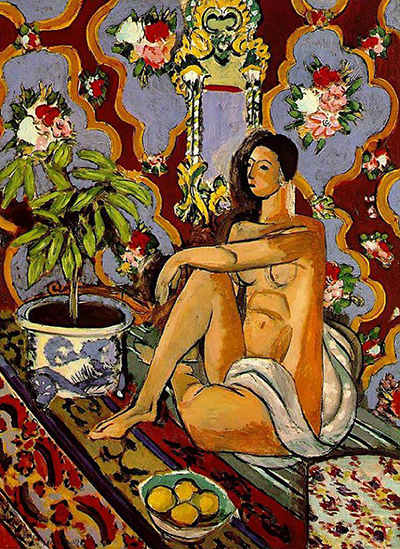
A seated woman occupies the middle of Henri Matisse's Decorative Figure on an Ornamental Background , yet the painting gives its patterned surroundings nearly equal force. A red floral hanging rises behind her. Its blue, lobed compartments seem to expand around a yellow-green mirror, a potted plant and bouquets of flowers. A striped support and red rug tilt toward a bowl of lemons at the lower edge. The figure's back is strikingly straight, her bent leg angular, her skin modeled in broad planes. She holds her place amid the crowded color without becoming detached from it. That uneasy balance between body and ornament is the picture's subject as much as the nude herself. [1]
The Centre Pompidou owns the oil on canvas , which it titles Figure décorative sur fond ornemental and dates to winter 1925–26 in Nice . It measures 130 × 98 centimetres and has inventory number AM 2149 P . The English short name “Decorative Figure” is useful for this page's URL, but it leaves out half of the artist's problem: how a figure can hold its own against an ornamental ground. The museum's catalogue also records older titles, including Nude and Decorative Figure on a Floral Background . The full current title guides the reading here. [1]
At a Glance
- Artist Henri Matisse
- Work Decorative Figure on an Ornamental Background
- Date 1925–26
- Explore Painting
This work across Henri Matisse’s career
Dance (1910)
1910The Red Studio
1911The Piano Lesson
1916The Snail
1953Contents
- How does the figure hold the center?
- What is the “ornamental background” made of?
- Why does the room feel both deep and flat?
- When was it made and first seen?
How does the figure hold the center?
The woman's body makes a compact construction of straight and curved forms. Her back rises almost vertically beside the patterned field. One knee comes up to meet the arm laid across it; the other leg folds low, bringing a foot toward the left. The head turns into three-quarter view, small above the long back and firmly shaped torso. White cloth wraps around the lower body and falls behind the hip. It is possible to follow this bodily arrangement even though the painting does not supply a deep, quiet background to isolate it. Matisse gives the nude edges strong enough to stand amid the decorative pressure. [1]
The body does not have the smooth, anatomically continuous finish expected from an academic nude. Brown outlines, abrupt color shifts and shadows divide the torso into planes. The strong vertical back and bent knee act almost like the sides of a structure. Centre Pompidou curator Isabelle Monod-Fontaine connects this sculptural treatment with Matisse's Grand nu assis, bras levés , a large seated-nude sculpture under development in the same Nice period. Studio photographs place its clay model before the floral hanging that later appears in the canvas. The painting is not an illustration of that sculpture, but the relation explains why its living model can seem both present and carved into simplified masses. [1]
Monod-Fontaine identifies the model as Henriette Darricarrère , who worked regularly with Matisse in Nice. Her role should not disappear under the painting's generic title. The museum describes an actual sitter whose face and characteristic hairstyle remain visible even after the body has been reshaped for the composition. Matisse set a person against a staged collection of objects; the resulting form is highly worked, not a neutral record of how Henriette sat at one instant. The apparent calm of her face gives us no reliable account of her feelings or of the artist's intentions toward her. [1]
What is the “ornamental background” made of?
The dense field behind the figure was based on a floral fabric hanging in Matisse's Nice studio. In 1921 , he equipped a new workspace with movable textile panels, rugs, cushions, a platform and other objects so he could transform the setting around a model. This was a constructed studio scene, not a documentary view of a room in North Africa. The hanging appears in period studio photographs and in several later paintings. Its reddish ground, blue four-lobed compartments and red, pink and white bouquets gave Matisse a pattern large enough to compete with the figure in front of it. [1]
The fabric did not belong to this picture alone. Monod-Fontaine traces it through at least four other paintings made in 1928 , including Two Odalisques in Stockholm and The Models' Rest in Philadelphia. In those works, the dark ground and blue compartments appear in altered relationships to different figures. This reuse shows how the Nice studio could provide a changing set of visual materials: a particular hanging was real, but its placement and painted color were open to revision. Comparing these paintings would reveal repeated props, not one continuous fictional room or a single scene witnessed on different days. [1]
The yellow-green mirror near the top middle is easy to miss as a separate object. Its curling frame answers the lobed shapes of the hanging, and the blue within it resembles another colored compartment. The plant at left has a similar ambiguity: green leaves spread out of a blue-and-white ceramic pot, but their shapes seem to grow into the hanging's painted bouquets. Matisse lets real props and fabric motifs echo each other until the eye has to pause to sort them. This is one reason the ground feels so active. Ornament is not just a repeatable wallpaper pattern; several different things have been made to rhyme in paint. [1]
The lower half of the picture changes the rhythm. Diagonal stripes on a narrow mattress or support, the red-patterned rug and an angled seat create a sloping space under the body. A round planter sits on one side, a more rectangular form on the other. A shallow bowl of bright lemons near the front draws the eye down toward the viewer. These objects make enough depth for the woman to seem seated. Yet the rug and support tilt up steeply, so the floor also becomes another expanse of color and pattern. The painting keeps alternating between an inhabitable room and a decorated flat surface. [1]
Matisse adjusted the hanging within the painting as well as arranging it in the room. Monod-Fontaine reports that the interiors of its large medallions were first painted in a dark brown-violet tone and later changed to blue . That revision makes each medallion more separate and gives the mirror a stronger visual echo. It is an object-specific example of the artist choosing the painting's color relationships rather than simply copying an observed cloth. The real textile supplied a starting structure; painted changes made the pattern serve the tension between figure and ground. [1]
Watch: Matisse’s art and working methods
Choose a museum film or a close reading to continue exploring Matisse’s work.
Matisse: “For Me It’s Always New”
The Museum of Fine Arts, Boston considers Matisse’s creative practice.
Watch on YouTubeWhy does the room feel both deep and flat?
A preparatory drawing, discussed in the Pompidou catalogue, places the figure at an angle within more ordinary recession. In the finished canvas, Matisse lifts and flattens the wall, seat and rug planes. The sitter remains convincingly three-dimensional, while the space around her refuses to settle into one perspective. Her straight back faces a tapestry of loops and bouquets; below, the angled support seems almost too steep to be a floor. This is a deliberate visual contest, not a failure to construct a room. [1]
The painting's title sharpens that contest. It calls the figure decorative and the ground ornamental. Monod-Fontaine notes the distinction: the body is strongly built, with a near-architectural straight back, while the surrounding motifs proliferate. “Decorative” here need not mean superficial or merely pretty. The figure helps organize a demanding composition whose parts repeatedly threaten to crowd one another. The painting asks whether a human body can remain a solid presence when every nearby surface insists on being seen. Matisse's answer is provisional and exciting because neither side wins entirely. [1]
The work belongs to the Nice paintings often called Matisse's odalisques, but that label needs care. The Fondation Beyeler explains that the odalisque was a European painting tradition built around imagined harem scenes and erotic stereotypes of a generalized “Orient.” Matisse staged models and textiles in his own studio after travels in North Africa; the arrangement here is not evidence of an actual harem or a particular North African interior. Unlike many costumed odalisques, Henriette wears no ornate outfit or jewelry in this canvas, only the white cloth. The painting concentrates the staged setting into a difficult formal encounter between her body and the surrounding objects. [2] [1]
When was it made and first seen?
The owner dates the canvas to winter 1925–26 and says Matisse completed it in time for the Salon des Tuileries in June 1926 . A 1927 date has sometimes been repeated. Monod-Fontaine links some of that confusion to a preparatory drawing dated retrospectively and to the fact that Matisse did not immediately sign and date the painting, which remained in his possession. The Salon appearance gives a firm public anchor before 1927. The page therefore uses the museum's winter 1925–26 date rather than repeating the simpler but misleading “1925” of the legacy account. [1]
The painting attracted attention at its first showing and later joined Matisse's 1931 retrospective, according to the Pompidou catalogue. He kept it until the French state purchased it in 1938 . Those facts matter because the canvas was neither an obscure private experiment nor a work immediately separated from the artist. It circulated under changing titles and dates while remaining important enough for major exhibitions. The present museum number, AM 2149 P , identifies the oil painting regardless of those historical labels. [1]
One naming trap remains. The National Gallery of Art in Washington owns a separate 1908 bronze called Figure décorative . It is not this canvas, despite the overlapping short English title. The bronze has a different pose, material, date, dimensions and collection history. Keeping the full Pompidou title with the 1925–26 date prevents the two from being folded into one work. [3]
Return to the picture by following a simple path: from the bowl of yellow lemons along the steep rug, up the sitter's angled leg and straight back, then outward through the plant and mirror into the floral hanging. The eye can keep moving, but the figure repeatedly draws it back. That movement gives the painting its force. A human body and a busy, movable studio décor have been pressed into the same shallow painted space without losing their differences. For related paths through this period, see the paintings directory and the separate Interior at Nice , whose room and sitter should be read on their own terms.
Explore 113 Matisse artworks
This directory covers the 113 individual works explored in these articles, rather than a complete catalogue of Matisse’s output. Cut-paper designs and prints appear under Drawing in the medium filter; each row names its form. Dates retain the qualifications explained in the linked articles.
Discussion
Look again at the images and ideas explored in Henri Matisse, Decorative Figure on an Ornamental Background , 1925–26. These editorial prompts invite your observations.
Reader Insights
How does the figure hold the center?
Which comparison discussed in the article helps you see the work differently?
How do the materials and historical setting affect your reading?
Join the Conversation
Share a detail, comparison or question about Henri Matisse, Decorative Figure on an Ornamental Background , 1925–26 below.
References
- Centre Pompidou , Figure décorative sur fond ornemental , AM 2149 P, current owner record and Isabelle Monod-Fontaine's 1989 and 2007 collection-catalogue essays, accessed in French and paraphrased. View source .
- Fondation Beyeler , Matisse: Invitation to the Voyage , room 6 guide, 2024 exhibition interpretation of the Nice studio and European odalisque tradition. View source .
- National Gallery of Art , separate Figure décorative , 2011.9.1, owner record for the distinct 1908 bronze. View source .






 Henri Matisse.jpg)
