


 by
Tom Gurney
Tom Gurney BSc (Hons) is an art history expert with over 20 years experience
Email:
tomgurney1@gmail.com
/ Phone:
+44 7429 011000
Henri Matisse, The Casbah Gate (Entrance to the Kasbah) , 1912: Introduction
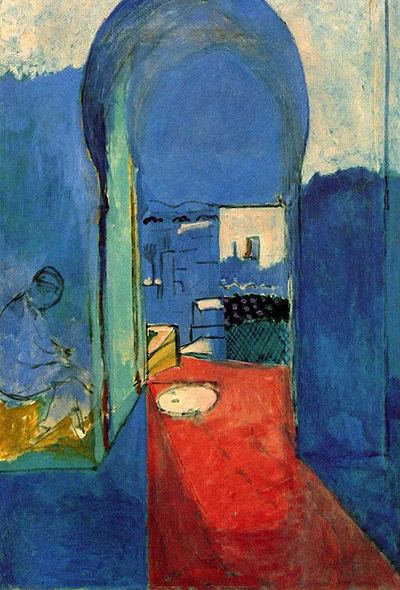
A high arch opens through a wall of blue. Beneath it, a red passage runs toward a pale building, while a seated person almost disappears into the shadow at the left. Henri Matisse painted this Tangier subject in 1912 as one part of his Moroccan Triptych . The Pushkin State Museum of Fine Arts owns the oil on canvas , measuring 116 × 80 centimetres , under the title The Casbah Gate and inventory number Ж-4058 . Entrance to the Kasbah is a documented alternate English title, retained in this page's address. [1] [2]
The painting's first impression is architectural: an enormous shaded opening surrounds a much smaller glimpse of the city beyond. Yet the arch is less a diagram of a building than a way to organize color and light. Deep blue advances across the foreground; red turns the viewer inward; cream and light blue seem to recede. The seated person gives the gateway human scale, but Matisse makes that presence easy to miss. Looking for the figure changes how the supposedly empty passage is seen. [2]
At a Glance
- Artist Henri Matisse
- Work The Casbah Gate (Entrance to the Kasbah)
- Date 1912
- Explore Painting
This work across Henri Matisse’s career
Dance (1910)
1910The Red Studio
1911The Piano Lesson
1916The Snail
1953Contents
- What do we see through the gate?
- Why is the foreground so blue?
- Who is sitting beside the entrance?
- How does the painting belong to the Moroccan Triptych?
- Is this a specific Tangier gate?
What do we see through the gate?
The arch fills much of the tall canvas. Its curve is broad at the top, with a thick blue side wall on either side. Matisse gives little of the masonry the kind of line by line detail one might expect from an architectural drawing. Instead, varying blues and violet tones suggest a surface receiving less light than the space beyond. The pale area inside the opening feels bright because it is surrounded by such a large mass of shadow.
A red form begins near the lower center and narrows as it leads toward that brightness. It can look almost like a carpet laid down for the viewer, but the painting provides no evidence of an actual textile. Read as a strip of ground or passage, it works as a strong directional mark. It makes the eye cross the blue foreground, pass under the arch and arrive at the cream-colored architecture further in. The color need not describe every change in paving to make that movement clear.
Beyond the opening, pale vertical and horizontal shapes imply walls and a small opening. They do not resolve into a complete map of streets. A patch of light blue sits above, giving the enclosed space a sense of air. The farther architecture is not sharply separated from the light around it. Its softened edges make distance feel luminous, while the dark near wall remains forceful and close. Matisse uses a few large relationships in place of a catalogue of surfaces.
The gateway also changes the viewer's imagined position. We appear to stand in shadow and look toward stronger light, yet the canvas does not tell us exactly where the passage begins or ends. The arch is both something to look at and something to look through. Its heavy blue shape makes the scene feel near and enclosed; the glimpse past it opens the picture again. That tension between a solid painted form and a view beyond it drives the composition.
Why is the foreground so blue?
The archive of the former Museum of Modern Western Art describes the blue as a deep shadow that has absorbed the foreground. This is a useful starting point, but it does not reduce the blue to ordinary local color. Matisse spreads it through walls, arch and ground so that shapes that might be separate in a measured view are joined in one cool field. Blue becomes the painting's main structure: a large area against which red and pale cream can act. [2]
There is variation within that field. Some passages are darker and more violet; other strokes catch light or open toward white. The side walls do not need a rigid outline all the way down. Their dark surfaces meet the ground in a way that lets the eye feel an enveloping shade. The red path then has unusual force. It is relatively small, yet its warmth draws attention from the larger blue area and gives the central opening a clear direction.
This concentrated color also slows the eye. At first the viewer may see the blue arch and red path as a simple arrangement of broad shapes. Then quieter differences emerge: a dark edge, a pale patch, a person whose outline shares the wall's color. A description that calls the picture merely a record of blue and white buildings misses that experience. Matisse organizes visibility itself, making some parts immediate and others dependent on longer looking.
The triptych context strengthens this point. The Russian Ministry of Culture's discussion reads blue as a connection among all three Moroccan canvases, though it takes on a different role in each. In the Gate, blue holds a heavy foreground shadow. In the other paintings it can help describe a window view or the space surrounding a seated model. The repeated color makes the group coherent without making the three scenes identical. [3]
Watch: Matisse’s art and working methods
Choose a museum film or a close reading to continue exploring Matisse’s work.
Matisse: “For Me It’s Always New”
The Museum of Fine Arts, Boston considers Matisse’s creative practice.
Watch on YouTubeWho is sitting beside the entrance?
Look at the left side near the base of the arch. A small seated person emerges from the darker tones. The figure is important precisely because it does not command the picture. The museum archive notes how readily the person merges with the blue shade; the figure can seem to appear only after the larger doorway has been taken in. [2]
The pose is simplified. The image gives enough to register a seated body but too little to establish a name, occupation, expression or action with confidence. It would be easy to turn the person into a bit of invented local story. The painting gives a more interesting visual role: a human measure beside the outsized arch, and a point where shadow and figure become difficult to separate. The doorway is monumental in relation to that small presence.
Because the person sits at the threshold, the scene is also less vacant than it first appears. The painting does not present an untouched passage waiting for a visitor. Someone already occupies the shade. But Matisse keeps that person within the same broad color scheme as the architecture. Neither the figure nor the gateway is a mere accessory to the other; their unequal scale helps us sense the weight of the wall and the depth beyond it.
How does the painting belong to the Moroccan Triptych?
Matisse went to Tangier twice , from late January to mid-April 1912 and from early October 1912 to mid-February 1913 , according to the Museum of Modern Art's exhibition chronology. MoMA lists The Casbah Gate among works painted during the second stay ; the former Museum of Modern Western Art archive dates the canvas to 1912 . Together these records place it in the autumn or winter part of the Moroccan period without establishing an exact painting day. The triptych brings together three different motifs rather than one continuous landscape. [4] [5] [2]
The other two canvases are Landscape Viewed from a Window. Tangier and Zorah on the Terrace . One looks outward from a window toward the city; the other places a woman in a terrace setting. The Casbah Gate approaches the old city through an arch. Together they vary a basic question: how can a frame—window, room or gateway—shape what we see? Their spaces are not interchangeable. The window offers a distant view, the terrace a person within a setting, and the gate a passage from cool shade toward light. [3] [4]
Seen alone, the Gate may appear unusually spare: a few strong colors, a small figure and a view that withholds detail. Within the group, its compression gains another purpose. The arch repeats the feeling of looking through an opening that animates the window scene, but with the wall brought close and made dominant. Its blue also answers the blue in the other two works. This is a relationship of composition and color, not evidence that the three canvases reproduce one exact sequence of places or hours.
Pushkin's Morozov research says that Matisse himself assembled the three pictures for the collector. That establishes a deliberate grouping, although it does not turn the scenes into a literal travel narrative. A viewer can move from the Gate's large dark foreground to the terrace's more open blue, or from the window's distant city toward the Gate's physical threshold. The group allows those comparisons without requiring a single story about a journey through Tangier. [6]
Is this a specific Tangier gate?
The former Museum of Modern Western Art archive says that Matisse's archive contains a postcard of Bab el-Assa , a Tangier gate, and suggests it may have informed this motif. The postcard is a useful clue to the kind of place Matisse was considering. It is not proof that every angle and color in the painting faithfully copies that gate. The archive itself emphasizes how freely he sets aside documentary detail in favor of the dominant blue. [2]
That distinction matters when reading the title. “Kasbah” names the fortified old-city setting, but the painting does not function as a guide to its buildings or inhabitants. The gate and seated figure are recognizable; their simplified forms carry a visual experience of shadow, heat and passage. Matisse's view is still a view of a place, yet the canvas asks us to notice how color remakes that place on its surface. We can value its Tangier context without treating the picture as a literal survey.
Its later history also belongs to the work. The archive records the painting as coming from Ivan Morozov's collection in 1918 and gives its later Museum of Modern Western Art inventory number 365 . It is now in the Pushkin Museum's collection as Ж-4058 . These identifiers help distinguish the actual canvas from another Moroccan scene or a reproduction with a similar title. The owner calls it The Casbah Gate ; the historical archive calls it Entrance to the Kasbah . Both refer to this painting. [2] [1]
Return to the red passage after finding the seated person. The path directs us inward, but the shadow makes us linger at the threshold. This is why the painting remains more than a quick glimpse of a doorway: it lets color govern how near and far, visible and hidden, are experienced. See Landscape Viewed from a Window. Tangier and Zorah on the Terrace for the other triptych subjects, or the paintings guide for Matisse's wider work.
Explore 113 Matisse artworks
This directory covers the 113 individual works explored in these articles, rather than a complete catalogue of Matisse’s output. Cut-paper designs and prints appear under Drawing in the medium filter; each row names its form. Dates retain the qualifications explained in the linked articles.
Discussion
Look again at the images and ideas explored in Henri Matisse, The Casbah Gate (Entrance to the Kasbah) , 1912. These editorial prompts invite your observations.
Reader Insights
What do we see through the gate?
Which comparison discussed in the article helps you see the work differently?
How do the materials and historical setting affect your reading?
Join the Conversation
Share a detail, comparison or question about Henri Matisse, The Casbah Gate (Entrance to the Kasbah) , 1912 below.
References
- Pushkin State Museum of Fine Arts , The Casbah Gate , current owner title, medium and inventory number. View source .
- Museum of Modern Western Art archive , Entrance to the Kasbah , 1912 date, dimensions, triptych membership, Morozov provenance and curatorial account. View source .
- Russian Ministry of Culture , Artefact, The Moroccan Triptych , triptych subjects and blue-color interpretation. View source .
- Museum of Modern Art , Matisse in Morocco: The Paintings and Drawings, 1912–1913 (1990), Tangier travel chronology and account of the triptych. View source .
- Museum of Modern Art , Henri Matisse's Travels in Morocco chronology, placement of The Casbah Gate among works of the second Tangier stay. View source .
- Pushkin State Museum , Morozov collection record for the Moroccan Triptych, Matisse's assembly of the three pictures for Morozov. View source .






 Henri Matisse.jpg)
