


 by
Tom Gurney
Tom Gurney BSc (Hons) is an art history expert with over 20 years experience
Email:
tomgurney1@gmail.com
/ Phone:
+44 7429 011000
Henri Matisse, Fruit and Coffeepot : An Early Still Life in Colour: Introduction
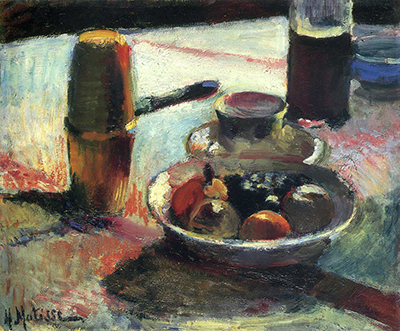
Henri Matisse's Fruit and Coffeepot gathers a handled pot, a shallow dish of fruit and smaller vessels on a tabletop. The State Hermitage Museum in Saint Petersburg holds the painting. It is often dated around 1898 , although a Russian museum research project calls it 1899 in its text and around 1900 in its caption. The precise year should not be treated as settled. The commonly published medium is oil on canvas and the dimensions 38.5 × 46.5 cm . These details identify the Hermitage picture rather than another early Matisse still life with a pot and fruit. [1] [2] [3]
The painting rewards a slow look because its domestic objects are neither sharply outlined nor dissolved into light. The fruit keeps its rounded form, while colour moves across the pot, dish and tablecloth in visible strokes. This balance between a readable arrangement and independent patches of paint gives the small canvas much of its energy.
At a Glance
- Artist Henri Matisse
- Work Fruit and Coffeepot
- Date c. 1898–1900
- Explore Painting
This work across Henri Matisse’s career
Dance (1910)
1910The Red Studio
1911The Piano Lesson
1916The Snail
1953Contents
- What is arranged on the table?
- How does colour change the objects?
- Why does the 1910 purchase matter?
What is arranged on the table?
The coffeepot stands toward the left, its dark handle curving away from the warm-coloured body. At the centre, fruit sits in a low, pale-rimmed dish. A dark upright vessel occupies the space to the right, while other small light shapes punctuate the cloth. The objects overlap, but Matisse leaves enough of each contour visible to keep the tabletop legible. A viewer can move from the tall pot to the low dish and back across the smaller forms without a single object taking over the scene.
The tabletop tilts toward us. Its slant gives access to the fruit and the dish, yet makes the grouping feel slightly unstable: the objects seem to rest on a surface that is also a field of angled brushstrokes. The light cloth is broken by blue, violet, ochre and warmer touches. These colours are not just a neutral ground for the still life. They pull its separate parts together, especially where reflections and shadows touch the base of the vessels.
In the reproduction, the fruit appears as several warm red-orange forms with darker pieces among them. The small image does not justify assigning each piece a certain botanical name. What matters visually is the contrast between their rounded, softly modelled surfaces and the brisker strokes around them. The pale lip of the dish makes a partial ring that holds the fruit together even as the paint remains loose.
Watch: Matisse’s art and working methods
Choose a museum film or a close reading to continue exploring Matisse’s work.
MoMA Conservators discover Matisse's process for "The Red Studio" | CONSERVATION STORIES
Conservators examine the making of The Red Studio.
Watch on YouTubeHow does colour change the objects?
The pot has weight, built from broad strokes, but it is not a uniformly brown or metallic shape. Warmer and cooler marks interrupt its surface. The dark handle and coloured edges stop it merging into the cloth. At the same time, the colours nearby seem to find echoes in it. The Polish public education resource that reproduces the Hermitage work similarly calls attention to the pot's broad strokes, coloured contours and reflections in the tablecloth; these are useful prompts for looking, rather than evidence for a particular recipe of pigments or a documented sequence of painting. [4]
There is no need to label the picture simply “Fauvist” on the strength of its colour. It belongs to Matisse's early development, before the 1905 works for which that term is usually used. The colour here still helps describe light and volume, but it also begins to claim attention in its own right. Even the shadow on the cloth is made interesting through colour, not just a darkened version of white.
The Russian museum research project records collector Ivan Morozov buying Fruit and Coffeepot through the Druet gallery in 1910 . That later purchase places the modest early painting within the history of French modern art collecting in Moscow; it does not resolve its exact date of production. [3]
The painting is often discussed alongside early experiments in which Matisse tested what still life could do. A useful nearby comparison is his Blue Pot and Lemon , also associated with the Hermitage collection. That picture brings a pot and fruit close to a window; Fruit and Coffeepot compresses its objects onto a more crowded tabletop. The comparison is about different pictorial arrangements, not proof that the two paintings were made together or in a fixed order. [4]
Another comparison needs a stronger distinction. The French Ministry of Culture records a separate Nature morte au pichet in Le Havre , dated around 1896 , with a pot, fruit and dark bottle. Similar household props do not make it the Hermitage canvas. The different title, collection and measurements protect the identity of each work and show how often Matisse returned to the same visual problem: how simple vessels and fruit could become an arrangement of light, shape and colour. [5]
Why does the 1910 purchase matter?
The Morozov acquisition gives the painting a documented later moment even while its creation date remains uncertain. By 1910, the collector could buy an early Matisse still life through a Paris gallery, showing that the small domestic canvas continued to circulate after the artist's style had changed. That provenance does not prove what Matisse intended in the late 1890s, nor does it make the work a 1910 painting. It helps distinguish the painting's own history from later labels attached to similar still lifes. [3]
The dated comparisons sharpen the visual question. The Le Havre Nature morte au pichet brings related household objects into a separate, earlier composition; Blue Pot and Lemon uses a window setting; here the dish, pot and smaller vessels press into a compact tabletop. Across those works, a pot is a repeatable subject, but its relation to surrounding colour and space changes. In Fruit and Coffeepot , the light cloth carries reflections and short strokes that keep the objects connected without dissolving their forms. The comparisons support close looking, not a fixed evolutionary ladder from one canvas to the next. [4] [5]
Look again at the coloured marks on the cloth immediately below the dish. They do not describe an object that can be named, yet they affect how solid the dish and fruit feel. This is the still life's central exchange: Matisse gives each thing enough form to be recognised, then makes the spaces between things just as active. The paintings directory offers the broader sequence, while The Dinner Table shows a more elaborate early treatment of a laid table.
Explore 113 Matisse artworks
This directory covers the 113 individual works explored in these articles, rather than a complete catalogue of Matisse’s output. Cut-paper designs and prints appear under Drawing in the medium filter; each row names its form. Dates retain the qualifications explained in the linked articles.
Discussion
Look again at the images and ideas explored in Henri Matisse, Fruit and Coffeepot : An Early Still Life in Colour. These editorial prompts invite your observations.
Reader Insights
What is arranged on the table?
Which comparison discussed in the article helps you see the work differently?
How do the materials and historical setting affect your reading?
Join the Conversation
Share a detail, comparison or question about Henri Matisse, Fruit and Coffeepot : An Early Still Life in Colour below.
References
- State Hermitage Museum , historic digital collection endpoint for Fruit and Coffeepot , collection lead; endpoint intermittently unavailable at drafting. View source .
- Wikimedia Commons file record , Fruit and Coffeepot , image record sourced to Hermitage, oil-on-canvas medium, 38.5 × 46.5 cm and circa-1898 listing. View source .
- Museum of New Western Art research project , 1910 chronology, Hermitage Fruit and Coffeepot identified with variant date lines and Morozov's 1910 Druet-gallery acquisition. View source .
- Polish Ministry of Education , early Matisse teaching resource, reproduction and discussion of Fruit and Coffeepot and Blue Pot and Lemon . View source .
- French Ministry of Culture , Nature morte au pichet , separate Le Havre still life and its object record. View source .






 Henri Matisse.jpg)
