


 by
Tom Gurney
Tom Gurney BSc (Hons) is an art history expert with over 20 years experience
Email:
tomgurney1@gmail.com
/ Phone:
+44 7429 011000
Henri Matisse, Game of Bowls (1908): Figures at Play: Introduction
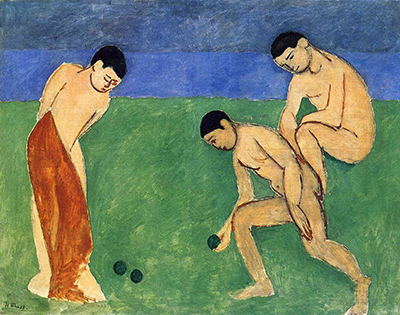
Three figures attend to a small game on a stretch of green. One bends at the left, partly covered in reddish cloth; another steps forward with a dark ball in hand; a third folds into a high, compact pose at the right. Two more balls lie near the foreground. Above them, the landscape has been reduced to broad horizontal bands of green and blue. Henri Matisse's Game of Bowls , painted in 1908 , turns an ordinary shared activity into a picture of sharply related bodies, colors and intervals. The State Hermitage Museum in Saint Petersburg owns the oil on canvas , recorded at 115 × 146.6 centimetres in the Russian national Artefact record of a Shchukin collection exhibition. [1]
The title promises a game, but the painting gives no detailed account of its rules or outcome. It holds a moment before or during a throw, when one person's action depends on the positions of the others. The lean setting makes that relation unusually clear. Nothing behind the players competes with the downward tilt of their heads, the ball in the central figure's hand or the pair already resting on the ground. Looking at these few elements is enough to discover how much movement the picture can contain without a crowded scene.
At a Glance
- Artist Henri Matisse
- Work Game of Bowls (1908)
- Date 1908
- Explore Painting
This work across Henri Matisse’s career
Dance (1910)
1910The Red Studio
1911The Piano Lesson
1916The Snail
1953Contents
- What is happening among the three figures?
- Why is the landscape so spare?
- How does it relate to Bathers with a Turtle?
- What became of the painting in Shchukin's collection?
What is happening among the three figures?
The figure at left leans forward from a comparatively upright stance. Dark hair and a lowered face draw the eye toward the ground. The reddish cloth covering part of the body is the largest warm-colored area in the painting; its near-vertical mass anchors that side. One might first notice it as clothing, then see how its rust color balances the skin tones of the other two figures. The left figure's attention runs toward the two balls below, giving the otherwise spare green foreground a purpose.
The central player is the clearest agent in the game. The torso slopes forward and the near arm hangs with a dark ball held low. One leg bends while the other extends backward, making the pose seem poised between stillness and movement. The ball has not visibly left the hand. Matisse depicts readiness, not a freeze-frame of a completed throw. The body connects the small objects on the ground to the group of figures: its reach makes the game readable while its long legs carry a strong diagonal across the green field.
At right, the third figure perches or crouches higher than the central player. Bent knees and a lowered head compress the body into a curved shape that answers the central figure's stretch. The two overlap, but their poses remain distinct. One reaches outward with an object; the other gathers inward and watches. Their close grouping leaves the left figure more isolated, so the viewer's attention can travel across the canvas in stages rather than take in three equivalent bodies at once.
The three dark balls are small, but they organize the entire scene. Two sit near the left player's feet; one remains in the central hand. Their repeated round shapes are much darker than the grass. Each becomes a visual point that the lowered gazes and reaching arms seem to address. The exact rules of the depicted game are not needed for this effect. The painting tells us where the players' attention lies, and leaves the next movement open.
Why is the landscape so spare?
Most of the canvas behind the figures is a green field. Above it is a cooler blue band and then a darker upper zone. The Russian exhibition record describes the backdrop through these broad stripes, comparing it with the simplified setting of Matisse's Bathers with a Turtle . The areas can be read as ground and distance without a mapped place, particular village or documented hour of day. They provide a stage for the figures and let each silhouette hold its own shape against a relatively uninterrupted color. [1]
The bands are horizontal; the bodies are all bends and diagonals. The center player's leg crosses much of the green, the left figure leans down and the right one folds over the group. These directions stop the painting from becoming static. At the same time, the blue line across the background steadies the action. A landscape with trees, houses and receding paths would give more information about a place; Matisse chooses to give more weight to the relation between people and open ground.
Skin color makes another rhythm. The bodies are pale and warm against green and blue, but they are not modeled to appear like sculptures under consistent natural light. Their edges are strong enough to separate them from the fields around them, while areas of color remain broad. The rust-red drapery at left intensifies the palette without spreading red across the entire canvas. A viewer can move from that fabric to a face, then to an arm and a leg, noticing how economical color can guide a fairly complex bodily arrangement.
This is one reason the picture can feel solemn despite its playful subject. The figures are absorbed in a small action. None looks toward the viewer or turns the game into a comic anecdote. The setting holds them apart from everyday distractions, and the spare poses make each gesture count. The effect is visible without assigning secret identities or a fixed symbolic role to the clothed and unclothed bodies. A proposed link between their different dress and tragedy in the collector's family remains speculative; the painting and the secure records do not require it to explain the scene.
Watch: Matisse’s art and working methods
Choose a museum film or a close reading to continue exploring Matisse’s work.
Matisse: “For Me It’s Always New”
The Museum of Fine Arts, Boston considers Matisse’s creative practice.
Watch on YouTubeHow does it relate to Bathers with a Turtle?
Collector Sergei Shchukin saw Matisse's Bathers with a Turtle while it was promised to Karl Ernst Osthaus . The Russian Shchukin exhibition account says he asked Matisse for something related, but Matisse would not simply repeat the existing picture. Game of Bowls is the resulting 1908 work connected to that request. The link is historically useful because it explains why the two paintings can resemble each other without being copies. Both set three figures against broad bands of color; their small foreground objects hold attention. Yet the Hermitage players focus on balls and a shared game, while the other canvas asks its bathers to gather around a turtle. [1] [2]
The Art Institute of Chicago's scholarly catalogue identifies Bathers with a Turtle as a separate 1907–08 canvas now at the Saint Louis Art Museum , and illustrates Game of Bowls as the 1908 Hermitage painting. The difference in scale is substantial: the Saint Louis work is a large, wider canvas; the Hermitage work is smaller and its action more immediately graspable. In the turtle painting, the animal can seem puzzling because the figures' relation to it is difficult to settle. Here, the repeated balls and central player's hand make the activity legible, even though the outcome remains unknown. [2]
The two pictures also diverge in bodily grouping. The turtle painting spaces its figures around an enigmatic creature. In Game of Bowls , two figures overlap tightly at right, while the draped figure stands apart at left. The dark balls link both sides across the open green. Matisse took a related formal problem—several bodies, an object of attention and a stripped landscape—and reorganized it around a different action. The Bathers with a Turtle page gives that painting its own visual and collection history.
Shchukin's interest in these Arcadian figure pictures preceded his later, separate commission for the monumental Dance and Music panels. The Art Institute dates his acquisitions of such works to 1908 and the stairway commission to spring 1909 . Game of Bowls can be seen beside those later experiments in simplified figures and large color fields, but it was not one of the two commissioned stairway murals. Its game, scale and original route into Shchukin's collection are distinct. [3]
What became of the painting in Shchukin's collection?
The picture did not remain an isolated purchase. Hermitage researcher Olga Leontyeva , drawing on a newly found letter and evidence about the hanging in Shchukin's Moscow mansion, explains that Game of Bowls occupied the center of the main wall in the Pink Salon. Its width helped set a measure for later works arranged around it. The green field played a part in a larger group of paintings within a room that also had its own wall color, ceiling and furnishings. This is a later history of display and planning, not evidence that Matisse painted the 1908 canvas to a pre-existing 1911 salon diagram. [4]
That placement changes how we can imagine viewing the work. In a gallery today, one painting may be encountered on its own. In Shchukin's house it could be read among other Matisses, with its horizontal bands and three figures answering neighboring pictures. The 1908 scene of a small game became a structural center for an ambitious room arrangement. Leontyeva's account is especially valuable because it connects a visible property of the canvas—its width—to the practical decisions of hanging later works. It gives the collector's setting specificity without claiming that the game hides a coded personal story. [4]
The ownership path then changed. The NeWestMuseum record traces the work from Shchukin's collection through the 1918 nationalisation and its later presence in the Museum of Modern Western Art to the Hermitage in 1948 . These are stages in the painting's history, not changes to the people or activity depicted. The accession associated with it is 9154 , a useful safeguard when works with similar early Matisse subjects are discussed together. [5]
To return to the canvas itself, follow the ball in the central hand, then the two on the grass. Look upward along the players' bent bodies and across the line where green meets blue. The painting keeps a human action and a nearly abstract arrangement in view at the same time. Its few objects make the game recognizable; its broad bands and compressed poses make that brief moment feel larger than a casual scene. Explore the paintings guide for the surrounding years of Matisse's work.
Explore 113 Matisse artworks
This directory covers the 113 individual works explored in these articles, rather than a complete catalogue of Matisse’s output. Cut-paper designs and prints appear under Drawing in the medium filter; each row names its form. Dates retain the qualifications explained in the linked articles.
Discussion
Look again at the images and ideas explored in Henri Matisse, Game of Bowls (1908): Figures at Play. These editorial prompts invite your observations.
Reader Insights
What is happening among the three figures?
Which comparison discussed in the article helps you see the work differently?
How do the materials and historical setting affect your reading?
Join the Conversation
Share a detail, comparison or question about Henri Matisse, Game of Bowls (1908): Figures at Play below.
References
- Artefact , Russian national Shchukin exhibition record for Game of Bowls , Hermitage identity, medium, size, Shchukin request and comparison with Bathers with a Turtle . View source .
- Art Institute of Chicago , online scholarly catalogue, Bathers by a River , figure 25.5, object comparison and Hermitage attribution. View source .
- Art Institute of Chicago , “Opportunity and Invention, 1909–1910”, Shchukin's 1908 acquisitions and later stairway commission. View source .
- Olga Leontyeva , “Неизвестное письмо,” Hermitage magazine, Pink Salon installation research and Game of Bowls placement. View source .
- NeWestMuseum , Игра в шары , historical collection record, inventory and transfer dates. View source .






 Henri Matisse.jpg)
