 by
Tom Gurney
Tom Gurney BSc (Hons) is an art history expert with over 20 years experience
Email:
tomgurney1@gmail.com
/ Phone:
+44 7429 011000
Henri Matisse, Lagoon from Jazz , plate XVIII: Introduction
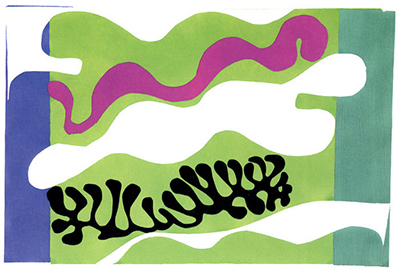
A pale, winding opening crosses a field of strong green. Above it, a violet ribbon bends and broadens; below it, a black branching form spreads across the page. Blue presses in at the left edge, while deeper green holds the right. Henri Matisse called this image Lagoon (Le Lagon). Its colors and branching shapes suggest water and aquatic life, but they do not describe a particular stretch of coast. The eye moves among separate, flat forms and makes a place from their relationships.[1][2]
The image on this page reproduces the design of Lagoon, plate XVIII in Jazz, Matisse's illustrated book published in 1947. The eighteenth plate is one of three consecutive Lagoon plates, numbered XVII, XVIII and XIX. MoMA catalogues its book impression as a pochoir, or stencil print, on pages 130–131. The design was related to Matisse's arrangements of gouache-painted cut paper, but the printed page is not itself a collage of paper shapes. That distinction helps explain why the forms look so crisp and why the book could carry Matisse's colors to readers beyond his studio.[1][3][4]
At a Glance
- Artist Henri Matisse
- Work Lagoon from Jazz , plate XVIII
- Date 1947
- Explore Printmaking
This work across Henri Matisse’s career
Dance (1910)
1910The Red Studio
1911The Piano Lesson
1916The Snail
1953Contents
- Which Lagoon does this page show?
- What happens across the green field?
- How did painted paper become a printed plate?
- Is it a memory of a real lagoon?
- How does this plate fit within Jazz?
Which Lagoon does this page show?
The title alone cannot identify a single image in Jazz. MoMA records Lagoon on plate XVII, pages 122–123; again on plate XVIII, pages 130–131; and once more on plate XIX, pages 138–139. These are three designs occupying different positions in the same book. The bright green field, violet upper band, broad white channels and black lower branching shape in the image here correspond to XVIII. A caption that gives only “The Lagoon, 1944” would make it too easy to confuse this print with another plate or with an original cut-paper study.[1][3][4]
MoMA dates the plate's design and production broadly 1943–47 and says the book was published in 1947. Its plate XVIII impression, object 930.1964.18, belongs to an illustrated-book edition of 250. Those are facts about MoMA's particular book copy. A reproduction of the design cannot establish which physical impression supplied it. What we can identify securely is the composition and its place in the book.[1]
The title's repetition invites comparison. Rather than providing one definitive view of a lagoon, Matisse returned to the idea with changed arrangements of colored forms. The three plates can be read as variations: a shared subject or memory tested through different distributions of color, open space and branching silhouettes. They are not three states of the same physical sheet, and XVIII is not an alternative label for XIX. The sequence asks the reader to recognize a family resemblance while attending to what changes from one page to the next.[3][4][2]
What happens across the green field?
Green covers most of plate XVIII, yet it never becomes a quiet background. Its large area makes every interruption count. A narrow dark-blue edge on the left acts almost like a border, while a deeper green passage at the right closes the field. Between them, the violet band turns across the upper part of the picture. Its bend sets a loose horizontal movement against the vertical edges. These strong shapes do not fade gradually into one another; their borders remain emphatic.
The irregular white areas create the clearest sense of passage. They wind through the green and separate the violet from the black shape below. At one point the white widens; elsewhere it narrows and seems to fork. A viewer may see channels of water moving around plants, or the open intervals between colored pieces. Because white can be both empty paper and a positive shape to follow, the plate keeps shifting between solid forms and spaces. It rewards a second look at the areas that initially seem unprinted.
The black form in the lower part resembles branching aquatic growth more than a measured drawing of one plant. A thicker section gives way to several thinner arms. Its dark silhouette stands out sharply against the light opening and green around it, carrying a different visual weight from the flexible violet ribbon above. The two shapes make the page feel animated in different directions: the violet sweeps sideways, while the black seems to branch and spread. Neither needs shading to appear active.
There is no horizon, shore, reflection or fixed viewpoint to tell us exactly where we stand. The page can suggest looking into water without depicting an underwater landscape in conventional perspective. Its forms might appear to float in front of one another, yet they also stay firmly on the surface of the printed sheet. That is part of the work's precision. A few interlocking colors generate a lively sense of depth and movement without pretending to offer a literal view through a window.
Calling the white bands “clouds” would force a sky into a picture that supplies no stable up or down in landscape terms. The lagoon title and the branchlike shapes make an aquatic reading more persuasive, but they still leave the forms open. Matisse's visual language works through suggestion. The viewer recognizes the behavior of water, plants and light while continuing to see independent patches of color and edges.
Watch: Matisse’s art and working methods
Choose a museum film or a close reading to continue exploring Matisse’s work.
Matisse: The Cut Outs
Tate introduces its exhibition devoted to Matisse’s cut-paper work.
Watch on YouTubeHow did painted paper become a printed plate?
For Jazz, Matisse developed designs by cutting shapes from paper colored with gouache and arranging them. The edge of each piece could be revised by cutting; its position could be changed by moving it. This way of working let him think in broad color areas and decisive contours. Centre Pompidou's account of the project describes the cut-paper maquettes from which printers made the plates. The maquette is a physical arrangement of painted paper, with its own surface and construction. The book plate translates that arrangement into a printed image.[5]
The translation used pochoir, a stencil process in which color is applied through cut openings. It was suited to the broad, saturated areas Matisse wanted. MoMA credits Edmond Vairel and Draeger Frères as printers of its Jazz plate XVIII and Tériade in Paris as publisher. The printed green, violet, blue and black therefore belong to a carefully produced edition, not to pieces of paper pasted onto every book page by Matisse. Understanding the medium changes how we read even the white areas: they are part of the printed design's planned intervals, not accidental gaps where a collage has fallen away.[1][5]
The book brought images together with Matisse's handwritten text. The plate occupies a spread, so its horizontal extension matters: the eye travels across the opening rather than stopping at the center. MoMA measures the printed composition in its copy at about 40.8 × 61.3 centimetres, on a sheet about 42.3 × 65 centimetres. Those dimensions describe the museum's book impression. In a smaller reproduction, the width still preserves the sweep from the blue edge through the violet and white to the right-hand green.[1]
There were also separate printed presentations of Jazz. The National Gallery of Art catalogues a portfolio containing the twenty color stencils, while MoMA identifies the plate on this page within a bound illustrated book. A plate can therefore be encountered as part of a book or in a portfolio holding; neither printed form should be mistaken for the painted-paper maquette. A reproduction of the design, such as the one here, cannot by itself identify which individual copy supplied it. Its value for this page is that it lets us study the plate XVIII arrangement.[1][6]
Is it a memory of a real lagoon?
Matisse traveled to French Polynesia in 1930. Saint Louis Art Museum connects the Jazz Lagoons with his memories of snorkeling in tropical water and the forms of seaweed. Centre Pompidou likewise places marine memories behind the lagoon imagery. These accounts give a grounded reason to see an underwater suggestion in the branching forms. They do not identify a particular lagoon or say that the black shape is a scientifically recognizable species. The memory became a starting point for new arrangements made years after the journey.[2][5]
The gap between journey and book is useful to keep in view. Matisse did not draw this plate as an immediate travel report. He returned to remembered sensations through the methods of the 1940s: colored paper, cutting, rearranging and then stencil printing. In plate XVIII, the greens are more assertive than any attempt to describe transparent water accurately. Black, violet and white establish their own rhythm across the page. Memory supplies a subject; the formal decisions make this a Jazz plate rather than a documentary image of Polynesia.
The sea also appears elsewhere in Matisse's work, but the lagoon sequence is especially concentrated. Three consecutive plates allow the reader to see the same title take different forms. Plate XVIII's generous green, looping violet and black branching form make its identity distinct. The relation among them carries as much meaning as any one isolated “seaweed” motif. Looking slowly across the sequence is a better way to understand Matisse's experimentation than treating the three images as interchangeable illustrations of tropical scenery.[3][4][2]
How does this plate fit within Jazz?
The book contains twenty pochoir plates. Some, such as Icarus, offer a named figure and an apparent episode. Lagoon works differently: it gives the viewer a place without drawing a conventional scene. It depends on how colored shapes and spaces meet. Both approaches grew from Matisse's painted-paper designs and became prints, but their subjects create different ways of reading. In Icarus, the title pulls us toward a myth; in Lagoon, it gives the abstracted field an aquatic direction.[1][7]
Begin at the left blue edge of plate XVIII, follow the violet curve, then trace the white opening around the black branches. Finally look at how much green remains. The composition gives no single object the whole story. It makes a lagoon from the pace and pressure of color across a printed spread. The cut-outs guide explains the painted-paper method behind Jazz, while the prints guide places its pochoirs among Matisse's other printed work.
Explore 113 Matisse artworks
This directory covers the 113 individual works explored in these articles, rather than a complete catalogue of Matisse’s output. Cut-paper designs and prints appear under Drawing in the medium filter; each row names its form. Dates retain the qualifications explained in the linked articles.
Discussion
Look again at the images and ideas explored in Henri Matisse, Lagoon from Jazz , plate XVIII. These editorial prompts invite your observations.
Reader Insights
Which Lagoon does this page show?
Which comparison discussed in the article helps you see the work differently?
How do the materials and historical setting affect your reading?
Join the Conversation
Share a detail, comparison or question about Henri Matisse, Lagoon from Jazz , plate XVIII below.
References
- Museum of Modern Art , Lagoon , plate XVIII from Jazz , book impression, title, dates, medium, dimensions, publisher, printer and edition. View source .
- Saint Louis Art Museum , Matisse and the Sea object labels, three Lagoon plates and French Polynesian aquatic context. View source .
- Museum of Modern Art , Lagoon , plate XVII from Jazz , preceding plate and book pagination. View source .
- Museum of Modern Art , Lagoon , plate XIX from Jazz , following plate and book pagination. View source .
- Centre Pompidou , Le lagon and Jazz contextual account, painted-paper maquettes, pochoir production and marine memory. View source .
- National Gallery of Art , Jazz portfolio, distinct portfolio presentation of the twenty stencils. View source .
- Museum of Modern Art , Icarus from Jazz , comparison with the named figure in plate VIII. View source .
 Henri Matisse.jpg)