 by
Tom Gurney
Tom Gurney BSc (Hons) is an art history expert with over 20 years experience
Email:
tomgurney1@gmail.com
/ Phone:
+44 7429 011000
Henri Matisse, Large Decoration with Masks , 1953: Introduction
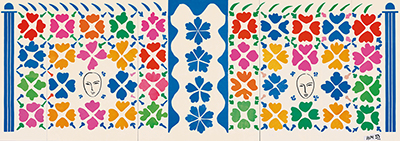
Henri Matisse's Large Decoration with Masks stretches across nearly ten metres. Colored flowers and small branching forms repeat on white; two spare faces interrupt the pattern; blue columns hold its ends and center. Made in 1953 , it was a full-size cut-paper design for a ceramic mural , not a folding screen or an installed wall of tiles. The National Gallery of Art in Washington owns the original painted-paper work, assembled on five joined canvas panels and measuring about 3.54 metres high by 9.96 metres wide . [1] [2]
At a Glance
- Artist Henri Matisse
- Work Large Decoration with Masks
- Date 1953
- Explore Cut paper and drawing
This work across Henri Matisse’s career
Dance (1910)
1910The Red Studio
1911The Piano Lesson
1916The Snail
1953Contents
- How is the decoration organised?
- How would a viewer meet a work this wide?
- Why did the patio commission change direction?
- What was it designed to become?
How is the decoration organised?
The two broad side fields are filled with four-part flower shapes. Blue, green, pink, orange, red and yellow appear repeatedly, but their sequence changes across the surface. The repetition makes a grid without turning every section into a copy of its neighbor. Small clove-like shapes between the flowers help link one group to another. White remains visible around every cut form, so the space between colors becomes part of the rhythm. [1]
A central blue strip carries a vertical row of blue flowers. Narrow blue columns close the outer edges. These strong upright elements frame the wide, busy fields without stopping the eye from moving sideways. At the upper edge, short blue marks give way to green ones across the center. The whole design is symmetrical in broad structure, yet color shifts and differing cut contours keep it lively. Its scale would require a viewer to move along it rather than take in every detail at once. [1]
The five joined panels are a support for one continuous design. Their seams divide the expanse physically, but the repeated forms and white ground carry across them. This is why the piece reads as a wall decoration rather than five separate scenes. The National Gallery records Matisse's blue “HM 53/53” inscription at the lower right, a small mark at the far end of a composition whose overall rhythm is far more conspicuous than its signature. [1]
Each mask replaces a flower near the inner area of a side field. The faces are small compared with the decoration: light ovals with eyes, nose and mouth drawn in dark lines. Their placement creates two pauses in the floral pattern. A visitor may notice them only after first seeing the broad color grid. Nothing in the owner record establishes a specific person, ritual or fixed symbolic meaning for either face. The masks matter visibly because a line-drawn human sign interrupts a repeated cut-paper motif. [1] [2]
How would a viewer meet a work this wide?
The National Gallery's measurement, just under ten metres across, makes a single, fixed viewpoint inadequate. A visitor standing near one mask would see flower shapes and white intervals in detail, while the other mask could remain far across the wall. Stepping back would reveal the blue uprights and broad symmetry, but individual cut contours would merge into a rhythmic field. The work supports both encounters. Its five joined canvas panels form one continuous decoration, yet their combined width asks the viewer to move and to discover repetition through time as well as across space. [1]
The two masks offer human signs within a largely floral field. They are not large portraits competing with the flowers. Their small drawn features reward the close look that the enormous pattern might otherwise discourage. Moving between one face and the other, a viewer can feel how Matisse varied the intervening flower colours while keeping the basic motif recognizable. This is an interpretation of the visible composition, not a claim that the faces portray the Brodys or any named people. [1] [2]
Watch: Matisse’s art and working methods
Choose a museum film or a close reading to continue exploring Matisse’s work.
Matisse: The Cut Outs
Tate introduces its exhibition devoted to Matisse’s cut-paper work.
Watch on YouTubeWhy did the patio commission change direction?
MoMA says the first broad design exceeded the width of the Brodys' intended patio wall. That practical limit shaped the next stage. Matisse did not merely shrink this flower-and-mask pattern to fit; he developed other proposals, with The Sheaf eventually selected as the fourth and final design. The shift from an extended floral grid to a concentrated spray of leaves shows two different answers to the same site. The paper original survived as a full-scale composition even though the commission took another form. [3]
Material changes would have mattered too. A cut-paper maquette preserves hand-shaped edges, joins, white spaces and drawn mask features. A ceramic wall would translate the design into fabricated units suited to a patio. MoMA identifies this work as a maquette; the National Gallery records the object now before us as gouache-painted cut paper mounted across canvases. Seeing it as a proposal does not make it visually incomplete. Its rhythmic flowers and quiet faces can be read as a finished cut-out, while the commission history explains the architectural scale for which that rhythm was imagined. [1] [2] [3]
What was it designed to become?
MoMA's research into the cut-outs identifies the commission: Sidney and Frances Brody wanted a ceramic decoration for the patio of their Los Angeles home. Matisse began with this unusually wide composition. It proved too wide for the site, and he developed further proposals. The Sheaf , a spray of colored leaves, became the fourth and final design . Large Decoration with Masks therefore has two identities worth keeping together: it is a finished, room-scale cut-paper work to see in its own right, and it was a preliminary design for a ceramic that took another form. [3]
The material distinction is clear in the National Gallery's record. Matisse's assistants colored paper with gouache; he cut shapes, arranged and revised them, and the pieces were eventually pasted on white paper mounted to canvas. MoMA's exhibition label also records ink, consistent with the drawn mask details. A ceramic mural would require translation into another material. The object reproduced here retains the cut and pasted paper whose edges and white intervals drive the design. [1] [2]
MoMA relates the repeating flowers to Matisse's long interest in decoration and to tile-like patterns. The repetition is architectural: blue columns and a central axis help a viewer understand almost ten metres of color. Yet its cut leaves and flowers vary enough to avoid mechanical regularity. Compare the eventually selected Sheaf to see how the same patio commission could move from a wide floral grid to a concentrated burst of leaves; the cut-outs guide explains the painted-paper method used for both works. [3]
Explore 113 Matisse artworks
This directory covers the 113 individual works explored in these articles, rather than a complete catalogue of Matisse’s output. Cut-paper designs and prints appear under Drawing in the medium filter; each row names its form. Dates retain the qualifications explained in the linked articles.
Discussion
Look again at the images and ideas explored in Henri Matisse, Large Decoration with Masks , 1953. These editorial prompts invite your observations.
Reader Insights
How is the decoration organised?
Which comparison discussed in the article helps you see the work differently?
How do the materials and historical setting affect your reading?
Join the Conversation
Share a detail, comparison or question about Henri Matisse, Large Decoration with Masks , 1953 below.
References
- National Gallery of Art , Large Decoration with Masks , owner record, visual description, medium, dimensions and accession. View source .
- Museum of Modern Art , Henri Matisse: The Cut-Outs audio label, original ceramic-maquette identity, medium and scale. View source .
- Museum of Modern Art , Henri Matisse: The Cut-Outs press release, Brody patio commission, rejected width and The Sheaf sequence. View source .
 Henri Matisse.jpg)