


 by
Tom Gurney
Tom Gurney BSc (Hons) is an art history expert with over 20 years experience
Email:
tomgurney1@gmail.com
/ Phone:
+44 7429 011000
Male Model by Henri Matisse: a figure built through colour: Introduction
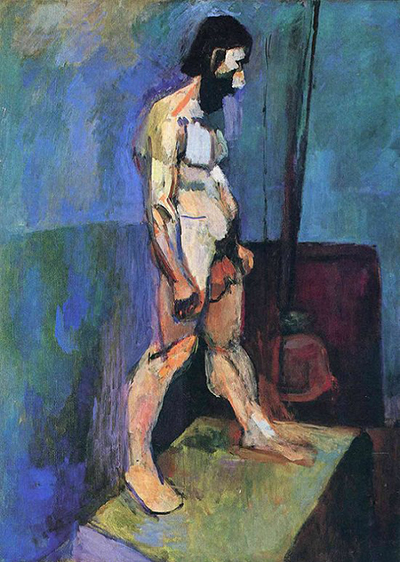
Henri Matisse's Male Model shows a nude man standing on a small raised platform in a studio-like setting. His head turns down and to the side; one leg advances while the other bears more of his weight. Warm colours shape the body against a blue-violet ground. The painting may seem far from the broad, bright colour fields of Matisse's later work, yet it asks a related question: how can colour and painted marks make a human figure feel substantial while keeping the canvas visibly flat? Made in Paris around 1900 , it records a period of intensive study of the body before the paintings associated with Fauvism. [1] [2]
At a Glance
- Artist Henri Matisse
- Work Male Model
- Date c. 1900
- Explore Painting
This work across Henri Matisse’s career
Dance (1910)
1910The Red Studio
1911The Piano Lesson
1916The Snail
1953Contents
- What is Male Model?
- How does the pose occupy the canvas?
- Why is the background so active?
- What did Matisse take from Cézanne?
- How does the painting relate to The Serf?
- How did MoMA acquire the painting?
What is Male Model?
The Museum of Modern Art in New York catalogues the work as oil on canvas , 99.3 × 72.7 centimetres , painted in Paris circa 1900 . Its object number is 377.1975 . The approximate date matters: it places the painting near Matisse's early figure and sculpture studies without pretending that a precise day or month is known. The canvas is large enough for a standing body to dominate it, but it is not a life-size mural. The plain title describes the subject rather than identifying a mythological character or telling a narrative. [1]
MoMA's 1978 catalogue connects the work to nude studies Matisse made at the Académie Carrière . Figure drawing was central to the training of artists in Paris, and MoMA's later retrospective notes Matisse's experience of drawing from plaster casts and nude models. The picture belongs within that practice, but it is more than a classroom exercise in reproducing anatomy. Matisse uses the model to test how the body's volumes meet a coloured background and how a figure can advance or recede without disappearing into the illusion of a deep room. [2] [3]
The model is identified in MoMA's catalogue as an Italian sitter named Bevilaqua , whose name also appears with the spelling Bevilacqua in later institutional accounts. The same man posed for Matisse's early sculpture The Serf . That connection is valuable, but it does not make the oil canvas a picture of the finished sculpture. One work is paint on canvas; the other is a modeled body developed over several years and known through later casts. They share a sitter and a concern with bodily weight while remaining separate objects. [2] [4]
How does the pose occupy the canvas?
The figure stands with his feet apart on a yellow-green platform. One foot is nearer the lower edge, while the other reaches diagonally toward the right. This gives the body a direction through space instead of setting it squarely against the viewer. The head bends forward, and the dark hair and beard make a compact shape above a pale face. Arms hang beside the torso; hands become small, dark interruptions against the lighter legs. The pose is neither a walking action nor a theatrical gesture. Its interest lies in the shift of weight through a body held in place. [1]
The platform matters because it gives the feet somewhere to stand and marks a lower plane distinct from the wall. Its near edge angles across the bottom of the painting. Yet it does not create a neat perspective box around the model. The back of the setting remains spare, and a dark vertical at the right gives a studio cue without supplying a detailed interior. The viewer attends to a body seen in relation to a few firm spatial hints. Those hints are enough to make the pose legible, but they leave room for colour to do much of the work. [1]
Look at the shoulders and chest. Warm beige and orange strokes describe lit planes, while darker green, brown and blue marks interrupt their edges. The body does not have a single smooth skin tone. Matisse builds it from patches that turn or meet at angles. A highlighted shoulder can appear to push outward; a dark stroke beside the ribs can pull the eye inward. This makes the figure rugged and substantial, the qualities MoMA's retrospective connects with Matisse's study of Cézanne around the turn of the century. [1] [3]
The legs continue that alternation of light and dark. Their broad pale areas carry the body's weight toward the platform, while dark edges prevent them from dissolving into the cooler wall. The feet are not rendered as an anatomical demonstration of every toe. They make the stance credible enough for the viewer to sense pressure on the ground. This is a different kind of accuracy: the body convinces through its overall mass and balance, even where individual details are simplified. [1] [2]
Watch: Matisse’s art and working methods
Choose a museum film or a close reading to continue exploring Matisse’s work.
Matisse: “For Me It’s Always New”
The Museum of Fine Arts, Boston considers Matisse’s creative practice.
Watch on YouTubeWhy is the background so active?
The wall or ground behind the model contains blue, violet and green rather than one neutral colour. It is worked more heavily at the left, where marks press close to the illuminated side of the figure. At the right, broad darker passages make a quieter counterweight. MoMA's catalogue observes that these unequal treatments let different parts of the background seem to occupy different positions in space. It is not merely a curtain behind the “real” subject. The ground helps decide whether the body seems to emerge toward the viewer or sink back into the painted field. [2]
The relation is clearest around the head and neck. Dark hair and beard usually set a strong contour, yet nearby cool colour enters some of the face's shadowed passages. MoMA's analysis notes how the background hue seems to penetrate the head and neck, limiting the distance between figure and ground. A viewer can read a solid head turned in space and, at the same time, see coloured shapes on a flat canvas. The painting does not choose only one of those experiences. It keeps them in tension. [2]
A dark band running beside the model is another boundary. It sets off the pale body, but it also becomes a painted shape in its own right. MoMA describes a deliberately created false shadow along the figure's left side, rather than a simple report of light falling naturally. This helps secure the contour and brings a surrounding patch into the figure's design. The physical studio may have supplied the model and platform; the painted studio is organized by Matisse's decisions about where a dark edge is needed. [2]
What did Matisse take from Cézanne?
MoMA's 1978 catalogue calls the painting openly based on Cézanne's methods . Its later retrospective places Male Model beside Carmelina as a figure painting shaped by Matisse's study of Cézanne's construction and composition. This is a specific art-historical comparison, not a claim that Matisse copied one identifiable Cézanne nude stroke for stroke. Angular planes, abrupt meetings of colour and a body built as a substantial form are the useful points of connection. They help explain why the model can seem heavy and compact even though its paint remains visibly loose. [2] [3]
The painting also shows Matisse making the problem his own. The warm figure and cool setting are not simply separated. Blue-violet can come toward the skin; a dark stroke may belong both to a bodily edge and the space around it. The diagonal stance gives the figure depth while the worked background repeatedly calls attention back to the surface. MoMA's catalogue treats that ambiguity between person and ground as an early concern that continued in later figure paintings. Here it is particularly visible because the subject is so spare: there is little story or decoration to distract from the experiment. [2]
This is why labels such as “proto-Cubism” can be less helpful than looking carefully at the canvas. Cézanne's constructive planes matter, but the work belongs to circa 1900 , before the developments usually grouped as Cubism. MoMA's sources explain it through study of the nude, Cézanne, and Matisse's own treatment of the figure-ground boundary. Those specifics tell a reader more than a retrospective label imposed because a few edges appear angular. [2] [3]
How does the painting relate to The Serf?
Matisse explored the same male sitter in sculpture. The Baltimore Museum of Art, in an exhibition on Matisse as painter and sculptor, linked Male Model with the early, Rodin-related figure The Serf as evidence that his two-dimensional and three-dimensional studies were already in conversation around 1900 . SFMOMA's account of a Serf cast also identifies the Italian model and the sculpture's connection to Rodin's practice. These records support a relationship of model and artistic problem, not a claim that the canvas depicts a completed bronze on its plinth. [4] [5]
The distinction becomes clear when considering materials. In the oil painting, contrasting colours and brush marks give the torso volume against a relatively flat ground. In the sculpture, Matisse modeled a standing figure in three dimensions; the object can be circled, and later bronze casts have their own histories. The two works let him examine weight, stance and roughness through different means. Readers interested in his other early body studies can also turn to Carmelina , which MoMA's retrospective groups with Male Model in the Cézanne-inflected period. [3] [4]
How did MoMA acquire the painting?
MoMA's provenance records the painting with the artist from 1900 until at least 1951 . It was with Pierre and Patricia Matisse in New York by 1966 , then with Eugene Victor Thaw , acting as an agent, by 1975 . MoMA purchased it from Thaw that year using the Kay Sage Tanguy and Abby Aldrich Rockefeller Funds . These stages are documented, though the museum notes that provenance research remains in progress. The object was exhibited at MoMA before its 1975 accession; an exhibition history and an ownership history are not the same thing. [1]
Its current museum identity is therefore clear even though a gallery position may change: MoMA 377.1975 , a Paris oil study from around 1900. The work is a useful starting point for Matisse's wider paintings because its visible problem—making figure and coloured ground act together—appears in different forms across his later career. The artist overview gives the broader chronology; this picture keeps attention on the moment when careful study of a standing body became a test of painterly construction. [1] [2]
Explore 113 Matisse artworks
This directory covers the 113 individual works explored in these articles, rather than a complete catalogue of Matisse’s output. Cut-paper designs and prints appear under Drawing in the medium filter; each row names its form. Dates retain the qualifications explained in the linked articles.
Frequently Asked Questions
Discussion
Look again at the images and ideas explored in Male Model by Henri Matisse: a figure built through colour. These editorial prompts invite your observations.
Reader Insights
What is Male Model ?
Which comparison discussed in the article helps you see the work differently?
How do the materials and historical setting affect your reading?
Join the Conversation
Share a detail, comparison or question about Male Model by Henri Matisse: a figure built through colour below.
References
- MoMA , Male Model , 377.1975. View source .
- MoMA , Matisse in the Collection of the Museum of Modern Art (1978), object essay and catalogue entry. View source .
- MoMA , Henri Matisse: A Retrospective (1992), exhibition text. View source .
- Baltimore Museum of Art , “Matisse: Painter as Sculptor”. View source .
- SFMOMA , Le Serf (The Serf) . View source .






 Henri Matisse.jpg)
