 by
Tom Gurney
Tom Gurney BSc (Hons) is an art history expert with over 20 years experience
Email:
tomgurney1@gmail.com
/ Phone:
+44 7429 011000
Matisse's The Moroccans : a remembered scene built with black: Introduction
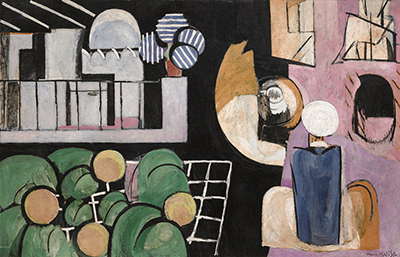
Henri Matisse's The Moroccans gathers a mosque, a terrace, fruit and people into a large painting that never settles into one continuous view. At upper left, pale architecture frames a dome and a balcony with striped flowers. Four yellow melons and broad green leaves fill the lower left. To the right, a white-turbaned person sits with their back to us among other shapes that are harder to name. An extensive black field moves between the groups. It can feel like shade, yet it is also the force that makes the painting's separate parts hold together. Matisse made the canvas at Issy-les-Moulineaux , outside Paris, in late 1915 and fall 1916 , recalling visits to Morocco several years earlier. [1] [2] [3]
The painting belongs to the Museum of Modern Art, New York , which records it as oil on canvas , 181.3 × 279.4 centimetres , object 386.1955 . Its almost three-metre width matters to the experience of looking: the eye must cross long passages of black to connect the dome, fruit and seated figure. Although the title is geographical, this is not a picture made on the spot in Tangier. MoMA dates the finished object to the period of Matisse's work in France; his two Moroccan trips took place in the winters of 1911–12 and 1912–13 . The gap between travel and completion makes memory and reconstruction central to what we see. [1] [4]
At a Glance
- Artist Henri Matisse
- Work The Moroccans
- Date 1915–16
- Explore Painting
This work across Henri Matisse’s career
Dance (1910)
1910The Red Studio
1911The Piano Lesson
1916The Snail
1953Contents
- What is arranged across the canvas?
- Why did Matisse return to Morocco in paint?
- How did the composition change?
- What does the black do?
- How does it differ from the earlier Moroccan paintings?
- What happened to the painting afterward?
What is arranged across the canvas?
The left side can be read in two levels. Above is a stretch of architecture: a pale dome rises behind a parapet, verticals divide a balcony, and a cluster of rounded, striped forms suggests flowers. Below, broad green shapes wrap around yellow melon circles. A black gap divides the two zones but does not sever them. Curves in the flowers echo curves in the fruit; the dark setting makes both groups stand out. This repeated roundness invites a viewer to move up and down the left side before crossing to the figure on the right. [2] [3]
On the right, a white circular head and dark blue body make a seated person visible from behind. The posture is compact rather than descriptive. Around this figure, pink-violet architecture, an oval dark opening, pale patches and linear marks resist a stable reading. MoMA's 1978 catalogue follows an early sketch and an X-ray to propose possible figures and an arched doorway in this zone. It explicitly notes that some forms cannot be deciphered with certainty. The first task for the viewer is therefore not to label every patch as a person or building. It is to notice how a clear seated silhouette sits inside an area where figure and architecture can exchange roles. [2] [3]
The central black area is more than a neutral interval. It separates the architecture, still life and figure, leaving each partly self-contained. It also surrounds them in one continuous dark colour. At the upper edge, pale diagonal bars cut into the black; lower down, the black winds between green fruit, the balcony and the figure's setting. Its paths direct the eye across the wide format. MoMA's later People brochure says the black might suggest hard-to-see shadow, but cautions that it is uncertain whether shadow is the painting's intended explanation. That is a valuable distinction: black can evoke depth while working as a colour and a construction device on the canvas. [2] [3]
Try following the white and pale shapes instead. The dome glows against black at left; a pale parapet leads toward the vase; the seated figure's round head forms another isolated light. The connections are formal, not a straight line of perspective from foreground to horizon. The same is true of green: leaves swell into rounded masses, then stop at the dark boundary. Yellow appears as four melon centres and as a warmer angular patch near the figure. These recurrences let the three zones answer one another while retaining their distinct subjects. The picture can be pieced together slowly, rather than delivered at once as a conventional scene. [2] [3]
The melons are particularly unstable. Their yellow discs and surrounding leaves are recognisable as fruit when considered together. Seen from farther away, the circular forms can also recall round heads or turbans. MoMA's historical catalogue records that viewers have made just such comparisons, and notes echoes between the four flowers above and the four melons below. This is not permission to announce that the melons secretly are people. It explains how Matisse uses repeated shapes to let one subject resonate with another. A still life can take on a human rhythm, while a turban can become a circular element in a larger colour structure. [2]
Why did Matisse return to Morocco in paint?
Matisse travelled to Morocco twice in the winters of 1911–12 and 1912–13 , making paintings and drawings of Tangier and its surroundings. MoMA's 1990 exhibition checklist records those works separately from The Moroccans . Some of the earlier pictures describe a view through an opening; others concentrate on a sitter, a terrace or a quiet gathering. The later canvas looks back across this body of work instead of simply enlarging one observed scene. Its combination of architecture, fruit and figures can be understood as a considered synthesis of remembered motifs, painted in the changed circumstances of 1915–16. [2] [4]
The 1978 MoMA catalogue traces the idea back to 1913 , after Matisse's second Moroccan stay. It says he meant to make a major picture from memory and had a canvas stretched, but found the dimensions wrong for the composition he wanted. He did not finish the large work then. A letter to painter Charles Camoin dated 22 November 1915 describes a new Moroccan memory and includes a sketch. The original arrangement contained details that later shifted or disappeared. This evidence makes the final painting a product of renewed thought over years, not a rapid translation of a travel sketch into a finished canvas. [2]
MoMA's catalogue places the early conception near Matisse's Arab Café , painted in 1913 and now in the Hermitage. The Hermitage describes that work as a quiet grouping around a fish bowl and musical instrument, slowly simplified from more observed detail. The Moroccans is not the same café scene reproduced at a bigger size: the bowl and musical focus of the earlier canvas are absent, and the new picture's fruit and architectural groups establish a different structure. The relation is a useful one of subject, memory and revision. It shows Matisse returning to Moroccan experience while changing the means by which a canvas could hold people and space. [2] [5]
Matisse's own later description, as recorded in the MoMA catalogue, mentions people on a terrace together with melons and gourds. That account supports a social setting, but it does not resolve every enigmatic form on the right or determine the seated person's identity. The original sketch described more figures in a small café. Some disappeared as the design hardened into larger zones. The finished painting lets a viewer sense a gathering without providing a continuous story of who each person is or what they are doing. [2]
The location of making is equally important. Issy-les-Moulineaux is the place in MoMA's object record; Morocco is the remembered subject. An account that says the painting was made during the 1912 or 1913 trip collapses distinct stages of the work. Nor does the current painting represent Matisse's late career: he lived until 1954 and made decades of art after this wartime experiment. Placing it accurately between travel, the prewar Moroccan pictures and the 1916 studio work helps explain why its familiar motifs look so compressed and severe. [1] [2]
Watch: Matisse’s art and working methods
Choose a museum film or a close reading to continue exploring Matisse’s work.
Matisse: “For Me It’s Always New”
The Museum of Fine Arts, Boston considers Matisse’s creative practice.
Watch on YouTubeHow did the composition change?
The visible picture is a finished arrangement, but it was not the only arrangement Matisse tried. In its 1978 object essay, MoMA discusses the 1915 sketch and an X-ray of the canvas. The sketch includes a parasol and a diagonally reclining figure that did not remain in the final version. The X-ray indicates earlier forms beneath the current upper-left architecture and another stage of the figure at right. These findings support an account of reworking; they do not let us watch every brushstroke or assign a precise date to each surviving patch of paint. [2]
One telling change is the growth of the still life. MoMA observes that the group of four yellow melons and large green leaves is missing from the 1915 sketch. The fruit now occupies much of the lower-left area. A tile pattern survives nearby, but its orientation may preserve something of an earlier flight of steps. This is more than an added decorative corner. Replacing a route through pictured space with clustered round objects changes how the wide canvas is read: the lower-left zone becomes dense and almost frontal, while the eye must use repeated shapes and colour to connect it with the other groups. [2]
The seated figure changed as well. MoMA's catalogue says a small white figure in the sketch was moved and enlarged toward the lower right. X-ray evidence suggests an intervening version before the final compact sitter took shape. The catalogue uses the term priest for that figure, reflecting one historical reading of clothing and setting. From the finished image alone, a white head covering and blue body are easier to establish than a precise religious or social identity. The distinction matters: documentary descriptions of a developing motif should inform a close reading, but should not become a false certainty about every shape in the final painting. [2] [3]
The upper-left area underwent a comparable transformation. MoMA's X-ray discussion points to the trace of a large parasol from the sketch beneath what became architecture. In the visible canvas, parapet, dome and flowers provide a firm group of verticals, curves and circles. Across the black gap, the right-hand dark oval may be an arched doorway rather than another person, according to the catalogue's comparison with the earlier Entrance to the Casbah . This is an argued reading, not an exact label printed on the canvas. It is useful because it shows how motifs associated with the 1912–13 works were altered and absorbed into the final geometry. [2]
The prolonged revision continued into 1916 . The 1978 account notes that Matisse did not complete the work during its first 1915 phase, and cites a July 1916 letter in which he describes the struggle the Moroccan painting was causing him. The Art Institute of Chicago situates this effort among his demanding projects of the First World War years, when he also reworked large works such as Bathers by a River . These institutional sources support a picture of intense formal labour. They do not make the Moroccan scene a coded illustration of a battle. Its wartime context matters as the moment of work and experiment, not as an invented subject hidden among the figures. [2] [6]
What does the black do?
Much of the canvas is black, yet it is neither merely an absence nor a naturalistic night sky. It surrounds the building at left, opens a wide interval across the centre and presses against the pink and blue on the right. Without it, the architecture, melons and seated figure might seem like unrelated studies placed side by side. With it, the groups occupy a shared pictorial field. The black makes their edges sharper and their colours more intense. It can make the white dome and turban appear luminous while allowing the eye to cross between zones that have no convincing single-point perspective. [2] [3]
The effect is clearer if the black is read as a positive colour. At top, it forms a broad bar behind the pale diagonals. Between the melon leaves, it is a narrow contour; toward the middle, it becomes an expansive plane. It therefore changes shape and role as it travels. The green leaves seem to swell against it, while the building's flat pale planes seem cut from it. There is no need to decide that all these black passages depict the same physical shadow. Their continuity is a compositional answer to the painting's discontinuous subject matter. [2] [3]
MoMA's 1978 catalogue relates this use of black to Matisse's still lifes of 1916 , especially Gourds . In that smaller work, separate objects are held together by the surrounding colour field. The catalogue argues that such a method helped Matisse resolve the larger Moroccan painting: rounded organic forms could coexist with a rectangular, architectural structure. This is a historical interpretation grounded in the order of the works and their visible organisation. It gives a stronger explanation than simply saying Matisse chose black to suggest a shaded café. It also explains why black can feel bright by contrast rather than deadening the canvas. [2]
The Art Institute's comparison with Bathers by a River makes the 1916 experiment easier to see. Both large paintings underwent substantial reworking, and in both, black helps divide and connect substantial areas. But Bathers organises standing bodies and a landscape in a tall, banded design. The Moroccans spreads architecture, still life and seated figures across a horizontal canvas. The shared device does not make the two pictures the same scene or prove that one is a study for the other. It shows Matisse testing a powerful structural colour in different pictorial problems at the same moment. [6] [7]
How does it differ from the earlier Moroccan paintings?
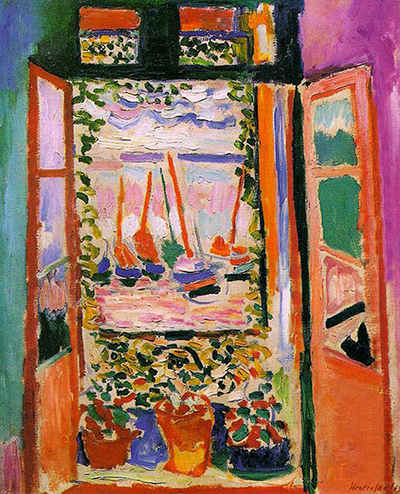
The earlier works made in or immediately after the Tangier visits often concentrate on one main visual encounter. The Hermitage's Arab Café holds a still, extended gathering in a relatively unified turquoise setting. The triptych shown in MoMA's 1992 retrospective brought together separate Moroccan views of a window, a terrace and a casbah gate. The Moroccans retains elements associated with architecture, terrace and seated company, but compresses different kinds of picture into one large oil. Its upper left is almost an architectural composition, its lower left an assertive still life, its right a figure group. The eye has to stitch them together through colour and repeated form rather than follow a straightforward walk through space. [2] [5] [8]
The distinction matters for the title. The Moroccans might suggest that portraits of several people will dominate. Instead, architecture and melons occupy as much attention as the human zone. The seated figure is turned away; other possible figures are fragmentary. MoMA's People brochure frames this as a challenge to quick narrative recognition: the viewer assembles a possible social scene by moving across separated parts. The picture does not simply refuse a subject. It offers one through the act of looking, with enough firm motifs to begin and enough unresolved forms to keep the relation between people and setting active. [3]
The painting also carries forward Matisse's interest in windows and thresholds without becoming one uncomplicated view from a window. A parapet, dome and dark opening suggest built space, but the lower-left fruit does not occupy a securely measured foreground before them, and the right section is not smoothly attached by a shared horizon. The result is a remembered place expressed through neighbouring pictorial groups. It can evoke a café terrace in Tangier while insisting on the canvas as a designed surface. This is why the painting's abstraction does not require the subjects to disappear; rather, recognisable elements are held in a more demanding relation. [2] [3]
What happened to the painting afterward?
MoMA records the work as a 1955 gift from Mr. and Mrs. Samuel A. Marx . Its public provenance research page lists Leo Stein with the painting as of 1916 , Léonce Rosenberg in 1917 , Matisse again in 1918 , and Florene and Samuel Marx as purchasers from the artist in 1952 . The museum marks this provenance as work in progress. These entries should be read as the institution's current documented sequence, not proof that every intermediate movement is fully known. They also distinguish the date of the finished work from its much later museum acquisition. [1]
The canvas was exhibited before the gift; MoMA's record lists a 1951 Matisse exhibition as well as later collection displays. A visitor interested in seeing it should consult the museum's current record because gallery placement changes. Its longer history of display and interpretation has made it a key work for understanding Matisse's 1910s experiments, but that reputation does not replace the visual question it still poses. What joins a terrace, fruit and seated people when the spaces between them seem so dark and wide? Matisse's answer is not an explanatory caption within the image; it is the carefully revised relationship of black, colour and shape across a monumental surface. [1] [2]
For a broader route through this period, see the paintings overview and Matisse biography . The earlier Moroccan works and the 1916 Bathers by a River make useful comparisons, provided their dates and collections remain distinct. The Moroccans remains a painting of recollection and construction: it asks viewers to recognise a place while also seeing how slowly, and how deliberately, that place was remade in paint. [2] [7]
Explore 113 Matisse artworks
This directory covers the 113 individual works explored in these articles, rather than a complete catalogue of Matisse’s output. Cut-paper designs and prints appear under Drawing in the medium filter; each row names its form. Dates retain the qualifications explained in the linked articles.
Frequently Asked Questions
It belongs to the Museum of Modern Art, New York , object 386.1955 . Check the museum's current object page for display information before visiting. [1]
Discussion
Look again at the images and ideas explored in Matisse's The Moroccans : a remembered scene built with black. These editorial prompts invite your observations.
Reader Insights
What is arranged across the canvas?
Which comparison discussed in the article helps you see the work differently?
How do the materials and historical setting affect your reading?
Join the Conversation
Share a detail, comparison or question about Matisse's The Moroccans : a remembered scene built with black below.
References
- The Museum of Modern Art , The Moroccans , object 386.1955. View source .
- The Museum of Modern Art , Matisse in the Collection of the Museum of Modern Art (1978), pp. 110–113. View source .
- The Museum of Modern Art , People exhibition brochure, pp. 3–4. View source .
- The Museum of Modern Art , Matisse in Morocco (1990), exhibition checklist. View source .
- State Hermitage Museum , Arab Café , GE-9661. View source .
- Art Institute of Chicago , “The Challenge of Painting, January–December 1916”. View source .
- Art Institute of Chicago , Bathers by a River , fifth state. View source .
- The Museum of Modern Art , Henri Matisse: A Retrospective (1992). View source .
 Henri Matisse.jpg)