 by
Tom Gurney
Tom Gurney BSc (Hons) is an art history expert with over 20 years experience
Email:
tomgurney1@gmail.com
/ Phone:
+44 7429 011000
Matisse's Nude in the Studio : a model, a stand and restless colour: Introduction
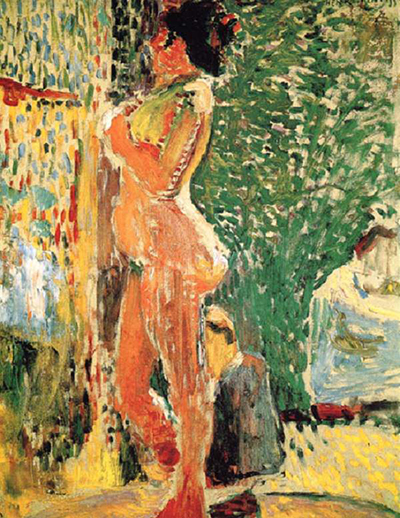
Henri Matisse's Nude in the Studio shows a standing woman on a round platform. Her figure is prominent, but it is not isolated against a blank wall: short, changing marks of red, green, yellow and blue make the space around her active. The Artizon Museum in Tokyo dates the work 1899 and records it as oil on paper . Its interpretation places the scene in the practice of art students studying a live model, with easels arranged around the stand. Matisse makes that familiar teaching arrangement a test of how a body and its surroundings can be described in colour. [1]
Artizon's bilingual exhibition checklist gives the sheet's size as 66.3 × 50.5 centimetres . These facts matter because the object can be mistaken for a later Matisse canvas or for a fully developed Fauvist painting. It belongs to the experiments of a thirty-year-old artist before the much better-known colour breakthroughs of 1904 and 1905. The work's lively surface already rewards close looking, without needing to turn it into an advance announcement of everything he would paint later. [1] [2] [3]
At a Glance
- Artist Henri Matisse
- Work Nude in the Studio
- Date 1899
- Explore Painting
This work across Henri Matisse’s career
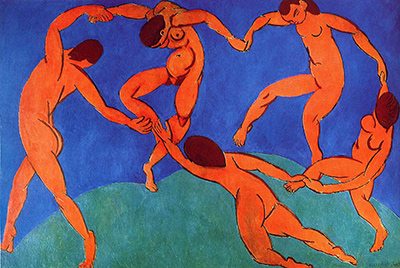
Dance (1910)
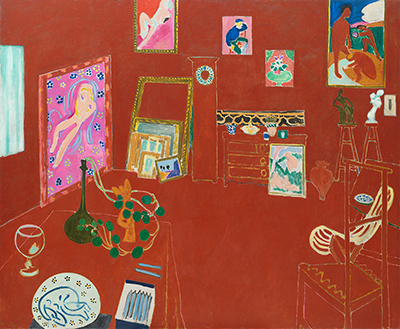
1910The Red Studio
1911The Piano Lesson
1916The Snail
1953Contents
- Why is the round stand important?
- How does colour build the body and room?
- Is the painting pointillist?
- How does it compare with Male Model?
- What can the painting tell us about Matisse's early work?
Why is the round stand important?
The stand makes the subject more specific than a generic nude in an invented interior. The model stands above the surrounding floor on a low, round platform. Its curved edge is visible near the bottom of the composition, where yellow and ochre passages separate it from adjacent colour. It gives her feet a place in space and tells us that she has been positioned to be studied. Artizon explains that students would arrange their easels around such a stand. The painting therefore points to a shared working room, even though it does not identify every person or object at its margins. [1]
The figure turns away enough that her back and side are important to the view. Her head is a compact darker shape above the warmer body; one raised arm changes the outline near the shoulder. The long downward movement of torso and legs is answered by upright and slanting marks behind her. She is still, but the picture is not static. The platform fixes her position while the marks around it keep the room visually unsettled. Looking from the feet upward, we move from an implied classroom floor to the model's body and then to the more broken colours around her head. [1]
The stand also prevents a simple reading of the woman as a figure posed in a private domestic room. Nude study was a central part of artistic training, as Artizon notes. Here the subject is someone posing for observation, and the viewer's position is among potential observers. That does not tell us the model's name, what she thought of the pose or which students were present. The owner record supplies the educational setting; the painted surface supplies the raised stand and the relationships among figure, floor and background. Keeping those two sorts of evidence separate makes the image more intelligible. [1]
How does colour build the body and room?
Warm red and orange make much of the model and nearby space stand out. Their force is sharpened by green marks to the right. Artizon singles out this red–green contrast as a defining feature. The colours do not merely fill outlined areas after the figure has been drawn. They help us tell where the body ends, where the background begins and where the two seem to press together. A darker edge can clarify a shoulder or hip, while a neighbouring bright mark keeps that edge from becoming a smooth, finished contour. [1]
At the left, narrow changing touches give the surrounding space a different rhythm from the broader warm passages near the model. At the far right, pale and cooler shapes break up the expanse of green and orange. One can see the suggestion of the working room without confidently naming every shape. The painting does not offer the kind of orderly studio inventory that would let us count easels or identify a particular seated student. Its fragments make us aware of other activity around the model while holding the central figure in view. [1]
The surface has a flickering character because neighbouring dabs often remain distinct. A green touch can be read beside a red one rather than absorbed into a single brownish shadow. Blue and yellow interrupt the warmer field. Yet the marks vary in size and direction; they are not a grid of equal dots. Their unevenness is part of the picture's energy. It lets the setting feel provisional, as though Matisse were deciding in paint how much of the room was needed to support the figure. [1]
The work's paper support is also worth keeping in mind. Artizon catalogues an oil painting on paper, rather than an oil painting directly on canvas. That medium does not by itself prove that the picture was a quick sketch or that it was never reconsidered. It is, however, part of the object's identity, and the visible, separately handled strokes make its process easier to notice. The stand's arc, the warm body and the cool interruptions are enough to organise a coherent image even without a polished account of the whole studio. [1] [2]
Watch: Matisse’s art and working methods
Choose a museum film or a close reading to continue exploring Matisse’s work.
MoMA Conservators discover Matisse's process for "The Red Studio" | CONSERVATION STORIES
Conservators examine the making of The Red Studio.
Watch on YouTubeIs the painting pointillist?
Artizon describes Matisse as working in a pointillist manner here, then makes a useful distinction. Georges Seurat and Paul Signac developed Neo-Impressionist painting in relation to optical theory, applying separated colour with a more systematic purpose. Matisse used irregular dabs freely to intensify this picture's colour. The owner therefore identifies a family resemblance in the divided touches without claiming that this sheet follows a fixed scientific formula. The variation between its marks is as important as the fact that they are visible. [1]
That distinction helps place the work in time. The Metropolitan Museum of Art describes Matisse's academic training and his early experiments with several styles, including Neo-Impressionism. It dates his encounter with Signac at Saint-Tropez and the resulting Luxe, calme et volupté to 1904 , years after this studio nude. The later painting offers a different, better documented episode of pointillist practice. Calling the 1899 sheet an experiment with divided colour is warranted by Artizon; treating the 1904 encounter as the direct cause of marks made five years earlier is not. [1] [3]
The same chronology matters for Fauvism . The Met connects the movement's public emergence with Matisse's intensely coloured paintings at the 1905 Salon d'Automne . Here, in 1899, red and green already assert themselves with unusual force, but the nude remains tied to a recognizable academic exercise and a particular raised stand. Describing what the colour does in this picture is more precise than placing the painting in a movement that would be named years later. It allows the early experiment to be distinctive on its own terms. [1] [3]
How does it compare with Male Model?
Matisse's Male Model is another early painting of a nude on a raised support. The Museum of Modern Art dates that canvas to Paris, circa 1900 and records it as oil on canvas , 99.3 × 72.7 centimetres . The near dates and standing poses make a useful comparison, but they are separate works in different collections and media. There is no need to claim that the Artizon painting directly prepared the MoMA canvas, or that the sitters shared a studio session. [4]
In Male Model , the body is built with weighty planes of warm colour against a cooler blue-violet ground. MoMA's 1978 catalogue relates that constructive treatment to Matisse's study of Cézanne. In Nude in the Studio , the woman's body is surrounded by more varied, broken touches and vivid red–green opposition; Artizon discusses its freer pointillist manner. Both pictures turn a studio pose into a problem of figure and surrounding space, yet they test different ways of making that relationship visible. One stresses mass and an uneasy boundary with the ground; the other lets divided colour animate the entire setting. [1] [4] [5]
The comparison also keeps the word study useful without making it dismissive. Neither painting needs a mythological title or narrative to justify sustained attention. The apparent simplicity of a standing figure exposes decisions about viewpoint, support, contour, light and the part played by nearby colour. Matisse could use an ordinary training arrangement to ask how much a painted room should describe and how much it could remain a field of active marks. The Artizon sheet's answer is especially striking because the round platform stays clear while so much else flickers around it. [1] [4]
What can the painting tell us about Matisse's early work?
Artizon places Matisse's training under Gustave Moreau at the École des Beaux-Arts before his experiments with a variety of styles. The Met gives that academic path a broader chronology. This painting shows how a traditional subject could become a site of experiment within it. A model still poses on a stand; the picture does not reject observation. But the colour marks do not submit to a single smooth, neutral description of her body and the room. They compete, overlap and sharpen one another. [1] [3]
The evidence does not establish the precise classroom where Matisse painted this sheet, the identity of its model or a list of other students present. Those gaps need not be filled with an invented story. The confirmed date, support, dimensions and Artizon's explanation of the stand let the viewer read what is actually distinctive: a nude study in which the training setting remains legible while irregular colour touches take on their own life. Readers can set it beside Matisse's other paintings and the nearby Male Model without confusing the two objects. [1] [2]
Explore 113 Matisse artworks
This directory covers the 113 individual works explored in these articles, rather than a complete catalogue of Matisse’s output. Cut-paper designs and prints appear under Drawing in the medium filter; each row names its form. Dates retain the qualifications explained in the linked articles.
Frequently Asked Questions
Artizon identifies it as a round model stand around which art students arranged their easels. The raised position belongs to the practice of drawing or painting a nude model from observation. [1]
Discussion
Look again at the images and ideas explored in Matisse's Nude in the Studio : a model, a stand and restless colour. These editorial prompts invite your observations.
Reader Insights
Why is the round stand important?
Which comparison discussed in the article helps you see the work differently?
How do the materials and historical setting affect your reading?
Join the Conversation
Share a detail, comparison or question about Matisse's Nude in the Studio : a model, a stand and restless colour below.
References
- Artizon Museum , Nude in the Studio object record. View source .
- Artizon Museum , bilingual exhibition checklist, no. 021. View source .
- The Metropolitan Museum of Art , “Henri Matisse (1869–1954)”. View source .
- The Museum of Modern Art , Male Model , 377.1975. View source .
- The Museum of Modern Art , Matisse in the Collection of the Museum of Modern Art (1978). View source .
 Henri Matisse.jpg)