 by
Tom Gurney
Tom Gurney BSc (Hons) is an art history expert with over 20 years experience
Email:
tomgurney1@gmail.com
/ Phone:
+44 7429 011000
Henri Matisse, Panel with Mask : Five Fields of Cut Colour: Introduction
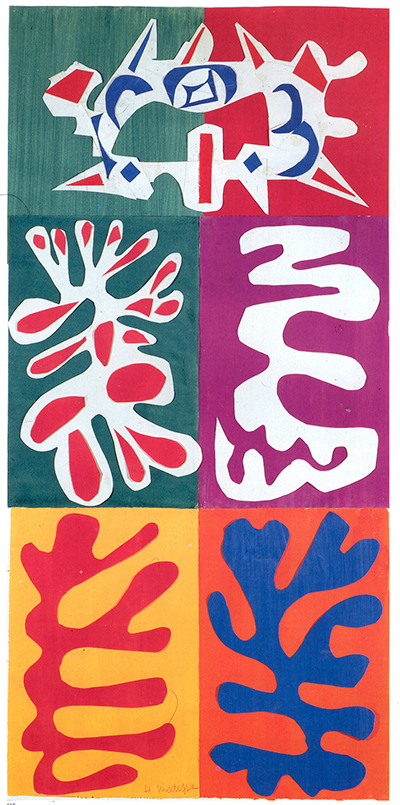
Henri Matisse's Panel with Mask ( Le Panneau au masque ) is a tall 1947 cut-paper composition . At the top, a white, angular mask spreads over green and red. Below it, four rectangular fields hold separate branching shapes in white, pink-red and blue. The Museum of Modern Art's 2014 Cut-Outs checklist identifies the work as gouache on paper, cut and pasted, on paper , measuring 110 × 53 cm , in the collection of Designmuseum Danmark . The museum itself named this work among the paper cut-outs it was preparing to lend for the Tate and MoMA exhibitions of 2014–15. [1] [2]
Its title points to the mask, but the whole panel matters. The mask occupies one wide upper compartment. Two rows of paired compartments form the rest, making five coloured fields in all. The disciplined grid lets Matisse vary the silhouettes and colour pairings without losing the work's vertical unity. It is more than a set of five independent emblems: each field changes how the next one is seen.
At a Glance
- Artist Henri Matisse
- Work Panel with Mask
- Date 1947
- Explore Cut paper and drawing
This work across Henri Matisse’s career
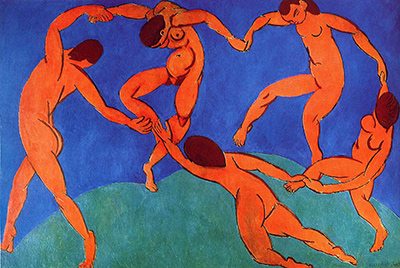
Dance (1910)
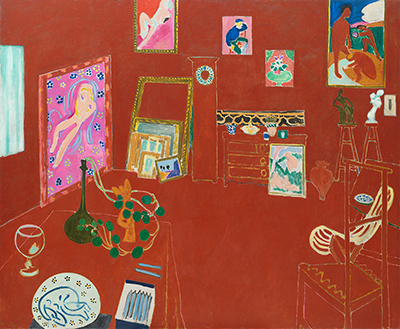
1910The Red Studio
1911The Piano Lesson
1916The Snail
1953Contents
- Where is the mask?
- How is the grid used?
- Why do the five fields read as one panel?
- What can it be compared with?
Where is the mask?
The top field is split into dark green at left and red at right. Against both colours, the white form stretches across the width. Blue pieces mark inner curves and angular details, while smaller red and green areas appear inside or around the white. It does not read as a naturalistic portrait of a named person. Its uneven outline, not a shaded face, gives it a mask-like presence. White points project to the sides, so the shape seems too wide for its rectangular compartment.
The mask is also the only form that crosses a division between two background colours. Green and red meet behind it, but the pale shape ignores that seam. The white creates an upper burst of activity before the eye descends into the tighter arrangement below. This difference in scale and complexity explains why the title singles it out, even though the lower motifs take up most of the panel's height.
In the middle row, a white cut form filled with smaller red and dark green marks sits on the left. It looks denser and more fragmented than its neighbour. On the right, a broad white meander lies against a purple-pink field. Its open turns leave coloured spaces inside the form, so the background becomes part of what the eye follows. These two compartments balance intricacy against a single sweeping line.
The lower pair changes the palette again. A red branching shape reaches across yellow at left; a dark blue one spreads against orange-red at right. Each suggests a leaf or marine growth without requiring a specific species. Their lobes and gaps echo the upper white motifs, but the strong colour reversal makes the bottom feel like a conclusion rather than a repeated middle row. The entire panel alternates between pale forms on dark grounds and saturated forms on warm grounds.
Watch: Matisse’s art and working methods
Choose a museum film or a close reading to continue exploring Matisse’s work.
Matisse: The Cut Outs
Tate introduces its exhibition devoted to Matisse’s cut-paper work.
Watch on YouTubeHow is the grid used?
The Museum of Fine Arts, Boston describes the background of Panel with Mask as a five-rectangle grid in its Matisse in the Studio exhibition material. That observation is a useful way into the work. Straight seams hold the fields apart, while cut shapes push against or across the implied boundaries. The top mask bridges two colours; the lower shapes mostly stay within their own boxes. As a result, the panel feels both measured and animated. [3]
The work's narrow, upright format encourages a top-to-bottom reading. Yet the paired squares repeatedly pull the eye left and right. The mask's wide spread, the opposing middle shapes and the differently weighted lower branches keep the composition from becoming a simple vertical strip. Decorative rhythm grows out of alternation: straight background divisions against curved cut edges, dense internal fragments against spacious gaps, and cool colours against warm ones.
MoMA's account of the cut-out method explains that Matisse used gouache-painted sheets of paper , cut forms from them, and arranged the pieces before permanent mounting. Pinning allowed many cut-outs to be repositioned. The checklist's medium statement establishes what this object is made of, but the general process account does not prove exactly how many times Matisse moved a particular shape in Panel with Mask . A reproduction can show colour and contour; it cannot by itself reveal an undocumented sequence of pinning, gluing or alteration. [4] [1]
Why do the five fields read as one panel?
The Boston museum's description of a five-rectangle ground explains the structure, but the repeated contours explain its unity. The white upper mask has projections and gaps; the middle forms answer them in smaller, more contained ways; the lower branches return to an outward spread in saturated colour. A viewer can compare these silhouettes from top to bottom while the straight borders keep each colour encounter distinct. The mask's crossing of the green-red division is especially important: it teaches the eye to look through a grid even as the grid organises everything beneath it. [3]
The documented size, 110 by 53 centimetres, also makes the panel much taller than the nearby L'Esquimau . The eye must descend through the paired fields rather than scan across a long orange sheet. That difference prevents a shared mask motif from becoming a mistaken shared object identity. Both belong to Designmuseum Danmark's holdings, and both were named in its lending account, but their formats create different visual experiences. Panel with Mask compresses variety into a vertical sequence, with each field acting like a pause before the next. [1] [2]
What can it be compared with?
MoMA's 2014 checklist also includes The Eskimo , a separate 1947 cut-out held by Designmuseum Danmark. It uses a different horizontal arrangement and its own mask-like element. Their shared owner, year and medium make them useful neighbours, but one should not be treated as a panel removed from the other. The title Panel with Mask likewise should not be confused with the much later Large Decoration with Masks . [1]
Return to the white shape at the top and then follow the coloured forms downward. The mask does more than introduce a subject: its mixture of angles, curves and gaps sets up the visual language repeated and changed in the four fields below. The cut-outs directory places this compact decorative panel among Matisse's wider experiments with painted paper.
Explore 113 Matisse artworks
This directory covers the 113 individual works explored in these articles, rather than a complete catalogue of Matisse’s output. Cut-paper designs and prints appear under Drawing in the medium filter; each row names its form. Dates retain the qualifications explained in the linked articles.
Discussion
Look again at the images and ideas explored in Henri Matisse, Panel with Mask : Five Fields of Cut Colour. These editorial prompts invite your observations.
Reader Insights
Where is the mask?
Which comparison discussed in the article helps you see the work differently?
How do the materials and historical setting affect your reading?
Join the Conversation
Share a detail, comparison or question about Henri Matisse, Panel with Mask : Five Fields of Cut Colour below.
References
- Museum of Modern Art , Henri Matisse: The Cut-Outs exhibition checklist (2014), title, 1947 date, medium, dimensions, Designmuseum Danmark collection and separate Eskimo entry. View source .
- Designmuseum Danmark , 2013 annual report, the museum's account of lending Le Panneau au masque and L'Esquimau to Tate and MoMA. View source .
- Museum of Fine Arts , Boston, “Matisse in the Studio”, curatorial description of Panel with Mask and its five rectangular background fields. View source .
- Museum of Modern Art , “What is a Cut-Out?”, general gouache-paper, cutting, pinning and mounting method. View source .
 Henri Matisse.jpg)